


PIR Motion Detector
#PIR sensor
#motion detection
#home automation
#security
#low-power
#sensor circuit
#human detection
#appliances
#gadgets
#business security

Description: The presented schematic illustrates the construction of a simple PIR motion detector sensor. PIR sensors are capable of detecting motion and are primarily utilized to determine if a person has entered or exited the sensor's range. These sensors are compact, cost-effective, energy-efficient, user-friendly, and durable. Consequently, they are frequently integrated into various appliances and devices used in residential and commercial settings. They are commonly known as PIR sensors.
The PIR (Passive Infrared) motion detector operates by sensing changes in infrared radiation within its environment. When a warm object, such as a human body, moves across the sensor's field of view, it triggers the sensor to activate. The sensor consists of two pyroelectric elements that detect changes in infrared levels. When a difference in temperature is detected between these elements, the sensor outputs a signal that can be used to activate alarms, lights, or other devices.
The circuit typically includes a PIR sensor module, which contains the pyroelectric elements, a signal processing unit, and an output mechanism. The output can be digital or analog, depending on the design requirements. The digital output can be connected directly to a microcontroller or relay to control other devices, while the analog output can be used for more complex signal processing applications.
Power supply requirements for the PIR motion detector are generally low, allowing for battery operation or integration into existing power systems. The circuit may also incorporate additional components such as resistors, capacitors, and diodes to ensure stable operation and to filter noise from the output signal.
Common applications of PIR sensors include security systems, automatic lighting control, and energy-saving systems in buildings. Their versatility and efficiency make them a popular choice for motion detection in various environments. Proper placement and calibration of the sensor are crucial for optimal performance, ensuring that the detection range aligns with the intended area of coverage.Presented schematic shows how to build simple PIR motion detector sensor. PIR sensors allow you to sense motion, almost always used to detect whether a human has moved in or out of the sensors range. They are small, inexpensive, low-power, easy to use and don`t wear out. For that reason they are commonly found in appliances and gadgets used in homes or businesses. They are often referred to as PIR, .
The PIR (Passive Infrared) motion detector operates by sensing changes in infrared radiation within its environment. When a warm object, such as a human body, moves across the sensor's field of view, it triggers the sensor to activate. The sensor consists of two pyroelectric elements that detect changes in infrared levels. When a difference in temperature is detected between these elements, the sensor outputs a signal that can be used to activate alarms, lights, or other devices.
The circuit typically includes a PIR sensor module, which contains the pyroelectric elements, a signal processing unit, and an output mechanism. The output can be digital or analog, depending on the design requirements. The digital output can be connected directly to a microcontroller or relay to control other devices, while the analog output can be used for more complex signal processing applications.
Power supply requirements for the PIR motion detector are generally low, allowing for battery operation or integration into existing power systems. The circuit may also incorporate additional components such as resistors, capacitors, and diodes to ensure stable operation and to filter noise from the output signal.
Common applications of PIR sensors include security systems, automatic lighting control, and energy-saving systems in buildings. Their versatility and efficiency make them a popular choice for motion detection in various environments. Proper placement and calibration of the sensor are crucial for optimal performance, ensuring that the detection range aligns with the intended area of coverage.Presented schematic shows how to build simple PIR motion detector sensor. PIR sensors allow you to sense motion, almost always used to detect whether a human has moved in or out of the sensors range. They are small, inexpensive, low-power, easy to use and don`t wear out. For that reason they are commonly found in appliances and gadgets used in homes or businesses. They are often referred to as PIR, .

PIR Sensor Based Security System circuit diagramworkingapplications
PIR (Passive Infrared Radial) Sensor-Based Security System, circuit diagram, working, applications.
The PIR (Passive Infrared) sensor-based security system is designed to detect motion by measuring changes in infrared radiation emitted by objects in its vicinity, particularly warm bodies such as humans...

PIR Sensor Security Light & Switch
Moderately priced Passive Infrared (PIR) sensor modules are now widely available. By using these readymade and pre-configured PIR sensors, even an average electronics enthusiast can implement motion detection systems effectively.
Passive Infrared (PIR) sensors are devices that detect infrared radiation emitted...

PIR LED Security Light Circuit
This circuit represents a general-purpose white LED security light equipped with a Passive Infrared (PIR) motion sensing mechanism. The core component of the circuit is the PIR sensor module SB0061, which is a pyroelectric sensor designed for human body detection....

PIR Sensor Circuits
The focus is on 12 Volt DC powered PIR sensors and their associated circuits, which can be directly powered by a 12 Volt battery charged through renewable energy sources such as wind or solar. This article examines how the low...

Security Light & Switch with PIR Sensor
The SB0061 is a pyroelectric sensor module designed for human body detection. It integrates a PIR (Passive Infrared) detector with a Fresnel lens on a compact printed circuit board (PCB), along with an analog integrated circuit (IC) identified as SB0061...

Low-power-inverter
This low-power inverter utilizes only nine components to convert 10 to 16 VDC into a 60 Hz, 115 V square-wave output suitable for operating AC equipment with a maximum power of 25 W. The initial section of the 556 timer...
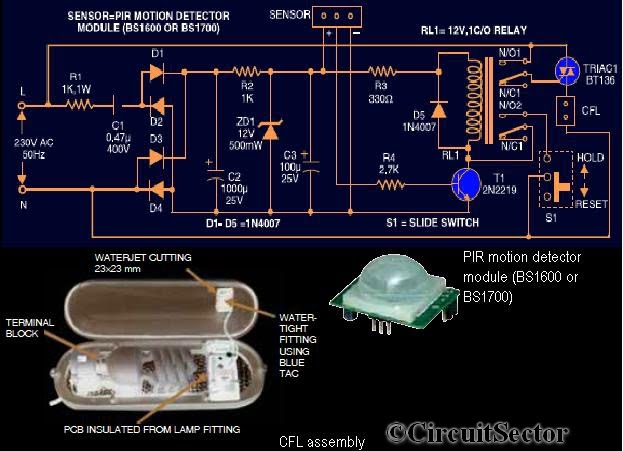
Motion Sensor For Security Light Using PIR BS1600 PCB
This circuit diagram is based on the PIR motion sensor module BS1600 (or BS1700) designed for security lighting in power-saving mode. If the component is unavailable in local stores, it can be purchased online. A key advantage of this motion...

Object motion detector circuit diagram
The core component of the motion detection circuit is the motion detection chip IC1 (KC778B). The signal frequency from the PIR sensor is low, ranging from 0.1Hz to 10Hz, while the bandwidth is quite broad, which the chip will optimize....

motion sensor using pir sensor module
A diode is used in series to drop the voltage to 5.4 V, as the operating voltage for the PIC microcontroller should be below 5.5 V. Additionally, the diode provides protection to the circuit in case of reverse polarity of...