


robot sense sensors
#tactile sensor
#robotics
#automotive
#manufacturing
#medical
#aerospace
#touch-sensitive
#light control
#industrial

Description: Sensors are utilized in various everyday objects, including touch-sensitive elevator buttons (tactile sensors) and lamps that adjust brightness through touch. The applications of sensors are vast, many of which are unknown to the general public. These applications span across industries such as automotive, machinery, aerospace, healthcare, manufacturing, and robotics. A sensor is defined as a device that receives and responds to specific stimuli.
Sensors play a crucial role in modern electronic systems, facilitating interaction between the user and the device. In the context of tactile sensors, these devices detect physical pressure or touch, converting mechanical force into an electrical signal. This process typically involves a resistive or capacitive mechanism, where the change in resistance or capacitance due to pressure is measured and interpreted by a microcontroller or processing unit.
In elevator systems, tactile sensors enhance user experience by providing a responsive interface. When a user presses a button, the sensor detects the force applied and activates the corresponding elevator function, such as calling the elevator to a specific floor. This interaction is not only intuitive but also contributes to the overall efficiency of the system.
In lighting applications, touch-sensitive lamps utilize capacitive sensing technology. When a user touches the base of the lamp, the sensor detects the change in capacitance caused by the proximity of the user's hand. This signal is processed to adjust the brightness level of the lamp, allowing for a seamless and user-friendly lighting experience.
Beyond consumer products, sensors are integral to various industrial applications. In automotive systems, sensors monitor critical parameters such as temperature, pressure, and position, enabling advanced features like automatic braking and stability control. In aerospace, sensors contribute to navigation and flight control systems, ensuring safety and efficiency in air travel.
In the medical field, sensors are employed in devices that monitor vital signs, providing real-time data that is essential for patient care. In manufacturing, sensors facilitate automation and quality control, ensuring that products meet specified standards. Robotics heavily relies on sensors for navigation and interaction with the environment, allowing for the development of sophisticated autonomous systems.
Overall, the versatility and significance of sensors in diverse applications underscore their importance in enhancing functionality, safety, and user experience across various sectors.Sensors are used in everyday objects such as touch-sensitive elevator buttons (tactile sensor) and lamps which dim or brighten by touching the base. There are also innumerable applications for sensors of which most people are never aware. Applications include cars, machines, aerospace, medicine, manufacturing and robotics. A sensor is a device which receives and responds..
Sensors play a crucial role in modern electronic systems, facilitating interaction between the user and the device. In the context of tactile sensors, these devices detect physical pressure or touch, converting mechanical force into an electrical signal. This process typically involves a resistive or capacitive mechanism, where the change in resistance or capacitance due to pressure is measured and interpreted by a microcontroller or processing unit.
In elevator systems, tactile sensors enhance user experience by providing a responsive interface. When a user presses a button, the sensor detects the force applied and activates the corresponding elevator function, such as calling the elevator to a specific floor. This interaction is not only intuitive but also contributes to the overall efficiency of the system.
In lighting applications, touch-sensitive lamps utilize capacitive sensing technology. When a user touches the base of the lamp, the sensor detects the change in capacitance caused by the proximity of the user's hand. This signal is processed to adjust the brightness level of the lamp, allowing for a seamless and user-friendly lighting experience.
Beyond consumer products, sensors are integral to various industrial applications. In automotive systems, sensors monitor critical parameters such as temperature, pressure, and position, enabling advanced features like automatic braking and stability control. In aerospace, sensors contribute to navigation and flight control systems, ensuring safety and efficiency in air travel.
In the medical field, sensors are employed in devices that monitor vital signs, providing real-time data that is essential for patient care. In manufacturing, sensors facilitate automation and quality control, ensuring that products meet specified standards. Robotics heavily relies on sensors for navigation and interaction with the environment, allowing for the development of sophisticated autonomous systems.
Overall, the versatility and significance of sensors in diverse applications underscore their importance in enhancing functionality, safety, and user experience across various sectors.Sensors are used in everyday objects such as touch-sensitive elevator buttons (tactile sensor) and lamps which dim or brighten by touching the base. There are also innumerable applications for sensors of which most people are never aware. Applications include cars, machines, aerospace, medicine, manufacturing and robotics. A sensor is a device which receives and responds..

Voltage Regulator For Cars And Motorcycles
This regulator circuit can be used on an alternator that has one field terminal grounded. When the input voltage becomes too high, Q1 conducts, and the base of Q2 is driven toward ground, reducing the voltage fed to Q3. This...

Light control relay control lamp
The circuit operates on 220V AC input, which is transformed to approximately 12V DC using a step-down transformer (T), a diode bridge rectifier (VDI-VD4), and a filter capacitor (C1). This setup is designed to power the entire circuit. The light...

860 Watt limited-range light control
The system is designed to regulate an 860-watt lamp load from half to full power. This is achieved through the controlled half-plus-fixed half-wave phase control method. Applying half power to an incandescent lamp results in 30% of the full light...

The medical electric aspirator waterproof controller (2)
The working principle of the circuit pertains to a medical electric aspirator waterproof controller, which includes a power supply circuit, a liquid level detection control circuit, and an alarm circuit, as illustrated in Figure 9-47. The power supply circuit is...

Automotive Electrical Tester
This compact tester is designed for checking vehicle electrical circuits. Two LEDs indicate whether one of the clips is connected to the positive supply line (red) or to ground (green). The unit is powered by the vehicle battery. It is...
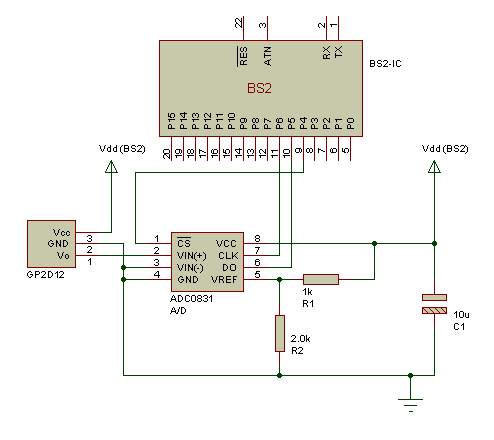
Code Collection
CrustCrawler develops and manufactures advanced walking robots and robotic accessories.
CrustCrawler specializes in the design and production of innovative walking robots, which incorporate advanced technologies and engineering principles to achieve improved mobility and functionality. These robots are typically characterized by their...

Medical treat ventilator controller
The medical ventilator controller circuit consists of an astable oscillator, a control circuit, and a power supply circuit. The astable oscillator is constructed using resistors R1, R2, a potentiometer RP, capacitors C1, C2, and a time base integrated circuit IC1....

simplest smf automotive battery charger
A simple battery charger circuit is described, utilizing a single transistor for voltage detection and automatically disconnecting the battery from the supply when fully charged. The circuit's high voltage trip point is set to switch off the charging voltage when...
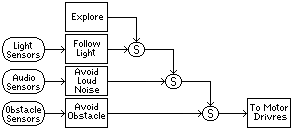
Subsumption Architecture
This term refers to a robotic control concept developed by Rodney Brooks, closely associated with behavior-based robotics, which incorporates modular behavior-based artificial intelligence. Unlike traditional artificial intelligence that relies on a centralized, top-down planning, execution, and monitoring structure, subsumption architecture...