


Sensitive Tilt Trigger
#tilt sensor
#switch
#sensitive
#trigger
#any-direction
#alarm
#security
#monitoring
#tilt detection
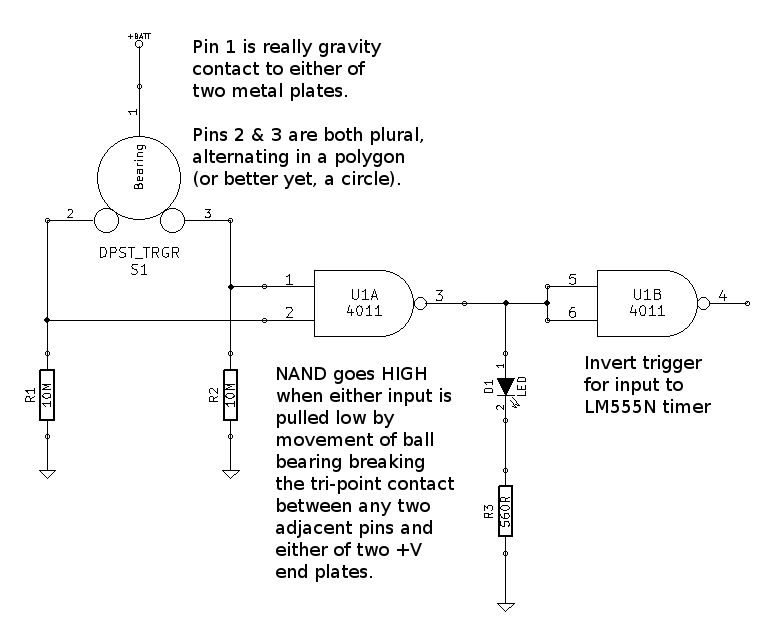
Description: Designed for any purpose that might require a highly sensitive, omnidirectional, non-tilt switch. This document outlines the construction of a specific switch.
The circuit design focuses on creating a highly sensitive tilt switch that can detect orientation changes in any direction. This type of switch is essential in applications where precise angle measurements are critical, such as in robotics, gaming controllers, and safety mechanisms in various devices.
The core component of the circuit is a microelectromechanical system (MEMS) accelerometer, which can detect changes in acceleration and tilt. The accelerometer is connected to a microcontroller that processes the data and determines whether the switch should be activated or deactivated based on predefined tilt thresholds.
Power supply for the circuit can be provided through a battery or a regulated power source, ensuring that the switch operates efficiently without excessive power consumption. The output of the microcontroller can be configured to drive a relay or a transistor, allowing for control of higher power devices.
Additional components may include pull-up or pull-down resistors to stabilize the input signals, capacitors for filtering noise, and diodes for protection against reverse polarity. The circuit can be housed in a compact enclosure to protect it from environmental factors, ensuring reliable operation in various conditions.
Overall, this design provides a versatile and sensitive tilt switch suitable for a wide range of applications, enhancing the functionality and responsiveness of electronic systems.Designed for any purpose that might need a very sensitive, any-direction, do-not-tilt switch. This instruction describes construction of: 1) My initia..
The circuit design focuses on creating a highly sensitive tilt switch that can detect orientation changes in any direction. This type of switch is essential in applications where precise angle measurements are critical, such as in robotics, gaming controllers, and safety mechanisms in various devices.
The core component of the circuit is a microelectromechanical system (MEMS) accelerometer, which can detect changes in acceleration and tilt. The accelerometer is connected to a microcontroller that processes the data and determines whether the switch should be activated or deactivated based on predefined tilt thresholds.
Power supply for the circuit can be provided through a battery or a regulated power source, ensuring that the switch operates efficiently without excessive power consumption. The output of the microcontroller can be configured to drive a relay or a transistor, allowing for control of higher power devices.
Additional components may include pull-up or pull-down resistors to stabilize the input signals, capacitors for filtering noise, and diodes for protection against reverse polarity. The circuit can be housed in a compact enclosure to protect it from environmental factors, ensuring reliable operation in various conditions.
Overall, this design provides a versatile and sensitive tilt switch suitable for a wide range of applications, enhancing the functionality and responsiveness of electronic systems.Designed for any purpose that might need a very sensitive, any-direction, do-not-tilt switch. This instruction describes construction of: 1) My initia..
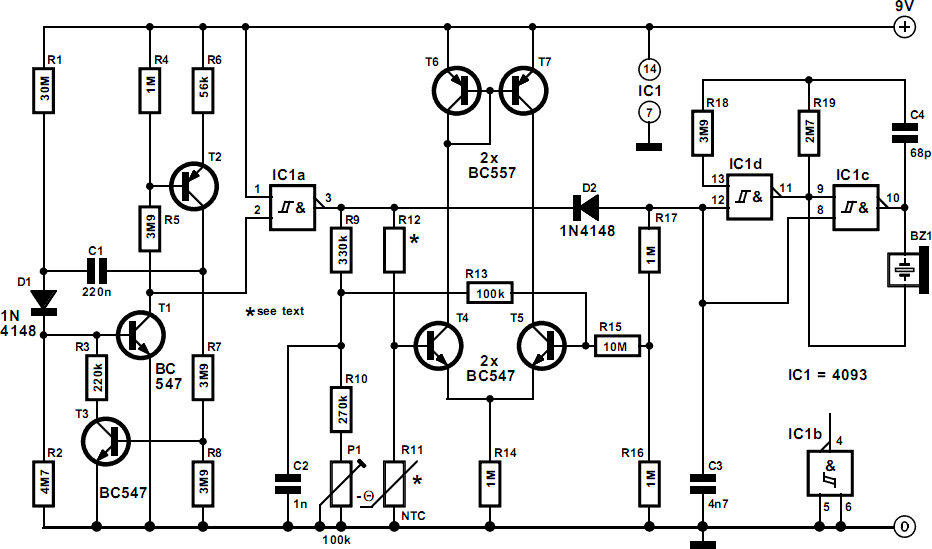
General-Purpose Alarm
The alarm can be utilized for various applications, including frost monitoring and room temperature monitoring. In its quiescent state, the circuit consumes only a few microamperes, allowing a 9 V dry battery (PP3, 6AM6, MN1604, 6LR61) to potentially last up...

Electronic Locker Guard
Protect your locker or briefcase from theft using this pocket-sized gadget. It emits a loud police siren to attract attention. The circuit utilizes a single integrated circuit (IC).
This circuit is designed to provide a compact and effective security solution for...

Single-Ic Alarm
With a single integrated circuit (IC), it is possible to construct a straightforward and dependable auto burglar alarm or a similar alarm system. Refer to (a) for the timing information related to the alarm circuit in (b). When leaving the...

Home Security System
This alarm circuit activates when switches S1 through S5 are engaged. This action illuminates LED1 and triggers transistor Q1 through integrated circuits IC1C and IC1D. Relay RY1 is configured for self-latching. Switch S10 is utilized for resetting the circuit. When...

No Doze Alarm Circuit
This circuit emits a loud tone if the input switch (S2) is not retriggered at designated intervals. If the user falls asleep and fails to re-trigger the circuit, it will continue to sound until S2 is pressed.
The circuit operates on...

Easy-auto-alarm
Refer to (a) for the timing information related to the alarm circuit depicted in (b). When departing from the vehicle, the arming switch should be flipped, and the door closed to activate the device. The subsequent opening of an entrance...

Simple Alarm Circuit Keeps Wandering Children
The receiver circuit in Figure 1 activates an audio alarm when the transmitter (Figure 2) moves beyond a specified perimeter. The transmitter functions as a voltage-controlled oscillator, operating at approximately 915 MHz within the unlicensed ISM (industrial/scientific/medical) band. It features...
Fridge Door Alarm Circuit
Emits a beep if the door remains open for more than 20 seconds. This circuit is housed in a compact enclosure and is positioned in the refrigerator near the lamp or the opening.
The described circuit functions as a door alarm...
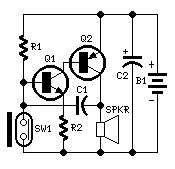
Personal Alarm
This circuit, enclosed in a small plastic box, can be placed into a bag or handbag. A small magnet is placed close to the reed switch and connected to the hand or the clothes of the person carrying the bag...