


Signal Conditioning Amplifier for Piezofilm Sensor
#piezofilm
#signal conditioning
#amplifier
#temperature sensor
#microphone
#mechanical sensor
#electrical conversion
#thermal sensor

Description: The signal can be converted by piezoelectric films in various ways, including thermal to electrical (temperature sensor) and mechanical to electrical (microphone).
Piezoelectric films are materials that generate an electrical charge in response to applied mechanical stress or temperature changes. These films are commonly used in various applications due to their ability to convert different types of energy into electrical signals.
In the context of temperature sensing, piezoelectric films can be utilized as thermal sensors. When the temperature changes, the film expands or contracts, causing mechanical stress that induces an electrical charge. This charge can be measured and calibrated to provide accurate temperature readings, making piezoelectric films suitable for applications in HVAC systems, automotive temperature monitoring, and industrial processes.
Similarly, piezoelectric films can function as microphones by converting sound waves (mechanical energy) into electrical signals. When sound waves hit the film, they create vibrations that induce a voltage across the material. This property is exploited in various audio devices, including microphones and sensors used in voice recognition systems, where the accurate conversion of sound to electrical signals is crucial for performance.
Overall, piezoelectric films serve as versatile components in electronic circuits, enabling the transformation of thermal and mechanical energy into usable electrical signals for various applications across multiple industries.The signal can be converted by piezoelectric films in many ways such as thermal to electrical (temperature sensor), mechanical to electrical (microphone), and.
Piezoelectric films are materials that generate an electrical charge in response to applied mechanical stress or temperature changes. These films are commonly used in various applications due to their ability to convert different types of energy into electrical signals.
In the context of temperature sensing, piezoelectric films can be utilized as thermal sensors. When the temperature changes, the film expands or contracts, causing mechanical stress that induces an electrical charge. This charge can be measured and calibrated to provide accurate temperature readings, making piezoelectric films suitable for applications in HVAC systems, automotive temperature monitoring, and industrial processes.
Similarly, piezoelectric films can function as microphones by converting sound waves (mechanical energy) into electrical signals. When sound waves hit the film, they create vibrations that induce a voltage across the material. This property is exploited in various audio devices, including microphones and sensors used in voice recognition systems, where the accurate conversion of sound to electrical signals is crucial for performance.
Overall, piezoelectric films serve as versatile components in electronic circuits, enabling the transformation of thermal and mechanical energy into usable electrical signals for various applications across multiple industries.The signal can be converted by piezoelectric films in many ways such as thermal to electrical (temperature sensor), mechanical to electrical (microphone), and.

Temperature-to-frequency converter
Al's positive input is biased by the thermocouple. Al's output drives a basic voltage-to-frequency (V-F) converter, which consists of 74C04 inverters and related components. Each V-F output pulse results in a fixed amount of charge being transferred from a 100...

Temperature Monitor with Alarm
This temperature monitor alarm circuit continuously monitors room temperature and emits a beep when the temperature falls below 20 degrees Celsius. The ability to constantly check the temperature can help reduce air conditioning costs by reminding users to turn off...

DS1621 PC Thermometer Circuit
The following circuit is a PC thermometer utilizing the DS1621. Features include the ability to plug into any available PC COM port, a temperature range of -20 to 125°C, and the capability to display temperatures in both Celsius (°C) and...

TMPO1 internal functional block diagram and basic application circuit
TMP01 is a temperature sensor that features a programmable temperature controller, an integrated reference voltage source, a current source, a voltage comparator, and an amplifier circuit. The internal circuit function block diagram and basic application circuit are provided. The key...

Audio Voice-Over Circuit PCB
This circuit features a microphone and preamplifier that take precedence over any other audio signal, functioning similarly to a one-way intercom. When the push-to-talk switch is activated, the main amplifier switches from music playback to the voice signal. Essentially, a...

Digital Miscellaneous Temperature Gauge
A diode (IN4148) is utilized as a temperature sensor. IC2 is an A/D converter with BCD output. A reference voltage set by R7 is applied to the positive input of IC2. As the temperature rises, the voltage across the temperature...
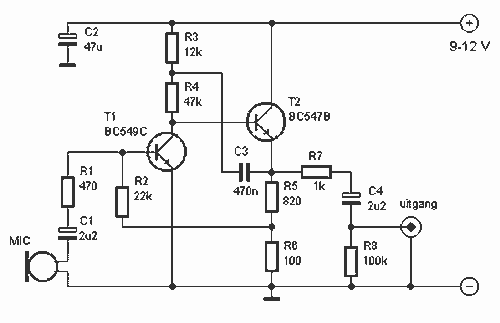
Basic Microphone preamplifier
This preamplifier amplifies the signal from a microphone, an amplifier so that it can be further strengthened. The circuit supplies an output signal line. With two transistors, it is not difficult to build such a circuit. The amplifier produces noise...

Overheat Detector Alarm Switch
The circuit utilizes a precision integrated temperature sensor, the LM35 (IC1), which provides a linear and directly proportional output in millivolts over a temperature range of 0 to +155 degrees Celsius. This sensor can be incorporated into fire smoke detectors,...

Digital Remote Thermometer Circuit With Receiver and Transmitter
This circuit is designed for precise centigrade temperature measurement. It features a transmitter section that converts the sensor's output voltage, which is proportional to the measured temperature, into frequency. The output frequency bursts are transmitted through the mains supply cables....