


Snow Depth Measurement Sensor
#snow depth
#measurement
#weather
#Internet of Things
#data collection
#sensor network
#environmental monitoring
#DIY sensor
#weather stations
#outdoor sensors

Description: A sensor is being developed to measure snowfall. If this sensor can be produced at a low cost, the potential of the Internet can be harnessed to gather extensive data across large areas. Current popular weather data collection platforms, such as Weather Underground and the Citizen Weather Observer Program, do not yet include fields for snowfall measurements, although this is changing. WeatherMatrix has initiated a beta system for reporting snowfall. Dan Awtrey has authored several articles on utilizing 1-Wire Addressable Digital Instruments for environmental monitoring. These 1-Wire devices are cost-effective and straightforward to interface with, allowing multiple devices to operate on the same 1-Wire bus. A system is being constructed based on these devices. An inexpensive web camera without an IR filter is used to visualize the beam size and location. In the following images, the sensor beam was directed straight down, 34 cm from the sensor face, producing a spot size with an approximate diameter of 1 cm. Data was collected over an hour (1,041 samples) to analyze the sensor voltage distribution. The mean supply voltage was 4.98 VDC, while the mean range voltage was 0.799 VDC with a standard deviation of 0.01 VDC. The minimum recorded voltage was 0.77 VDC, and the maximum was 0.86 VDC. The mean sensor temperature was 78°F, and the mean light sensor reading was 0.3 mV. An additional 100 feet of wire was added between the power supply and the sensor, leading to another hour of data collection. The mean supply voltage decreased to 4.786 VDC, and the mean range voltage dropped to 0.787 VDC, maintaining a standard deviation of 0.01 VDC. The minimum voltage recorded was 0.76 VDC, while the maximum was 0.81 VDC. Bright sunlight can disrupt the performance of the Sharp sensor, causing an increase in range sensor voltage and its deviation when the photodiode detects over 50 mV. Since snowfall typically does not occur in bright sunlight, one strategy is to avoid measurements during such conditions. However, if monitoring snow melting and compaction in sunlight is desired, the data can be corrected using cubic polynomial fitting and a moving average. Accuracy in lower light conditions can be enhanced through interpolation. For calibration, measurements are taken at various heights, and the corresponding voltages are recorded. A cubic polynomial is fitted to these data points, and the calibration temperature and source voltage parameters are stored in the DS2438's 32-byte non-volatile memory (pages 3-6). This feature allows for easy field replacement of the snowfall sensors. It is observed that sensor calibration is influenced by temperature, with optimal calibration occurring around 32°F. A graph illustrates the differences in calibration between 77°F and 28°F. A C program, based on the 1-Wire SDK Version 4.00 Beta, has been developed to read the DS2438’s Vdd, Vac, temperature, and rsense voltage. Multiple samples are averaged and applied in the polynomial for snow height calculations. Data is logged into a file named after the DS2438 ROM ID and the current date.
The proposed sensor system for measuring snowfall utilizes a 1-Wire Addressable Digital Instrument architecture, which allows for efficient data collection and minimal costs. The integration of a web camera facilitates visual confirmation of the sensor's operational parameters, enhancing the reliability of data collection. The design includes a robust calibration process, ensuring that the sensor maintains accuracy despite environmental changes. The use of cubic polynomial fitting for data correction demonstrates a sophisticated approach to handling external factors such as sunlight interference.
The sensor's architecture should include a microcontroller capable of interfacing with the 1-Wire devices, managing data acquisition, and performing necessary computations. The power supply must be stable, ideally incorporating voltage regulation to accommodate fluctuations caused by the extended wire length. The sensor's output can be connected to a data logger or a wireless communication module for real-time data transmission, allowing for extensive monitoring over large areas.
In terms of practical implementation, the sensor should be housed in a weather-resistant enclosure to protect against the elements. Additionally, the calibration process should be designed to be user-friendly, enabling field technicians to perform adjustments quickly without specialized tools. This will ensure that the sensor remains operational and accurate across various deployment scenarios, from urban environments to remote locations. Overall, this snowfall measurement system presents a comprehensive solution for enhancing weather data collection and improving the understanding of snowfall patterns.Developing a sensor to measure the snow. If the sensor could be made inexpensively, then the power of the Internet could be used to collect a large number of samples over large areas. The popular weather datacollections sites ( Weather Underground, Citizen Weather Observer Program ) currently don`t provide fields for snowfall, but this is changing.
I noticed that WeatherMatrix has started a beta system for reporting snowfall. Dan Awtrey has written several articles about using 1-Wire Addressable Digital Instruments for Environmental Monitoring. The 1-Wire devices are very inexpensive and easy to interface with. Many devices can be supported on the 1-Wire bus. I decided to build a system based on them. Using an inexpensive web camera that doesn`t have an IR filter, you can see the beam size and location.
In the following images, the sensor beam was aimed straight down (34 CM from sensor face). The spot size has an approximate diameter of 1 CM. Data was taken for an hour (1041 samples) to see the sensor voltage distribution. The mean voltage supply was 4. 98 VDC. The mean range voltage was 0. 799 VDC with a 0. 01 VDC standard deviation. The minimum voltage was 0. 77 VDC and the maximum was 0. 86 VDC. The mean sensor temperature was 78F. The mean light sensor reading was 0. 3 mV. One hundred feet of wire was added between the power supply and the sensor. Another hour of data was collected. The mean voltage supply dropped to 4. 786 VDC. The mean range voltage dropped to 0. 787 VDC with a 0. 01 VDC standard deviation. The minimum voltage was 0. 76 VDC and the maximum was 0. 81 VDC Bright sunlight can interfere with the Sharp sensor. The range sensor voltage and it`s deviation increase when the photodiode reports > 50+ mV. Since it usually doesn`t snow when the sun is out, one approach is not to make measurements in bright sunlight. If you want to watch the snow melt and compact in the sun light, the data can be corrected using a cubic polynomal and a moving average.
Accuracy in the lower light range can be improved by using interpolation. To calibrate the sensor, measurements are taken at different heights and the voltages recorded. A Cubic is fit to the data and the four parameters, the calibration temperature and the calibration source voltage are stored in the DS2438`s 32-byte nonvolatile memory (pages 3-6). Storing the calibration data in the sensor makes the snowfall sensors easily field replacable. It appears that the sensor calibration is affected by temperature. It is best to calibrate the unit at around 32F. This graph shows the difference between a calibration at 77F and 28F. A C program based on the 1-Wire SDK Version 4. 00 Beta was written to read the DS2438 Vdd, Vac, temperature, and rsense voltage. Multiple samples are averaged and then used in the polynomial to calculate the snow height. Data is logged to a file with the name created from the DS2438 ROM ID and current date.
The proposed sensor system for measuring snowfall utilizes a 1-Wire Addressable Digital Instrument architecture, which allows for efficient data collection and minimal costs. The integration of a web camera facilitates visual confirmation of the sensor's operational parameters, enhancing the reliability of data collection. The design includes a robust calibration process, ensuring that the sensor maintains accuracy despite environmental changes. The use of cubic polynomial fitting for data correction demonstrates a sophisticated approach to handling external factors such as sunlight interference.
The sensor's architecture should include a microcontroller capable of interfacing with the 1-Wire devices, managing data acquisition, and performing necessary computations. The power supply must be stable, ideally incorporating voltage regulation to accommodate fluctuations caused by the extended wire length. The sensor's output can be connected to a data logger or a wireless communication module for real-time data transmission, allowing for extensive monitoring over large areas.
In terms of practical implementation, the sensor should be housed in a weather-resistant enclosure to protect against the elements. Additionally, the calibration process should be designed to be user-friendly, enabling field technicians to perform adjustments quickly without specialized tools. This will ensure that the sensor remains operational and accurate across various deployment scenarios, from urban environments to remote locations. Overall, this snowfall measurement system presents a comprehensive solution for enhancing weather data collection and improving the understanding of snowfall patterns.Developing a sensor to measure the snow. If the sensor could be made inexpensively, then the power of the Internet could be used to collect a large number of samples over large areas. The popular weather datacollections sites ( Weather Underground, Citizen Weather Observer Program ) currently don`t provide fields for snowfall, but this is changing.
I noticed that WeatherMatrix has started a beta system for reporting snowfall. Dan Awtrey has written several articles about using 1-Wire Addressable Digital Instruments for Environmental Monitoring. The 1-Wire devices are very inexpensive and easy to interface with. Many devices can be supported on the 1-Wire bus. I decided to build a system based on them. Using an inexpensive web camera that doesn`t have an IR filter, you can see the beam size and location.
In the following images, the sensor beam was aimed straight down (34 CM from sensor face). The spot size has an approximate diameter of 1 CM. Data was taken for an hour (1041 samples) to see the sensor voltage distribution. The mean voltage supply was 4. 98 VDC. The mean range voltage was 0. 799 VDC with a 0. 01 VDC standard deviation. The minimum voltage was 0. 77 VDC and the maximum was 0. 86 VDC. The mean sensor temperature was 78F. The mean light sensor reading was 0. 3 mV. One hundred feet of wire was added between the power supply and the sensor. Another hour of data was collected. The mean voltage supply dropped to 4. 786 VDC. The mean range voltage dropped to 0. 787 VDC with a 0. 01 VDC standard deviation. The minimum voltage was 0. 76 VDC and the maximum was 0. 81 VDC Bright sunlight can interfere with the Sharp sensor. The range sensor voltage and it`s deviation increase when the photodiode reports > 50+ mV. Since it usually doesn`t snow when the sun is out, one approach is not to make measurements in bright sunlight. If you want to watch the snow melt and compact in the sun light, the data can be corrected using a cubic polynomal and a moving average.
Accuracy in the lower light range can be improved by using interpolation. To calibrate the sensor, measurements are taken at different heights and the voltages recorded. A Cubic is fit to the data and the four parameters, the calibration temperature and the calibration source voltage are stored in the DS2438`s 32-byte nonvolatile memory (pages 3-6). Storing the calibration data in the sensor makes the snowfall sensors easily field replacable. It appears that the sensor calibration is affected by temperature. It is best to calibrate the unit at around 32F. This graph shows the difference between a calibration at 77F and 28F. A C program based on the 1-Wire SDK Version 4. 00 Beta was written to read the DS2438 Vdd, Vac, temperature, and rsense voltage. Multiple samples are averaged and then used in the polynomial to calculate the snow height. Data is logged to a file with the name created from the DS2438 ROM ID and current date.

Digital-ProfiLab 4.0
Digital-ProfiLab was designed for measurement and control applications, combining features like circuit and logic simulation, front panel design, and hardware control to one powerful tool. Incoming signals from external devices may be processed and displayed. A circuit editor is used...
RealView 2.0
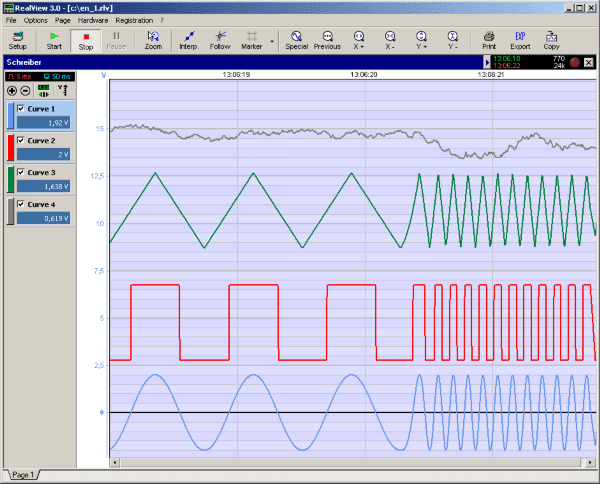
RealView is a measurement application, which records and plots measured values from analogue hardware devices in real-time. Several curves can be plotted into a single diagram. Several diagrams can be arranged on one or more pages if necessary. Plot options...

ProfiLab-Expert 4.0
The ProfiLab-Expert software allows you to develop your own digital or analogue measuring technology projects. It doesn't matter if you want to create analogue measurements or digital controls - you can realize it all. And for all this you don't...

Advances in Measurement & Sensor Tech
This issue features articles on various measurement and sensor-related embedded design projects. Readers are encouraged to attempt similar projects and share their results. Starting on page 14, Petre Tzvetanov Petrov describes a multilevel audible logical probe design. Petrov notes that...
RealView 2.0
RealView is a measurement application, which records and plots measured values from analogue hardware devices in real-time. Several curves can be plotted into a single diagram. Several diagrams can be arranged on one or more pages if necessary. Plot options...
Digital-ProfiLab 4.0
Digital-ProfiLab was designed for measurement and control applications, combining features like circuit and logic simulation, front panel design, and hardware control to one powerful tool. Incoming signals from external devices may be processed and displayed. A circuit editor is used...
ProfiLab-Expert 4.0
The ProfiLab-Expert software allows you to develop your own digital or analogue measuring technology projects. It doesn't matter if you want to create analogue measurements or digital controls - you can realize it all. And for all this you don't...

Blanket internal measurement circuit disconnection
The internal disconnection circuit for a blanket operates on the principle of induction. It includes a wire approximately 2 cm in length that senses the proximity of a charged mains power source. When the sensing wire is close to the...