


Static Detector

Description: This circuit detects the presence of electrostatic fields by using a Field Effect Transistor (FET) to alter the flash rate of two Light Emitting Diodes (LEDs). The FET is installed in the timing circuit and causes a change in the flash rate of the two LEDs.
The circuit operates by sensing variations in electrostatic fields through the FET, which is sensitive to electric fields due to its high input impedance. When an electrostatic field is detected, the FET's gate receives a voltage change, influencing its conduction state. This change in the FET's behavior is used to modulate the timing characteristics of a connected oscillator circuit.
The timing circuit typically consists of a resistor-capacitor (RC) network that defines the charge and discharge time, thereby determining the frequency at which the LEDs flash. The FET acts as a variable resistor within this RC network, adjusting the charge time based on the intensity of the detected electrostatic field. As the electrostatic field strength increases, the FET allows more current to flow, which results in a faster charge time and, consequently, a quicker flash rate of the LEDs.
The two LEDs are connected in parallel, each capable of emitting light at different frequencies, thereby providing a visual indication of the electrostatic field's presence and strength. The differing flash rates can be used to indicate varying levels of electrostatic energy, allowing for a more nuanced understanding of the field's characteristics.
Overall, this circuit serves as a simple yet effective method for visualizing electrostatic fields, making it useful in various applications such as educational demonstrations, research, and industrial monitoring where electrostatic fields may pose risks or require measurement. This circuit detects the presence of electrostatic fields by using an FET to alter the flash rate of two LEDs. The FET is i nstalled in the timing circuit and causes a change in the flash rate of the two LEDs.
The circuit operates by sensing variations in electrostatic fields through the FET, which is sensitive to electric fields due to its high input impedance. When an electrostatic field is detected, the FET's gate receives a voltage change, influencing its conduction state. This change in the FET's behavior is used to modulate the timing characteristics of a connected oscillator circuit.
The timing circuit typically consists of a resistor-capacitor (RC) network that defines the charge and discharge time, thereby determining the frequency at which the LEDs flash. The FET acts as a variable resistor within this RC network, adjusting the charge time based on the intensity of the detected electrostatic field. As the electrostatic field strength increases, the FET allows more current to flow, which results in a faster charge time and, consequently, a quicker flash rate of the LEDs.
The two LEDs are connected in parallel, each capable of emitting light at different frequencies, thereby providing a visual indication of the electrostatic field's presence and strength. The differing flash rates can be used to indicate varying levels of electrostatic energy, allowing for a more nuanced understanding of the field's characteristics.
Overall, this circuit serves as a simple yet effective method for visualizing electrostatic fields, making it useful in various applications such as educational demonstrations, research, and industrial monitoring where electrostatic fields may pose risks or require measurement. This circuit detects the presence of electrostatic fields by using an FET to alter the flash rate of two LEDs. The FET is i nstalled in the timing circuit and causes a change in the flash rate of the two LEDs.

STRESS METER
It consisted of 16 LEDs in a circle with two touch pads. By placing your fingers on the touch pads, the circuit started and ran the LEDs in a "chaser" pattern around the display, with a beep each time a...

Two-LED Voltage Indicator
Many applications do not require the precision of a digital or analog (bar graph) indicator but still benefit from more than a simple low/high signal. An example is a battery charge level indicator in a car. This basic circuit, which...
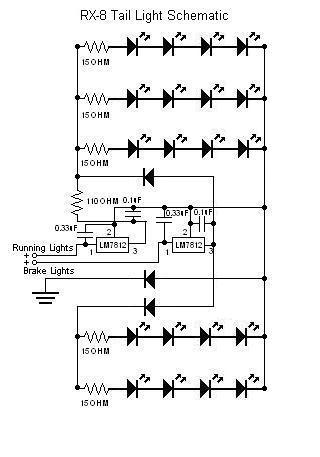
RX-8 LED
The circuit has been successfully recreated and functions properly when the line connected to the 1 µF capacitor of the "2" terminal of the running lights' LM7812 is not grounded. This line is also connected to the 33 µF capacitor...
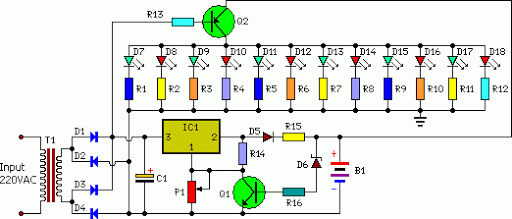
automatic low power emergancy light
An emergency light system utilizing white LEDs, which provides several advantages: 1. It is highly bright due to the use of white LEDs. 2. The light activates automatically during a mains power failure and deactivates when mains power is restored....

Quick move LED game
The object of Quick Draw is to test your reaction time against your opponent's. A third person acts as a referee and begins the duel by pressing S1, which lights LED1. Upon seeing LED1 go on, you try to outdraw...

30W amplifier circuit
The circuit utilizes an FET amplifier configuration for output, incorporating an NE5532 operational amplifier powered by a 15V supply. The output stage features a FET that amplifies the voltage after passing through several stages. The bias circuit for the output...

Thrifty LED Protector
An LED will fail if the current flowing through it is excessively high. This issue can be easily resolved by incorporating a simple resistor in series, which is an effective and low-cost solution. However, as the power supply voltage increases,...

LED Boost Circuit
The completed board may be driven by voltages between 0.8 and 3 Volts. While the basic design goal was candle-like light from a single cell, the values used were chosen to allow safe operation from 3 Volts so you can,...
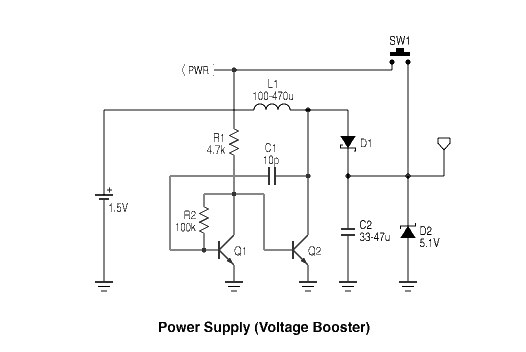
Wave Joule Thief circuit
A series of LEDs that turn on and off in a precise sequence, creating a calming and hypnotic effect. Various LED chaser, scanner, and sequencer circuits exist, utilizing discrete transistors, logic integrated circuits (ICs), or microcontrollers. However, a common limitation...