


Sun-tracker
#sun-tracker
#solar
#phototransistors
#alignment
#light sensing
#energy
#automation
#monitoring
#position sensing

Description: In solar cell array applications and solar instrumentation, it is desirable to monitor the approximate position of the sun to allow efficient automatic alignment. The L14G11ens can provide about 15° of accuracy in a simple level sensing circuit, and a full hemisphere can be monitored with about 150 phototransistors. The sun provides approximately 80 mW/cm² to the L14G1 when on the centerline. This will keep the output down to about 0.5 V for angles up to 7.5°. The sky provides approximately 0.5 mW/cm² to the L14G1 and will keep the output greater than 10 V when viewed. White clouds viewed from above can lower this voltage to about 5 V on some devices. This circuit can directly drive TTL logic by using the 5-V supply and changing the load resistor to 430 Ω. Different bright objects can also be located with the same type of circuitry simply by adjusting the resistor values to provide the desired sensitivity.
In solar energy applications, the ability to accurately track the sun's position is crucial for maximizing the efficiency of solar panels and instrumentation. The L14G11ens sensor system is designed to achieve approximately 15° of angular accuracy, utilizing a configuration of around 150 phototransistors arranged to cover a full hemisphere. This configuration allows the system to effectively detect and respond to varying solar conditions.
When the sun is directly aligned with the sensor, it generates a significant output of approximately 80 mW/cm², resulting in an output voltage that can drop to about 0.5 V when the angle is within 7.5°. In contrast, ambient sky conditions contribute a much lower energy density of around 0.5 mW/cm², allowing the output voltage to remain above 10 V under typical viewing scenarios. However, the presence of white clouds can significantly affect this output, potentially reducing the voltage to approximately 5 V on certain devices.
The circuit is designed to interface seamlessly with TTL logic circuits, leveraging a 5-V power supply. By modifying the load resistor to 430 Ω, the circuit can be optimized for direct logic-level interfacing. Additionally, the system can be adapted for detecting other bright objects in the environment. This adaptability is achieved by adjusting the resistor values within the circuit, allowing for the fine-tuning of sensitivity to meet specific application requirements. This flexibility makes the L14G11ens sensor not only suitable for solar tracking but also versatile for a range of optical detection tasks.In solar cell array applications and solar instrumentation, it is desirable to monitor the approximate position of the sun to allow efficient automatic alignment. The Ll4Gllens can provide about 15° of accuracy in a simple level sensing circuit, and a full hemisphere can be monitored with about 150 phototransistors.
The sun provides "" 80 mW/cm2 to the L14Gl when on the centerline. This will keep the output down to,; 0.5 V for f),; 7.5°. The sky provides "" 0.5 mW/cm2 to the Ll4G1 and will keep the output greater than 10 V when viewed. White douds viewed from above can lower this voltage to "" 5 Von some devices. This circuit can directly drive TTL logic by using the 5-V supply and changing the load resistor to 430 0. Different bright objects can also be located with the same type of circuitry simply by adjusting the resistor values to provide the desired sensitivity.
In solar energy applications, the ability to accurately track the sun's position is crucial for maximizing the efficiency of solar panels and instrumentation. The L14G11ens sensor system is designed to achieve approximately 15° of angular accuracy, utilizing a configuration of around 150 phototransistors arranged to cover a full hemisphere. This configuration allows the system to effectively detect and respond to varying solar conditions.
When the sun is directly aligned with the sensor, it generates a significant output of approximately 80 mW/cm², resulting in an output voltage that can drop to about 0.5 V when the angle is within 7.5°. In contrast, ambient sky conditions contribute a much lower energy density of around 0.5 mW/cm², allowing the output voltage to remain above 10 V under typical viewing scenarios. However, the presence of white clouds can significantly affect this output, potentially reducing the voltage to approximately 5 V on certain devices.
The circuit is designed to interface seamlessly with TTL logic circuits, leveraging a 5-V power supply. By modifying the load resistor to 430 Ω, the circuit can be optimized for direct logic-level interfacing. Additionally, the system can be adapted for detecting other bright objects in the environment. This adaptability is achieved by adjusting the resistor values within the circuit, allowing for the fine-tuning of sensitivity to meet specific application requirements. This flexibility makes the L14G11ens sensor not only suitable for solar tracking but also versatile for a range of optical detection tasks.In solar cell array applications and solar instrumentation, it is desirable to monitor the approximate position of the sun to allow efficient automatic alignment. The Ll4Gllens can provide about 15° of accuracy in a simple level sensing circuit, and a full hemisphere can be monitored with about 150 phototransistors.
The sun provides "" 80 mW/cm2 to the L14Gl when on the centerline. This will keep the output down to,; 0.5 V for f),; 7.5°. The sky provides "" 0.5 mW/cm2 to the Ll4G1 and will keep the output greater than 10 V when viewed. White douds viewed from above can lower this voltage to "" 5 Von some devices. This circuit can directly drive TTL logic by using the 5-V supply and changing the load resistor to 430 0. Different bright objects can also be located with the same type of circuitry simply by adjusting the resistor values to provide the desired sensitivity.

Light sensing circuit diagram
In the silicon-controlled trigger circuit, a cadmium sulfide cell is connected to a relaxation oscillator, which serves as a sensor to activate a blinking light in a darkroom. This setup causes a speaker to emit a warning sound of Ka,...
Solar robotics
BEAM enthusiasts often quickly learn to scavenge necessary components for their projects from technoscrap. However, there will always be occasions when purchasing new parts or materials becomes essential. This trend is increasingly prevalent as Application Specific Chips are being used...

SOLAR REVOLVER
How would you use an SE with a chip enable? Good question and well one thing leads to another and before you know it a new solar roller is born. The design started out as a simple example of using...

The VTSE solar engine
The VTSE uses the popular 1381 chip and that is its main advantage. The potentiometer (or two fixed resistors) connects one leg between the output and input of the 1381 and the other leg to the supply voltage. These resistors...

The MicroPower SE
A micro power solar engine has been a goal since my introduction to BEAM Robotics. I believe that if there wasn't one before, there is one now. What I'm presenting to you looks very similar to one of the circuits...

SOLAR_POWER_OVERCHARGE_PROTECTION
A voltage regulator is connected across the solar cell to prevent damage to the storage battery due to overcharging. A series diode prevents the array from discharging the battery during hours of darkness. The regulator does not draw power from...
12V LDO Solar Charge Control
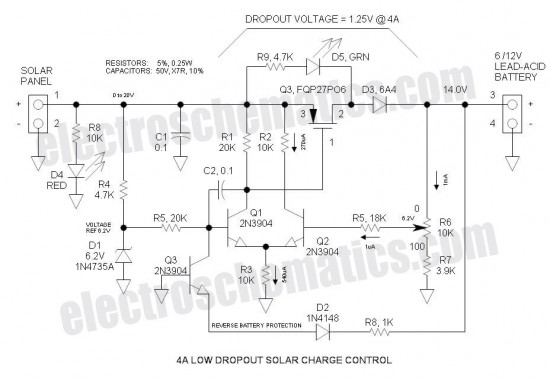
This Low Dropout Voltage (LDO) solar charge controller utilizes a straightforward differential amplifier combined with a series P-channel MOSFET linear regulator, creating an effective synergy. The voltage output is adjustable and is primarily designed for charging 12V lead-acid batteries. Specifications...

solar led
This circuit was developed in response to the observation that many solar LED lights utilizing a CDS light sensor appeared to have an excessive number of components. The intention was to simplify the design. This circuit does not incorporate a...

The T3SE type 3 solar engine
The all-transistor T3SE works much like a conventional SE: like the Tritium, it fires when the charging current drops below the minimum and after the circuit triggers, positive feedback is used to latch the circuit, resetting at a fixed voltage...