


Touch Controlled Capacitive Sensor Circuit

Description: Parts List The circuit was specifically designed for shop window animation as it utilizes a capacitive sensor that is activated by a touch control system.
The circuit is intended for enhancing visual displays in retail environments by creating dynamic animations that respond to user interactions. The core component of this design is a capacitive sensor, which detects changes in capacitance caused by human touch. This sensor allows for a seamless interaction between the user and the display, enabling animations to be triggered with a simple touch.
The system typically consists of the following essential components:
1. **Capacitive Sensor Module**: This module is responsible for detecting touch. It operates by measuring the capacitance changes when a finger approaches or touches the sensor area.
2. **Microcontroller**: A microcontroller processes the signals from the capacitive sensor. It interprets the touch input and controls the output for the animation display. Depending on the complexity of the animation, the microcontroller may be programmed to handle multiple touch inputs and trigger different animations accordingly.
3. **LEDs or Display Module**: The output display can consist of LEDs or other types of display modules (like LCDs or OLEDs) that visually represent the animations. The choice of display will depend on the desired visual effects and the complexity of the animations.
4. **Power Supply**: A stable power supply is crucial for the operation of the circuit. It should provide the necessary voltage and current to the microcontroller, sensor, and display components.
5. **Resistors and Capacitors**: These passive components may be included in the circuit to stabilize the operation of the capacitive sensor and to filter out noise, ensuring accurate touch detection.
6. **Optional Components**: Depending on the design requirements, additional components such as transistors or MOSFETs may be used for driving larger loads or enhancing the circuit's functionality.
The design of this circuit emphasizes user interaction, making it ideal for environments such as shop windows, where engaging displays can attract customers. The integration of a touch control system allows for a modern and intuitive experience, setting this circuit apart from traditional static displays.Parts List The circuit was specially designed for shop windows animation as it makes use of a capacitive sensor that is triggered by touch control system
The circuit is intended for enhancing visual displays in retail environments by creating dynamic animations that respond to user interactions. The core component of this design is a capacitive sensor, which detects changes in capacitance caused by human touch. This sensor allows for a seamless interaction between the user and the display, enabling animations to be triggered with a simple touch.
The system typically consists of the following essential components:
1. **Capacitive Sensor Module**: This module is responsible for detecting touch. It operates by measuring the capacitance changes when a finger approaches or touches the sensor area.
2. **Microcontroller**: A microcontroller processes the signals from the capacitive sensor. It interprets the touch input and controls the output for the animation display. Depending on the complexity of the animation, the microcontroller may be programmed to handle multiple touch inputs and trigger different animations accordingly.
3. **LEDs or Display Module**: The output display can consist of LEDs or other types of display modules (like LCDs or OLEDs) that visually represent the animations. The choice of display will depend on the desired visual effects and the complexity of the animations.
4. **Power Supply**: A stable power supply is crucial for the operation of the circuit. It should provide the necessary voltage and current to the microcontroller, sensor, and display components.
5. **Resistors and Capacitors**: These passive components may be included in the circuit to stabilize the operation of the capacitive sensor and to filter out noise, ensuring accurate touch detection.
6. **Optional Components**: Depending on the design requirements, additional components such as transistors or MOSFETs may be used for driving larger loads or enhancing the circuit's functionality.
The design of this circuit emphasizes user interaction, making it ideal for environments such as shop windows, where engaging displays can attract customers. The integration of a touch control system allows for a modern and intuitive experience, setting this circuit apart from traditional static displays.Parts List The circuit was specially designed for shop windows animation as it makes use of a capacitive sensor that is triggered by touch control system

Capacitive liquid level sensor circuit
Figure 1 (A) depicts the circuit diagram of one embodiment of the fluid level detector designed. The circuit is typically powered by a 12-volt automobile battery, which is reduced to a 5-volt DC source using a voltage regulator consisting of...

Touch Volume Control Circuit
Touch controls are not only utilized for switching devices on or off but can also manage various functions. A notable example is the TV remote control. When it is crucial to maintain activated functions for an extended period, employing a...
Capacitive Sensor
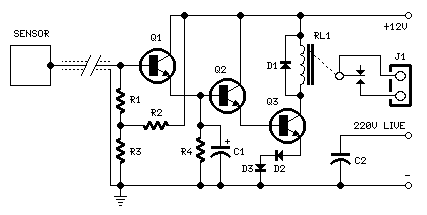
The purpose of this circuit is to animate shop-windows by means of a capacitive sensor placed behind a post-card-like banner. The card is placed against the glass inside the shop-window, and the visitor can activate the relay placing his hand...

Stud Sensor Automatic circuit
This device is a highly effective capacitive sensor. In North America, it is primarily utilized for detecting wooden beams behind drywall or plaster. This model is preferred over newer designs due to its reliability, as it does not frequently malfunction...

Auto Stud Sensor
This thing is a very nifty capacitive sensor. For you europeans, this little gem is used in north america mostly for detecting wooden beams behind drywall or plaster. I'll take one of these over the new design any day, because...

Use Analog Techniques To Measure Capacitance In Capacitive Sensors
Capacitive sensors are utilized in various devices, ranging from consumer electronics to industrial and process control systems. Touch buttons are increasingly integrated into lamps and dimmers, while motion detectors can sense minute changes in deflection. Hygrometers measure humidity levels, and...
Capacitive Sensor
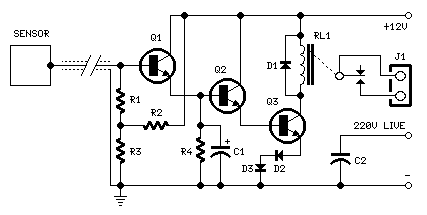
Q1, Q2, and Q3 form a high-impedance super-Darlington configuration that drives the relay, amplifying the 50 or 60 Hz alternating mains supply frequency induced in the sensor by the human body. Capacitors C1, D2, and D3 ensure clean switching of...
Mains-operated Capacitive Sensor
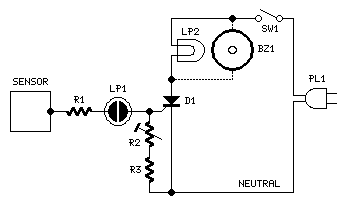
This very simple circuit acts as a high sensitivity capacitive sensor. Lamps and/or Buzzers are operated at half the mains supply voltage when a part of the human body comes in contact with the sensor or approaches it at a...

Capacitive-sensor-alarm
The unit is built around a balanced-bridge circuit that utilizes both capacitance and inductance. The bridge comprises capacitors C2 and C3, along with the center-tapped winding of transformer Tl. One end of the bridge is connected to ground through capacitor...