


ULN2429 liquid detector circuit diagram electronic project
#liquid detector
#ULN2429
#automotive
#industrial
#home automation
#sensing
#monolithic IC
#bipolar integrated circuit
#presence detection
#absence detection

Description: This electronic liquid detector circuit diagram is based on the ULN2429 monolithic bipolar integrated circuit designed for detecting the absence or presence of many different types of liquids. The ULN2429 electronic liquid detector circuit can be used in automotive, home, or industrial applications. The absence or presence of the liquid is determined by comparing the loaded probe resistance (probe immersed in the fluid) with an internal or external resistance. At the output, you can connect an LED, incandescent lamp, loudspeaker, or even relays or solenoids, but only if a capacitor is connected to pin 12 to provide a DC output (typically, the output signal is a square wave). If a device requiring more than 30 volts needs to be connected at the output, the ULN2429A-1 can be used, which is identical but supports devices operating up to 50 volts.
The ULN2429 integrated circuit serves as a versatile solution for liquid detection across various environments. It operates by utilizing a probe that is immersed in the liquid being monitored. The resistance of the probe changes based on whether the probe is submerged in a liquid or exposed to air. This resistance change is compared to a predetermined internal or external reference resistance to determine the liquid's presence or absence.
The circuit can be configured to drive several types of output devices. When a liquid is detected, the output of the ULN2429 can activate an LED to provide a visual indication of the liquid's presence. Alternatively, it can drive an incandescent lamp for more substantial illumination or a loudspeaker for auditory alerts. The design also supports the operation of relays and solenoids, which can be used for automated control systems, such as shutting off a valve or activating a pump.
To ensure the output signal is suitable for these devices, a capacitor must be connected to pin 12 of the ULN2429. This capacitor smooths the output signal, converting the typically generated square wave into a more stable DC signal. This adjustment is critical when interfacing with devices that require a steady voltage supply.
For applications that necessitate higher voltage outputs, the ULN2429A-1 variant is recommended. This version of the integrated circuit retains the same functionality while accommodating devices that operate up to 50 volts, thereby expanding the range of potential applications in industrial settings where higher voltage systems are common.
Overall, the ULN2429 liquid detector circuit is a robust and flexible design suitable for various liquid detection applications, providing reliable performance and ease of integration into existing systems.This electronic liquid detector circuit diagram is based on the ULN2429 monolithic bipolar integrated circuit designed for detecting the absence or presence of many different types of liquids. The ULN2429 electronic liquid detector circuit can be used in automotive, home or industrial applications.
The absence or presence of the liquid is deter mined by comparing the loaded probe resistance (probe immersed in the fluid ) with an internal or external resistance. At the output you can connect a LED, incandescence lamp, loud speaker or even such relays or solenoids, but just I you connect at pin 12 a capacitor, to provide a dc output ( typically the output signal is a square wave ).
If you need to connect at the output a device that need more than 30 volts you can use the ULN2429A-1 which is identical, but support devices with operation up to 50 volts.
The ULN2429 integrated circuit serves as a versatile solution for liquid detection across various environments. It operates by utilizing a probe that is immersed in the liquid being monitored. The resistance of the probe changes based on whether the probe is submerged in a liquid or exposed to air. This resistance change is compared to a predetermined internal or external reference resistance to determine the liquid's presence or absence.
The circuit can be configured to drive several types of output devices. When a liquid is detected, the output of the ULN2429 can activate an LED to provide a visual indication of the liquid's presence. Alternatively, it can drive an incandescent lamp for more substantial illumination or a loudspeaker for auditory alerts. The design also supports the operation of relays and solenoids, which can be used for automated control systems, such as shutting off a valve or activating a pump.
To ensure the output signal is suitable for these devices, a capacitor must be connected to pin 12 of the ULN2429. This capacitor smooths the output signal, converting the typically generated square wave into a more stable DC signal. This adjustment is critical when interfacing with devices that require a steady voltage supply.
For applications that necessitate higher voltage outputs, the ULN2429A-1 variant is recommended. This version of the integrated circuit retains the same functionality while accommodating devices that operate up to 50 volts, thereby expanding the range of potential applications in industrial settings where higher voltage systems are common.
Overall, the ULN2429 liquid detector circuit is a robust and flexible design suitable for various liquid detection applications, providing reliable performance and ease of integration into existing systems.This electronic liquid detector circuit diagram is based on the ULN2429 monolithic bipolar integrated circuit designed for detecting the absence or presence of many different types of liquids. The ULN2429 electronic liquid detector circuit can be used in automotive, home or industrial applications.
The absence or presence of the liquid is deter mined by comparing the loaded probe resistance (probe immersed in the fluid ) with an internal or external resistance. At the output you can connect a LED, incandescence lamp, loud speaker or even such relays or solenoids, but just I you connect at pin 12 a capacitor, to provide a dc output ( typically the output signal is a square wave ).
If you need to connect at the output a device that need more than 30 volts you can use the ULN2429A-1 which is identical, but support devices with operation up to 50 volts.

Camshaft Position Sensor
AutoZone Repair Guide for Engine Performance and Emission Control Components and Systems, specifically focusing on the Camshaft Position Sensor.
The Camshaft Position Sensor (CMP) is a critical component in modern internal combustion engines, playing a vital role in the management of...

Liquid Detector Water Sensor Circuit
This is a straightforward liquid detector that utilizes a relay to activate an evacuation mechanism. It can be employed for water or any liquid that conducts electricity. Any PNP transistor capable of handling the relay current can be used. Refer...
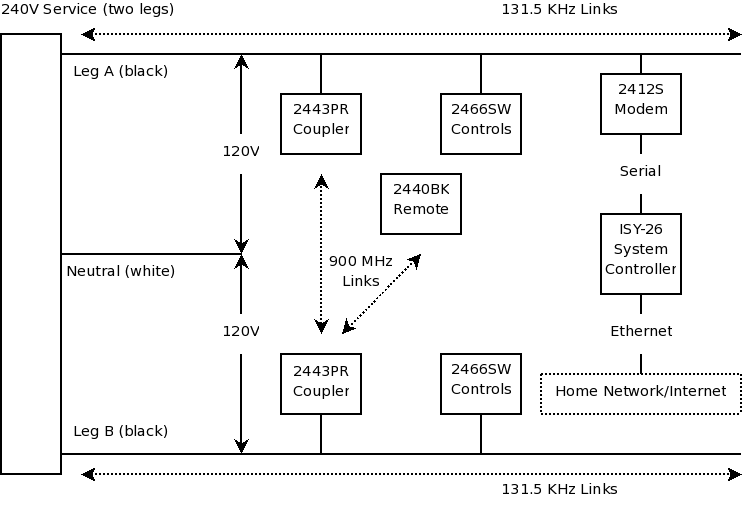
home automation Installation
First and foremost, if one is not skilled with tools and electrical systems, it is advisable to hire a qualified electrician rather than attempting to undertake this task independently. The electrician should review this page for specific cautions and advice....
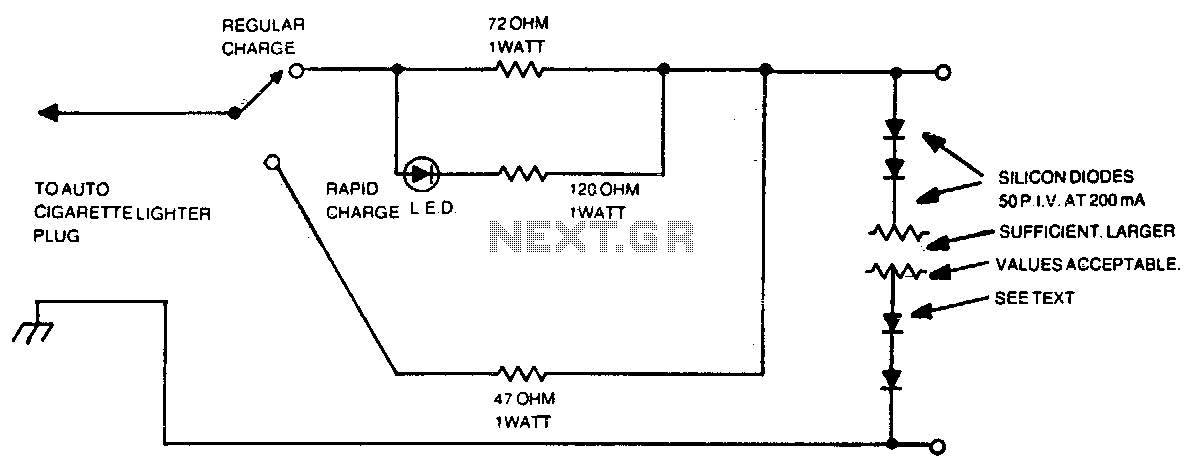
Automotive charger for ni-cad battery packs
The number of silicon diodes across the output is determined by the voltage of the battery pack. Each diode is considered at 0 volts. For example, a 10-volt pack would require 10/0 = 157, or 16 diodes.
In the context of...

Liquid detector water sensor circuit
This is a straightforward liquid detector that utilizes a relay to activate an evacuation valve. It can be employed for water or any conductive liquid.
The liquid detector circuit operates by leveraging the conductivity of liquids to trigger a relay. The...

Liquid detector circuit diagram using logic gates
The liquid detector is a device designed to detect the presence of liquid using alternating voltage. This circuit can be constructed using common electronic components. The alternating voltage is generated by a gate with a Schmitt trigger function, acting as...

Computerize Your Room/House
You have read about computerized rooms or seen home automation products advertised in electronics magazines. You have decided to try it yourself. However, it is important to note that this project is not inexpensive. A computer is required, which is...

simplest smf automotive battery charger
A simple battery charger circuit is described, utilizing a single transistor for voltage detection and automatically disconnecting the battery from the supply when fully charged. The circuit's high voltage trip point is set to switch off the charging voltage when...

Voltage Regulator For Cars And Motorcycles
This regulator circuit can be used on an alternator that has one field terminal grounded. When the input voltage becomes too high, Q1 conducts, and the base of Q2 is driven toward ground, reducing the voltage fed to Q3. This...