


using thermopile sensor in ir digital thermometers
#thermopile
#infrared
#temperature measurement
#digital thermometer
#medical devices
#sensors
#IR heat
#eardrum
#hypothalamus
#non-contact

Description: Due to their speed, accuracy, effectiveness, and cost-efficiency, infrared (IR) digital thermometers have supplanted traditional mercury thermometers. An ear digital thermometer utilizes a thermopile sensor to measure the infrared heat emitted by the eardrum, which correlates with the temperature of the hypothalamus.
Infrared digital thermometers operate based on the principle of detecting infrared radiation emitted by objects, which in this case is the human body. The thermopile sensor consists of multiple thermocouples connected in series or parallel, allowing it to convert infrared radiation into an electrical signal. This signal is then processed to provide a temperature reading.
In an ear digital thermometer, the design typically includes an infrared lens that focuses the emitted infrared radiation from the eardrum onto the thermopile sensor. The sensor's output is amplified and converted into a digital signal, which is then displayed on a digital readout. The thermometer may also incorporate a microcontroller for processing the signal, managing the display, and ensuring accurate temperature readings.
To enhance accuracy, many IR digital thermometers are calibrated to account for various factors, such as ambient temperature and distance from the measurement point. Additionally, some models may include features like memory functions to store previous readings, or a fever alert system that indicates when a measured temperature exceeds a predefined threshold.
Overall, the integration of a thermopile sensor, digital processing, and user-friendly design elements makes infrared digital thermometers a valuable tool in both clinical and home settings for quick and reliable temperature assessment.Because of their speed, accuracy, effectiveness, and cost, infrared (IR) digital thermometers have replaced traditional mercury thermometers. Using a thermopile sensor, an ear digital thermometer measures the infrared heat of the eardrum, which reflects the temperature of the hypothalamus..
Infrared digital thermometers operate based on the principle of detecting infrared radiation emitted by objects, which in this case is the human body. The thermopile sensor consists of multiple thermocouples connected in series or parallel, allowing it to convert infrared radiation into an electrical signal. This signal is then processed to provide a temperature reading.
In an ear digital thermometer, the design typically includes an infrared lens that focuses the emitted infrared radiation from the eardrum onto the thermopile sensor. The sensor's output is amplified and converted into a digital signal, which is then displayed on a digital readout. The thermometer may also incorporate a microcontroller for processing the signal, managing the display, and ensuring accurate temperature readings.
To enhance accuracy, many IR digital thermometers are calibrated to account for various factors, such as ambient temperature and distance from the measurement point. Additionally, some models may include features like memory functions to store previous readings, or a fever alert system that indicates when a measured temperature exceeds a predefined threshold.
Overall, the integration of a thermopile sensor, digital processing, and user-friendly design elements makes infrared digital thermometers a valuable tool in both clinical and home settings for quick and reliable temperature assessment.Because of their speed, accuracy, effectiveness, and cost, infrared (IR) digital thermometers have replaced traditional mercury thermometers. Using a thermopile sensor, an ear digital thermometer measures the infrared heat of the eardrum, which reflects the temperature of the hypothalamus..

PC Infrared Receiver
This is the latest version of the Improved Infrared Receiver with Status LED which can control any desktop PC with an ordinary remote control. The project comes along with a small PCB in order to save space. It connects to...

reading electricity meter ir impulses
Yesterday, an attempt was made to read the infrared impulses from an electricity meter using a phototransistor. The phototransistor can detect infrared signals from various remote controls in the house but fails to detect the blinking signal from the electricity...

Infrared-Led based Wireless Data & Voice Communication withCircuit
The objective of this project is to design a circuit for an electronic infrared communication system, develop innovative ideas for implementing this circuit, and study the circuitry along with various components such as DTMF generators, DTMF decoders, operational amplifiers, and...

USB IR Toy
Use a remote control with your computer, view infrared signals on a logic analyzer, or capture and replay remote control buttons. The USB Infrared Toy v2 features an enhanced IR transmitter and several new functionalities. Numerous intriguing infrared projects are...

Infrared Receiver for PC Schematic andCircuit
It is unusual that personal computers are not equipped with a standard remote control interface. Many motherboards feature an IRDA port; however, this port is not compatible with the 38 kHz frequencies commonly used by regular remote controls. Fortunately, WinLIRC...

The Infrared Demodulation Circuit Using Low-Noise Amplifier
This circuit employs an HgCdTe demodulation device that can be cooled to 77K using liquid nitrogen. It utilizes a constant current bias for the demodulation device, which is connected to the input port. The voltage amplification factor is 200, and...
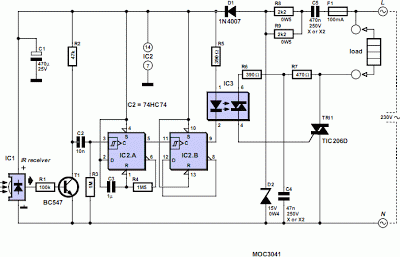
On-off Infrared Remote Control
Most homes today have several infrared remote controls, such as those for televisions, video recorders, and stereos. However, many individuals have experienced frustration when lights remain illuminated after settling into a comfortable chair to watch a movie. This project aims...

Infrared Detector Circuit with PID20
This infrared detector circuit utilizes a passive infrared detector component, PID20, which converts heat radiation into electrical impulses. The output voltage of the PID20 increases when an object approaches, provided that the object is warmer than the surrounding environment. The...

Basic IR Detector/Emitter
This is a very basic infrared detector/emitter circuit. One major downside of this circuit, is that ambient infrared light will interfere with its detecting obstacles.
The described circuit functions as a basic infrared (IR) detector and emitter system, commonly utilized in...