


water level circuit
#water level
#1-Wire
#home automation
#optical sensor
#measurement
#PC interface
#timer
#capacitor
#pond
#pool

Description: In home automation applications, there are instances where measuring the level of a body of water, such as in a pool or pond, is desired. The 1-Wire network facilitates easy interfacing of sensors to a PC or a simple controller. Some experimenters utilize a series of capacitors and a timer to gauge water depth, while a simpler optical method can also be employed. This method involves a ping-pong ball that floats on the water's surface within a pipe. An infrared triangulation sensor provides a non-linear voltage output that corresponds to the distance from the sensor to the ping-pong ball. The prototype system is capable of measuring level changes up to 24 cm with a resolution of approximately 1 cm. This range and resolution can be adjusted by selecting different infrared sensors. A lookup table derived from the polynomial can be stored in the DS2438's 40-byte non-volatile memory, allowing for easy replacement of water level sensors. By storing the voltage multiplied by 100 as a single byte, a range of 40 cm can be accommodated. For this prototype, a Link 1-Wire RS-232 adapter is employed for communication with the sensor, while TCL routines are utilized for data processing. TCL for Windows is accessible from ActiveState, and RRDtool is used for graph generation. This project is intended for experimental purposes only, with the user assuming all responsibilities for assembly, installation, and usage. The circuit is provided without warranty, and the author does not guarantee its functionality in any specific application. It is advised not to use this device in scenarios where failure or incorrect operation could endanger safety. This schematic is intended for non-commercial use only.
In the context of home automation, the described water level measurement system leverages a straightforward optical method to gauge water levels effectively. The system's core consists of a floating ping-pong ball and an infrared triangulation sensor, which together facilitate non-contact measurement. The infrared sensor's output voltage is non-linear and varies according to the distance to the ping-pong ball, allowing for precise level measurements.
The design can measure changes in water level up to 24 cm with a resolution of 1 cm, making it suitable for various applications where accurate water level monitoring is essential. The flexibility to adjust the measurement range and resolution by selecting different infrared sensors enhances the system's adaptability to different environments and requirements.
The integration of a DS2438 chip for data storage is particularly advantageous, as it enables the storage of calibration data in a non-volatile format. This ensures that the sensor can be easily replaced without the need for recalibration, streamlining maintenance and enhancing user convenience. The use of a lookup table derived from polynomial equations further aids in translating sensor voltage readings into meaningful depth measurements.
Communication with the sensor is facilitated through a Link 1-Wire RS-232 adapter, which simplifies the interface between the sensor and a PC or microcontroller. The employment of TCL routines for data processing allows for efficient handling of the sensor data, while RRDtool provides a robust solution for visualizing the data in graph form, aiding in real-time monitoring and analysis.
It is crucial to note that this circuit is intended solely for experimental use. Users must understand the inherent risks involved in assembly and operation, as the author disclaims any responsibility for malfunction or failure of the device. The schematic is restricted to non-commercial use, ensuring that the design remains accessible for educational and experimental purposes without infringing on commercial rights.There are situations in home automation applications where you would like to measure the level of some body of water (e. g. pool, pond). The 1-Wire network makes it easy to interface sensors to a PC or simple controller. Some experimenters use a string of capacitors and a timer to measure water depth. I decided to use a simple optical approach. The idea is very simple. A pin-pong ball floats on top of the water in the pipe. An infrared triangulation sensor outputs a non-linear voltage corresponding to the distance to the ping-pong ball. The prototype system can measure level changes of up to 24cm with a resolution of around 1cm. This range / resolution can be changed by using different infrared sensors. A lookup table created from the polynomial can be stored in the DS2438 40 Byte nonvolatile memory. This makes the water level sensors easily replaceable. Storing the voltage multipled by 100 as a single byte allows a 40cm range to be stored. For the prototype the values are: The Link 1-wire RS-232 adapter is used to communicate with the sensor.
TCL routines are used to process the data. TCL for Windows is available from ActiveState. RRDtool is used to generate graphs. This project is for experimental use only. The user assumes all responsibilities for assembly, installation, and use. This circuit is provided without warranty and the author makes no claim that this device will work in any particular application. Do not use in applications where failure or incorrect operation could jeopardize someone`s safety. This schematic is provided for noncommercial use only.
In the context of home automation, the described water level measurement system leverages a straightforward optical method to gauge water levels effectively. The system's core consists of a floating ping-pong ball and an infrared triangulation sensor, which together facilitate non-contact measurement. The infrared sensor's output voltage is non-linear and varies according to the distance to the ping-pong ball, allowing for precise level measurements.
The design can measure changes in water level up to 24 cm with a resolution of 1 cm, making it suitable for various applications where accurate water level monitoring is essential. The flexibility to adjust the measurement range and resolution by selecting different infrared sensors enhances the system's adaptability to different environments and requirements.
The integration of a DS2438 chip for data storage is particularly advantageous, as it enables the storage of calibration data in a non-volatile format. This ensures that the sensor can be easily replaced without the need for recalibration, streamlining maintenance and enhancing user convenience. The use of a lookup table derived from polynomial equations further aids in translating sensor voltage readings into meaningful depth measurements.
Communication with the sensor is facilitated through a Link 1-Wire RS-232 adapter, which simplifies the interface between the sensor and a PC or microcontroller. The employment of TCL routines for data processing allows for efficient handling of the sensor data, while RRDtool provides a robust solution for visualizing the data in graph form, aiding in real-time monitoring and analysis.
It is crucial to note that this circuit is intended solely for experimental use. Users must understand the inherent risks involved in assembly and operation, as the author disclaims any responsibility for malfunction or failure of the device. The schematic is restricted to non-commercial use, ensuring that the design remains accessible for educational and experimental purposes without infringing on commercial rights.There are situations in home automation applications where you would like to measure the level of some body of water (e. g. pool, pond). The 1-Wire network makes it easy to interface sensors to a PC or simple controller. Some experimenters use a string of capacitors and a timer to measure water depth. I decided to use a simple optical approach. The idea is very simple. A pin-pong ball floats on top of the water in the pipe. An infrared triangulation sensor outputs a non-linear voltage corresponding to the distance to the ping-pong ball. The prototype system can measure level changes of up to 24cm with a resolution of around 1cm. This range / resolution can be changed by using different infrared sensors. A lookup table created from the polynomial can be stored in the DS2438 40 Byte nonvolatile memory. This makes the water level sensors easily replaceable. Storing the voltage multipled by 100 as a single byte allows a 40cm range to be stored. For the prototype the values are: The Link 1-wire RS-232 adapter is used to communicate with the sensor.
TCL routines are used to process the data. TCL for Windows is available from ActiveState. RRDtool is used to generate graphs. This project is for experimental use only. The user assumes all responsibilities for assembly, installation, and use. This circuit is provided without warranty and the author makes no claim that this device will work in any particular application. Do not use in applications where failure or incorrect operation could jeopardize someone`s safety. This schematic is provided for noncommercial use only.

Water Level Alarm
A circuit that offers visual indication of fluid level in a vessel, with a switchable audible alarm. Example uses would be to monitor the level of water in a bath or cold storage tank.
The described circuit functions as a fluid...
Water Level Alarm
A circuit that offers visual indication of fluid level in a vessel, with a switchable audible alarm. Example uses would be to monitor the level of water in a bath or cold storage tank.
The described circuit functions as a fluid...

bedside lamp timer schematics
Q1 and Q2 create an ALL-ON ALL-OFF circuit that, when in the off state, draws negligible current. P1 initiates the circuit, activating the relay and powering the two integrated circuits (ICs). The lamp is energized through the relay switch, and...

Long Duration Timer
This timer can provide a time delay ranging from 10 minutes to 12 hours. The time delay is adjustable via a rotary switch, and upon completion of the timing cycle, a relay is energized and remains latched until the circuit...
Appliance Cutoff Timer
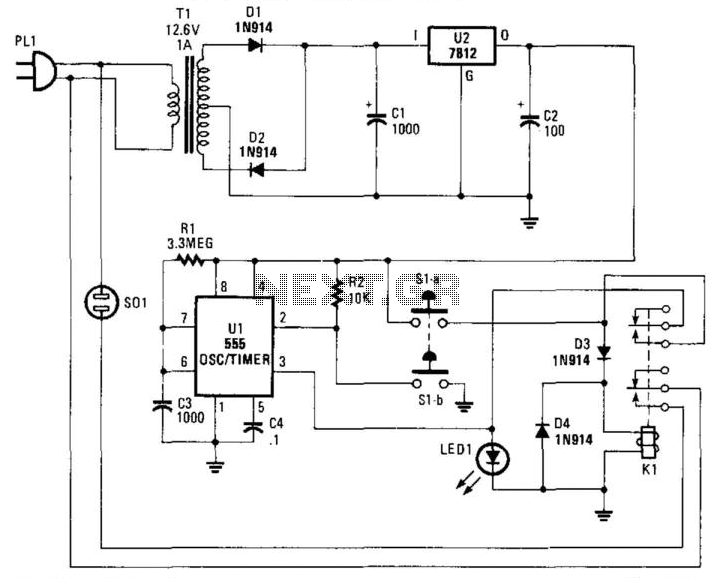
Suitable for cutting off an appliance or other AC load, this timer will cut the AC power after a period determined by R1/C3, as shown, for about 40 minutes. K1 is a relay that should handle about 10 A. S1A...
Timer circuit with 106 fixed preset time
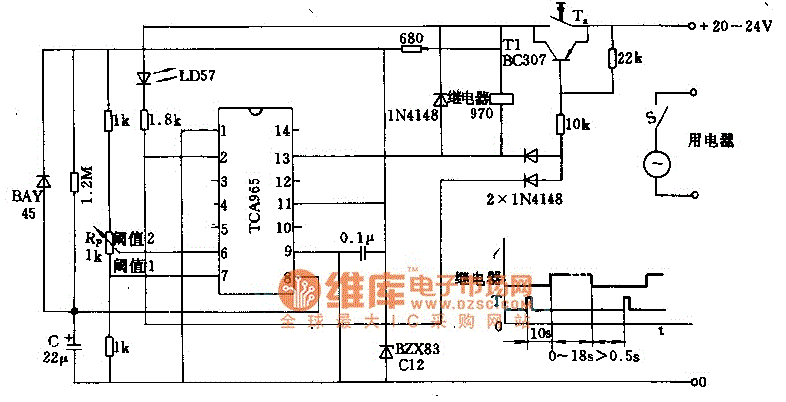
The foot 13 between valve value 1 and valve value 2 will draw the transistor base current. If the relay releases, after a recovery time of 0.5 seconds, pressing the key will initiate the switching process again. The timer is...

A Bedside Lamp Timer Circuit
This circuit is designed to power a lamp or other appliance for a specified duration of 30 minutes, after which it automatically turns off. It is particularly useful for nighttime reading, as it can turn off a bedside lamp if...

Repeating Interval Timers
Do not use the on-board relay to switch mains voltage. The board's layout does not provide adequate isolation between the relay contacts and the low-voltage components. If mains voltage switching is required, mount a suitably rated relay in a safe...

control interface via pc keyboard
One of the more challenging aspects of creating a control or security system that utilizes a PC, such as a burglar alarm, is connecting the sensors to the computer. This typically requires specialized interface expansion boards, and programming that includes...