


Windshield washer fluid watcher
#conductive probes
#fluid level
#automotive
#sensor
#washer fluid
#current detection
#reservoir
#monitoring

Description: This circuit relies on the small current between two conductive probes suspended in a washer fluid reservoir. When the fluid level is below the probes, Q1 activates, and the Sonolert emits a sound.
The circuit operates by utilizing two conductive probes that are positioned at a specific height within a washer fluid reservoir. These probes act as a level sensing mechanism, detecting the presence or absence of fluid. When the fluid level drops below the height of the probes, a minute current flows between them, triggering the transistor Q1.
Transistor Q1, when activated, allows current to flow through the circuit, energizing the Sonolert, a sound-emitting device. The Sonolert serves as an auditory alert, notifying the user that the washer fluid level is low. The design of the circuit ensures that it is sensitive to small changes in fluid level, providing an early warning to prevent running out of washer fluid while driving.
To enhance reliability, the circuit may incorporate a resistor in series with the probes to limit the current and prevent corrosion. Additionally, a capacitor may be used to filter out noise, ensuring that the Sonolert only activates under appropriate conditions. Proper placement of the probes is crucial to ensure accurate fluid level detection and to avoid false triggering due to splashing or turbulence in the reservoir.
Overall, this simple yet effective circuit design provides a practical solution for monitoring washer fluid levels in vehicles, contributing to safe driving conditions.This circuit relies upon the minute current between two conductive probes suspended in a washer fluid reservoir When the level is below the probes, Q1 turns on and the Sonolert sounds.
The circuit operates by utilizing two conductive probes that are positioned at a specific height within a washer fluid reservoir. These probes act as a level sensing mechanism, detecting the presence or absence of fluid. When the fluid level drops below the height of the probes, a minute current flows between them, triggering the transistor Q1.
Transistor Q1, when activated, allows current to flow through the circuit, energizing the Sonolert, a sound-emitting device. The Sonolert serves as an auditory alert, notifying the user that the washer fluid level is low. The design of the circuit ensures that it is sensitive to small changes in fluid level, providing an early warning to prevent running out of washer fluid while driving.
To enhance reliability, the circuit may incorporate a resistor in series with the probes to limit the current and prevent corrosion. Additionally, a capacitor may be used to filter out noise, ensuring that the Sonolert only activates under appropriate conditions. Proper placement of the probes is crucial to ensure accurate fluid level detection and to avoid false triggering due to splashing or turbulence in the reservoir.
Overall, this simple yet effective circuit design provides a practical solution for monitoring washer fluid levels in vehicles, contributing to safe driving conditions.This circuit relies upon the minute current between two conductive probes suspended in a washer fluid reservoir When the level is below the probes, Q1 turns on and the Sonolert sounds.

Add a sensor to a board and measure something with it
This week's plan is to build a device that warns of the potential for a knockdown, which is the process by which an over-canvassed ship is laid over on her beam-ends. The risk of sinking is high during this event,...

Three Phase protective circuit of the current detection line
Drawing transistors that comprise the gate VTi, VT2, VT3, and similar components.
The schematic involves a configuration of transistors designated as VTi, VT2, and VT3, which are integral to forming a gate structure. These transistors are typically arranged in a complementary...
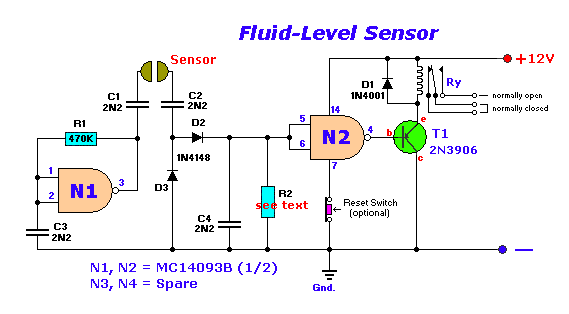
MC14093B Fluid Level SensorCircuit Diagram
The circuit diagram presented illustrates the MC14093B Fluid Level Sensor Circuit. It is characterized by its compact and simple design, utilizing a single-chip configuration suitable for a wide range of applications.
The MC14093B is a CMOS quad two-input NAND gate that...

Automobile Lights-On Reminder
The circuit provides a visible or audible warning when the headlights are on. It utilizes a 2N1305 transistor as a switch to activate either a Sonalert tone generator or a small 12-V lamp. The operating current for the transistor is...
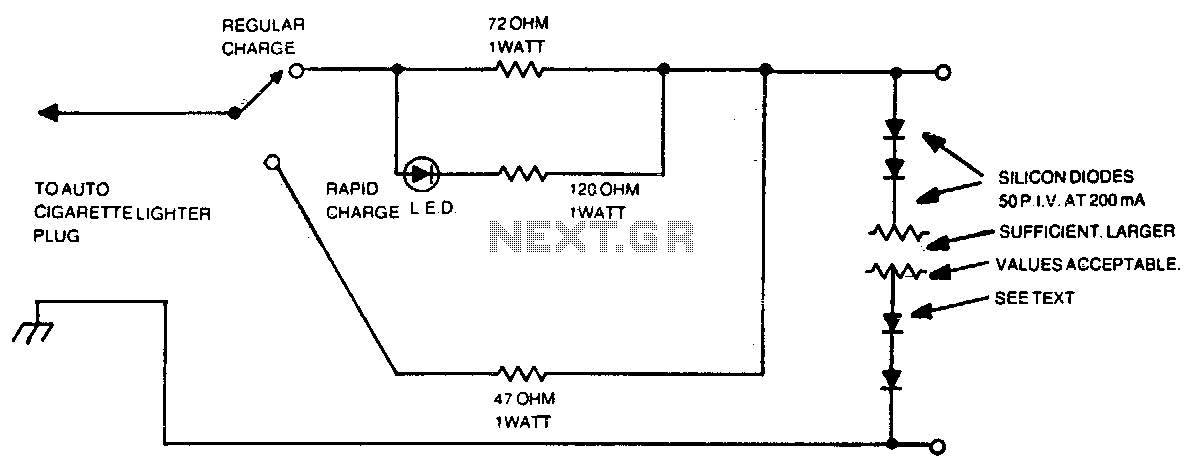
Automotive charger for ni-cad battery packs
The number of silicon diodes across the output is determined by the voltage of the battery pack. Each diode is considered at 0 volts. For example, a 10-volt pack would require 10/0 = 157, or 16 diodes.
In the context of...

Fluid level meter version 2
IC4 serves as a counter and oscillator combination, which is the pivotal component of the circuit. The oscillator generates an AC signal that is output on pin 7. This signal is routed through a voltage divider composed of resistors R3...

serendipity
The circuit is a fluid level meter that converts the fluid level in a container into a single-digit number displayed on a seven-segment display. In this scenario, 0 represents the lowest fluid level, while 9 indicates the highest level.
The fluid...

Field disturbance sensor-alarm
The change in ambient light triggers the alarm by changing the resistance of LDR1 and LDR2.
The circuit utilizes two light-dependent resistors (LDR1 and LDR2) to detect variations in ambient light levels. LDRs are passive components that exhibit a change in...

Sensor-Activated Relay Pulser Circuit
A sensor activates transistor Q1 to turn on the low-frequency 555 oscillator, which generates pulses to control LAMP II. The sensor may respond to variations in light or temperature. Either resistor RA or RB can function as the sensor, depending...