


XTR108 circuit diagram of a three-wire RTD connection
#XTR108
#RTD
#three-wire
#temperature sensor
#lead resistance
#circuit diagram
#measurement
#industrial
#precision
#error compensation
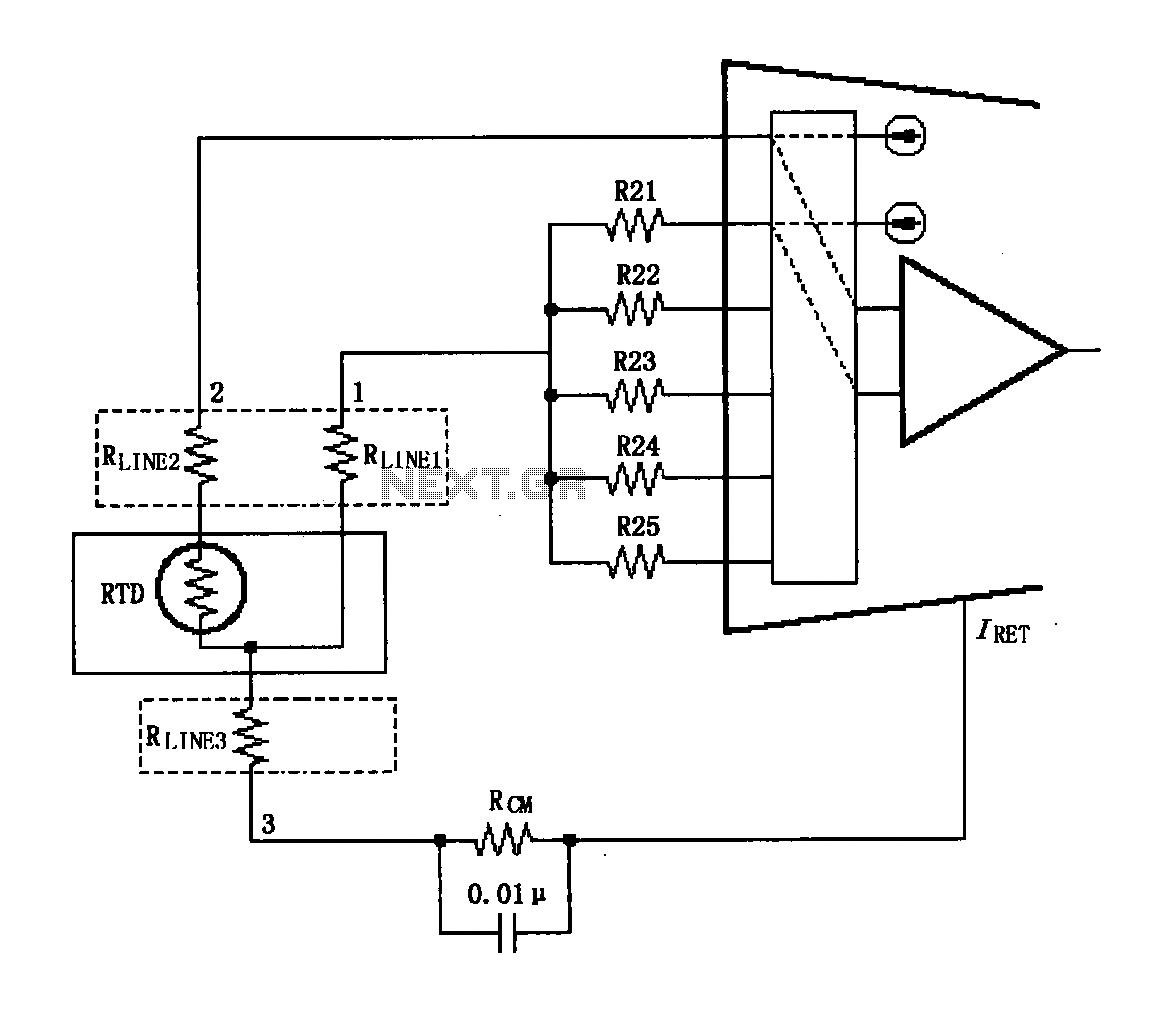
Description: The circuit diagram illustrates the three-wire RTD connection for the XTR108. It is important to note that the lead resistance of the RTD sensor can introduce measurement errors. In the provided figure, connections "1" and "2" represent the lead lengths, which can affect the magnitude and direction of any interference encountered. This interference is categorized as common mode voltage, which can be mitigated by the programmable gain amplifier (PGA) integrated within the XTR108. The circuit offers five selectable temperature ranges, achieved by selecting resistors R21 through R25, allowing for different minimum temperature characteristics.
The XTR108 is a precision current-output temperature sensor interface designed to work with three-wire RTD (Resistance Temperature Detector) configurations. The three-wire setup is advantageous as it helps to compensate for lead resistance, a common source of error in temperature measurements. The circuit ensures that the effects of lead resistance are minimized, thereby enhancing measurement accuracy.
In the schematic, the connections labeled "1" and "2" denote the RTD leads, which connect to the XTR108. The lead resistance can introduce a voltage drop that may skew the temperature readings. The XTR108’s PGA plays a critical role in addressing this common mode voltage, effectively filtering out unwanted interference and improving the integrity of the signal.
Additionally, the circuit's design includes the capability to select from five different temperature ranges. This is accomplished through the use of resistors R21 to R25, which adjust the gain settings of the PGA. By altering these resistors, the circuit can be tailored to optimize performance for various temperature measurement applications, thus providing flexibility and precision in temperature sensing.
Overall, the design of the XTR108 three-wire RTD connection circuit emphasizes accuracy, flexibility, and noise reduction, making it suitable for a wide range of temperature monitoring applications.Shown for the XTR108 three-wire RTD connection circuit. Sensor connection RTD lead resistance may introduce errors. Using the figure and 2 connection, if "1" and "2" to XTR108 lead length as the lead resistance, as the size and direction of the interference introduced too. This interference belong to the common mode voltage, common-mode voltage can be suppressed by XTR108 the PGA.
The circuit has five selectable temperature range, i.e., by selecting R21 ~ R25 to select five different minimum temperature characteristics.
The XTR108 is a precision current-output temperature sensor interface designed to work with three-wire RTD (Resistance Temperature Detector) configurations. The three-wire setup is advantageous as it helps to compensate for lead resistance, a common source of error in temperature measurements. The circuit ensures that the effects of lead resistance are minimized, thereby enhancing measurement accuracy.
In the schematic, the connections labeled "1" and "2" denote the RTD leads, which connect to the XTR108. The lead resistance can introduce a voltage drop that may skew the temperature readings. The XTR108’s PGA plays a critical role in addressing this common mode voltage, effectively filtering out unwanted interference and improving the integrity of the signal.
Additionally, the circuit's design includes the capability to select from five different temperature ranges. This is accomplished through the use of resistors R21 to R25, which adjust the gain settings of the PGA. By altering these resistors, the circuit can be tailored to optimize performance for various temperature measurement applications, thus providing flexibility and precision in temperature sensing.
Overall, the design of the XTR108 three-wire RTD connection circuit emphasizes accuracy, flexibility, and noise reduction, making it suitable for a wide range of temperature monitoring applications.Shown for the XTR108 three-wire RTD connection circuit. Sensor connection RTD lead resistance may introduce errors. Using the figure and 2 connection, if "1" and "2" to XTR108 lead length as the lead resistance, as the size and direction of the interference introduced too. This interference belong to the common mode voltage, common-mode voltage can be suppressed by XTR108 the PGA.
The circuit has five selectable temperature range, i.e., by selecting R21 ~ R25 to select five different minimum temperature characteristics.

Differential Temperature Sensor
A differential temperature sensor is employed to measure the temperature difference between two distinct areas. The schematic diagram of the circuit is provided for reference.
The differential temperature sensor circuit typically consists of two temperature sensing elements, such as thermocouples or...
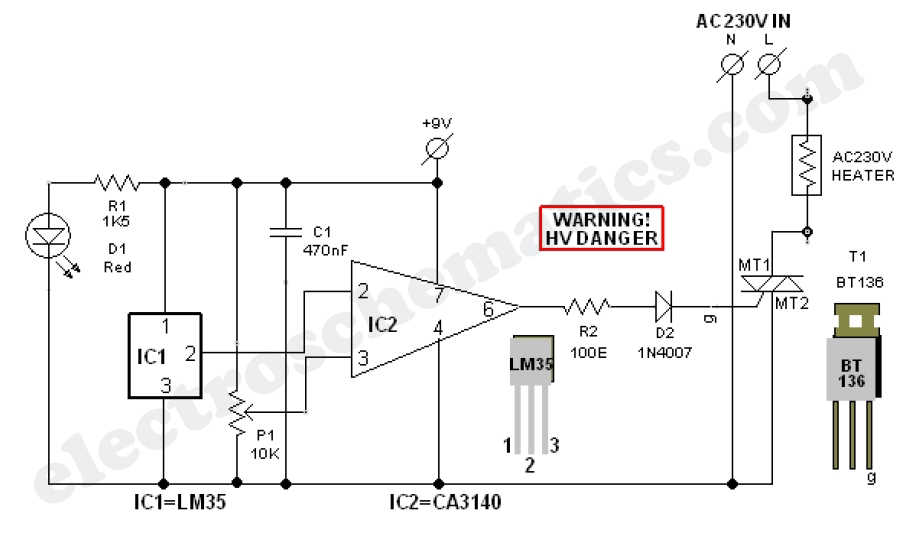
Electric AC Heater Controller Unit
The compact circuit of the electric AC heater controller is designed around the well-known 3-Pin Integrated Temperature Sensor LM35 (IC1) from National Semiconductor Corporation (NSC).
The circuit utilizes the LM35 temperature sensor, which provides an analog output voltage that is linearly...

Intelligent interface circuit and temperature sensor DS1620 SPI bus circuit
This circuit features a three-wire serial interface for smart temperature sensors, specifically the DS1620, along with an SPI bus interface circuit.
The DS1620 is a high-accuracy digital temperature sensor that communicates over a three-wire interface, which consists of a data line...
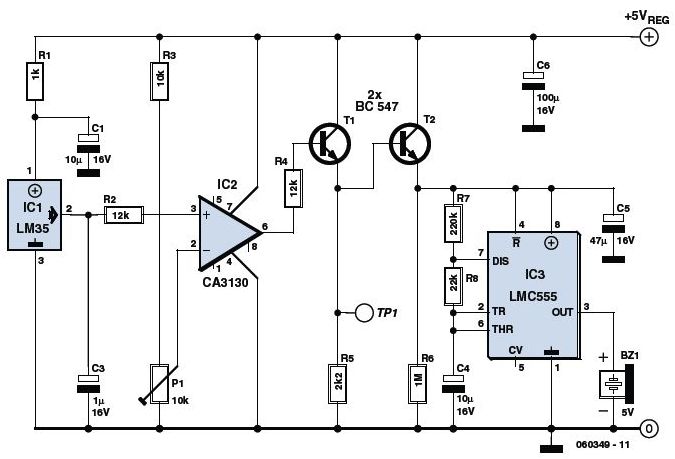
Detector circuit
This is an Overheat Detector Alarm Switch using the Temperature Sensor IC LM35. The core of this overheat detector (fire alarm) circuit is a precision integrated temperature sensor, the LM35 (IC1), which provides an accurately linear and directly proportional output...

Using a diode as a temperature sensor and 3 1 2 digits Thermometer
A diode temperature sensor is utilized in a 3-digit thermometer, featuring a 3-digit A/D converter and display driver IC L7106/7107. This configuration amplifies the signal, performs A/D conversion, and executes a series of decoding and display driver processes to present...

Overheat Detector Alarm/Switch
At the core of this circuit is a precision integrated temperature sensor, the LM35 (IC1), which provides a linear and directly proportional output related to temperature measurements.
The LM35 temperature sensor is a well-known device used for temperature sensing applications. It...

Precision RTD signal conditioner
The circuit provides complete, linearized signal conditioning for a platinum RTD. This LTC1043-based circuit is considerably simpler than instrumentation or multi-amplifier based designs and operates from a single 5 V supply. Amplifier A1 serves as a voltage-controlled, ground-referred current source...

RTD remote temperature sensing current voltage conversion circuit
When the RTD temperature sensor is positioned far from the amplifier, the resistance of the sensor leads and their susceptibility to interference and other issues cannot be overlooked. The circuit shown in the figure addresses this problem. It utilizes a...

Digital Miscellaneous Temperature Gauge
A diode (IN4148) is utilized as a temperature sensor. IC2 is an A/D converter with BCD output. A reference voltage set by R7 is applied to the positive input of IC2. As the temperature rises, the voltage across the temperature...