


Hexfet Switch Circuit

Description: The hexFET can switch DC power to relays, motors, lamps, and various other devices. This configuration can also be utilized to switch resistors in and out of a circuit. R1, R2, and R3 represent resistive loads that can be switched in and out of the circuit.
The hexFET (High Electron Mobility Field Effect Transistor) is a type of power transistor that is particularly effective for switching applications in DC circuits. Its ability to handle high voltages and currents makes it suitable for controlling a wide range of devices such as relays, motors, and lamps.
In the described circuit, the hexFET is employed to control the flow of DC power to multiple outputs. The configuration allows for the dynamic switching of resistive loads, represented by R1, R2, and R3, which can be incorporated into or excluded from the circuit as needed. This feature enhances the flexibility of the circuit design, enabling it to adapt to various operational requirements.
The switching action is typically controlled by a gate voltage applied to the hexFET, which allows for rapid transitions between the on and off states. When the gate voltage exceeds a certain threshold, the hexFET enters the conduction state, allowing current to flow through the load. Conversely, when the gate voltage is removed or reduced below the threshold, the hexFET turns off, interrupting the current flow.
This capability is particularly advantageous in applications where load management is crucial, such as in automated systems where different devices need to be activated or deactivated based on specific conditions. The use of resistive loads in the circuit allows for testing and calibration of the switching mechanism, ensuring reliable operation under varying conditions.
Overall, the integration of hexFETs in DC power switching circuits provides an efficient and reliable solution for controlling multiple devices, contributing to the overall performance and functionality of electronic systems. The hexFET can swatch dc power to relays (as shown in A), motors, lamps, and numerous other-devices. That arrangement can even be used to switch resistors in and out of a circuit, as shown in B. Rl, R2, and R3 represent resistive loads that can be switched in and out of the circuit.
The hexFET (High Electron Mobility Field Effect Transistor) is a type of power transistor that is particularly effective for switching applications in DC circuits. Its ability to handle high voltages and currents makes it suitable for controlling a wide range of devices such as relays, motors, and lamps.
In the described circuit, the hexFET is employed to control the flow of DC power to multiple outputs. The configuration allows for the dynamic switching of resistive loads, represented by R1, R2, and R3, which can be incorporated into or excluded from the circuit as needed. This feature enhances the flexibility of the circuit design, enabling it to adapt to various operational requirements.
The switching action is typically controlled by a gate voltage applied to the hexFET, which allows for rapid transitions between the on and off states. When the gate voltage exceeds a certain threshold, the hexFET enters the conduction state, allowing current to flow through the load. Conversely, when the gate voltage is removed or reduced below the threshold, the hexFET turns off, interrupting the current flow.
This capability is particularly advantageous in applications where load management is crucial, such as in automated systems where different devices need to be activated or deactivated based on specific conditions. The use of resistive loads in the circuit allows for testing and calibration of the switching mechanism, ensuring reliable operation under varying conditions.
Overall, the integration of hexFETs in DC power switching circuits provides an efficient and reliable solution for controlling multiple devices, contributing to the overall performance and functionality of electronic systems. The hexFET can swatch dc power to relays (as shown in A), motors, lamps, and numerous other-devices. That arrangement can even be used to switch resistors in and out of a circuit, as shown in B. Rl, R2, and R3 represent resistive loads that can be switched in and out of the circuit.

Eggs warming control circuit
The circuit is illustrated. It includes a DC power circuit with a power switch (S3) that converts 220V AC voltage through a buck converter (T), a rectifier (UR), and filter capacitors (C3 and C4) to generate a +9V output. This...

AMP Hexadecimal Rotary Switch
Pictures and a sample schematic (including pinouts) of an AMP hexadecimal (16-position) switch with a screw slot actuator.
The AMP hexadecimal switch is a 16-position rotary switch designed for applications requiring multiple selectable options. This switch features a screw slot actuator...

Intelligent trailing switch
This circuit is a straightforward yet effective design where devices connected to the trailing sockets will operate only when the device connected to the control socket is powered on. For instance, if a motor is connected to the control socket...

Power Supply/OPUS Kill Switch
After searching for a few days, a solution for this idea has not been found. A switch panel is being created in the dashboard containing four switches.
The switch panel design for the dashboard involves integrating four switches that can control...

Mini Tracker
A grasshopper is a switch that can activate at any moment. A plastic piece is positioned between two switch contacts to keep them apart, connected to a cotton thread fixed to the floor. When the object is moved, the cotton...
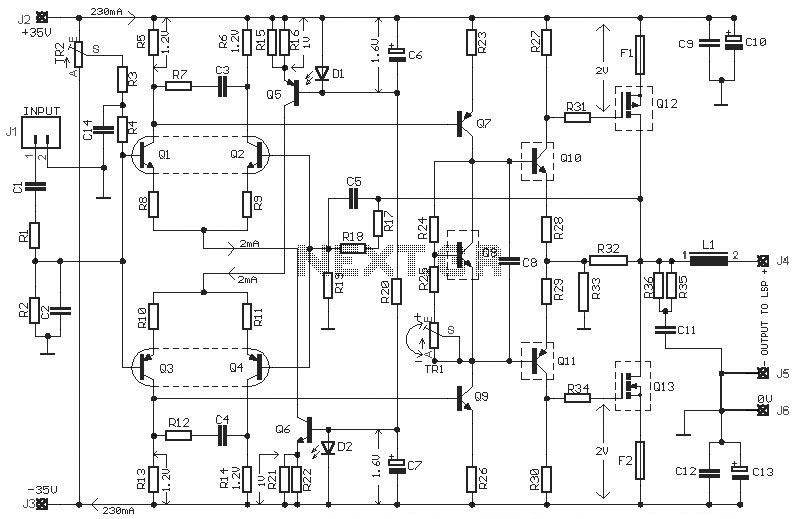
HEXFET Audio Amp 65 Watts Circuit
This HEXFET Audio Amplifier 65 Watts circuit diagram includes three circuit images. For a more comprehensive understanding, refer to the original post titled "HEXFET Audio Amp 65 Watts." The post not only provides circuit information but also includes a list...

Power-switching circuit
This circuit facilitates on/off switching, soft starting, current monitoring, current tripping, and overcurrent protection for a 30 Vdc power supply, accommodating normal load currents of up to 2 A. The switch is activated by an "on" command pulse and deactivated...

Normally-open-and-closed-relays
The phototransistor and photodarlington couplers function as direct current relays in saturated switching, handling currents up to 5 mA and 50 mA, respectively. For applications requiring higher currents or voltage capabilities, supplementary devices are necessary to buffer or amplify the...

8 input Relays circuit
It is the essential continuity of circuits Sel 8 Sources and Up/Down Sel 8 Sources, but can work and autonomously, collaborating with any suitable circuit of control. The Relay 1-8 can be 6-24v DC. For current of collector of transistors...