


Mcu Reset And Oscillator Circuits Applicationnote
#MICU2290
#step-up regulator
#switching regulator
#power switch
#Schottky diode
#48V applications
#avalanche photo diode
#APD
#voltage regulation
#integrated components

Description: Introduction The MIC2290 is an internally compensated standard step-up switching regulator that features an integrated power switch and Schottky diode. The inclusion of these components makes the MIC2290 an optimal solution for 48V Avalanche Photo Diode (APD) applications. In addition to these critical integrated components, the MIC2290 can be utilized with 0603 size chip inductors when configured for 48V APD applications. The small size of the inductor, combined with the capabilities of the MIC2290, results in a highly space-efficient design. Theory of Operation Understanding the operation of the MIC2290 in APD applications is comparable to that of a standard step-up switching regulator. The same analytical methods can be applied when modeling the behavior of the APD application circuit. The simplified MIC2290 APD application circuit is depicted in Figure 2. The MIC2290 APD circuit operates in two phases. In the first phase, known as Phase 1, energy is stored in the magnetic flux of the inductor (L1). This is achieved by the internal power switch (NPNx) turning on, allowing the inductor to experience a constant voltage from the input voltage (VIN) to ground. Phase 1 is illustrated in Figure 3. In the second phase, referred to as Phase 2, the energy stored in the inductor is released.
The MIC2290 is designed to efficiently convert a lower input voltage to a higher output voltage, making it suitable for applications requiring specific voltage levels, such as those involving 48V Avalanche Photo Diodes (APDs). The integrated power switch and Schottky diode minimize external component requirements, enhancing reliability and reducing board space.
The operation of the MIC2290 can be understood through its two-phase switching mechanism. During Phase 1, the internal NPN transistor acts as a switch, allowing current to flow into the inductor L1. This current generates a magnetic field, and energy is stored in the inductor as the voltage across it rises. The inductor is charged until the switch turns off, which is controlled by the feedback mechanism within the regulator to maintain the desired output voltage.
In Phase 2, the energy stored in the inductor is released to the output. When the switch turns off, the magnetic field collapses, inducing a voltage that adds to the input voltage, resulting in a higher output voltage. The Schottky diode provides a path for the current to flow to the output capacitor, ensuring that the output voltage remains stable and ripple-free.
The MIC2290's ability to work with compact 0603 inductors allows for a significant reduction in the overall size of the circuit, making it ideal for applications where space is at a premium. The design considerations for the MIC2290 include careful selection of inductor values and output capacitors to optimize performance and efficiency. The circuit's layout must also be considered to minimize inductive and capacitive parasitics, which can adversely affect the performance of the switching regulator.
Overall, the MIC2290 offers a robust solution for high-voltage applications, providing efficient power conversion and a compact design suitable for modern electronic devices.Introduction The MIC2290 is an internally compensated standard step- up Switching Regulator with an integrated power Switch and Schottky Diode The attribute of an internal power Switch and Schottky Diode makes the MIC2290 the most optimized solution for 48V Avalanche Photo Diode (APD) applications. In addition to the critical integrated components , the MIC2290 CAN be used with 0603 size chip inductors when configured for 48V APD applications. The physically small inductor size comprised with the MIC2290 capabilities produces a very space optimized design. Theory of Operation Understanding how the MIC2290 APD application circuit works is similar to how a standard Step-up switching Regulator works.
The same analytical methods CAN be employed when modeling the behavior of the APD application circuit. The simplified MIC2290 APD application circuit is in Figure 2. The MIC2290 APD circuit works in two phases. The first phase, or Phase 1, increases the energy stored in the magnetic flux of the inductor (L1). This is accomplished with the internal power Switch (NPNx) turning on and allowing the inductor to experience a constant voltage from the input voltage (VIN) to ground.
Phase 1 is illustrated in Figure 3. Upon the second phase, or Phase 2, the energy stored in the
The MIC2290 is designed to efficiently convert a lower input voltage to a higher output voltage, making it suitable for applications requiring specific voltage levels, such as those involving 48V Avalanche Photo Diodes (APDs). The integrated power switch and Schottky diode minimize external component requirements, enhancing reliability and reducing board space.
The operation of the MIC2290 can be understood through its two-phase switching mechanism. During Phase 1, the internal NPN transistor acts as a switch, allowing current to flow into the inductor L1. This current generates a magnetic field, and energy is stored in the inductor as the voltage across it rises. The inductor is charged until the switch turns off, which is controlled by the feedback mechanism within the regulator to maintain the desired output voltage.
In Phase 2, the energy stored in the inductor is released to the output. When the switch turns off, the magnetic field collapses, inducing a voltage that adds to the input voltage, resulting in a higher output voltage. The Schottky diode provides a path for the current to flow to the output capacitor, ensuring that the output voltage remains stable and ripple-free.
The MIC2290's ability to work with compact 0603 inductors allows for a significant reduction in the overall size of the circuit, making it ideal for applications where space is at a premium. The design considerations for the MIC2290 include careful selection of inductor values and output capacitors to optimize performance and efficiency. The circuit's layout must also be considered to minimize inductive and capacitive parasitics, which can adversely affect the performance of the switching regulator.
Overall, the MIC2290 offers a robust solution for high-voltage applications, providing efficient power conversion and a compact design suitable for modern electronic devices.Introduction The MIC2290 is an internally compensated standard step- up Switching Regulator with an integrated power Switch and Schottky Diode The attribute of an internal power Switch and Schottky Diode makes the MIC2290 the most optimized solution for 48V Avalanche Photo Diode (APD) applications. In addition to the critical integrated components , the MIC2290 CAN be used with 0603 size chip inductors when configured for 48V APD applications. The physically small inductor size comprised with the MIC2290 capabilities produces a very space optimized design. Theory of Operation Understanding how the MIC2290 APD application circuit works is similar to how a standard Step-up switching Regulator works.
The same analytical methods CAN be employed when modeling the behavior of the APD application circuit. The simplified MIC2290 APD application circuit is in Figure 2. The MIC2290 APD circuit works in two phases. The first phase, or Phase 1, increases the energy stored in the magnetic flux of the inductor (L1). This is accomplished with the internal power Switch (NPNx) turning on and allowing the inductor to experience a constant voltage from the input voltage (VIN) to ground.
Phase 1 is illustrated in Figure 3. Upon the second phase, or Phase 2, the energy stored in the

capacitor Explaining a car voltage regulator circuit
The circuit regulates approximately 12V from the car battery down to 5V for use by an Atmel AVR microcontroller. The presence of two capacitors on each side of the linear regulator LM7805 raises questions regarding their purpose. It is suggested...

Power Supply Design Made Easy
Utilizing Integrated Switching Regulators in Power Supply Design Engineers often find themselves pondering where to begin when designing power supplies. Key decisions must be made regarding...
Integrated switching regulators are critical components in modern power supply design, offering efficient voltage conversion...

How to implement a soft power switch controllable by microcontroller
A circuit that allows a microcontroller to toggle a GPIO pin for shutting down the entire system, including the microcontroller itself. The system is normally powered down. When a momentary button is pressed by the user, power is restored. The...

5V Switching Regulator Very Simple Circuit
Switching Regulator for High Power Efficiency. When it is necessary to convert a high voltage to a significantly lower voltage, a switching regulator is the optimal choice.
A switching regulator is an essential component in modern power management systems, particularly when...

Power Supply 0-30V / 0-2A
The basic requirements for a laboratory power supply are to provide the necessary voltages and currents with low output resistance, low noise, minimal ripple, and good stabilization. These requirements are addressed within the circuit design. Many power supplies incorporate electronic...
protected
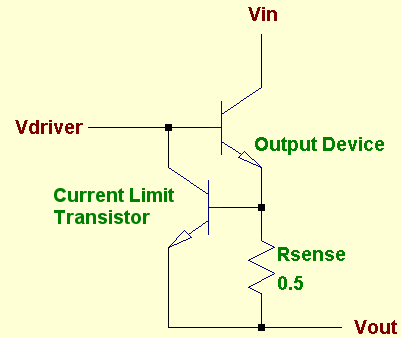
A voltage regulator is designed to provide a fixed voltage to any load. This inherently means it must supply the necessary current through that load to satisfy Ohm's Law, I = V/R. As the resistance (R) approaches zero, such as...

psu
The Chameleon II Power Supply Circuits convert the raw input supply into stable voltage outputs necessary for the Chameleon interfaces. The outputs provided are +5V, +12V, and -12V.
The Chameleon II Power Supply Circuits are designed to ensure reliable operation of...

Switching Regulator with L4972A
The LA9472A is a 2A monolithic step down switching regulator operating in continuous mode and realized in a new BCD technology allowing the integration of isolated, vertical DMOS power transistors with mixed CMOS/bipolar transistors. The device can deliver 2A at...
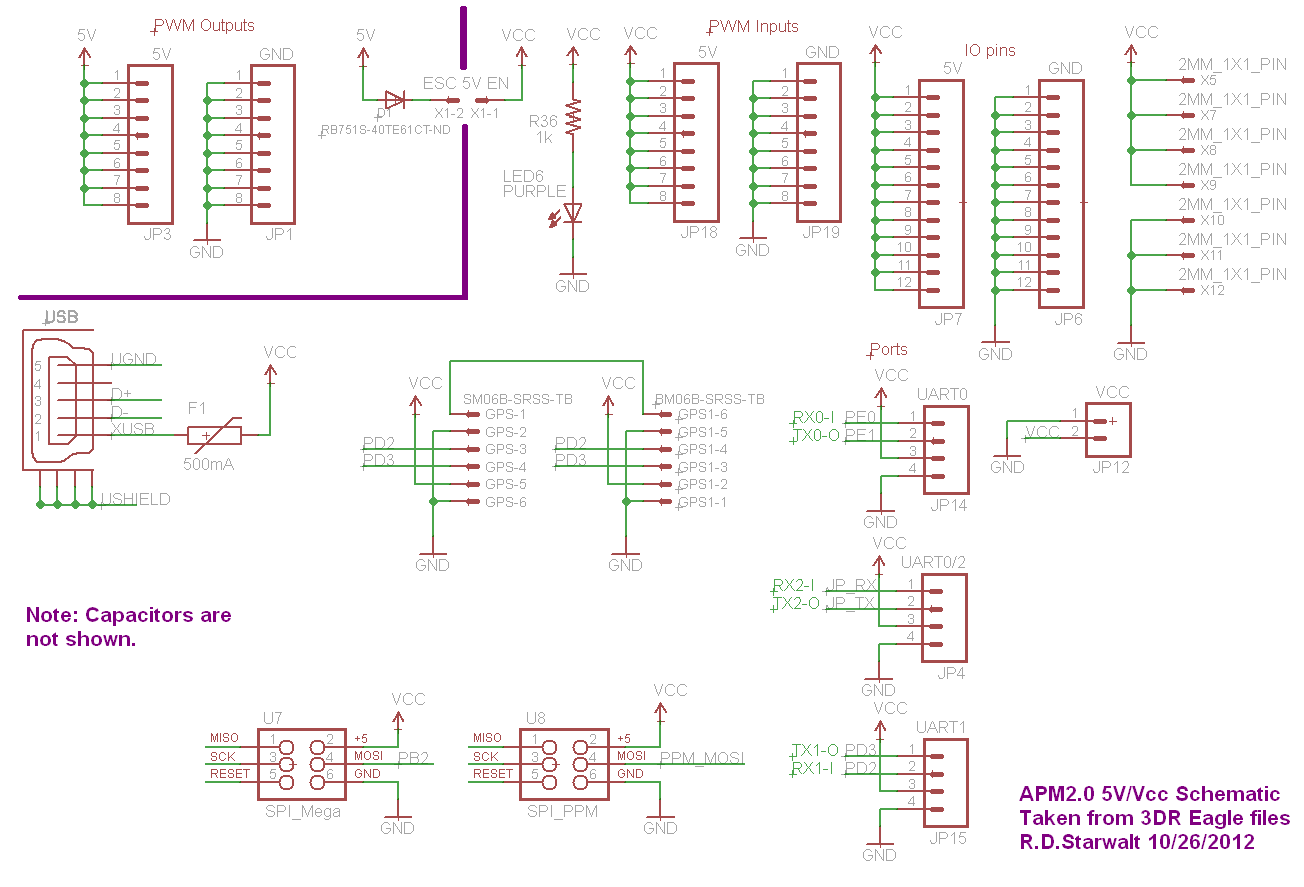
APM2.0 5V/Vcc Schematic
The PWM Output section has been separated into the upper left corner, delineated by a heavy purple line that is bridged by jumper JP1 on the APM2.0. This design choice highlights that diode D1 allows current to pass through JP1,...