


btr200
#wireless intercom
#Telex
#communication
#RF
#event production
#legacy equipment
#audio
#signal processing
#repair
#maintenance

Description: A friend and frequent collaborator in event production has been accumulating legacy Telex wireless intercom equipment from various sources. While the gear typically arrives in a nominally functional condition, it occasionally presents minor issues and exhibits wear and tear from use. Over time, a number of persistent problems have developed across his collection of equipment, prompting him to request assistance in diagnosing and repairing some of the units. Some issues are relatively minor, such as broken XLR connector latches, for which he has spare parts, and various loose components. A significant concern involves dirty or corroded battery-pack contacts, which are often the cause of flaky performance. The intercom connectivity can be easily misconfigured due to the incorrect setting of a nine-position DIP switch and a level selector that must be adjusted for compatibility with four common wired-side standards. More subtle issues include distorted audio and units that previously functioned together but have since failed, necessitating further investigation. A common oversight when setting up these systems is the distinction between dynamic and electret microphone elements in the headsets, which requires a corresponding slide switch in the beltpacks or base stations to be set correctly based on the type of microphone in use. The headsets do not provide any external indication of the microphone type installed. Mismatches typically result in very low transmitted audio. The operation manual for the Radiocom TR-200 belt-pack transceiver incorrectly states that all headsets used with this intercom are dynamic microphones, while the testing revealed a mix of both types. Fortunately, testing can be performed without powering up the equipment; connecting an ohmmeter between pins 1 and 2 on the 4-pin XLR headset plug can determine the microphone's DC resistance, with dynamic microphones measuring around 150 ohms and electret modules exceeding 600 ohms. It is also important to note that electret elements, when set correctly, are very sensitive, often requiring the microphone gain to be turned down significantly. The TR-200 wireless beltpack contains an analog system utilizing generic FM transmission across various VHF bands between approximately 190 MHz and 210 MHz, lacking any digital or spread-spectrum capabilities. Frequencies are crystal-controlled and fixed for each unit and base station, making any changes to configurations challenging. The system employs two flexible antenna wires with physical separation, avoiding the need for an internal duplexer. One issue encountered was that the "battery" LED on a pack did not illuminate during power-up or provide a low battery warning. This was traced to the panel LEDs having small brown connectors that were bent over for retention after being inserted. One of these bent leads was found to be too close to another component, creating a risk of shorting. The resolution involved unbending the LED lead and trimming it short, ensuring that the connectors remained secure once the unit was assembled. After addressing these straightforward issues, attention turned to a more complex challenge involving two identical base stations operating on the same frequency range, neither of which was receiving signals from a beltpack, despite one unit being marked as "used to work." Each base station is designed to support four beltpack units in full-duplex mode, allowing all users to communicate interactively. The base stations can also connect to a wired system, enabling communication among the entire production crew.
The Telex wireless intercom system consists of several key components, including beltpack transceivers, base stations, and headsets. The beltpack, such as the TR-200 model, features a compact design with controls for microphone selection and audio level adjustment. The system utilizes a nine-position DIP switch to configure intercom settings, allowing compatibility with different wired standards. Each beltpack is powered by rechargeable batteries, which must be regularly maintained to ensure optimal performance.
The base stations serve as the central hub for communication, receiving audio signals from the beltpacks and relaying them to other units or wired systems. Each base station can manage multiple beltpacks, facilitating seamless communication during events. The use of VHF frequencies allows for reliable transmission over considerable distances, although users must be aware of the fixed frequency limitations and potential interference from other devices operating in the same range.
Proper maintenance of the equipment is crucial for ensuring consistent performance. Regular cleaning of battery contacts, inspection of connectors, and testing of microphone elements can prevent many common issues. Additionally, users should familiarize themselves with the specifications and operational requirements of the system to avoid misconfigurations that could hinder performance. In summary, the Telex wireless intercom system is a versatile solution for event production, but it requires diligent upkeep and understanding to function effectively.A friend and frequent event-production collaborator has been accumulating legacy Telex wireless intercom gear from various sources, and while the equipment arrives in a nominally working state it sometimes has a few little problems and tends to take a certain amount of wear and tear on gigs anyway. With enough annoying problems having built up ove r time across his pile of gear, he asked me to take a look at a bunch of it to see what could be fixed/improved/whatever. Some of it was pretty minor - broken XLR connector latches but he had spare parts for that; miscellaneous loose stuff; and a lot of dirty/corroded battery-pack contacts which 90+% of the time are behind flakey performance.
[You`ll see my spraycan of de-ox-it in several of the pictures. ] The intercom-connectivity is easy to get wrong with mis-setting of a nine position DIP switch and a level selector, needed to adapt to any of *four* common wired-side standards. But some of the issues were more subtle, such as distorted audio or units that used to work together and since failed; these would require a little more investigation.
One easy thing to miss when systems are set up is the fact that there can be either dynamic or electret microphone elements in the headsets, and the little slide switch in beltpacks or base stations needs to be set to match which type is plugged in. The headsets show absolutely NO external indication as to which is installed. Mismatches generally result in very low transmitted audio. The operation manual for the Radiocom TR-200 belt-pack transceiver specifically states "all headsets used with this intercom are dynamic microphones", which is clearly wrong since the small collection provided to me for testing turned out to be a mix of both types.
Fortunately, it`s easy to test for without even having to power up any gear. An ohmmeter connected between pins 1 and 2 on the 4-pin XLR headset plug tests the microphone`s DC resistance; dynamics are about 150 ohms and electret modules weigh in somewhere over 600. And it should be noted that the electret elements with the proper setting are VERY hot; units using them probably need the mic gain turned almost all the way down.
Here`s what`s inside a TR-200 wireless beltpack - or about half of it, as the transmitter board is on the other side of this. It`s all analog, using generic FM transmission on various VHF bands between 190-ish and 210 MHz - nothing digital or spread-spectrum about it.
Frequencies are crystal-controlled and basically fixed for each unit and base station, there`s no agility for changing configurations and it seems like trying to put in different "rocks" would be a royal pain in the ass. Two flexible antenna wires with physical separation are used instead of having something like a duplexer inside.
One issue was that the "battery" LED on a pack didn`t flash on power-up or warn when the battery was getting low. Here`s why. The two panel LEDs have these little brown connectors run up onto the LED leads, which then got bent over for retention after they poke out the bottom.
I`ve circled where one of said bent leads wound up too close and sporadically touching another part. I suppose it was bloody lucky that didn`t short something out destructively. The fix was to unbend that bit of the LED lead and clip it short; these little connectors really aren`t going anywhere once the unit is assembled. After dealing with some of the low-hanging fruit it was time to move on to what seemed like a bigger challenge: two identical base stations on the same frequency range, neither of which would receive from a beltpack and one marked "used to work".
Well, that could be any sort of issue, couldn`t it. With these systems each base station can handle four beltpack units in a completely full-duplex fashion, so that all the users can talk interactively. The base can also connect to a wired system so that everyone on the production crew can cha
The Telex wireless intercom system consists of several key components, including beltpack transceivers, base stations, and headsets. The beltpack, such as the TR-200 model, features a compact design with controls for microphone selection and audio level adjustment. The system utilizes a nine-position DIP switch to configure intercom settings, allowing compatibility with different wired standards. Each beltpack is powered by rechargeable batteries, which must be regularly maintained to ensure optimal performance.
The base stations serve as the central hub for communication, receiving audio signals from the beltpacks and relaying them to other units or wired systems. Each base station can manage multiple beltpacks, facilitating seamless communication during events. The use of VHF frequencies allows for reliable transmission over considerable distances, although users must be aware of the fixed frequency limitations and potential interference from other devices operating in the same range.
Proper maintenance of the equipment is crucial for ensuring consistent performance. Regular cleaning of battery contacts, inspection of connectors, and testing of microphone elements can prevent many common issues. Additionally, users should familiarize themselves with the specifications and operational requirements of the system to avoid misconfigurations that could hinder performance. In summary, the Telex wireless intercom system is a versatile solution for event production, but it requires diligent upkeep and understanding to function effectively.A friend and frequent event-production collaborator has been accumulating legacy Telex wireless intercom gear from various sources, and while the equipment arrives in a nominally working state it sometimes has a few little problems and tends to take a certain amount of wear and tear on gigs anyway. With enough annoying problems having built up ove r time across his pile of gear, he asked me to take a look at a bunch of it to see what could be fixed/improved/whatever. Some of it was pretty minor - broken XLR connector latches but he had spare parts for that; miscellaneous loose stuff; and a lot of dirty/corroded battery-pack contacts which 90+% of the time are behind flakey performance.
[You`ll see my spraycan of de-ox-it in several of the pictures. ] The intercom-connectivity is easy to get wrong with mis-setting of a nine position DIP switch and a level selector, needed to adapt to any of *four* common wired-side standards. But some of the issues were more subtle, such as distorted audio or units that used to work together and since failed; these would require a little more investigation.
One easy thing to miss when systems are set up is the fact that there can be either dynamic or electret microphone elements in the headsets, and the little slide switch in beltpacks or base stations needs to be set to match which type is plugged in. The headsets show absolutely NO external indication as to which is installed. Mismatches generally result in very low transmitted audio. The operation manual for the Radiocom TR-200 belt-pack transceiver specifically states "all headsets used with this intercom are dynamic microphones", which is clearly wrong since the small collection provided to me for testing turned out to be a mix of both types.
Fortunately, it`s easy to test for without even having to power up any gear. An ohmmeter connected between pins 1 and 2 on the 4-pin XLR headset plug tests the microphone`s DC resistance; dynamics are about 150 ohms and electret modules weigh in somewhere over 600. And it should be noted that the electret elements with the proper setting are VERY hot; units using them probably need the mic gain turned almost all the way down.
Here`s what`s inside a TR-200 wireless beltpack - or about half of it, as the transmitter board is on the other side of this. It`s all analog, using generic FM transmission on various VHF bands between 190-ish and 210 MHz - nothing digital or spread-spectrum about it.
Frequencies are crystal-controlled and basically fixed for each unit and base station, there`s no agility for changing configurations and it seems like trying to put in different "rocks" would be a royal pain in the ass. Two flexible antenna wires with physical separation are used instead of having something like a duplexer inside.
One issue was that the "battery" LED on a pack didn`t flash on power-up or warn when the battery was getting low. Here`s why. The two panel LEDs have these little brown connectors run up onto the LED leads, which then got bent over for retention after they poke out the bottom.
I`ve circled where one of said bent leads wound up too close and sporadically touching another part. I suppose it was bloody lucky that didn`t short something out destructively. The fix was to unbend that bit of the LED lead and clip it short; these little connectors really aren`t going anywhere once the unit is assembled. After dealing with some of the low-hanging fruit it was time to move on to what seemed like a bigger challenge: two identical base stations on the same frequency range, neither of which would receive from a beltpack and one marked "used to work".
Well, that could be any sort of issue, couldn`t it. With these systems each base station can handle four beltpack units in a completely full-duplex fashion, so that all the users can talk interactively. The base can also connect to a wired system so that everyone on the production crew can cha

SENSITIVE RF VOLTMETER
This schematic illustrates a peak-reading diode voltmeter that is powered by two amplification stages. A 100 µF capacitor is utilized to create a substantial time constant, which ensures effective damping of the meter. The restricted differential output voltage, combined with...
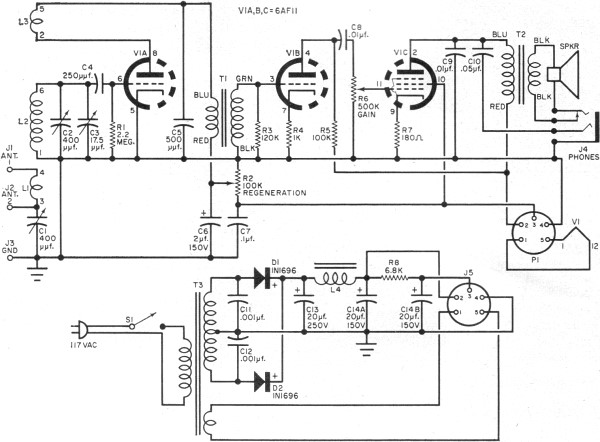
One Receiver
RF Cafe visitor David M. requested the scanning and posting of an article from the January 1963 edition of Popular Electronics, authored by Philip Hatfield from the Receiving Tube Department of General Electric. The article describes a straightforward design utilizing...
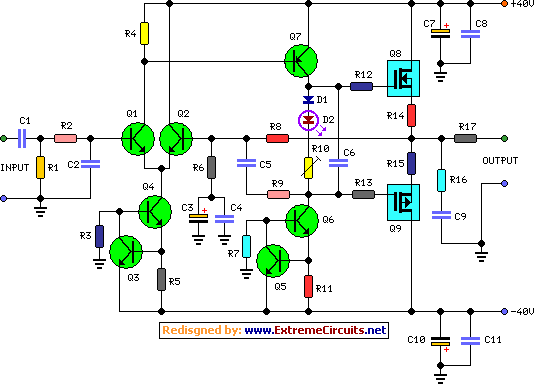
60 Watt Audio Power Amplifier
In the original circuit, a series of three diodes was connected to resistor R10. Two of these diodes have been replaced with a red LED to enhance quiescent current stability across a broader temperature range. This modification was suggested by...

GBPPR 1 GHz RF Spectrum Analyzer
An RF spectrum analyzer is an essential tool for experimenters. The spectrum analyzer project described here is an enhancement of the "Spectrum Analyzer for the Radio Amateur" (Part 2) project by Wes Hayward (W7ZOI) and Terry White (K7TAU), which appeared...
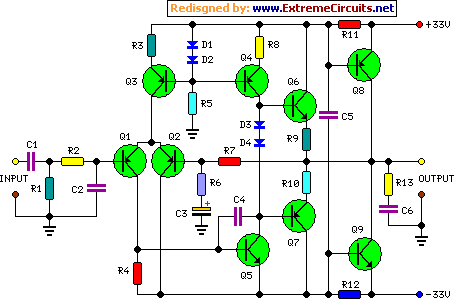
45 Watt Class-B Audio Power Amplifier
The goals were achieved by utilizing a discrete-component operational amplifier (op-amp) driving a bipolar junction transistor (BJT) complementary common-emitter output stage configured for Class B operation. In this configuration, the output transistors remain off for small output currents, allowing the...
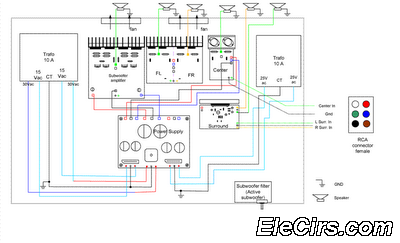
5.1 Surround Amplifier
The circuit for creating a 5.1 surround sound home theater amplifier consists of six individual amplifiers, with one dedicated mono channel. Each channel has specific specifications tailored to its function, contributing to the overall surround sound experience.
The 5.1 surround sound...

Variable_audio_oscillator_with_a_range_of_20_hertz_to_20_kilohertz
A variable audio oscillator operates within a frequency range of 20 hertz to 20 kilohertz. The circuit utilizes an Intersil 8038 waveform generator, which is designed in a 14-pin dual in-line package (DIP).
The variable audio oscillator circuit is designed to...

Closed-Loop Automatic Power Control for RF Applications
This is a circuit for Closed-Loop Automatic Power Control for RF Applications. The circuit utilizes a log detector (AD8318) and a variable gain amplifier (VGA) (ADL5330).
The Closed-Loop Automatic Power Control (APC) circuit is designed to maintain a consistent output power...
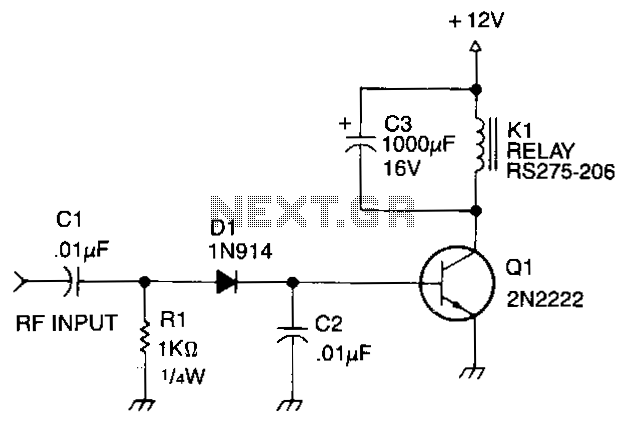
Rf-actuated-relay
Automatic antenna switching or RF power indication can be achieved with this circuit. Relay will key with less than 150 mW drive on 2 m.
The circuit designed for automatic antenna switching or RF power indication utilizes a relay that is...