


BU8732AKV Codec Ic For Digital Mobile Phone
#DTMF
#receiver IC
#telephone
#binary serial data
#dynamic range
#digital mobile phone
#codec
#SSOP
#DIP
#signal conversion

Description: The BU8872 and BU8872FS are DTMF receiver integrated circuits designed for application in telephone answering machines, converting 16 distinct types of DTMF signals into 4-bit binary serial data. These receivers are available in a compact 8-pin DIP package (BU8872) or a 16-pin SSOP package (BU8872FS) and feature a wide dynamic range, which eliminates the necessity for an external input amplifier. Additionally, expertise from multiple companies has been integrated into these products to facilitate guard time control via a host microcomputer. Developed by ROHM Co. Ltd.
The BU8872 and BU8872FS integrated circuits serve as efficient solutions for decoding Dual-Tone Multi-Frequency (DTMF) signals, which are commonly used in telephone systems for signaling. The ability to convert 16 different DTMF signals into a 4-bit binary format allows for straightforward interfacing with microcontrollers and digital systems, enabling seamless integration into various applications, particularly in telecommunications.
The wide dynamic range of these ICs is a significant feature that enhances their performance by allowing them to operate effectively across a variety of signal levels without the need for additional amplification. This not only simplifies the circuit design but also reduces the overall component count and potential points of failure in the system.
The packaging options of the BU8872 (8-pin DIP) and BU8872FS (16-pin SSOP) provide flexibility for designers, allowing for easy incorporation into both space-constrained designs and standard PCB layouts. The DIP format is well-suited for prototyping and applications where space is less of a concern, while the SSOP format is ideal for compact designs requiring a smaller footprint.
Furthermore, the capability for guard time control through a host microcomputer is an advanced feature that enhances the reliability of DTMF signal detection. This allows for better handling of signal variations and timing issues that may arise in real-world applications, ensuring accurate decoding of DTMF signals even in less-than-ideal conditions.
Overall, the BU8872 and BU8872FS are robust and versatile components for any system requiring reliable DTMF signal processing, making them valuable assets in the design of modern telecommunications equipment.The BU8872 and BU8872FS are DTMF receiver ICs developed for use in telephone answering machines, and convert 16 different types of DTMF signals into 4-bit binary serial data. In addition to a compact 8-pin DIP BU8872 or 16-pin SSOP BU8872FS package, these receivers feature a wide dynamic range, eliminating the need for an external input Amplifier
Expertise from a number of companies has been incorporated into these products to enable guard time control through a host microcomputer. By ROHM Co. Ltd.
The BU8872 and BU8872FS integrated circuits serve as efficient solutions for decoding Dual-Tone Multi-Frequency (DTMF) signals, which are commonly used in telephone systems for signaling. The ability to convert 16 different DTMF signals into a 4-bit binary format allows for straightforward interfacing with microcontrollers and digital systems, enabling seamless integration into various applications, particularly in telecommunications.
The wide dynamic range of these ICs is a significant feature that enhances their performance by allowing them to operate effectively across a variety of signal levels without the need for additional amplification. This not only simplifies the circuit design but also reduces the overall component count and potential points of failure in the system.
The packaging options of the BU8872 (8-pin DIP) and BU8872FS (16-pin SSOP) provide flexibility for designers, allowing for easy incorporation into both space-constrained designs and standard PCB layouts. The DIP format is well-suited for prototyping and applications where space is less of a concern, while the SSOP format is ideal for compact designs requiring a smaller footprint.
Furthermore, the capability for guard time control through a host microcomputer is an advanced feature that enhances the reliability of DTMF signal detection. This allows for better handling of signal variations and timing issues that may arise in real-world applications, ensuring accurate decoding of DTMF signals even in less-than-ideal conditions.
Overall, the BU8872 and BU8872FS are robust and versatile components for any system requiring reliable DTMF signal processing, making them valuable assets in the design of modern telecommunications equipment.The BU8872 and BU8872FS are DTMF receiver ICs developed for use in telephone answering machines, and convert 16 different types of DTMF signals into 4-bit binary serial data. In addition to a compact 8-pin DIP BU8872 or 16-pin SSOP BU8872FS package, these receivers feature a wide dynamic range, eliminating the need for an external input Amplifier
Expertise from a number of companies has been incorporated into these products to enable guard time control through a host microcomputer. By ROHM Co. Ltd.
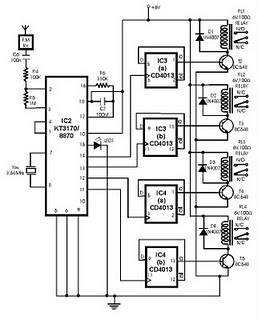
radio remote control using dtmf circuit
This project utilizes DTMF (dual-tone multi-frequency) signals, commonly used in telephones for dialing digits, as control codes. The DTMF tones are employed for frequency modulation of the carrier signal. At the receiver unit, these frequency-modulated signals are intercepted to extract...

DTMF Decoder 2
This device and all information contained on this website is for educational purposes only. This device must be used in conjunction with any and all local, provincial, and federal laws. It is the responsibility of the end user to comply...

Telephone-line powered repertory dialer
A repertory dialer phone contains a library of phone numbers that can be entered and dialed, allowing access to up to fifteen frequently used numbers. It also includes the capability to store the last dialed number or an additional telephone...

Dtmf detection in GSM modem
A project is being developed involving GSM technology, with the objective of detecting key presses on the remote side during an active call. An attempt is being made to utilize a DTMF decoder circuit connected to the speaker output; however,...

MC34017A Telephone Tone Ringer Bipolar Linear/I2L
It is widely recognized that power-saving regulations necessitate very low power consumption during standby conditions for all equipment continuously connected to mains power. In the standard version of the power supply, standby power consumption is approximately 9.0 W for a...

Tone-dialing-telephone
This circuit illustrates the TP5700 interfacing directly with a low-voltage DTMF generator. VREGt provides the required minimum bias of 2 V to enable the TP5380 to detect key closures and pull its mute output high. Subsequently, VREGt switches to a...
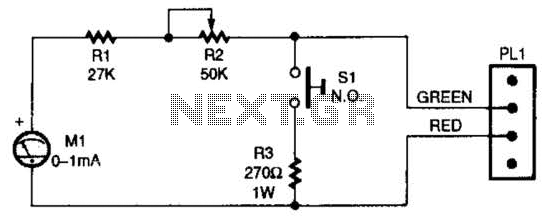
Telephone Hold Circuit Circuit
When the switch SI is pressed, the silicon-controlled rectifier (SCR) is activated, connecting LED1 and resistor R1 across the telephone line. This action causes the line voltage to drop to approximately 20 volts, which maintains the connection to the central...

MT8885 Integrated DTMF Transceiver With Power-Down And Adaptive Micro Interface
This design note presents a simple yet feature-rich 16-watt output, universal AC input adapter power supply for modems, hubs, or similar applications. The circuit utilizes a discontinuous mode (DCM) flyback converter topology designed around ON Semiconductor's NCP1027 monolithic current mode...

Telephone electronic ringer circuit
The telephone electronic ringer circuit is illustrated in the provided figure. It features an NPN transistor (either 9014 or 3DG12) as the primary component. The sound device, referred to as YD, functions as both a feedback device and is composed...