


Cheapskates Headset Adapter
#headset
#adapter
#DPDT switch
#telephone
#audio
#communication
#DIY
#electronics
#cheap
#Harvey Norman

Description: Here is a more affordable and simpler method to create a telephone headset adapter. The only components needed are an inexpensive headset (available for $5 at Harvey Norman), a DPDT switch, and...
To construct a telephone headset adapter using the specified components, the process begins with selecting a suitable inexpensive headset that includes both a microphone and earpiece. The DPDT (Double Pole Double Throw) switch is a critical component in this setup, as it allows for the switching of audio signals between the headset and the telephone system.
The first step involves disassembling the headset to access its internal wiring. Identify the connections for the microphone and the earpiece. Typically, the headset will have two wires for the earpiece (left and right channels) and one wire for the microphone. These wires must be carefully soldered to the appropriate terminals on the DPDT switch.
The DPDT switch has six terminals, which can be utilized to route the audio signals. The first two terminals will connect to the microphone input of the telephone, while the next two will connect to the earpiece. The remaining terminals will serve as the output connections from the telephone to the headset. By toggling the switch, the user can alternate between using the telephone's built-in audio and the headset audio.
Once all connections are made, it is essential to ensure that the switch is mounted securely and that the wiring is insulated to prevent any short circuits. A small enclosure can be used to house the switch and wiring, providing protection and a professional appearance.
Testing the completed adapter involves plugging it into a telephone and ensuring that both the microphone and earpiece function correctly. Adjustments may be needed if there are issues with audio quality or connectivity.
This method offers a cost-effective solution for individuals seeking to utilize a headset with a telephone, making it accessible for a variety of applications, including teleconferencing and personal use.Here s a cheaper and easier method of making a telephone headset adapter. All that s required is a cheap headset ($5 at Harvey Norman), a DPDT switch and..
To construct a telephone headset adapter using the specified components, the process begins with selecting a suitable inexpensive headset that includes both a microphone and earpiece. The DPDT (Double Pole Double Throw) switch is a critical component in this setup, as it allows for the switching of audio signals between the headset and the telephone system.
The first step involves disassembling the headset to access its internal wiring. Identify the connections for the microphone and the earpiece. Typically, the headset will have two wires for the earpiece (left and right channels) and one wire for the microphone. These wires must be carefully soldered to the appropriate terminals on the DPDT switch.
The DPDT switch has six terminals, which can be utilized to route the audio signals. The first two terminals will connect to the microphone input of the telephone, while the next two will connect to the earpiece. The remaining terminals will serve as the output connections from the telephone to the headset. By toggling the switch, the user can alternate between using the telephone's built-in audio and the headset audio.
Once all connections are made, it is essential to ensure that the switch is mounted securely and that the wiring is insulated to prevent any short circuits. A small enclosure can be used to house the switch and wiring, providing protection and a professional appearance.
Testing the completed adapter involves plugging it into a telephone and ensuring that both the microphone and earpiece function correctly. Adjustments may be needed if there are issues with audio quality or connectivity.
This method offers a cost-effective solution for individuals seeking to utilize a headset with a telephone, making it accessible for a variety of applications, including teleconferencing and personal use.Here s a cheaper and easier method of making a telephone headset adapter. All that s required is a cheap headset ($5 at Harvey Norman), a DPDT switch and..

Automatic telephone call recording circuit
The DC voltage present on the telephone line typically ranges from 45 to 50V when on-hook and drops to approximately 6V when off-hook. This condition activates a step-down circuit relay, which in turn controls a tape recorder. Audio input is...

Audio Mixer with one transistor
This single transistor audio mixer is utilized in an amplifier circuit design featuring a base-driven transistor, where the emitter is current-controlled. The majority of the driving current flows through the collector.
This audio mixer circuit employs a single transistor to mix...

Fast Audio Peak Limiter
The circuit devised by Phil Allison still has some input voltage limitations, since it is based on a FET. Junction FET VCAs also create considerable distortion, with the worst of it appearing when the signal is attenuated by 6dB. The...

Audio Booster circuit
The amplifier's gain is nominally 20 dB. Its frequency response is primarily influenced by the values of a few components, mainly C1 and R1. The schematic diagram's component values yield a frequency response of ±3.0 dB from approximately 120 Hz...

Audio Oscillators
A phase-shift audio oscillator exhibits excellent distortion characteristics due to "softened" diode limiting provided by the 1N914 diode and a resistor divider, along with degenerated gain facilitated by a 68-ohm emitter resistor. To minimize distortion, it is recommended to increase...

Audio-To-Adc Interface Circuit
This simple general-purpose driver for an analog/digital converter uses two 741 IC devices with adjustable gain and offset. Other op-amps might be substituted, but some circuit adjustments might be needed.
The circuit consists of two operational amplifiers (op-amps) from the 741...

Telephone hold button
The on-hook (no load) voltage across the red-green wires will be 48 V or slightly less when all telephones are on-hook (disconnected). When any telephone goes off-hook, the load current flowing in the telephone causes the voltage to fall below...
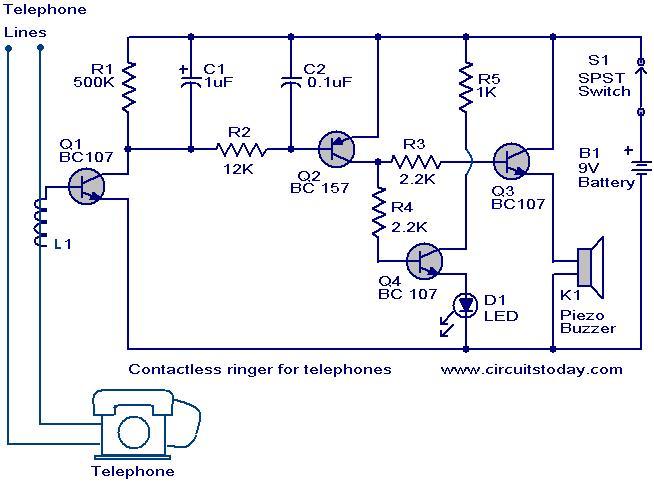
Contactless telephone ringer circuit
The contactless telephone ringer circuit is designed to produce an audible ring and a visual indication when a call is received. Its primary advantage lies in the absence of direct contact between the telephone line and the circuit, which eliminates...

Audio-millivoltmeter
This circuit exhibits a flat frequency response from 8 Hz to 50 kHz, maintaining a -3 dB level at the 10 mV range. Furthermore, while the upper frequency limit remains consistent across less sensitive ranges, the lower frequency limit extends...