


Cordless telephone voice processing circuit diagram
#cordless telephone
#voice processing
#CX9800
#microphone
#signal compression
#bandwidth
#desktop PC
#mobile phones

Description: The CX9800 models of mobile phones and desktop PCs feature a high-performance voice processing circuit that compresses the amplitude and bandwidth of the microphone signal. This design enhances the sensitivity of the microphone and its adaptability to varying distances. It includes a first-level limiting amplifier followed by a second-stage active filter. A high-pass RC filter is inserted between the microphone and the amplifier, which pre-emphasizes the input signal. The receiving de-emphasis circuit at the output of the frequency discriminator improves the signal-to-noise ratio of the voice signal. The phone amplifier uses the 4558 model, while the Taiwan version employs two single op-amp circuits, model 741.
The CX9800 series integrates advanced voice processing capabilities that are essential for optimizing audio performance in mobile and desktop applications. The circuit's design begins with the microphone, where the initial signal is captured. The amplitude and bandwidth compression is crucial for enhancing the microphone's sensitivity, allowing it to perform effectively over various distances.
The first-level limiting amplifier plays a vital role in controlling the dynamic range of the audio signal, ensuring that it remains within a manageable level to prevent distortion. Following this, the second-stage active filter refines the signal further, eliminating unwanted frequencies and enhancing the clarity of the audio output.
Incorporating a high-pass RC filter between the microphone and the amplifier is a strategic choice. This filter effectively removes low-frequency noise, which is particularly beneficial in environments where background sounds could interfere with voice clarity. The pre-emphasis applied at the amplifier input boosts certain frequency components of the signal, preparing it for optimal processing.
The de-emphasis circuit at the output of the frequency discriminator is designed to counteract the effects of the pre-emphasis, ensuring that the final output maintains a balanced frequency response. This circuit is critical for improving the signal-to-noise ratio, which directly influences the intelligibility and quality of voice communications.
The choice of the 4558 op-amp for the phone amplifier highlights the design's focus on reliability and performance. This dual op-amp configuration allows for efficient signal processing, while the use of the 741 single op-amps in the Taiwan variant provides flexibility in circuit design and implementation.
Overall, the CX9800 voice processing circuit exemplifies a well-engineered approach to audio signal management, utilizing various filtering and amplification techniques to deliver high-quality voice performance in mobile and desktop environments. CX9800 models of mobile phones and desktop PC have chosen excellent performance voice processing circuit, the amplitude and bandwidth of the microphone signal is compressed to improve the sensitivity of the microphone and microphone distance adaptability. The first level limiting amplifier, the second stage of active filter. Inserted between the microphone and the amplifier a high-pass RC filter, the amplifier input signal pre-emphasis; receiving de-emphasis circuit in the frequency discriminator output circuit can be improved signal to noise ratio of the voice signal. Phone amplifier selection 4558, Taiwan machine selects two single op-amp circuit, model 741.
The CX9800 series integrates advanced voice processing capabilities that are essential for optimizing audio performance in mobile and desktop applications. The circuit's design begins with the microphone, where the initial signal is captured. The amplitude and bandwidth compression is crucial for enhancing the microphone's sensitivity, allowing it to perform effectively over various distances.
The first-level limiting amplifier plays a vital role in controlling the dynamic range of the audio signal, ensuring that it remains within a manageable level to prevent distortion. Following this, the second-stage active filter refines the signal further, eliminating unwanted frequencies and enhancing the clarity of the audio output.
Incorporating a high-pass RC filter between the microphone and the amplifier is a strategic choice. This filter effectively removes low-frequency noise, which is particularly beneficial in environments where background sounds could interfere with voice clarity. The pre-emphasis applied at the amplifier input boosts certain frequency components of the signal, preparing it for optimal processing.
The de-emphasis circuit at the output of the frequency discriminator is designed to counteract the effects of the pre-emphasis, ensuring that the final output maintains a balanced frequency response. This circuit is critical for improving the signal-to-noise ratio, which directly influences the intelligibility and quality of voice communications.
The choice of the 4558 op-amp for the phone amplifier highlights the design's focus on reliability and performance. This dual op-amp configuration allows for efficient signal processing, while the use of the 741 single op-amps in the Taiwan variant provides flexibility in circuit design and implementation.
Overall, the CX9800 voice processing circuit exemplifies a well-engineered approach to audio signal management, utilizing various filtering and amplification techniques to deliver high-quality voice performance in mobile and desktop environments. CX9800 models of mobile phones and desktop PC have chosen excellent performance voice processing circuit, the amplitude and bandwidth of the microphone signal is compressed to improve the sensitivity of the microphone and microphone distance adaptability. The first level limiting amplifier, the second stage of active filter. Inserted between the microphone and the amplifier a high-pass RC filter, the amplifier input signal pre-emphasis; receiving de-emphasis circuit in the frequency discriminator output circuit can be improved signal to noise ratio of the voice signal. Phone amplifier selection 4558, Taiwan machine selects two single op-amp circuit, model 741.

LMV1090 Dual Input Far Field Noise Suppression Microphone Amplifier
Figure 1 illustrates the schematic for a universal input, 7.6 V, 700 mA constant voltage/constant current (CV/CC) power supply designed for LED driver applications. This design employs the LinkSwitch-II product LNK606PG in a flyback configuration. The LNK606PG (U1) integrates a...

Microphone Preamplifier with SSM 2015 P
An ultra low noise audio preamplifier particularly suited to microphone preamplification including balanced microphones. The IC features wide bandwidth, low distortion only 0.007% at a gain of 100, and very low noise only 1.3nV/Hz for source impedance up to 4k...

microphone Sennheiser MKH 415 T
The Sennheiser MKH 415 T is a medium shotgun microphone powered by the 12VDC A-B standard (also known as DIN 45 595 or T-power). It served as the predecessor to the widely recognized MKH 416, which continues to be produced....
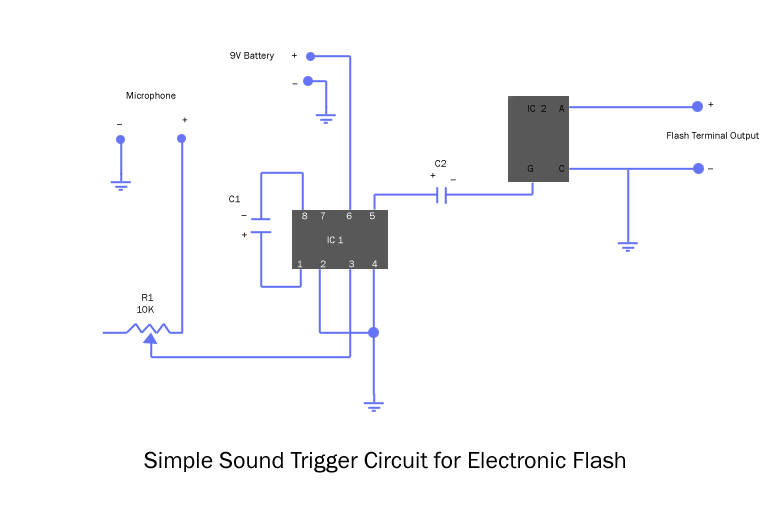
simple Sound Trigger
The microphone inputs connect to ground (-) and to the middle terminal of a 10K variable resistor (potentiometer), which serves as the sensitivity control. The output from the potentiometer is routed to pin 3 of the amplifier integrated circuit (IC),...

Microphone Preamplifier BC547B
This is a simple microphone preamplifier circuit which you can use between your microphone and stereo amplifier. This circuit amplifier microphone suitable for use with normal home stereo amplifier line/CD/aux/tape inputs. This microphone preamplifier can take both dynamic and electret...

Automatic Gain Control Microphone PreAmp
This microphone preamplifier incorporates automatic gain control, which keeps the output level fairly constant over a wide range of input.
The microphone preamplifier is designed to enhance the audio signal from a microphone while maintaining a consistent output level. The inclusion...

Microphone Preamp
This circuit is designed to interface a high-impedance microphone with a radio transceiver that requires a low-impedance microphone. The power supply can be provided either by a battery or sourced from the transceiver itself.
This circuit typically employs a preamplifier configuration...

sound capture
After conducting new experiments on sound analysis, a different design for the microphone amplifying section has been developed. The entire circuit is powered by a clean voltage supply ranging from +5V to +12V, which is filtered by capacitor C5. The...

Conference MIC
If the audio output is connected to equipment with a balanced input circuit that has a separate ground connection, the ground connects to OUTPUT terminal #1. The PZ-2LA can be powered by an external AC or DC source ranging from...