


Electronic phone bell
#phone bell
#warble tone
#ring pulses
#transistor
#NPN
#speaker
#tone control
#remote bell
#telecommunication

Description: The speaker produces a unique warble tone when ring pulses are applied to the phone line. This circuit can be utilized as a remote bell or by disconnecting the phone's ringer for direct operation. Resistor R1 adjusts the output duration, while resistors R2 and R3 regulate the tone's duty cycle and frequency. The transistor used is a general-purpose NPN photodevice. Additionally, the neon bulb and transistor are enclosed with heat-shrink tubing to create an optoisolator.
The circuit functions primarily by detecting the ringing signal from the phone line, which typically consists of alternating current (AC) pulses. When these ring pulses are received, the circuit activates the speaker, producing a warble tone that serves as an auditory alert. The design allows for flexibility in application, either as a standalone remote bell or integrated into a system where the phone's ringer is disabled.
The output duration can be fine-tuned through resistor R1, allowing the user to set how long the tone is emitted after the ring pulse is detected. This feature is particularly useful in environments where different notification lengths are required. The tone's frequency and duty cycle, controlled by resistors R2 and R3, can be adjusted to create various sound characteristics, enhancing the circuit's versatility in different settings.
The inclusion of a general-purpose NPN transistor serves as a switching device, amplifying the signal received from the phone line to drive the speaker effectively. The optoisolator configuration, formed by coupling the neon bulb and transistor within heat-shrink tubing, provides electrical isolation between the phone line and the speaker circuit. This isolation is crucial for protecting sensitive components from voltage spikes and ensuring safe operation.
Overall, this circuit design exemplifies a practical application of basic electronic components to create an effective notification system, with adjustable parameters that cater to specific user needs.The speaker emits a distinctive warble tone when ring pulses are applied to the phone line. Use this circuit as a remote bell or disconnect the phone"s ringer for direct use. Rl adjusts the duration of the output; R2 and R3 control the tone"s duty cycle and frequency. The transistor is a general-purpose NPN photodevice The neon bulb and transistor are coupled with the heat-shrink tubing to form an optoisolator.
The circuit functions primarily by detecting the ringing signal from the phone line, which typically consists of alternating current (AC) pulses. When these ring pulses are received, the circuit activates the speaker, producing a warble tone that serves as an auditory alert. The design allows for flexibility in application, either as a standalone remote bell or integrated into a system where the phone's ringer is disabled.
The output duration can be fine-tuned through resistor R1, allowing the user to set how long the tone is emitted after the ring pulse is detected. This feature is particularly useful in environments where different notification lengths are required. The tone's frequency and duty cycle, controlled by resistors R2 and R3, can be adjusted to create various sound characteristics, enhancing the circuit's versatility in different settings.
The inclusion of a general-purpose NPN transistor serves as a switching device, amplifying the signal received from the phone line to drive the speaker effectively. The optoisolator configuration, formed by coupling the neon bulb and transistor within heat-shrink tubing, provides electrical isolation between the phone line and the speaker circuit. This isolation is crucial for protecting sensitive components from voltage spikes and ensuring safe operation.
Overall, this circuit design exemplifies a practical application of basic electronic components to create an effective notification system, with adjustable parameters that cater to specific user needs.The speaker emits a distinctive warble tone when ring pulses are applied to the phone line. Use this circuit as a remote bell or disconnect the phone"s ringer for direct use. Rl adjusts the duration of the output; R2 and R3 control the tone"s duty cycle and frequency. The transistor is a general-purpose NPN photodevice The neon bulb and transistor are coupled with the heat-shrink tubing to form an optoisolator.

metal detector circuit
This project involves a simple metal detector circuit that is easy to construct using a single transistor and a few additional components. The circuit operates as a Colpitts oscillator, broadcasting on the AM band. To use it, place a quality...

transistor based single zone alarm
The circuit incorporates automatic exit and entry delays, a timed bell cut-off, and a system reset feature. It accommodates both normally-open and normally-closed switches and is compatible with standard input devices such as pressure mats, magnetic reed contacts, foil tape,...
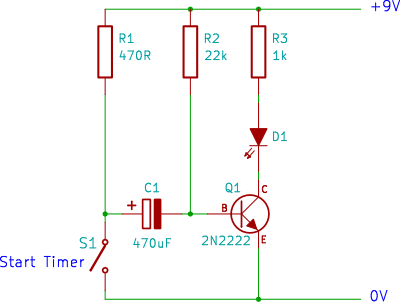
transistor timer
A single transistor timer circuit tutorial designed for beginners in electronics. This is an easy electronic circuit that can be constructed on a breadboard.
The single transistor timer circuit utilizes a transistor as the primary switching element to create a delay...

DC Coupled Transistor Amplifier
This is a directly coupled (DC) amplifier circuit. It is constructed using NPN and PNP transistors and is designed to amplify direct current (DC) signals.
The directly coupled amplifier circuit utilizes both NPN and PNP transistors to achieve its amplification. In...

My genelec 1031A pops when I turn it on ?
All of the above would be internal hardware issues. Still, there is a possible fix, though it is not quick or easy and there is no workaround. The unit would need to be opened for visual inspection, voltage measurements, confirmation...

Voice amplifier transistor
Dctl is a two-stage amplifier, with the first stage amplifying the collector voltage of transistor VT1. The second stage, represented by VT2, is proportional to the current flowing through the winding. The RF signal is applied to the sub-base of...

mini inverter 10w 30w by transistor d313
This is a small inverter rated at 30 watts. It converts DC voltage from a 12V battery to AC voltage of 220V-230V at a frequency of 50Hz, which is the same electricity used in households. It can power 2-3 air...
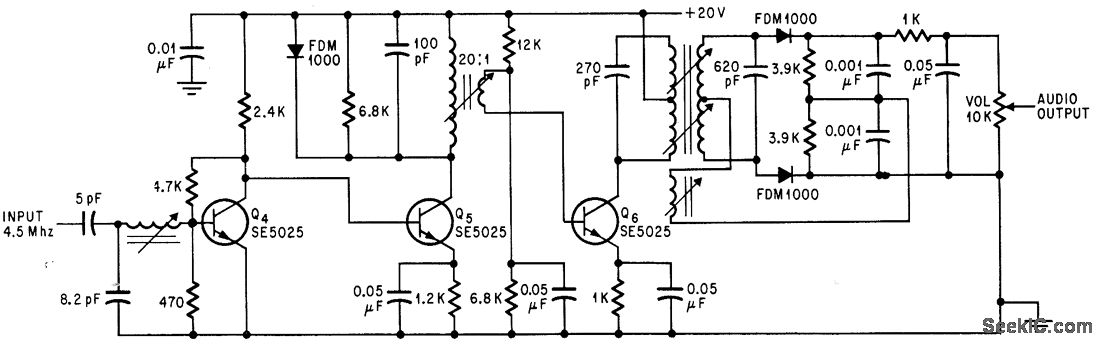
SOUND I F FOR COLOR TV
Utilizes three transistor stages and a Foster-Seeley discriminator to produce an audio output of 1 V peak-to-peak. -D. Bray, Solid State Makes Debut in Big Screen Color TV, Electronics, 39:8, p 99-105.
The circuit in question employs a combination of three...

water activated alarm
Under dry conditions, the transistor will not have any bias current and will be completely off. However, when the probes become wet, the transistor will conduct, triggering the alarm. An On/Off switch is included, and it is important to use...