


Light-Operated RingCircuit
#light-operated
#ring circuit
#KA2401
#telephone
#AC signal
#two tones
#peripheral components
#communication
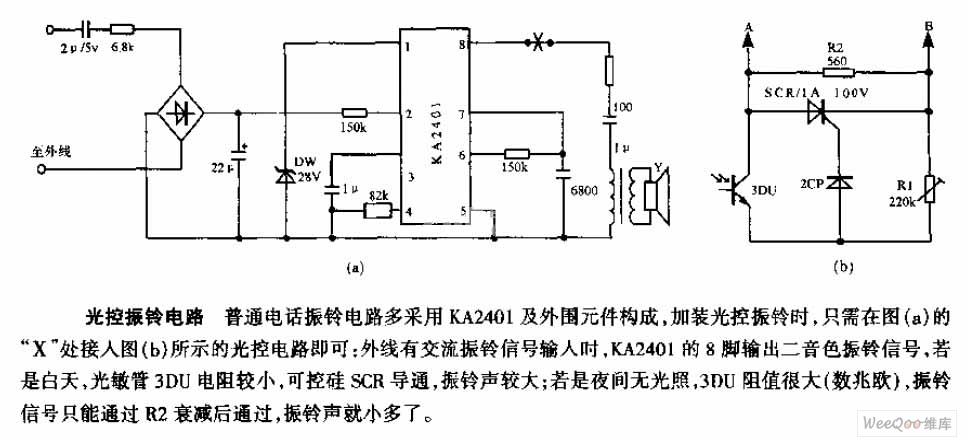
Description: The average telephone ring circuit consists of the KA2401 integrated circuit and its associated peripheral components. To integrate a light-operated ring circuit, connect the designated part X in the provided diagram (picture a) to the light-operated circuit shown in another diagram (picture b). When an AC ring signal is received through the external line, pin 8 of the KA2401 outputs a dual-tone ring signal. During daytime...
The light-operated ring circuit enhances the telephone ring circuit by incorporating a light-sensitive element that activates the ringing mechanism based on ambient light conditions. The KA2401 serves as the central processing unit, managing the signal processing and output functions. The connection point labeled "X" is critical for interfacing the light-operated circuit with the existing ring circuit.
When the external AC ring signal is detected, the KA2401's pin 8 generates a dual-tone output, which is typically indicative of a standard ringing cadence used in telecommunication systems. The light-operated circuit functions by utilizing a phototransistor or photodiode that responds to changes in light intensity. This component is strategically placed to ensure that the circuit activates only under specific lighting conditions, thereby conserving energy and preventing false ringing during daylight hours.
The integration of these components requires careful consideration of the power supply and grounding to prevent interference. Additionally, the selection of the light sensor should match the operational requirements of the circuit for optimal performance. Properly configuring the resistors and capacitors in the circuit will ensure that the output signal maintains clarity and consistency, allowing for effective ringing during nighttime or low-light conditions.
In summary, this light-operated ring circuit not only improves the functionality of the traditional telephone ring circuit but also introduces energy efficiency by minimizing unnecessary ringing during daylight, making it a valuable enhancement for modern telecommunication applications.Light-Operated Ring Circuit Average telephone ring circuit is composed of KA2401 and peripheral components. When adding light-operated ring circuit, just connects the part X in picture a with light-operated circuit in picture b.
When there is input of AC ring signal into the exterior line, the pin 8 of KA2401 outputs ring signal of two tones. In the day..
The light-operated ring circuit enhances the telephone ring circuit by incorporating a light-sensitive element that activates the ringing mechanism based on ambient light conditions. The KA2401 serves as the central processing unit, managing the signal processing and output functions. The connection point labeled "X" is critical for interfacing the light-operated circuit with the existing ring circuit.
When the external AC ring signal is detected, the KA2401's pin 8 generates a dual-tone output, which is typically indicative of a standard ringing cadence used in telecommunication systems. The light-operated circuit functions by utilizing a phototransistor or photodiode that responds to changes in light intensity. This component is strategically placed to ensure that the circuit activates only under specific lighting conditions, thereby conserving energy and preventing false ringing during daylight hours.
The integration of these components requires careful consideration of the power supply and grounding to prevent interference. Additionally, the selection of the light sensor should match the operational requirements of the circuit for optimal performance. Properly configuring the resistors and capacitors in the circuit will ensure that the output signal maintains clarity and consistency, allowing for effective ringing during nighttime or low-light conditions.
In summary, this light-operated ring circuit not only improves the functionality of the traditional telephone ring circuit but also introduces energy efficiency by minimizing unnecessary ringing during daylight, making it a valuable enhancement for modern telecommunication applications.Light-Operated Ring Circuit Average telephone ring circuit is composed of KA2401 and peripheral components. When adding light-operated ring circuit, just connects the part X in picture a with light-operated circuit in picture b.
When there is input of AC ring signal into the exterior line, the pin 8 of KA2401 outputs ring signal of two tones. In the day..

Remote-telephone-ringer
The two neon bulbs will illuminate when the voltage across the ringing circuit exceeds 100 V. These bulbs provide line isolation between the unit and the telephone line. Additionally, they function as a voltage divider for the bridge rectifier composed...

TS2418 Telephone Tone Ringer With Bridge Diode
The TS4956 is a comprehensive audio system device featuring three dedicated outputs: one for stereo headphones, one for loudspeaker drive, and one mono output for a hands-free set. The stereo headphone output can deliver over 25 mW per channel of...

Very Simple Telephone Intercom Circuit Circuit
Two telephones can be used as an intercom by utilizing this circuit. Older style rotary phones that are non-electronic may be the most suitable for this application. Additionally, handsets alone can be powered in this manner.
This intercom circuit allows for...

Telephone Call Recording Circuit Circuit
The DC voltage on a telephone line typically ranges from 45 to 50 V when on-hook and drops to around 6 V when off-hook. This circuit utilizes the voltage drop to activate a relay, which in turn controls a cassette...

TELEPHONE RINGER
This telephone ringer utilizes an AMI chip with part number S2561 and can be powered directly from the telephone line. The audio output is approximately 50 mW when supplied with a 10-V source.
The circuit design of the telephone ringer based...

telephone in use indicator
It is illegal to create a permanent physical connection to telephone lines in certain countries, including the UK and Ireland. When constructing this circuit, it is advisable to utilize a plug-in cord to allow for disconnection in the event of...
TELEPHONE RINGER
This telephone ringer utilizes an AMI chip with part number S2561 and can be powered directly from the telephone line. The audio output is approximately 50 mW when supplied with a 10-V source.
The circuit design of the telephone ringer based...

Telephone call meter using calculator & COB
This circuit utilizes a simple calculator along with a chip-on-board (COB) from an analog quartz clock to create a telephone call meter. The calculator converts STD/ISD calls into local call equivalents and continuously displays the current local call meter reading....

UM95088 TelephoneCircuit
The UM95088 telephone circuit diagram is depicted in the image above. The UM95088 is a specialized integrated module designed for dual-tone multi-frequency (DTMF) telephone dialing. It utilizes CMOS technology and comes in a 14-pin dual-in-line package. The schematic for the...