


N1FN Key Collection
#Morse key
#electrical switch
#amateur radio
#telegraphy
#communication
#radio equipment
#Morse code
#vintage electronics

Description: A Morse key is essentially an electrical switch that can define two states: on and off. Despite its simplicity, there is significant potential for artistry, and many Morse keys are considered works of art. The collection includes keys that are in working condition and have been used for amateur radio contacts. This usage creates a connection between the operator and previous users. Historically, these devices were essential tools for professional telegraphers. The collection features a K. P. Thomas Automorse key made by Hitchcox Bros. in Adelaide, Australia, circa 1920. This key sold for five pounds, equivalent to about a week's wages for a telegraphist. It is characterized by three paddles for automatic dots, automatic dashes, and manual dashes. The metal components are nickel-plated brass, while the finger-pieces are made of fiberboard. A base made from maple has been added, and the key remains in working condition with all original parts.
Additionally, there is an ElectroInstrument Key-8 paddle/keyer from the former Soviet Union, designed specifically for amateur radio operators. This device features dual paddles but lacks an iambic electronic keyer. Its base is a thick machined brass plate, and the body is brass with a heavy chromium plating, weighing 3 lbs 7 oz. A 5-pin DIN connector on the back provides connections for dit, dah, common, power, and audio lines, although it has been modified to operate the paddles without the keyer. Morse Express has recently stocked this paddle for sale.
The collection also includes "The Simplex Auto" bug from Melbourne, Australia, with a brass plate showing the serial number 5547 and the maker's name, Leo G. Cohen. Little is known about Cohen, but he worked in the Chief Telegraph Office of the General Post Office in Melbourne. The Simplex Auto was produced in several models over the years and influenced the design of Australian bugs, similar to Vibroplex in the US. The mechanical components are made of machined brass or nickel-plated brass, with the arm rotating on a steel double-ended needle bearing. The finger-pieces are made of Bakelite.
Additionally, there is a US Army Signal Corps "FLAMEPROOF KEY J-5-A" from L. S. Brach Mfg. Co. in Newark, NJ. The contact tension can be adjusted via a screw that protrudes through the cover. The key is painted a dark "GI green" over brass, with some paint missing from the top cover. Another flameproof key in the collection has the number CJB26003A on the base and a black Bakelite body. A viewer identified it on the webpage and provided a copy of the Military Standard, which includes a detailed drawing.
The Morse key collection showcases a variety of designs and functionalities, reflecting the evolution of telegraphy tools and their significance in communication history. Each key not only serves its practical purpose but also represents a piece of art and engineering, connecting the past with present amateur radio practices.A Morse key is nothing more than an electrical switch, capable of defining two states- on and off! But within that simplicity lies a lot of scope for artistry, and some Morse keys are truly works of art. I never intended to become a collector, but one thing has led to another and here I am. All of these keys are in working condition, and most of them have been used "on air" for at least one amateur
radio contact. Apart from proving that they work, this "laying on of hands" makes them truly mine and establishes what I feel to be some sort of mystical bond between myself and all the other operators who used them over the years. Most of these devices were at one time the "tools of the trade" for professional telegraphers. As an amateur radio operator I use telegraphy extensively, in fact almost exclusively, but I still find it difficult to imagine what it must have been like to pound brass for 8 hours a day, every day, as one`s means of putting bread on the table!
This is the star of my collection, a K. P. Thomas Automorse key made my Hitchcox Bros. in Adelaide, SA, Australia, circa 1920. The device sold for five Pounds, or about a week`s wages for a journeyman "telegraphist. " It is distinguished by three paddles- automatic dots, automatic dashes, and manual dashes. The metal parts are nickel-plated brass, and the finger-pieces are some sort of fiberboard. I added a base for it made from maple, and it is in working condition with all original parts. Thanks to Larry, VK6CP, I can show you an image of a contemporary ad for the Automorse. The ad says it is "guaranteed forever against wear, " and so far it is living up to the guarantee! A more recent device from the former Soviet Union, this is the ElectroInstrument Key-8 paddle/keyer. Manufactured by a former Soviet military instrument factory specifically for amateur radio operators, the device has dual paddles, but the built-in electronic keyer is not iambic! Base is a thick machined brass plate, body appears to be brass with a thick chromium plating, and it weighs a whopping 3 Lbs 7 Oz.
A 5 pin DIN connector on the back provides for dit, dah, common, power, and audio lines, but I`ve converted it to use the paddles without using the keyer. Morse Express has recently acquired stocks of this paddle for sale. Here are two views of "The Simplex Auto" bug (or semiautomatic mechanical key), from Melbourne, Victoria, Australia.
The brass plate shows serial number 5547 and the maker`s name- Leo G. Cohen. Little is known about Leo beyond the fact that he worked in the CTO (Chief Telegraph Office) in the GPO (General Post Office) in Melbourne. The Simplex Auto was made in several models for many years, and set the pattern for Australian bugs (or "jiggers" as they were called there) just as Vibroplex did in the US.
Hence most Australian bugs are "sideways. " The mechanical parts are machined brass or nickel plated brass, with the arm rotating on a steel double-ended needle bearing (upper bearing surface is an indentation in the heavy top cover). The finger-pieces are bakelite. Thanks to Larry, VK6CP, I can show you an image of a contemporary ad for the Simplex Auto. Below is a US Army Signal Corp "FLAMEPROOF KEY J-5-A" from L. S. Brach Mfg. Co, Newark, NJ. Contact tension can be adjusted with a screw which protrudes through the cover (behind the knob). The key is painted a dark "GI green" over brass- with a bit of paint missing from the top cover. Here`s another flameproof key. It has the number CJB26003A on the base and the body is black bakelite. A viewer recognized it here on the web page and sent me a copy of the actual Military Standard [MS17397(SHIPS) - click here to view a scan of it!] which includes a detailed drawing.
Turns out it`s a "KEY SIGNALLING SEARCHLIGHT
Additionally, there is an ElectroInstrument Key-8 paddle/keyer from the former Soviet Union, designed specifically for amateur radio operators. This device features dual paddles but lacks an iambic electronic keyer. Its base is a thick machined brass plate, and the body is brass with a heavy chromium plating, weighing 3 lbs 7 oz. A 5-pin DIN connector on the back provides connections for dit, dah, common, power, and audio lines, although it has been modified to operate the paddles without the keyer. Morse Express has recently stocked this paddle for sale.
The collection also includes "The Simplex Auto" bug from Melbourne, Australia, with a brass plate showing the serial number 5547 and the maker's name, Leo G. Cohen. Little is known about Cohen, but he worked in the Chief Telegraph Office of the General Post Office in Melbourne. The Simplex Auto was produced in several models over the years and influenced the design of Australian bugs, similar to Vibroplex in the US. The mechanical components are made of machined brass or nickel-plated brass, with the arm rotating on a steel double-ended needle bearing. The finger-pieces are made of Bakelite.
Additionally, there is a US Army Signal Corps "FLAMEPROOF KEY J-5-A" from L. S. Brach Mfg. Co. in Newark, NJ. The contact tension can be adjusted via a screw that protrudes through the cover. The key is painted a dark "GI green" over brass, with some paint missing from the top cover. Another flameproof key in the collection has the number CJB26003A on the base and a black Bakelite body. A viewer identified it on the webpage and provided a copy of the Military Standard, which includes a detailed drawing.
The Morse key collection showcases a variety of designs and functionalities, reflecting the evolution of telegraphy tools and their significance in communication history. Each key not only serves its practical purpose but also represents a piece of art and engineering, connecting the past with present amateur radio practices.A Morse key is nothing more than an electrical switch, capable of defining two states- on and off! But within that simplicity lies a lot of scope for artistry, and some Morse keys are truly works of art. I never intended to become a collector, but one thing has led to another and here I am. All of these keys are in working condition, and most of them have been used "on air" for at least one amateur
radio contact. Apart from proving that they work, this "laying on of hands" makes them truly mine and establishes what I feel to be some sort of mystical bond between myself and all the other operators who used them over the years. Most of these devices were at one time the "tools of the trade" for professional telegraphers. As an amateur radio operator I use telegraphy extensively, in fact almost exclusively, but I still find it difficult to imagine what it must have been like to pound brass for 8 hours a day, every day, as one`s means of putting bread on the table!
This is the star of my collection, a K. P. Thomas Automorse key made my Hitchcox Bros. in Adelaide, SA, Australia, circa 1920. The device sold for five Pounds, or about a week`s wages for a journeyman "telegraphist. " It is distinguished by three paddles- automatic dots, automatic dashes, and manual dashes. The metal parts are nickel-plated brass, and the finger-pieces are some sort of fiberboard. I added a base for it made from maple, and it is in working condition with all original parts. Thanks to Larry, VK6CP, I can show you an image of a contemporary ad for the Automorse. The ad says it is "guaranteed forever against wear, " and so far it is living up to the guarantee! A more recent device from the former Soviet Union, this is the ElectroInstrument Key-8 paddle/keyer. Manufactured by a former Soviet military instrument factory specifically for amateur radio operators, the device has dual paddles, but the built-in electronic keyer is not iambic! Base is a thick machined brass plate, body appears to be brass with a thick chromium plating, and it weighs a whopping 3 Lbs 7 Oz.
A 5 pin DIN connector on the back provides for dit, dah, common, power, and audio lines, but I`ve converted it to use the paddles without using the keyer. Morse Express has recently acquired stocks of this paddle for sale. Here are two views of "The Simplex Auto" bug (or semiautomatic mechanical key), from Melbourne, Victoria, Australia.
The brass plate shows serial number 5547 and the maker`s name- Leo G. Cohen. Little is known about Leo beyond the fact that he worked in the CTO (Chief Telegraph Office) in the GPO (General Post Office) in Melbourne. The Simplex Auto was made in several models for many years, and set the pattern for Australian bugs (or "jiggers" as they were called there) just as Vibroplex did in the US.
Hence most Australian bugs are "sideways. " The mechanical parts are machined brass or nickel plated brass, with the arm rotating on a steel double-ended needle bearing (upper bearing surface is an indentation in the heavy top cover). The finger-pieces are bakelite. Thanks to Larry, VK6CP, I can show you an image of a contemporary ad for the Simplex Auto. Below is a US Army Signal Corp "FLAMEPROOF KEY J-5-A" from L. S. Brach Mfg. Co, Newark, NJ. Contact tension can be adjusted with a screw which protrudes through the cover (behind the knob). The key is painted a dark "GI green" over brass- with a bit of paint missing from the top cover. Here`s another flameproof key. It has the number CJB26003A on the base and the body is black bakelite. A viewer recognized it here on the web page and sent me a copy of the actual Military Standard [MS17397(SHIPS) - click here to view a scan of it!] which includes a detailed drawing.
Turns out it`s a "KEY SIGNALLING SEARCHLIGHT

frx 2001
Software, applications, and programming resources. Amateur radio and travel. Stereogram art.
The provided content outlines various topics of interest, including software applications and programming resources, amateur radio, travel, and stereogram art. Each of these areas represents a distinct field with its...

Morse Code Decoder Circuit
There have been numerous inquiries regarding this project, primarily due to issues with the source code provided at the end of the author's notes. This problem has been widely reported online, and similar compilation errors have been encountered. It is...

Morse Code Beacon Keyer
This circuit stores a single morse code message as bits in an EPROM chip, the message is sent to a relay which can key a CW transmitter. The keyer can output either a one-shot message such as "CQ DX DE...

high-quality 2.3 GHz Amateur Radio Transceiver
The receiver is a triple superheterodyne receiver with two phase-locked loop (PLL) guided local oscillators. The first local oscillator (LO) operates at 2.1 GHz and can be adjusted in increments of 500 kHz, down-converting the received signal to a frequency...
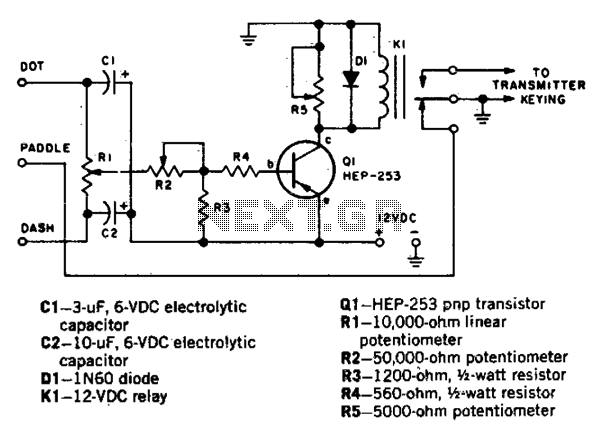
Electronic keyer
This circuit automatically generates Morse code dots and dashes determined by time constants involving C1 and C2. R1 establishes the dot/dash ratio, while R2 controls the speed. Additionally, R5 determines the relay drop-out point.
The circuit functions by utilizing capacitors C1...

Morse Code astable Oscillator
Astable or free-running multivibrators have been used in home-built amateur radio equipment for many years. The basic circuit is a two-stage amplifier with AC-coupled feedback from output to input. One transistor stage is on (conducting current) while the other is...

Morse Code with touch button (555)
This simple CPO is for those who want to practice Morse Code in a different way, ie without the morse key. It can be also used as a touch operated door bell. The popular timer IC555 is wired as an...

Amateur Radio Projects
The development of this interface for Echolink took some time. It utilizes the PIC16F84A microcontroller and accepts external DTMF signals from a radio. The latest version, Foxecho-k7, provides complete isolation between the radio and the PC and features automatic gain...

80M-amateur-radio-transmitter
This transmitter comprises a keyed crystal oscillator/driver and a high-efficiency final amplifier, both utilizing a TMOS Power FET as the active component. The total cost of components is under $20, and no specialized construction skills or circuit boards are necessary....