


STI5211 Low-cost HDTV Satellite Set-top Box Decoder For Microsoft VC-1 H.264 And MPEG-2

Description: The STI7167 utilizes advanced process technology to deliver a fully featured HD AVC DVB-C and DVB-T demodulator and decoder integrated circuit (IC). This highly integrated system-on-chip is designed for set-top box (STB) markets across cable, terrestrial, and terrestrial/IP hybrid networks globally. The STI7167 meets the latest requirements of operators and consumer electronics manufacturers. It supports advanced HD decoding formats (H264/VC-1/MPEG2) and complies with various standards, including DVB, ISMA, ATIS-IIF, SCTE, ATSC, ARIB, CEA, ITU, OpenCable, and MSTV. The STI7167 enables operators to specify a range of low-cost, high-performance HD STBs, including basic zappers, IP clients, interactive STBs, standalone DVRs, and DVR server/home network-capable STBs. Content delivery can occur through broadcast, broadband networks, or a combination of both (hybrid STBs). The STI7167 also addresses the latest conditional access, digital rights management (DRM), and trusted platform requirements of major operators worldwide by integrating advanced security features. It provides existing users of STMicroelectronics' advanced decoding ICs with improved performance and features while minimizing costs and accelerating time-to-market for next-generation deployments.
The STI7167 IC is a sophisticated solution that integrates multiple functionalities into a single chip, greatly enhancing the efficiency and performance of HD set-top boxes. Its design allows for seamless integration into various broadcasting environments, supporting both cable and terrestrial signals. The inclusion of multiple decoding formats ensures compatibility with a wide array of video content, catering to diverse consumer needs.
In terms of security, the STI7167 is equipped with cutting-edge features to protect content and comply with regulatory requirements. This is crucial for operators who need to safeguard their services against piracy and unauthorized access. The chip's architecture is optimized for low power consumption, making it suitable for deployment in energy-efficient devices.
The versatility of the STI7167 extends to its ability to handle hybrid STB configurations, allowing for flexible content delivery methods. This adaptability is particularly relevant in the current media landscape, where consumers demand access to content through various platforms. By facilitating both broadcast and broadband delivery, the STI7167 empowers operators to offer enhanced user experiences.
Overall, the STI7167 represents a significant advancement in the field of digital broadcasting technology, providing a comprehensive solution that aligns with the evolving demands of the market. Its integration of advanced features and adherence to industry standards positions it as a leading choice for manufacturers looking to develop next-generation set-top boxes.The STI7167 uses state-of-the-art process technology to provide a fully featured HD AVC DVB-C and DVB-T Demodulator and decoder IC. It is a highly integrated system-on-chip suitable for STB markets across cable, terrestrial, and terrestrial/IP hybrid networks worldwide.
The STI7167 is targeted at the latest Operator and CE manufacturer requirement s for STBs that use advanced HD decoding (H264/VC-1/MPEG2), and which conform to DVB, ISMA, ATIS-IIF, SCTE, ATSC, ARIB, CEA, ITU, OpenCable and MSTV specifications. The STI7167 provides a solution for operators to specify a range of low-cost, high performance HD STBs including low-cost zappers, IP clients, interactive STBs, DVR standalone and DVR server/home network-capable STBs, and with content delivery possible using broadcast or Broadband networks, or both (hybrid STBs).
The STI7167 keeps pace with the latest conditional access, DRM and trusted platform requirements of major operators worldwide by incorporating the latest generation of advanced security features. The STI7167 offers current users of ST`s growing family of advanced decoding ICs enhancements in performance and features, while reducing cost and time-to-market for the next generation deployments.
By STMicroelectronics
The STI7167 IC is a sophisticated solution that integrates multiple functionalities into a single chip, greatly enhancing the efficiency and performance of HD set-top boxes. Its design allows for seamless integration into various broadcasting environments, supporting both cable and terrestrial signals. The inclusion of multiple decoding formats ensures compatibility with a wide array of video content, catering to diverse consumer needs.
In terms of security, the STI7167 is equipped with cutting-edge features to protect content and comply with regulatory requirements. This is crucial for operators who need to safeguard their services against piracy and unauthorized access. The chip's architecture is optimized for low power consumption, making it suitable for deployment in energy-efficient devices.
The versatility of the STI7167 extends to its ability to handle hybrid STB configurations, allowing for flexible content delivery methods. This adaptability is particularly relevant in the current media landscape, where consumers demand access to content through various platforms. By facilitating both broadcast and broadband delivery, the STI7167 empowers operators to offer enhanced user experiences.
Overall, the STI7167 represents a significant advancement in the field of digital broadcasting technology, providing a comprehensive solution that aligns with the evolving demands of the market. Its integration of advanced features and adherence to industry standards positions it as a leading choice for manufacturers looking to develop next-generation set-top boxes.The STI7167 uses state-of-the-art process technology to provide a fully featured HD AVC DVB-C and DVB-T Demodulator and decoder IC. It is a highly integrated system-on-chip suitable for STB markets across cable, terrestrial, and terrestrial/IP hybrid networks worldwide.
The STI7167 is targeted at the latest Operator and CE manufacturer requirement s for STBs that use advanced HD decoding (H264/VC-1/MPEG2), and which conform to DVB, ISMA, ATIS-IIF, SCTE, ATSC, ARIB, CEA, ITU, OpenCable and MSTV specifications. The STI7167 provides a solution for operators to specify a range of low-cost, high performance HD STBs including low-cost zappers, IP clients, interactive STBs, DVR standalone and DVR server/home network-capable STBs, and with content delivery possible using broadcast or Broadband networks, or both (hybrid STBs).
The STI7167 keeps pace with the latest conditional access, DRM and trusted platform requirements of major operators worldwide by incorporating the latest generation of advanced security features. The STI7167 offers current users of ST`s growing family of advanced decoding ICs enhancements in performance and features, while reducing cost and time-to-market for the next generation deployments.
By STMicroelectronics

decoder circuit
The PPI-8255 is a general-purpose I/O programmable interface that is typically connected directly to a computer bus. This article demonstrates that the card can serve dual purposes: as an expander port and for direct I/O functionality. The card can be...

Background music decoder
This circuit is a background music (SCA) decoder designed to process an input demodulated (multiplex) FM signal. The NE565, a Phase Locked Loop (PLL) integrated circuit, serves as the foundation for this design.
The background music (SCA) decoder circuit utilizes the...

Instrumenting an Earth Satellite
In October 1958, when this article was written, only a year had passed since the successful launch of Sputnik, followed shortly by the launch of the Echo satellites, marking significant milestones for Russia and the USA, respectively. Prior to these...

Sca background music decoder
A resistive voltage divider is utilized to establish a bias voltage for the input (pins 2 and 3). The demodulated FM signal is introduced to the input through a two-stage high-pass filter, which serves to provide capacitive coupling and to...
Instrumenting an Earth Satellite
In October 1958, when this article was written, only a year had passed since the successful launch of Sputnik, followed shortly by the launch of the Echo satellites, marking significant milestones for Russia and the USA, respectively. Prior to these...

4-channel SQ logic decoder
4-channel SQ logic decoder with a current drain of 75 mA at 20 volts. The input impedance is 2M ohms, and the output impedance is 2K ohms (courtesy of GTE Sylvania Incorporated).
The 4-channel SQ logic decoder is an integrated circuit...
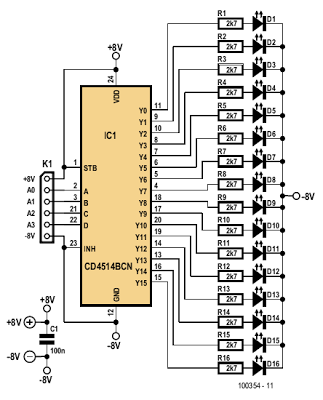
Simple Indicator for Dynamic Limiter Schematic Diagram
The indicator described here is specifically designed for adjusting the dynamic limiter outlined elsewhere in this edition and checking if the maximum level of the reference voltage (P1) requires modification. A 4-to-16 decoder integrated circuit (IC) of type 4514 is...

low power universal demultiplexer decoder
This circuit functions as a universal decoder, capable of operating either as a dual 1-of-4 decoder or as a single 1-of-8 decoder, depending on the signal applied to the Mode Control (M) input. In the dual mode, each section features...

A practical MS Decoder Circuit
The schematic diagram of the MS Decoder may appear complex, but it is relatively straightforward. Initially, both the Mid and Side signals are buffered using unity gain inverting buffers, which are constructed around IC1b and IC2b. This buffering serves two...