


Telephone pickup preampliifer
#preamplifier
#uA741
#telephone
#audio
#inductive pickup
#high impedance
#magnetic core
#voice pickup
#communication
#signal amplification
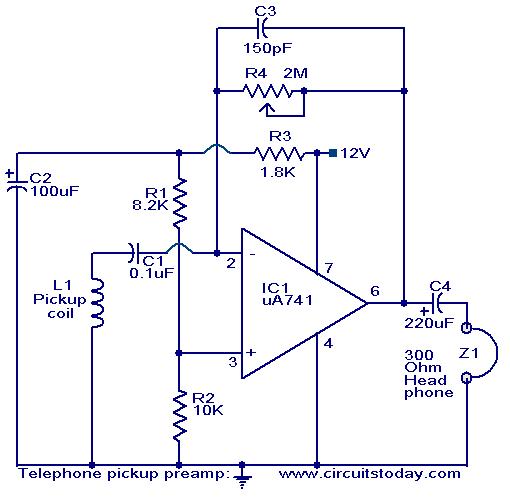
Description: This circuit utilizes the uA741 integrated circuit to capture voice signals from telephone lines without direct contact. By positioning a high-impedance magnetic core near a telephone device or along the telephone wires, the circuit can inductively pick up both sides of a conversation. A preamplifier, also based on the uA741, is employed to amplify these signals. The configuration functions as an inverting amplifier, with the gain determined by the feedback resistor R4. The operational amplifier provides sufficient gain to drive headphones, allowing the circuit to serve as a telephone bug.
The circuit is designed around the uA741 operational amplifier, which is a general-purpose op-amp known for its versatility in various applications. In this setup, the uA741 is configured as an inverting amplifier, which is a common configuration for signal amplification tasks. The gain of the amplifier is set by the resistor R4, which is connected in the feedback loop. The relationship between the input and output voltage is given by the formula:
\[ V_{out} = -\left(\frac{R_f}{R_{in}}\right) V_{in} \]
where \( R_f \) is the feedback resistor (R4 in this case) and \( R_{in} \) is the input resistor connected to the inverting input of the op-amp. By adjusting R4, the designer can control the gain to ensure that the output signal is strong enough to drive headphones or other audio output devices.
The high-impedance magnetic core acts as a sensor, capturing the electromagnetic fields generated by the telephone line. This allows the circuit to function without any physical connection to the telephone, making it useful for discreet audio monitoring applications. The circuit's passive components, including resistors and capacitors, should be selected to optimize performance and minimize noise, ensuring clear audio reproduction.
To enhance the circuit's effectiveness, careful consideration should be given to the placement of the magnetic core. Proximity to the telephone line or device is crucial for maximizing signal pickup. Additionally, the circuit may benefit from additional filtering stages to remove unwanted noise or interference, which can be achieved by incorporating capacitors in parallel with the resistors or using additional op-amp stages for further amplification and signal conditioning.
Overall, this simple yet effective circuit demonstrates the application of the uA741 op-amp in audio signal processing, particularly for non-invasive audio surveillance in telecommunication systems.Here is a simple circuit based on IC uA 741 that can be used to pickup voice from telephone lines without even contacting the line. If a high impedance magnetic core is placed near a telephone instrument or near one of the telephone wires, it picks up inductively both sides of the telephonic conversation without any electrical contact.
A preamplif ier based on IC uA741 is used to pickup these signals. The circuit is nothing but an inverting amplifier whose gain depends on the feedback resistance R4. The Op-Amp produces the necessary gain to drive the headphone. The circuit can be used as a telephone bug too.
The circuit is designed around the uA741 operational amplifier, which is a general-purpose op-amp known for its versatility in various applications. In this setup, the uA741 is configured as an inverting amplifier, which is a common configuration for signal amplification tasks. The gain of the amplifier is set by the resistor R4, which is connected in the feedback loop. The relationship between the input and output voltage is given by the formula:
\[ V_{out} = -\left(\frac{R_f}{R_{in}}\right) V_{in} \]
where \( R_f \) is the feedback resistor (R4 in this case) and \( R_{in} \) is the input resistor connected to the inverting input of the op-amp. By adjusting R4, the designer can control the gain to ensure that the output signal is strong enough to drive headphones or other audio output devices.
The high-impedance magnetic core acts as a sensor, capturing the electromagnetic fields generated by the telephone line. This allows the circuit to function without any physical connection to the telephone, making it useful for discreet audio monitoring applications. The circuit's passive components, including resistors and capacitors, should be selected to optimize performance and minimize noise, ensuring clear audio reproduction.
To enhance the circuit's effectiveness, careful consideration should be given to the placement of the magnetic core. Proximity to the telephone line or device is crucial for maximizing signal pickup. Additionally, the circuit may benefit from additional filtering stages to remove unwanted noise or interference, which can be achieved by incorporating capacitors in parallel with the resistors or using additional op-amp stages for further amplification and signal conditioning.
Overall, this simple yet effective circuit demonstrates the application of the uA741 op-amp in audio signal processing, particularly for non-invasive audio surveillance in telecommunication systems.Here is a simple circuit based on IC uA 741 that can be used to pickup voice from telephone lines without even contacting the line. If a high impedance magnetic core is placed near a telephone instrument or near one of the telephone wires, it picks up inductively both sides of the telephonic conversation without any electrical contact.
A preamplif ier based on IC uA741 is used to pickup these signals. The circuit is nothing but an inverting amplifier whose gain depends on the feedback resistance R4. The Op-Amp produces the necessary gain to drive the headphone. The circuit can be used as a telephone bug too.

Audio VU meter with Extra wide Dynamic Range 69 dB using Arduino
After experimenting with a stereo version of the VU meter described in a previous blog post, a studio-grade VU meter is now being presented. This meter features 24 steps, spaced equally every 3 dB, and covers a wide dynamic range...
TDA7295 80W Audio Amplifier
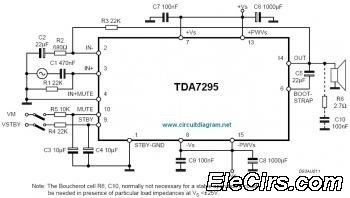
The IC TDA7295 is a monolithic integrated circuit designed for use as an audio class AB amplifier in high-fidelity applications, including home theaters and high-end televisions.
The TDA7295 is a versatile audio amplifier that delivers high-quality sound reproduction, making it suitable...

Audio-oscillator
The circuit's frequency of oscillation is given by the formula: f = 2.8 / [C1 x (R1 + R2)]. By adjusting the potentiometer R2, the output frequency can be varied from 60 Hz to 20 kHz. A portion of the...
Three-Level Audio Power Indicators
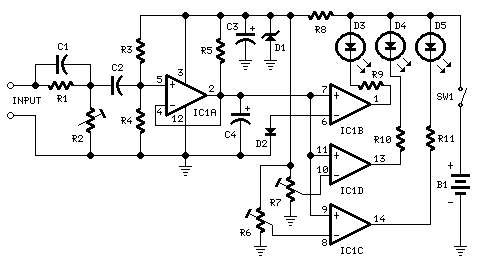
This circuit indicates audio output power using three LEDs. It serves as a useful addition to an amplifier.
The audio output power indicator circuit is designed to visually represent the power level of an audio amplifier through the use of three...

Power Amplifier 50W
Cleaned Input: This simple audio power amplifier was originally designed for a circuit board workshop, conducted by the OSU IEEE Student Group. At the workshop, 20 participants each constructed this amplifier, by etching and drilling the single sided circuit board,...

passive riaa preamplifier
There are two types of preamplifiers for magnetic phono cartridges. The most common type includes an RIAA equalization network in the feedback loop, as described in the March 2002 issue of SILICON CHIP. The second type, previously used in valve...

A Simple Audio Oscillator
A simple oscillator that can be utilized for code practice. To achieve adequate inductance for generating an audio frequency, an iron core transformer, similar to those employed in audio transformer-coupled amplifiers, is connected as illustrated.
The circuit comprises a basic oscillator...

Audio Metal Detector Schematic
The circuit described is a metal detector. The operation of the circuit is based on the superheterodyne principle, which is commonly used in superheterodyne receivers. The circuit utilizes two RF oscillators, both fixed at a frequency of 5.5 MHz. The...

Telephone Status Indicator Circuit
This simple circuit indicates the status of a phone, including Line OK, Dialing, and Call Attended. It also features a locking mechanism to block outgoing calls while allowing incoming calls, preventing misuse of the telephone. The circuit requires only a...