


TELETEXT devices
#teletext
#TV standard
#CCIR
#EBU
#vertical blanking interval
#test signals
#625 standard
#broadcast
#video signals

Description: Test signals inserted in the lines of the vertical blanking interval, defined by the TV standard, e.g. for the 625 standard the CCIR together with the EBU issued the formal specifications for the signals inserted in lines 17, 18, 330 and 331.
The vertical blanking interval (VBI) is a critical section of the television signal where no active video data is transmitted. It occurs during the time it takes for the electron beam in CRT displays to return to the top of the screen after finishing a frame. In the context of the 625-line standard, which is widely used in European television broadcasting, the CCIR (International Radio Consultative Committee) and the EBU (European Broadcasting Union) have established specific guidelines for inserting test signals into designated lines of the VBI.
In the 625 standard, lines 17, 18, 330, and 331 are allocated for the transmission of these test signals. These lines are strategically chosen to ensure that the insertion of test signals does not interfere with the visible image content. The test signals may include various types of data, such as teletext information, closed captions, or other forms of metadata that can be utilized for diagnostics or additional content delivery.
The specifications for these test signals include parameters such as signal amplitude, timing, and modulation techniques. The insertion of test signals must adhere to the defined voltage levels and timing intervals to ensure compatibility with television receivers. Devices designed to process these signals must be capable of accurately detecting and interpreting the data embedded within the VBI, which may involve filtering and demodulation techniques.
In summary, the vertical blanking interval serves as a vital opportunity for transmitting essential data without disrupting the viewer's experience. The formal specifications provided by the CCIR and EBU ensure that the implementation of test signals is standardized, facilitating the development of compatible broadcasting and receiving equipment across various platforms.Test signals inserted in the lines of the vertical blanking interval, defined by the TV standard, e. g. for the 625 standard the CCIR together with the EBU issued the formal specifications for the signals inserted in lines 17, 18, 330 and 331.
The vertical blanking interval (VBI) is a critical section of the television signal where no active video data is transmitted. It occurs during the time it takes for the electron beam in CRT displays to return to the top of the screen after finishing a frame. In the context of the 625-line standard, which is widely used in European television broadcasting, the CCIR (International Radio Consultative Committee) and the EBU (European Broadcasting Union) have established specific guidelines for inserting test signals into designated lines of the VBI.
In the 625 standard, lines 17, 18, 330, and 331 are allocated for the transmission of these test signals. These lines are strategically chosen to ensure that the insertion of test signals does not interfere with the visible image content. The test signals may include various types of data, such as teletext information, closed captions, or other forms of metadata that can be utilized for diagnostics or additional content delivery.
The specifications for these test signals include parameters such as signal amplitude, timing, and modulation techniques. The insertion of test signals must adhere to the defined voltage levels and timing intervals to ensure compatibility with television receivers. Devices designed to process these signals must be capable of accurately detecting and interpreting the data embedded within the VBI, which may involve filtering and demodulation techniques.
In summary, the vertical blanking interval serves as a vital opportunity for transmitting essential data without disrupting the viewer's experience. The formal specifications provided by the CCIR and EBU ensure that the implementation of test signals is standardized, facilitating the development of compatible broadcasting and receiving equipment across various platforms.Test signals inserted in the lines of the vertical blanking interval, defined by the TV standard, e. g. for the 625 standard the CCIR together with the EBU issued the formal specifications for the signals inserted in lines 17, 18, 330 and 331.
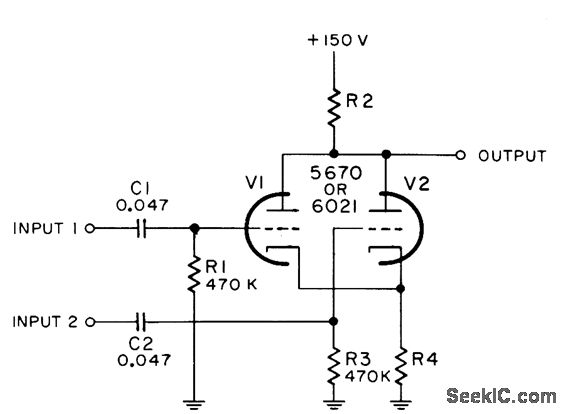
PREFERRED LOW LEVEL COMMON PLATE MIXER
The combination of video signals with pulses involves the inversion of the input signal. The resistor R4 is specified as 270 ohms for the 5670 model and 470 ohms for the 6021 model. Additionally, R2 is set to 680 ohms...
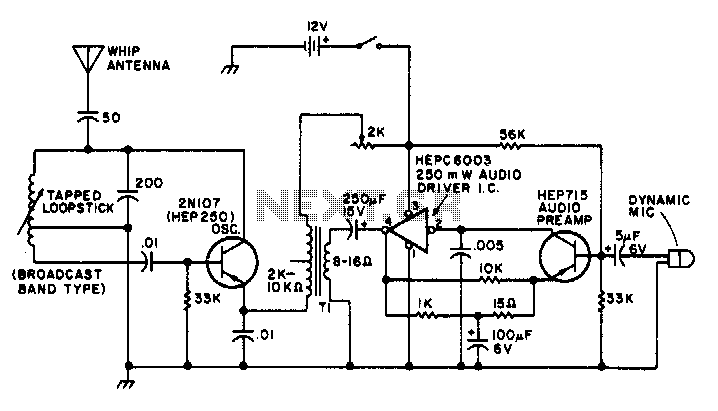
1-2Mhz broadcast transmitter
T1 is a low impedance output transformer with a conversion ratio of 5000 to 8 ohms.
The low impedance output transformer, T1, is designed to match the output of an audio amplifier to the impedance of the speaker load. The specified...

Broadcast circuits
This page is provided to the domain owner free of charge by Sedo's Domain Parking. The domain owner and Sedo do not have any relationship with third-party advertisers. References to any specific service or trademark are not controlled by Sedo...

Cable broadcast amplifiers circuit protection
A cable radio broadcasting studio in rural villages and towns is often equipped with high-power amplifiers that are susceptible to damage. This vulnerability primarily arises from frequent usage without specialized management, leading to situations where the system is often powered...