


Thunderhead Technologies
#voice modem
#text-to-speech
#weather conditions
#automated system
#Windows
#telephone
#TTS
#voice-back system
#PC

Description: WxVoice is an automated voice-back system that utilizes a PC's voice modem to convey current and past weather conditions over the telephone. It leverages Text-to-Speech (TTS) technology to generate a more natural-sounding dialogue compared to other products that rely on pre-recorded numbers and phrases. WxVoice serves as an add-on product to WxSolution and employs the built-in speech capabilities of Windows XP, Vista, 7, and 8.1.
WxVoice functions by interfacing with a personal computer equipped with a voice modem, which facilitates the transmission of voice data over telephone lines. The system operates by retrieving weather data from a designated source, which can be a local weather station or an online weather service. The retrieved data is then processed using TTS algorithms to convert the textual weather information into audible speech.
The TTS technology employed in WxVoice is designed to produce human-like speech patterns, enhancing user experience by making the information more accessible and easier to understand. The software is compatible with various versions of the Windows operating system, ensuring broad usability across different hardware configurations.
For implementation, users must ensure that the voice modem is correctly installed and configured within the Windows environment. The WxVoice software integrates seamlessly with the existing WxSolution platform, allowing users to manage their weather data and voice communication from a single interface.
In summary, WxVoice represents a sophisticated solution for delivering weather information through automated voice responses, significantly improving the interaction quality compared to traditional methods that utilize static audio files. The combination of real-time data access and advanced speech synthesis technology positions WxVoice as a valuable tool for both personal and professional applications in weather reporting.WxVoice is an automated voice-back system that uses your PC`s voice modem to speak the current and past weather conditions over the telephone. WxVoice takes advantage of Text-to-Speech (TTS) technology to produce a more natural sounding dialogue than other products that use pre-recorded numbers and phrases.
WxVoice is an add-on product to WxSolution. WxVoice uses the built-in Speech capabilities of Windows XP/Vista/7/8. 1.
WxVoice functions by interfacing with a personal computer equipped with a voice modem, which facilitates the transmission of voice data over telephone lines. The system operates by retrieving weather data from a designated source, which can be a local weather station or an online weather service. The retrieved data is then processed using TTS algorithms to convert the textual weather information into audible speech.
The TTS technology employed in WxVoice is designed to produce human-like speech patterns, enhancing user experience by making the information more accessible and easier to understand. The software is compatible with various versions of the Windows operating system, ensuring broad usability across different hardware configurations.
For implementation, users must ensure that the voice modem is correctly installed and configured within the Windows environment. The WxVoice software integrates seamlessly with the existing WxSolution platform, allowing users to manage their weather data and voice communication from a single interface.
In summary, WxVoice represents a sophisticated solution for delivering weather information through automated voice responses, significantly improving the interaction quality compared to traditional methods that utilize static audio files. The combination of real-time data access and advanced speech synthesis technology positions WxVoice as a valuable tool for both personal and professional applications in weather reporting.WxVoice is an automated voice-back system that uses your PC`s voice modem to speak the current and past weather conditions over the telephone. WxVoice takes advantage of Text-to-Speech (TTS) technology to produce a more natural sounding dialogue than other products that use pre-recorded numbers and phrases.
WxVoice is an add-on product to WxSolution. WxVoice uses the built-in Speech capabilities of Windows XP/Vista/7/8. 1.

Telephone hold button
The on-hook (no load) voltage across the red-green wires will be 48 V or slightly less when all telephones are on-hook (disconnected). When any telephone goes off-hook, the load current flowing in the telephone causes the voltage to fall below...

UM95088 TelephoneCircuit
The UM95088 telephone circuit diagram is depicted in the image above. The UM95088 is a specialized integrated module designed for dual-tone multi-frequency (DTMF) telephone dialing. It utilizes CMOS technology and comes in a 14-pin dual-in-line package. The schematic for the...

Isolated Telephone Interface
There's not much to this circuit. The two RJ-11 jacks are set up to feed the telephone circuit through from the wall to the phone. The active signal for a single phone is on the red and green wires. Yellow...

Homemade small telephone PBX circuit diagram
The circuit operates by sending ringing pulses through capacitor C1, resistor R1, and diode D2 to charge capacitor C2 to a voltage of 6V. This voltage causes transistors N1 and N2 to reverse, which activates V1, the analog hook, and...

Ringing phone light flasher
When the telephone rings, the line voltage increases to 72 volts. At this moment, the LED in the opto-coupler lights up, causing the transistor to conduct. As a result, transistor Q1 also conducts, activating the relay. Consequently, the load connected...

telephone ringer project
Make two telephones ring on stage. This involves sending a signal down a line to the phones. An old telephone exchange system was initially sought but not found. Several circuit ideas have been discovered, but the goal is to create...
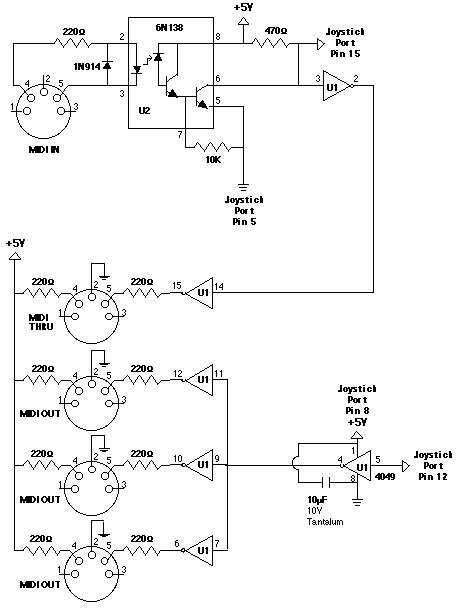
PC-Midi Interface
This design is intended for PC soundcards. For an interface suitable for a Mac, please refer to another page. For computers and PCs lacking a soundcard, Harmony Central's interface page may be helpful. The design has been constructed successfully, as...
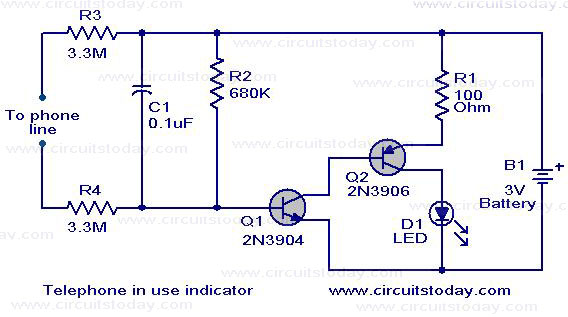
Telephone off-hook indicator
The circuit shown here serves as an indicator for when a telephone receiver is off-hook. It can be integrated with older telephone models that lack this feature. The circuit employs a complementary Darlington pair consisting of Q1 (2N3904) and Q2...

Telephone Status Indicator Circuit
This simple circuit indicates the status of a phone, including Line OK, Dialing, and Call Attended. It also features a locking mechanism to block outgoing calls while allowing incoming calls, preventing misuse of the telephone. The circuit requires only a...