


CMOS 4060 IC For Repeating Interval Timer
#CMOS 4060
#repeating timer
#interval timer
#binary counter
#timing circuit
#digital timer
#pulse generator
#clock circuit
#low power
#precision timing

Description: The following circuit illustrates a repeating interval timer circuit diagram utilizing the CMOS 4060 integrated circuit (IC). Features include its foundation on the CMOS 4060 IC and a 14-bit binary counter.
The CMOS 4060 IC is a versatile component widely used in timer and oscillator applications due to its high noise immunity and low power consumption. This integrated circuit includes a 14-stage binary ripple counter and an oscillator, which can be configured to generate a variety of timing intervals. The circuit can be designed to produce a stable output frequency by adjusting external components such as resistors and capacitors connected to the timing pins.
In a typical configuration of the repeating interval timer, the CMOS 4060 is connected to an external resistor-capacitor (RC) network. The values of these components determine the frequency of oscillation. The output from the oscillator feeds into the binary counter, which counts the pulses and can be configured to reset after a predetermined count, effectively creating a repeating timer function. The output can be taken from various stages of the counter, allowing for different timing intervals to be achieved depending on the specific application requirements.
To enhance functionality, additional components such as diodes and transistors may be included to drive higher loads or to interface with other logic levels. The circuit can be powered by a standard DC supply, making it suitable for battery-operated devices. Overall, the CMOS 4060-based repeating interval timer circuit is a reliable solution for applications requiring precise timing control.The following circuit shows about CMOS 4060 IC For Repeating Interval Timer Circuit Diagram. Features: Based On The CMOS 4060 IC, 14-bit binary ..
The CMOS 4060 IC is a versatile component widely used in timer and oscillator applications due to its high noise immunity and low power consumption. This integrated circuit includes a 14-stage binary ripple counter and an oscillator, which can be configured to generate a variety of timing intervals. The circuit can be designed to produce a stable output frequency by adjusting external components such as resistors and capacitors connected to the timing pins.
In a typical configuration of the repeating interval timer, the CMOS 4060 is connected to an external resistor-capacitor (RC) network. The values of these components determine the frequency of oscillation. The output from the oscillator feeds into the binary counter, which counts the pulses and can be configured to reset after a predetermined count, effectively creating a repeating timer function. The output can be taken from various stages of the counter, allowing for different timing intervals to be achieved depending on the specific application requirements.
To enhance functionality, additional components such as diodes and transistors may be included to drive higher loads or to interface with other logic levels. The circuit can be powered by a standard DC supply, making it suitable for battery-operated devices. Overall, the CMOS 4060-based repeating interval timer circuit is a reliable solution for applications requiring precise timing control.The following circuit shows about CMOS 4060 IC For Repeating Interval Timer Circuit Diagram. Features: Based On The CMOS 4060 IC, 14-bit binary ..

3-Bit Binary counter
This circuit utilizes two J-K flip-flops to create a three-bit binary counter, deviating from the conventional method of employing three flip-flops—one for each binary bit. In this design, the clock pulse from a 555 timer output serves as a bit...
Muscular Bio-Stimulator
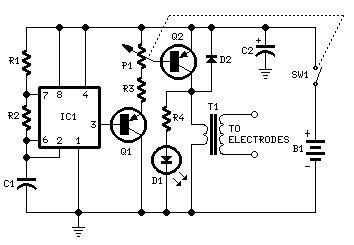
IC1 generates 150 µSec pulses at approximately 80Hz frequency. Q1 functions as a buffer, while Q2 inverts the pulse polarity and drives the transformer. The output pulse amplitude is adjusted by P1 and is visually indicated by the brightness of...
Pulse-Generator & Signal-Tracer
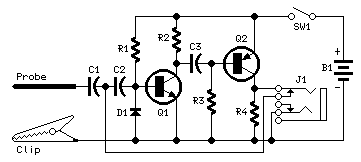
This simple circuit generates narrow pulses at about 700-800Hz frequency. The pulses, containing harmonics up to the MHz region, can be injected into audio or radio-frequency stages of amplifiers, receivers and the like for testing purposes. A high-pitched tone can...

Pulse Generator circuit
A simple pulse generator with a variable duty cycle and frequency is often useful in the lab to trigger or test other devices, such as a servo with a frequency of 50 Hz and pulses between 1 and 2 ms....

2Hz unsteady pulse single circuit diagram
The duty cycle of the capacitive circuit is very low, ranging from 1% to 10%. When the current is only 50 mA, the battery current consumption is just 1 A. Resistor R4 and capacitor C control the opening time, while...

How To Build A Burglar Alarm Using A Cmos 4060
This is a single-zone alarm system equipped with automatic exit, entry, and siren cut-off timers. It can accommodate various types of normally-closed input devices, such as magnetic reed contacts, foil tape, and passive infrared sensors (PIRs). Additionally, it is straightforward...

pulse generator circuit
The relaxation oscillator generates a relatively consistent square wave. By altering the duty cycle, the effect can be visualized using LEDs. The following variation of the relaxation oscillator circuit can be assembled.
The relaxation oscillator circuit typically consists of a resistor,...

About Area 50
This circuit divides a 10 MHz reference signal to produce outputs of 1, 10, 100, or 1000 pulses per second. The pulse width can be selected using jumpers, offering multiple options. A synchronization input aligns the output pulses with an...

cmos 4060 burglar alarm
This is a single-zone alarm system equipped with automatic exit, entry, and siren cut-off timers. It is designed to accommodate various types of normally-closed input devices, including magnetic reed contacts, foil tape, and passive infrared sensors (PIRs). Additionally, it is...