


LM555 interlocked monostable timer circuit
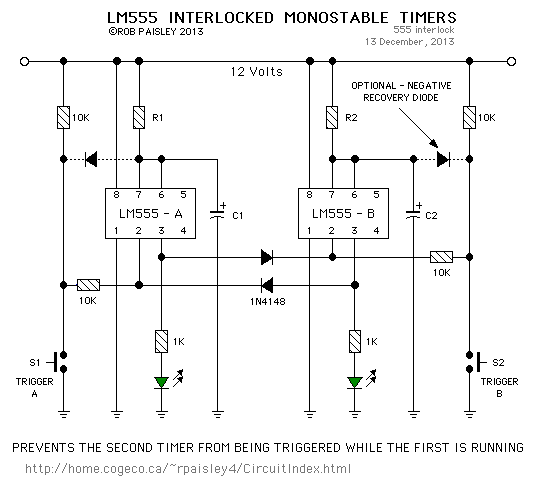
Description: This circuit is straightforward. The initial 555 timer prevents the second timer from being activated while the first is operational. Drive the circuit with a simple 12-volt power supply.
The circuit utilizes two 555 timer integrated circuits (ICs) configured in a monostable arrangement. The first 555 timer serves as the primary control element, which, when triggered, generates a pulse that maintains its output high for a predetermined duration. This output is connected to the trigger input of the second 555 timer.
When the first timer is in operation, its output remains high, effectively preventing the second timer from being triggered. The timing duration for the first timer is determined by an external resistor and capacitor. The values of these components can be calculated using the formula: T = 1.1 * R1 * C1, where T is the time in seconds, R1 is the resistance in ohms, and C1 is the capacitance in farads.
The second 555 timer is designed to activate only after the first timer has completed its timing cycle. This ensures that the two timers do not interfere with each other’s operation. The output of the second timer can be used to drive additional circuitry, such as LEDs or relays, depending on the application requirements.
Powering the circuit with a 12-volt supply is ideal, as it falls within the operating range of the 555 timer ICs, which typically accept voltages from 4.5 volts to 15 volts. Proper bypass capacitors should be placed close to the power pins of each timer to ensure stable operation and minimize voltage fluctuations.
Overall, this circuit design is effective for applications requiring sequential timing operations, where the coordination of two timing events is necessary without overlap.This circuit is simple. The first 555 timer prevents the second timer from being triggered while the first is running.
The circuit utilizes two 555 timer integrated circuits (ICs) configured in a monostable arrangement. The first 555 timer serves as the primary control element, which, when triggered, generates a pulse that maintains its output high for a predetermined duration. This output is connected to the trigger input of the second 555 timer.
When the first timer is in operation, its output remains high, effectively preventing the second timer from being triggered. The timing duration for the first timer is determined by an external resistor and capacitor. The values of these components can be calculated using the formula: T = 1.1 * R1 * C1, where T is the time in seconds, R1 is the resistance in ohms, and C1 is the capacitance in farads.
The second 555 timer is designed to activate only after the first timer has completed its timing cycle. This ensures that the two timers do not interfere with each other’s operation. The output of the second timer can be used to drive additional circuitry, such as LEDs or relays, depending on the application requirements.
Powering the circuit with a 12-volt supply is ideal, as it falls within the operating range of the 555 timer ICs, which typically accept voltages from 4.5 volts to 15 volts. Proper bypass capacitors should be placed close to the power pins of each timer to ensure stable operation and minimize voltage fluctuations.
Overall, this circuit design is effective for applications requiring sequential timing operations, where the coordination of two timing events is necessary without overlap.This circuit is simple. The first 555 timer prevents the second timer from being triggered while the first is running.
Drive the circuit with a simple 12 volt power supply.

Inductive switching power supply circuit diagram
The circuit consists of a 555 timer configured as an astable multivibrator along with resistors R1 and R2 and capacitor C1. It generates an oscillation frequency of approximately 10 kHz with a duty cycle close to 50%. Transistors VT2 and...
Infra-red Light Barrier Using 555
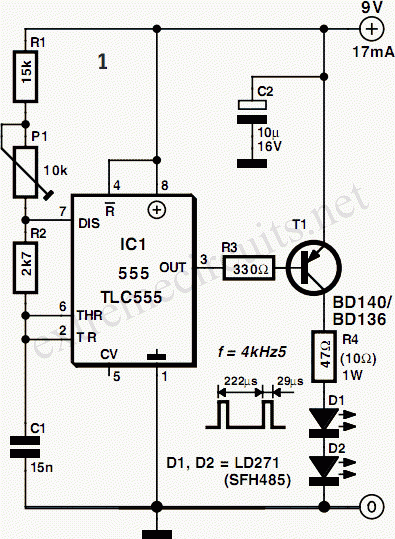
This is a short-range light barrier designed for use as an intruder alarm in doorposts and similar applications. The 555 timer in the transmitter oscillates at approximately 4.5 kHz.
The short-range light barrier operates by utilizing a transmitter and a receiver...

The motorcycle anti-theft alarm (3)
This article introduces a motorcycle anti-theft alarm that utilizes the 555 timer integrated circuit. The alarm is activated when a thief attempts to move the motorcycle vertically. The circuit consists of a trigger circuit and an alarm circuit, as illustrated...

Holiday Light Sequencer Circuit
The integrated circuit U1 (a 555 oscillator/timer) is configured as a conventional pulse generator. The frequency of the pulse generator is adjusted using potentiometer R11. Resistor R2 limits the maximum frequency attainable. The output from the pulse generator is connected...

Monostable to bistable relay with momentary switch
This circuit could be used to drive a monostable relay by a single momentary switch. Powered by 24 Volts, it works for a 12 Volts relay. When the button is pressed, Q1 is energized and the capacitor charges, while the...

Clap switch using timer 555
A single hand clap will be picked up by the electric mic which is coupled through C1 into the op amp IC1. The output of IC1 triggers the 555 IC timer IC2 which is configured as a monostable multivibrator. The...

Camera external shutter circuit 555 timer
The camera has been wired with external shutter leads, and a method is needed to trigger them. These leads must be connected together via a relay at regular intervals, approximately every 2 seconds, starting from launch. A 555 timer chip...

555 Rock lantern controller circuit diagram
The controller features a buck rectifier circuit utilizing a 555 multivibrator, designed for controlling approximately 220V, 5W low-power parallel lights or 6 to 12V small bulb series. The 555 timer, along with components D3, D4, RP1, and C2, forms an...

Device that it is self-running
If the input is coming from a function generator's typical output clip leads, then the "black" lead or "-" or "ground" is connected to the circuit's ground. The ground of Pin 3 of a 555 timer must also be common...