


Mp pulse width control
#pulse width control
#multiplexer
#RC networks
#multivibrator
#process control
#common mode signals
#differential multiplexers

Description: Differential multiplexers are typically employed in process control applications to mitigate errors caused by common mode signals. In this circuit, the dual multiplexing capability of the switch is utilized. This is accomplished by using the multiplexer to select pairs of RC networks, which control the pulse width of the multivibrator. This feature is particularly beneficial in process control applications that require a variable width sample "window" for different control signals.
In electronic circuit design, differential multiplexers offer a significant advantage by enabling the selection of multiple input signals while rejecting common mode noise. This is particularly crucial in environments where signal integrity is paramount, such as industrial process control systems. By leveraging the dual multiplexing capability, the circuit can dynamically adjust the pulse width of a multivibrator, which is essential for generating precise timing signals.
The operation of the differential multiplexer involves selecting pairs of resistors and capacitors (RC networks) that define the charge and discharge times of the multivibrator. By varying the RC time constants, the pulse width can be finely tuned to accommodate different control signals that may require varying sampling intervals. This adaptability is essential in scenarios where control signals fluctuate in frequency or duty cycle, allowing for improved responsiveness and accuracy in process control.
In practical applications, the configuration of the RC networks can be designed to optimize performance based on the specific requirements of the control system. For instance, if a wider sample window is needed for a slower control signal, the corresponding RC pair can be selected to produce a longer pulse width. Conversely, for faster signals, a different RC combination can be chosen to shorten the pulse width, thus ensuring that the system can effectively sample and respond to changes in the control signals.
Overall, the integration of differential multiplexers in process control circuits enhances the system's ability to handle diverse signal conditions while maintaining high fidelity in signal processing. This capability is essential for achieving reliable and efficient operation in complex industrial environments.Differential multiplexers are generally used in process control applications to eliminate errors due to common mode signals. In this circuit however, advantage is taken of the dual multiplexing capability of the switch. This is achieved by using the multiplexer to select pairs of RC networks to control the pulse width of the multivibrator.
This can be a particularly useful feature in process control applications where there is a requirement for a variable width sample "window" for different control signals.
In electronic circuit design, differential multiplexers offer a significant advantage by enabling the selection of multiple input signals while rejecting common mode noise. This is particularly crucial in environments where signal integrity is paramount, such as industrial process control systems. By leveraging the dual multiplexing capability, the circuit can dynamically adjust the pulse width of a multivibrator, which is essential for generating precise timing signals.
The operation of the differential multiplexer involves selecting pairs of resistors and capacitors (RC networks) that define the charge and discharge times of the multivibrator. By varying the RC time constants, the pulse width can be finely tuned to accommodate different control signals that may require varying sampling intervals. This adaptability is essential in scenarios where control signals fluctuate in frequency or duty cycle, allowing for improved responsiveness and accuracy in process control.
In practical applications, the configuration of the RC networks can be designed to optimize performance based on the specific requirements of the control system. For instance, if a wider sample window is needed for a slower control signal, the corresponding RC pair can be selected to produce a longer pulse width. Conversely, for faster signals, a different RC combination can be chosen to shorten the pulse width, thus ensuring that the system can effectively sample and respond to changes in the control signals.
Overall, the integration of differential multiplexers in process control circuits enhances the system's ability to handle diverse signal conditions while maintaining high fidelity in signal processing. This capability is essential for achieving reliable and efficient operation in complex industrial environments.Differential multiplexers are generally used in process control applications to eliminate errors due to common mode signals. In this circuit however, advantage is taken of the dual multiplexing capability of the switch. This is achieved by using the multiplexer to select pairs of RC networks to control the pulse width of the multivibrator.
This can be a particularly useful feature in process control applications where there is a requirement for a variable width sample "window" for different control signals.
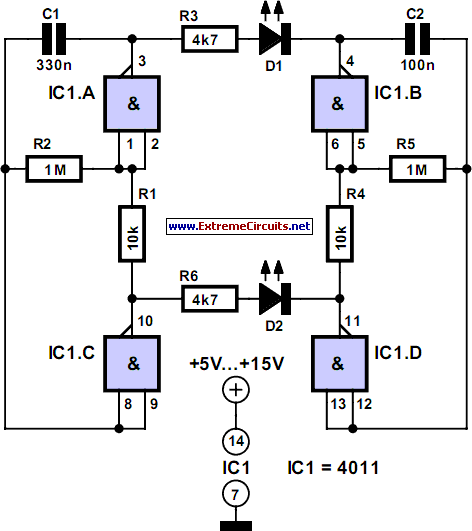
Irregular Flasher
Two multivibrators with different frequencies can be constructed using the NAND gates of a 4011 integrated circuit (IC). When the output of IC1, pin B is positive in relation to pin C, LED D1 illuminates. As the states of IC1,...

Electronic Communication Projects
When the output of the multivibrator is low, Q1 (an NPN transistor) will be OFF and Q2 (a PNP transistor) will be ON. Consequently, the negative terminal of capacitor C3 will be connected to ground, allowing it to charge from...

Electronic Head or Tail Circuit
The principle utilized in this electronic head or tail circuit is straightforward: a multivibrator controls a flip-flop. The multivibrator oscillates as long as the button S1 is pressed, while the flip-flop toggles on and off at a frequency of several...

Nearly half duty cycle multlvibrator
Three factors contribute to the output symmetry. The capacitor charges and discharges through the same external resistor. An internal resistive divider sets accurate switching thresholds within the chip; the bipolar types use dividers as well. Most importantly, the CMOS output...

One-Shot Multivibrator
A one-shot multivibrator generates a fixed-width pulse at the output when triggered by an input signal. This fixed-width output remains consistent, regardless of the input signal duration.
The one-shot multivibrator, also known as a monostable multivibrator, is a crucial component in...

Multivibrators including Monostable Astable and Bistable
Electronics tutorial about multivibrators, including monostable multivibrator circuits, astable multivibrators, bistable oscillators, and clocks.
Multivibrators are essential electronic circuits that generate specific output waveforms based on their configuration. They are classified into three primary types: monostable, astable, and bistable multivibrators. Each...

multivibrator
A multivibrator is a relaxation oscillator that utilizes two tubes, transistors, or other electronic devices.
A multivibrator circuit is a type of oscillator that generates a square wave output. It typically consists of two active devices, such as transistors or vacuum...
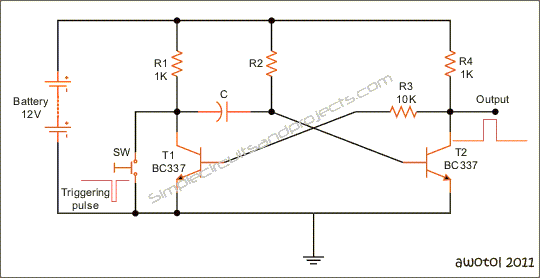
Multivibrator
Multivibrators are two-state (high or low) output circuits, which include oscillators, timers, and flip-flops. They are primarily used in applications involving timing, pulse generation, or pulse triggering of other devices. There are three types of multivibrators: monostable, bistable, and astable....

INVERTER_AND_PULSE_STRETCHER
The circuit samples the output of a multiplexer and provides the necessary current for driving a transfluxor in an analog-to-digital converter that generates a six-bit binary Gray code. -N. Aron and C. Granger, Analog-To-Digital Converter Uses Transfluxors, Electronics, 35:20, p...