


Adjustable Regulator
#LM117
#adjustable regulator
#voltage regulation
#3-terminal regulator
#positive voltage
#external resistors
#load regulation
#overload protection
#transistor packages

Description: The LM117 series of adjustable 3-terminal positive voltage regulators is capable of supplying in excess of 1.5A over a 1.2V to 37V output range. They are exceptionally easy to use and require only two external resistors to set the output voltage. Further, both line and load regulation are better than standard fixed regulators. Also, the LM117 is packaged in standard transistor packages which are easily mounted and handled. In addition to higher performance than fixed regulators, the LM117 series offers full overload protection available only in IC's. Included on the chip are current limit, thermal overload protection and safe area protection. All overload protection circuitry remains fully functional even if the adjustment terminal is disconnected. Normally, no capacitors are needed unless the device is situated more than 6 inches from the input filter capacitors in which case an input bypass is needed. An optional output capacitor can be added to improve transient response. The adjustment terminal can be bypassed to achieve very high ripple rejection ratios which are difficult to achieve with standard 3-terminal regulators. Besides replacing fixed regulators, the LM117 is useful in a wide variety of other applications. Since the regulator is floating and sees only the input-to-output differential voltage, supplies of several hundred volts can be regulated as long as the maximum input to output differential is not exceeded, i.e., avoid short-circuiting the output. Also, it makes an especially simple adjustable switching regulator, a programmable output regulator, or by connecting a fixed resistor between the adjustment pin and output, the LM117 can be used as a precision current regulator. Supplies with electronic shutdown can be achieved by clamping the adjustment terminal to ground which programs the output to 1.2V where most loads draw little current. For applications requiring greater output current, see LM150 series (3A) and LM138 series (5A) data sheets. For the negative complement, see LM137 series data sheet. Features: Guaranteed 1% output voltage tolerance (LM317A), Guaranteed max. 0.01%/V line regulation (LM317A), Guaranteed max. 0.3% load regulation (LM117), Guaranteed 1.5A output current, Adjustable output down to 1.2V, Current limit constant with temperature, P+ Product Enhancement tested, 80 dB ripple rejection, Output is short-circuit protected.
The LM117 series voltage regulators are designed for a variety of applications where adjustable output voltage is required. The device operates as a 3-terminal linear voltage regulator, allowing for a wide output voltage range from 1.2V to 37V while delivering up to 1.5A of output current. The LM117's architecture includes two external resistors that set the output voltage, making it straightforward to configure for specific voltage requirements.
The regulator features both line and load regulation performance that exceeds that of standard fixed regulators, ensuring stable output even with variations in input voltage or load conditions. The IC includes built-in protection mechanisms such as current limit, thermal overload protection, and safe area protection, which enhance its reliability during operation. These protections remain active even if the adjustment terminal is disconnected, providing an additional layer of safety.
In typical applications, the LM117 does not require external capacitors unless the device is more than 6 inches away from the input filter capacitors, in which case an input bypass capacitor should be used. An optional output capacitor can be connected to improve transient response, ensuring that the output voltage remains stable during sudden load changes.
The regulator's adjustment terminal can be bypassed to achieve high ripple rejection ratios, which is advantageous in sensitive applications where noise must be minimized. This flexibility allows the LM117 to serve not only as a replacement for fixed regulators but also in various configurations such as adjustable switching regulators, programmable output regulators, or precision current regulators by connecting a fixed resistor between the adjustment pin and output.
The LM117 series is particularly useful in high-voltage applications due to its floating nature, which allows it to regulate supplies with input-output differentials of several hundred volts, provided that the maximum differential is not exceeded to avoid output short-circuiting. For applications that demand higher output currents, the LM150 (3A) and LM138 (5A) series offer suitable alternatives, while the LM137 series provides a complementary negative voltage regulation solution.
Key features of the LM117 include a guaranteed output voltage tolerance of 1%, excellent line regulation of 0.01%/V, load regulation of 0.3%, and a ripple rejection ratio of 80 dB, ensuring robust performance across a range of operating conditions. The output is also protected against short-circuit conditions, further enhancing the device's utility in demanding environments.The LM117 series of adjustable 3-terminal positive voltage regulators is capable of supplying in excess of 1.5A over a 1.2V to 37V output range. They are exceptionally easy to use and require only two external resistors to set the output voltage.
Further, both line and load regulation are better than standard fixed regulators. Also, the LM117 is packaged in standard transistor packages which are easily mounted and handled. In addition to higher performance than fixed regulators, the LM117 series offers full overload protection available only in IC's. Included on the chip are current limit, thermal overload protection and safe area protection. All overload protection circuitry remains fully functional even if the adjustment terminal is disconnected. Normally, no capacitors are needed unless the device is situated more than 6 inches from the input filter capacitors in which case an input bypass is needed.
An optional output capacitor can be added to improve transient response. The adjustment terminal can be bypassed to achieve very high ripple rejection ratios which are difficult to achieve with standard 3-terminal regulators. Besides replacing fixed regulators, the LM117 is useful in a wide variety of other applications. Since the regulator is floating” and sees only the input-to-output differential voltage, supplies of several hundred volts can be regulated as long as the maximum input to output differential is not exceeded, i.e., avoid short-circuiting the output.
Also, it makes an especially simple adjustable switching regulator, a programmable output regulator, or by connecting a fixed resistor between the adjustment pin and output, the LM117 can be used as a precision current regulator. Supplies with electronic shutdown can be achieved by clamping the adjustment terminal to ground which programs the output to 1.2V where most loads draw little current.
For applications requiring greater output current, see LM150 series (3A) and LM138 series (5A) data sheets. For the negative complement, see LM137 series data sheet. Features ? Guaranteed 1% output voltage tolerance (LM317A) ? Guaranteed max. 0.01%/V line regulation (LM317A) ? Guaranteed max. 0.3% load regulation (LM117) ? Guaranteed 1.5A output current ? Adjustable output down to 1.2V ? Current limit constant with temperature ? P+ Product Enhancement tested ? 80 dB ripple rejection ? Output is short-circuit protected
The LM117 series voltage regulators are designed for a variety of applications where adjustable output voltage is required. The device operates as a 3-terminal linear voltage regulator, allowing for a wide output voltage range from 1.2V to 37V while delivering up to 1.5A of output current. The LM117's architecture includes two external resistors that set the output voltage, making it straightforward to configure for specific voltage requirements.
The regulator features both line and load regulation performance that exceeds that of standard fixed regulators, ensuring stable output even with variations in input voltage or load conditions. The IC includes built-in protection mechanisms such as current limit, thermal overload protection, and safe area protection, which enhance its reliability during operation. These protections remain active even if the adjustment terminal is disconnected, providing an additional layer of safety.
In typical applications, the LM117 does not require external capacitors unless the device is more than 6 inches away from the input filter capacitors, in which case an input bypass capacitor should be used. An optional output capacitor can be connected to improve transient response, ensuring that the output voltage remains stable during sudden load changes.
The regulator's adjustment terminal can be bypassed to achieve high ripple rejection ratios, which is advantageous in sensitive applications where noise must be minimized. This flexibility allows the LM117 to serve not only as a replacement for fixed regulators but also in various configurations such as adjustable switching regulators, programmable output regulators, or precision current regulators by connecting a fixed resistor between the adjustment pin and output.
The LM117 series is particularly useful in high-voltage applications due to its floating nature, which allows it to regulate supplies with input-output differentials of several hundred volts, provided that the maximum differential is not exceeded to avoid output short-circuiting. For applications that demand higher output currents, the LM150 (3A) and LM138 (5A) series offer suitable alternatives, while the LM137 series provides a complementary negative voltage regulation solution.
Key features of the LM117 include a guaranteed output voltage tolerance of 1%, excellent line regulation of 0.01%/V, load regulation of 0.3%, and a ripple rejection ratio of 80 dB, ensuring robust performance across a range of operating conditions. The output is also protected against short-circuit conditions, further enhancing the device's utility in demanding environments.The LM117 series of adjustable 3-terminal positive voltage regulators is capable of supplying in excess of 1.5A over a 1.2V to 37V output range. They are exceptionally easy to use and require only two external resistors to set the output voltage.
Further, both line and load regulation are better than standard fixed regulators. Also, the LM117 is packaged in standard transistor packages which are easily mounted and handled. In addition to higher performance than fixed regulators, the LM117 series offers full overload protection available only in IC's. Included on the chip are current limit, thermal overload protection and safe area protection. All overload protection circuitry remains fully functional even if the adjustment terminal is disconnected. Normally, no capacitors are needed unless the device is situated more than 6 inches from the input filter capacitors in which case an input bypass is needed.
An optional output capacitor can be added to improve transient response. The adjustment terminal can be bypassed to achieve very high ripple rejection ratios which are difficult to achieve with standard 3-terminal regulators. Besides replacing fixed regulators, the LM117 is useful in a wide variety of other applications. Since the regulator is floating” and sees only the input-to-output differential voltage, supplies of several hundred volts can be regulated as long as the maximum input to output differential is not exceeded, i.e., avoid short-circuiting the output.
Also, it makes an especially simple adjustable switching regulator, a programmable output regulator, or by connecting a fixed resistor between the adjustment pin and output, the LM117 can be used as a precision current regulator. Supplies with electronic shutdown can be achieved by clamping the adjustment terminal to ground which programs the output to 1.2V where most loads draw little current.
For applications requiring greater output current, see LM150 series (3A) and LM138 series (5A) data sheets. For the negative complement, see LM137 series data sheet. Features ? Guaranteed 1% output voltage tolerance (LM317A) ? Guaranteed max. 0.01%/V line regulation (LM317A) ? Guaranteed max. 0.3% load regulation (LM117) ? Guaranteed 1.5A output current ? Adjustable output down to 1.2V ? Current limit constant with temperature ? P+ Product Enhancement tested ? 80 dB ripple rejection ? Output is short-circuit protected

Variable Voltage and Current Power Supply circuit
An alternative approach to utilizing operational amplifiers (op-amps) for power supply regulation is presented. This method necessitates an additional winding on the power transformer to provide the op-amps with a bipolar voltage of +/- 8 volts. The negative voltage generated...

Voltage regulator for projection lamp
The circuit regulates the RMS output voltage across a load, specifically a projection lamp, to 100 volts ±2% for input voltages ranging from 105 to 250 volts AC. This regulation is achieved by indirectly sensing the light output of lamp...

Design and making of the stabilized voltage supply of switch
Under the loading condition of the resistance, the output voltage (Uo) variable range is from 30V to 36V, with a maximum output current (Imax) of 2A. When the input voltage (U2) changes from 15V to 21V, the voltage regulation factor...
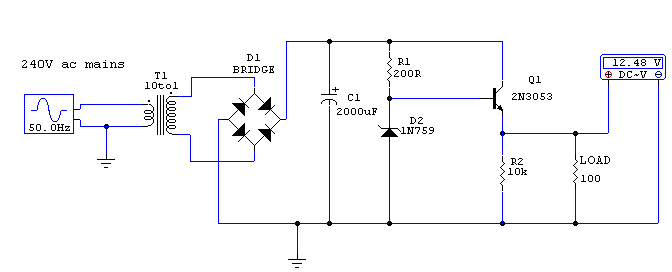
Regulated 12 Volt Supply
This circuit utilizes a 13-volt zener diode (D2) for voltage regulation. Approximately 0.7 volts are dropped across the base-emitter junction of the transistors, resulting in a higher current output of 12.3 volts. The circuit is capable of supplying loads up...

High Current Adjustable RegulatorCircuit Using LM117
The following circuit diagram illustrates the application of the LM117 as a high current adjustable regulator. The LM117 is capable of supplying more than 1.5A.
The LM117 is a popular adjustable voltage regulator that is designed to provide a stable output...

Power Supply 0-30V / 0-2A
The basic requirements for a laboratory power supply are to provide the necessary voltages and currents with low output resistance, low noise, minimal ripple, and good stabilization. These requirements are addressed within the circuit design. Many power supplies incorporate electronic...
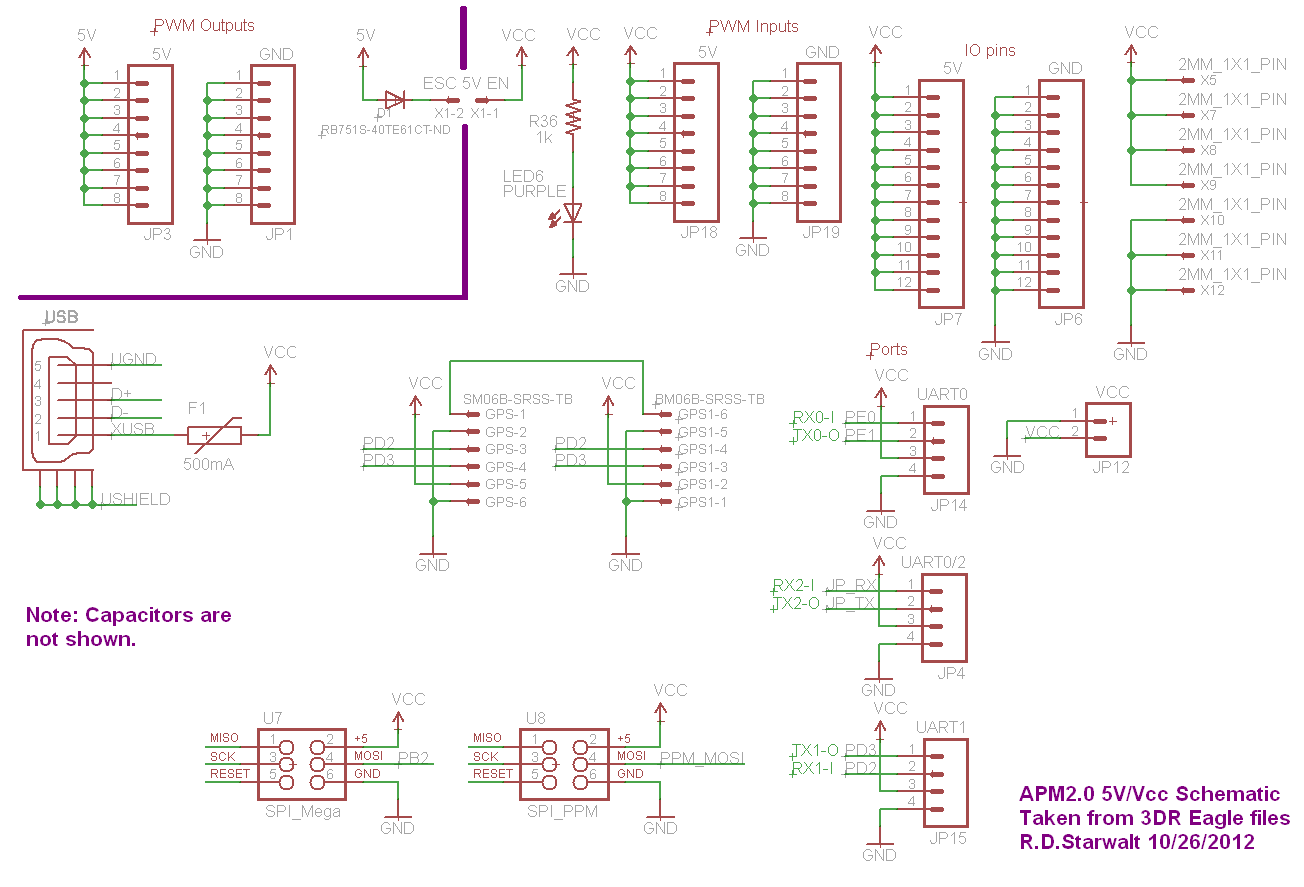
APM2.0 5V/Vcc Schematic
The PWM Output section has been separated into the upper left corner, delineated by a heavy purple line that is bridged by jumper JP1 on the APM2.0. This design choice highlights that diode D1 allows current to pass through JP1,...

Regulator circuit silicon resistor formed
The simple voltage regulator circuit consists of a silicon regulator and a resistor. It is designed to rectify and filter DC voltage, as illustrated in the accompanying figure. The voltage regulator is connected in parallel with the load, and the...
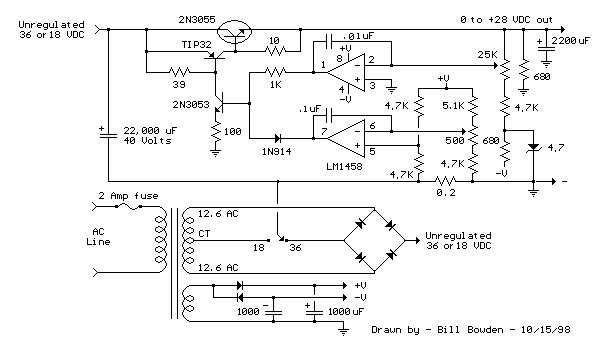
Current and Variable Voltage Power Supply
Another adjustment of application operational amplifiers to adapt a power supply is apparent below. The power supply requires an additional adjustment to supply the op-amps with a bipolar voltage (+/- 8 volts), and the negative voltage is also used to...