


LM10 Current Regulator
#current regulator
#LM10
#voltage source
#load regulation
#constant current
#circuit protection
#power management
#electronic components

Description: A current regulator functions as a load when connected to a voltage source or in series between a voltage source and an actual load. The primary characteristic of a current regulator is to maintain a constant current output regardless of variations in the load resistance or supply voltage.
A current regulator circuit is designed to ensure that a specific current flows through a load, providing stability in applications where current fluctuations could lead to undesirable performance or damage. The circuit typically consists of an operational amplifier (op-amp), a reference voltage source, and a pass element such as a transistor or MOSFET.
In operation, the op-amp compares the voltage across a sensing resistor, which is in series with the load, to a predetermined reference voltage. When the load current increases and the voltage across the sensing resistor exceeds the reference voltage, the op-amp's output will adjust the gate or base of the pass element, reducing the current flow to maintain the desired output. Conversely, if the load current decreases, the op-amp will increase the output to allow more current to flow.
This feedback mechanism allows the current regulator to adapt to changes in load conditions while ensuring that the current remains stable. The design can be applied in various scenarios, including LED drivers, battery chargers, and precision current sources in laboratory settings. Proper selection of components, including the op-amp, pass element, and sensing resistor, is crucial for achieving the desired performance and stability in the current regulation process.Current regulator acts like a load when connected to a voltage source, or in series between voltage source and real load. The main characteristic of a current..
A current regulator circuit is designed to ensure that a specific current flows through a load, providing stability in applications where current fluctuations could lead to undesirable performance or damage. The circuit typically consists of an operational amplifier (op-amp), a reference voltage source, and a pass element such as a transistor or MOSFET.
In operation, the op-amp compares the voltage across a sensing resistor, which is in series with the load, to a predetermined reference voltage. When the load current increases and the voltage across the sensing resistor exceeds the reference voltage, the op-amp's output will adjust the gate or base of the pass element, reducing the current flow to maintain the desired output. Conversely, if the load current decreases, the op-amp will increase the output to allow more current to flow.
This feedback mechanism allows the current regulator to adapt to changes in load conditions while ensuring that the current remains stable. The design can be applied in various scenarios, including LED drivers, battery chargers, and precision current sources in laboratory settings. Proper selection of components, including the op-amp, pass element, and sensing resistor, is crucial for achieving the desired performance and stability in the current regulation process.Current regulator acts like a load when connected to a voltage source, or in series between voltage source and real load. The main characteristic of a current..
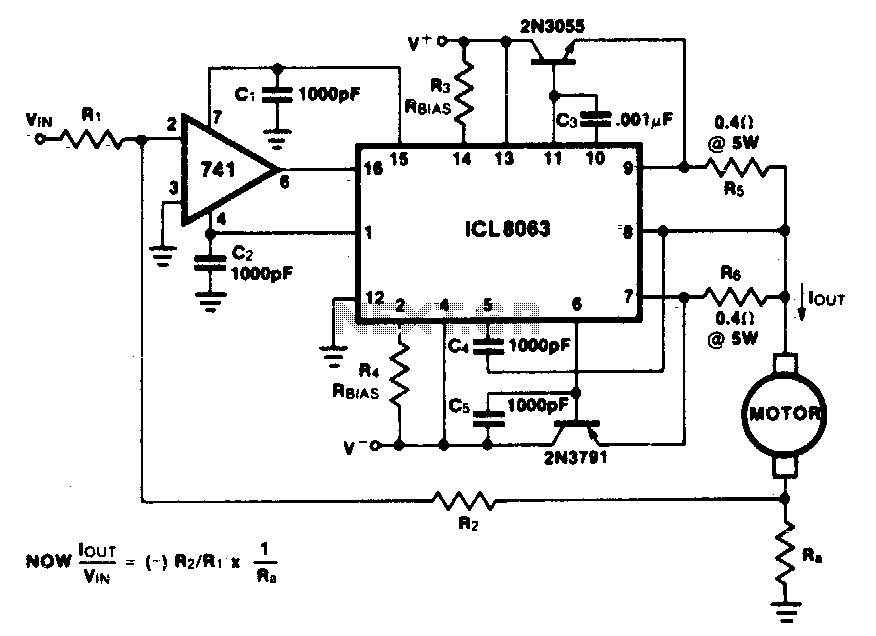
Constant current motor drive circuit
This minimum device circuit can be used to drive DC motors where there is some likelihood of stalling or lock-up. If the motor locks, the current drive remains constant, and the system does not destroy itself.
This circuit is designed to...

Current Regulators For LEDs
The following are current regulator circuits that can be used to drive light emitting diodes. As always, take time to do some testing before attempting to use these circuits in actual applications.
Current regulator circuits are essential for controlling the current...

Application of the constant current source circuit by the W7805
The circuit is composed of a W7805 positive current source application integration circuit that includes a voltage regulator. The W7805 regulator operates in suspension. A resistor is placed between its output terminal and the common terminal, forming a constant current....

supernode dependent voltage source
The top right node is connected to two voltage sources and contains three elements. All other nodes also have three elements. The selection of the top right node is significant because it allows for the determination of the node voltages...

Adjustable Constant Current Regulator
This is an adjustable constant current regulator circuit. This circuit can be used in a bench power supply to prevent the circuits that are tested from being damaged.
The adjustable constant current regulator circuit is designed to provide a stable output...

A Power Management Interface Circuit For Telecom Hot Swap With Local Dc/dc Conve
New cellular phones have incorporated high-resolution cameras that require bright illumination of the surrounding area to achieve high-quality pictures. Traditional xenon-filled photo flashes cannot be used due to the limited space available in cellular phone cameras. Instead, design engineers utilize...

Constant current charging circuit long delay
A constant current charging circuit with a long delay is implemented using the CD4541, which constitutes a constant current charging circuit suitable for Ni-Cd batteries. Upon powering on, the CD4541 output at pin high activates the TWH8778 electronic switch, allowing...

1 mA CURRENT SINKl
The constant current charging circuit, which consists of a three-port voltage stabilizer, is illustrated in figure 2-21. The electric potential difference between pin-1 and pin-2 of the LM317 is 1.25V. Ignoring the shunting effects of resistors R3, R1, and the...

Comparison of various circuit diagram VI conversion and a constant current source
The circuit is designed to provide several constant current outputs to the load resistor RL. The first RL is floating and is rarely utilized. The second RL serves as a virtual ground and is not commonly used either. The third...