


Logic Power Control for 78xx Regulator
#78xx
#voltage regulator
#logic control
#power management
#digital control
#analog regulator
#EEPROM
#power supply
#circuit control
#embedded systems

Description: Logic power control of an analog regulator can be useful in applications where a digital circuit or controller needs to manage a power source, such as in EEPROM.
In electronic systems, managing power effectively is crucial for the performance and reliability of various components. The logic power control of an analog regulator serves as an essential interface between digital circuits and power sources. This setup is particularly valuable in applications like Electrically Erasable Programmable Read-Only Memory (EEPROM), where precise control over power supply is necessary to ensure data integrity and operational stability.
The analog regulator typically regulates the output voltage to a stable level required by the digital circuit. The logic power control mechanism allows a digital controller to enable or disable the power supply to the analog regulator. This is achieved through a control signal generated by the digital circuit, which can be a simple logic high or low signal. When the control signal is high, the analog regulator activates, providing the necessary voltage to the EEPROM. Conversely, when the control signal is low, the regulator turns off, effectively cutting off the power supply to the EEPROM, which can help conserve energy and reduce unnecessary power consumption.
The circuit design may include additional components such as transistors or MOSFETs to facilitate the switching action of the power control. These components can handle higher current loads and provide isolation between the digital control signal and the analog power circuit, ensuring that the digital logic does not interfere with the sensitive analog signals. Furthermore, protection mechanisms such as diodes may be incorporated to prevent reverse current flow and safeguard the components from potential damage.
Overall, the integration of logic power control in an analog regulator presents a versatile solution for power management in digital applications, enhancing the efficiency and functionality of systems that rely on precise power delivery.Logic power control of analog regulator can be useful in application where a digital circuit/controller need to control power source, such as in EEPROM.
In electronic systems, managing power effectively is crucial for the performance and reliability of various components. The logic power control of an analog regulator serves as an essential interface between digital circuits and power sources. This setup is particularly valuable in applications like Electrically Erasable Programmable Read-Only Memory (EEPROM), where precise control over power supply is necessary to ensure data integrity and operational stability.
The analog regulator typically regulates the output voltage to a stable level required by the digital circuit. The logic power control mechanism allows a digital controller to enable or disable the power supply to the analog regulator. This is achieved through a control signal generated by the digital circuit, which can be a simple logic high or low signal. When the control signal is high, the analog regulator activates, providing the necessary voltage to the EEPROM. Conversely, when the control signal is low, the regulator turns off, effectively cutting off the power supply to the EEPROM, which can help conserve energy and reduce unnecessary power consumption.
The circuit design may include additional components such as transistors or MOSFETs to facilitate the switching action of the power control. These components can handle higher current loads and provide isolation between the digital control signal and the analog power circuit, ensuring that the digital logic does not interfere with the sensitive analog signals. Furthermore, protection mechanisms such as diodes may be incorporated to prevent reverse current flow and safeguard the components from potential damage.
Overall, the integration of logic power control in an analog regulator presents a versatile solution for power management in digital applications, enhancing the efficiency and functionality of systems that rely on precise power delivery.Logic power control of analog regulator can be useful in application where a digital circuit/controller need to control power source, such as in EEPROM.

Increase Regulator Voltage Output Schematic Diagram
It is often necessary to configure a voltage regulator integrated circuit (IC) to provide a higher output voltage than that established by the regulator alone. One method to achieve this is by connecting the common terminal to the midpoint of...

KC2ZPLs Web Design and Electronic Home
Now that these power supplies are available, it would be beneficial to evaluate their performance. Traditionally, an adjustable load (a robust resistor) is connected to the output to measure both output voltage and current at various points. This allows for...

Dual Voltage 12V Power Supply
The following circuit diagram of a dual voltage power supply can be used for miscellaneous applications. It requires a few components to build. The most important components of this circuit are regulators: 1: (AN) 7812 and 2: (AN) 7912. AN7812...

Voltage Regulator Calculation
Before designing an adjustable voltage regulator into a circuit or performing a redesign, it is essential to calculate the values for two resistors. While this calculation is straightforward, locating the appropriate resistors may present challenges. Fortunately, a technique exists to...

Auto Fuse for power supply
The power supply, with electronic stabilization - mainly those of laboratories - should be protected from overcurrent that emanates from short-circuits, erroneous association, or damage of repaired appliances. The circuit offers effective protection in power supply with output voltage up...

12v power supply circuit
This project involves a straightforward and practical 12V power supply circuit utilizing the LM7812 integrated circuit (IC). The LM7812 is a three-terminal fixed voltage regulator IC housed in a TO-220 package. It incorporates several built-in features such as thermal shutdown,...

A TREAD sized regulator
The size of the tread was 5 cm by 3 cm. The current design measures 5 cm by 3.3 cm. The regulator's foundation is based on Walt Jung's 1997 article, "Regulator Excels in Noise and Line Rejection," with modifications derived...

MDRC Mark 4 20 Amp Power Supply
The MDRC committee approached the author to take on the role of Electronic Components and Project Officer, which was accepted without hesitation. Upon assuming the position, it became evident that more time would be required than initially anticipated, primarily for...
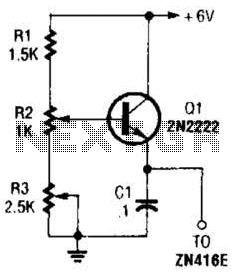
+1.5V Supply For Zn416E circuits
This regulator can be used with a +6-V source to supply the ZN416E low-voltage TRF radio receiver IC with the necessary +1.5 V. R3 sets the output voltage.
The circuit utilizes a voltage regulator designed to convert a +6 V input...