


Power Supply Current and Voltage Regulated By LM317 or LM350
#LM317
#LM350
#current regulation
#voltage regulation
#rotary switch
#potentiometer
#power supply
#adjustable regulator

Description: This circuit employs a rotary switch to select various current ranges, as using a potentiometer is not practical for lower resistance and high current ranges. However, a potentiometer can be utilized for lower current ranges, with the lowest switch range potentially being a potentiometer combined with a small series resistor. This allows for adjustment from approximately 10 mA to 500 mA. Fixed resistors are recommended for higher current ranges. It is advisable to construct two of these circuits to facilitate both positive and negative supply voltages when necessary. The circuits can be connected in parallel or series to accommodate higher currents or voltages, as required. The output voltage and current are influenced by the transformer used, as well as the choice of voltage regulator, with options including the LM317 for a maximum of 1.5 amps or the LM350 for a maximum of approximately 3 amps.
This circuit design utilizes a rotary switch to effectively manage current range selection, which is essential in applications requiring precise current control. The rotary switch offers a reliable method to toggle between different resistance settings, optimizing the circuit's performance across various operational conditions.
For the lower current ranges, incorporating a potentiometer allows for fine-tuning of the current output, enhancing the versatility of the circuit. The inclusion of a small series resistor with the potentiometer ensures that the circuit remains stable and prevents excessive current flow that could lead to damage.
In higher current applications, fixed resistors are preferred as they provide consistent and reliable performance without the variability introduced by a potentiometer. The recommendation to construct two circuits allows for dual polarity operation, which is beneficial in many electronic applications where both positive and negative voltages are required.
Connecting the circuits in parallel can increase the total current capacity, while a series configuration can elevate the output voltage, enabling the design to adapt to a wide range of power requirements.
The selection of the transformer is critical, as it determines the input voltage and current available to the circuit. The choice of voltage regulator, such as the LM317 or LM350, further influences the maximum output current. The LM317 is suitable for applications requiring up to 1.5 amps, while the LM350 can handle up to approximately 3 amps, allowing for flexibility depending on the specific needs of the application.
Overall, this circuit provides a robust solution for applications requiring adjustable current ranges, with considerations for safety, stability, and adaptability to various electrical demands.In this circuit I have used a Rotary Switch to select Various Current ranges as a Potentiometer is not very practical for the lower resistance/High Current Ranges. But if you wish to change it to a pot, you can try it. * It is practical to use a pot on the lower current ranges so the lowest switch range could be a pot with a small series resistor.
Allowing for adjustment from say 10 mA to 500 mA . Than use fixed resistors on the higher current ranges. I recommend in making two of these. This will allow for Plus and Minus supply voltages, when needed. They can Also be Paralleled or placed in Series for Higher Currents or Higher Voltages, As is Sometimes Needed. Output Voltage and current depends somewhat on the transformer used, as well as which Regulator used.
You have a choice of an LM317 for 1. 5 amps Max, or an LM350 to give about 3 amps Max.
This circuit design utilizes a rotary switch to effectively manage current range selection, which is essential in applications requiring precise current control. The rotary switch offers a reliable method to toggle between different resistance settings, optimizing the circuit's performance across various operational conditions.
For the lower current ranges, incorporating a potentiometer allows for fine-tuning of the current output, enhancing the versatility of the circuit. The inclusion of a small series resistor with the potentiometer ensures that the circuit remains stable and prevents excessive current flow that could lead to damage.
In higher current applications, fixed resistors are preferred as they provide consistent and reliable performance without the variability introduced by a potentiometer. The recommendation to construct two circuits allows for dual polarity operation, which is beneficial in many electronic applications where both positive and negative voltages are required.
Connecting the circuits in parallel can increase the total current capacity, while a series configuration can elevate the output voltage, enabling the design to adapt to a wide range of power requirements.
The selection of the transformer is critical, as it determines the input voltage and current available to the circuit. The choice of voltage regulator, such as the LM317 or LM350, further influences the maximum output current. The LM317 is suitable for applications requiring up to 1.5 amps, while the LM350 can handle up to approximately 3 amps, allowing for flexibility depending on the specific needs of the application.
Overall, this circuit provides a robust solution for applications requiring adjustable current ranges, with considerations for safety, stability, and adaptability to various electrical demands.In this circuit I have used a Rotary Switch to select Various Current ranges as a Potentiometer is not very practical for the lower resistance/High Current Ranges. But if you wish to change it to a pot, you can try it. * It is practical to use a pot on the lower current ranges so the lowest switch range could be a pot with a small series resistor.
Allowing for adjustment from say 10 mA to 500 mA . Than use fixed resistors on the higher current ranges. I recommend in making two of these. This will allow for Plus and Minus supply voltages, when needed. They can Also be Paralleled or placed in Series for Higher Currents or Higher Voltages, As is Sometimes Needed. Output Voltage and current depends somewhat on the transformer used, as well as which Regulator used.
You have a choice of an LM317 for 1. 5 amps Max, or an LM350 to give about 3 amps Max.

music circuit
This circuit allows for the adjustment of resistance using a potentiometer and the adjustment of capacitance by opening or closing switches. By manipulating the configuration of these switches, various combinations can be achieved to obtain different effective capacitance values. It...

current limiter circuit diagram
The LM117/LM317 from National Semiconductor Corporation is a three-terminal adjustable positive voltage regulator integrated circuit (IC). The output voltage range of the LM117/LM317 is from 1.2V to 37V with a load current capability of up to 1.5A. It is straightforward...
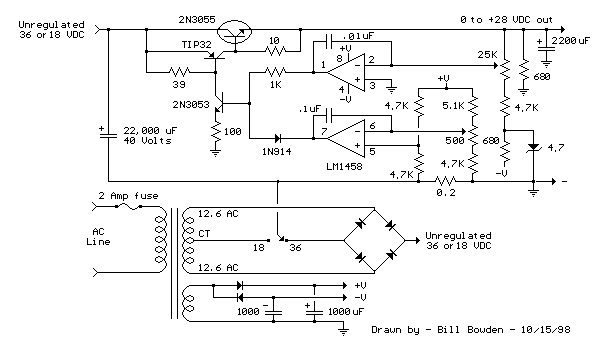
Current and Variable Voltage Power Supply
Another adjustment of application operational amplifiers to adapt a power supply is apparent below. The power supply requires an additional adjustment to supply the op-amps with a bipolar voltage (+/- 8 volts), and the negative voltage is also used to...

switching power supply schematic
This post summarizes the work of experts in switching power supply schematic diagrams who are thoroughly knowledgeable about all aspects of the subject.
Switching power supplies are crucial components in modern electronic devices, providing efficient voltage regulation and power conversion. The...
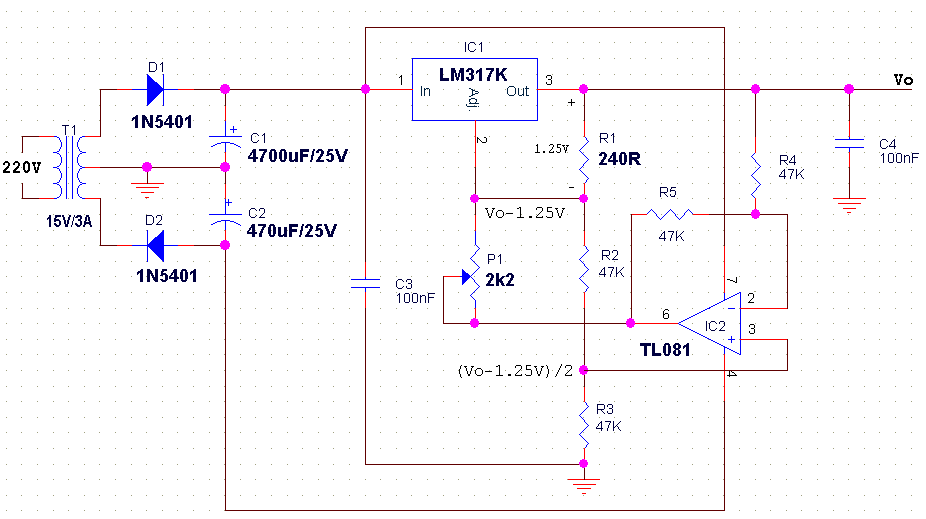
12Vdc 3A Adjustable Regulator Power Supply Circuit with LM317The LM317
The LM317 is an adjustable, positive 3-terminal voltage regulator capable of supplying 100 mA (for RA87U control) or 1.5 A (for Order Code UF27E and N61CA) across an output voltage range of 1.2 V to 37 V. These voltage regulators...

0-30 VDC Stabilized Power Supply with Current Control 0.002-3 A
The circuit begins with a step-down mains transformer featuring a secondary winding rated at 24 V/3 A, which connects across the input points at pins 1 and 2. The quality of the output supply is directly related to the transformer's...

power supply circuit
The SheevaPlug is known to have a suboptimal power supply, particularly affecting users in the UK operating at 240VAC. Additionally, heavy loads on the USB can cause issues, especially when connecting an external mechanical disk drive. This project aims to...

LM317 audio amplifier
The LM317 integrated circuit is commonly recognized as an adjustable voltage regulator; however, it can also function as an audio amplifier. This configuration represents a Class A audio amplifier utilizing the LM317, capable of delivering a maximum audio power output...
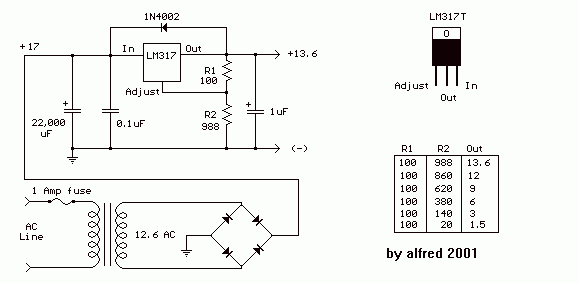
LM317 variable power supply
It's a variable power supply based on an LM317 voltage regulator. The range of power is between 1.6 and 13.5 volts, and it can provide up to 1.5 Amps if supplied with an adequate cooler, such as an aluminum plate....