


Wirelessly Powering a Swarm of Robots
#wireless power transfer
#robots
#energy transmission
#Intel
#Tesla
#swarm robotics
#60 Watts
#incandescent bulb
#electrical energy
#technology

Description: Wireless power transfer is not a new concept; it has been discussed since Tesla's patent in 1900, titled "Apparatus for Transmission of Electrical Energy" (USPTO #649, 621). As the technology evolves, the range of potential applications will expand. For instance, Intel's system can transmit up to 60 Watts with approximately 75% efficiency, demonstrated by lighting an incandescent bulb. The goal is to eventually enable remote charging of laptops. In the field of robotics, wireless power has the potential to revolutionize research and applications involving swarms of small robots (mini/micro). Tethering multiple robots or frequently changing batteries is impractical, especially for swarms consisting of hundreds or even just a dozen robots. An example is the battery-powered robot swarm developed by Caprari at EPFL in Switzerland, which operates around 100 robots simultaneously. Connecting 100 robots for battery charging presents significant challenges and impedes research. Instead, inductively-coupled wireless power can be employed, similar to Low-Frequency (125kHz) RFID, to power the swarm or facilitate simultaneous, contactless battery recharging. This is the objective of the work presented by Deyle and Reynolds in surface-based wireless power transmission and bidirectional communication for autonomous robot swarms. The fundamental design is straightforward and can be prototyped using discrete components and basic microcontrollers, making the technology accessible to researchers and hobbyists. The surface is equipped with a transmit coil that operates in resonance to enhance circulating current and increase magnetic flux, thereby providing a higher power density on the surface. Consequently, all robots can either operate simultaneously on the surface or remain stationary to recharge their onboard energy storage (such as a large capacitor or battery).
The wireless power transfer system described utilizes inductive coupling to transmit energy efficiently over short distances. The core component is a resonant transmit coil, which generates an oscillating magnetic field when energized. This magnetic field induces a current in a corresponding receive coil located within the robots. The design of the transmit coil is crucial; it must be tuned to resonate at the operating frequency (e.g., 125 kHz). This resonance enhances the system's efficiency, allowing for the transfer of power with minimal losses.
The surface design is optimized to accommodate multiple robots, ensuring that the magnetic field is strong enough to power all units simultaneously. The use of basic microcontrollers for control and communication allows for the integration of various operational modes, such as energy harvesting and data transmission. Each robot can be equipped with a receive coil and a suitable energy storage device, such as a lithium-ion battery or supercapacitor, to ensure reliable power supply during operation.
The system's efficiency is a critical factor, with approximately 75% efficiency achieved in initial tests. This level of efficiency is essential for practical applications, especially in scenarios where robots operate continuously or in swarms. Future developments may include enhancements to the coil design, optimization of the operating frequency, and advanced control algorithms to manage power distribution among multiple robots effectively.
Overall, the described wireless power transfer system holds significant promise for applications in robotics, enabling more flexible and efficient operation of autonomous systems while reducing the logistical challenges associated with battery management.Wireless power transfer is nothing new; it has been discussed since Tesla`s patent in 1900 entitled "Apparatus for Transmission of Electrical Energy" (USPTO #649, 621). However, as the technology matures, it will be interesting to see what myriad applications arise. For example, Intel`s system is capable of transmitting up to 60 Watts (the demo of lighting an incandescent bulb)
around 75% efficiency. They hope to one day use the system to remotely charge laptops. Meanwhile for robotics, wireless power has the capability to transform research and applications involving swarms of small (mini/micro) robots. When dealing with robot swarms numbering in the hundreds or even just a dozen, tethering is impractical and changing batteries is cumbersome.
By way of an example, consider the battery-powered robot swarm by Caprari from EPFL in Switzerland, where they have ~100 robots operating simultaneously. Hooking up 100 robots for battery charging does not sound like such a fun prospect - more importantly, it is a significant research impediment.
Instead, it is possible to use inductively-coupled wireless power, in a manner similar to Low-Frequency (125kHz) RFID, to power the swarm or just to perform simultaneous, contact-less battery recharging. This is the goal of the work presented by Deyle (myself) and Reynolds in Surface based wireless power transmission and bidirectional communication for autonomous robot swarms.
What`s great about this work is that the fundamental design is straight-forward, and can be prototyped using discrete components and basic microcontrollers, making the technology available to researchers and hobbyists alike. The surface is outfitted with a transmit coil. This coil operates in resonance to increase the circulating current and thus increase the magnetic flux - providing increased power density on the surface.
Now all of the robots can either operate simultaneously on the surface, or they can sit still and recharge on-board energy storage (such as a large capacitor or battery)! Here is what it looks like in operation (along with a wirelessly-powered LED).
The wireless power transfer system described utilizes inductive coupling to transmit energy efficiently over short distances. The core component is a resonant transmit coil, which generates an oscillating magnetic field when energized. This magnetic field induces a current in a corresponding receive coil located within the robots. The design of the transmit coil is crucial; it must be tuned to resonate at the operating frequency (e.g., 125 kHz). This resonance enhances the system's efficiency, allowing for the transfer of power with minimal losses.
The surface design is optimized to accommodate multiple robots, ensuring that the magnetic field is strong enough to power all units simultaneously. The use of basic microcontrollers for control and communication allows for the integration of various operational modes, such as energy harvesting and data transmission. Each robot can be equipped with a receive coil and a suitable energy storage device, such as a lithium-ion battery or supercapacitor, to ensure reliable power supply during operation.
The system's efficiency is a critical factor, with approximately 75% efficiency achieved in initial tests. This level of efficiency is essential for practical applications, especially in scenarios where robots operate continuously or in swarms. Future developments may include enhancements to the coil design, optimization of the operating frequency, and advanced control algorithms to manage power distribution among multiple robots effectively.
Overall, the described wireless power transfer system holds significant promise for applications in robotics, enabling more flexible and efficient operation of autonomous systems while reducing the logistical challenges associated with battery management.Wireless power transfer is nothing new; it has been discussed since Tesla`s patent in 1900 entitled "Apparatus for Transmission of Electrical Energy" (USPTO #649, 621). However, as the technology matures, it will be interesting to see what myriad applications arise. For example, Intel`s system is capable of transmitting up to 60 Watts (the demo of lighting an incandescent bulb)
around 75% efficiency. They hope to one day use the system to remotely charge laptops. Meanwhile for robotics, wireless power has the capability to transform research and applications involving swarms of small (mini/micro) robots. When dealing with robot swarms numbering in the hundreds or even just a dozen, tethering is impractical and changing batteries is cumbersome.
By way of an example, consider the battery-powered robot swarm by Caprari from EPFL in Switzerland, where they have ~100 robots operating simultaneously. Hooking up 100 robots for battery charging does not sound like such a fun prospect - more importantly, it is a significant research impediment.
Instead, it is possible to use inductively-coupled wireless power, in a manner similar to Low-Frequency (125kHz) RFID, to power the swarm or just to perform simultaneous, contact-less battery recharging. This is the goal of the work presented by Deyle (myself) and Reynolds in Surface based wireless power transmission and bidirectional communication for autonomous robot swarms.
What`s great about this work is that the fundamental design is straight-forward, and can be prototyped using discrete components and basic microcontrollers, making the technology available to researchers and hobbyists alike. The surface is outfitted with a transmit coil. This coil operates in resonance to increase the circulating current and thus increase the magnetic flux - providing increased power density on the surface.
Now all of the robots can either operate simultaneously on the surface, or they can sit still and recharge on-board energy storage (such as a large capacitor or battery)! Here is what it looks like in operation (along with a wirelessly-powered LED).

Donald Smith Devices too good to be true 13
Farmhand has read several pages and is attempting to understand more of the book. It can be challenging to comprehend at times how Tesla was able to achieve certain feats.
The provided text reflects an individual's struggle to fully grasp the...

wirelles power transfer using tesla coils
This project is a successor to SSTC1, which has been retired. The purpose of this coil is to operate with its breakout suppressed, demonstrating the concept of wireless power that Tesla himself worked on during his time. Further videos and...

Tesla / Imhotep Radiant Energy Circuit
An individual has been studying Nikola Tesla's work for approximately 11 months and recently discovered Imhotep's concept of Radiant energy.
The study of Nikola Tesla's contributions to electrical engineering and energy transmission has led to significant advancements in understanding electromagnetic fields...
nicola teslas electric car revealed
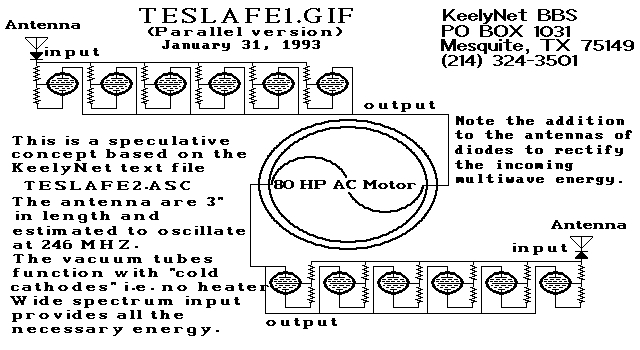
Two schematic diagrams illustrate a series and a parallel circuit configuration that Tesla may have utilized. The components featured are the 70L7GT Half Wave Rectifier tubes, which are surprisingly still available today. While there is an interest in accessing further...

Dont Kill Dipole
This is a quote attributed to Tesla, taken from his work "On Light and Other High Frequency Phenomena," discussing phenomena produced by various high-frequency effects.
The work of Nikola Tesla, particularly in "On Light and Other High Frequency Phenomena," delves into...