LM386
LM386 Low Voltage Audio Power Amplifier
Overview
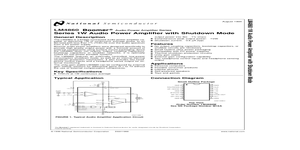
The LM386 is a versatile, low-voltage audio power amplifier designed for consumer applications where space and power efficiency are critical. This IC is capable of providing adequate amplification for small speakers while operating from a single power supply, making it ideal for battery-powered devices. With its minimal external component requirements and flexible gain configuration, the LM386 has become a staple in low-power audio applications.
This amplifier operates over a wide voltage range (4V-12V or 5V-18V depending on model variant) and can deliver up to 1 watt of output power into an 8-ohm load. The quiescent current drain is remarkably low (approximately 4mA), making it particularly suitable for portable applications where battery life is a primary concern.
Key Features
- Battery operation capability (4V-12V or 5V-18V)
- Low quiescent current: 4mA (typical)
- Internally set gain of 20 (26dB)
- Adjustable gain up to 200 (46dB) with external components
- Wide supply voltage range
- Low distortion: 0.2% (typical)
- Input referenced to ground
- No bootstrap capacitors required
- Available in 8-pin DIP, SOIC, and other packages
- Output power: up to 1W depending on supply voltage
- No output coupling capacitors required
Applications
The LM386 finds use in numerous audio applications where moderate power output and efficiency are required:
- Portable audio devices
- AM-FM radio amplifiers
- Intercom systems
- TV sound systems
- Line drivers
- Ultrasonic drivers
- Small servo drivers
- Power converters
- Educational electronics projects
- DIY audio projects and hobbyist applications
Electrical Characteristics
The following specifications are typical for VCC = 6V, TA = 25°C, RL = 8Ω, unless otherwise noted:
DC Characteristics
- Supply Voltage Range: 4V-12V (LM386N-1, LM386N-3), 5V-18V (LM386N-4)
- Quiescent Current: 4mA (typical)
- Output Power:
- 325mW (typical) at 6V, 8Ω, 10% THD
- 700mW (typical) at 9V, 8Ω, 10% THD
- 1W (typical) at 16V, 8Ω, 10% THD
AC Characteristics
- Voltage Gain: 20 (26dB) internally, adjustable to 200 (46dB)
- Bandwidth: 300kHz (typical)
- Input Resistance: 50kΩ (typical)
- Total Harmonic Distortion: 0.2% (typical) at 125mW, 8Ω
- Input Noise: 2μV (typical)
Pin Configuration and Functions
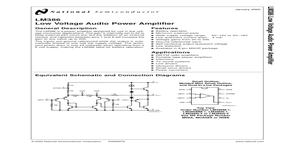
The LM386 is available in an 8-pin configuration:
- Pin 1 (Gain): Gain setting (when connected with Pin 8 via RC network)
- Pin 2 (Inverting Input): Inverting input (typically grounded)
- Pin 3 (Non-Inverting Input): Audio signal input
- Pin 4 (GND): Ground reference
- Pin 5 (Output): Amplified audio output
- Pin 6 (VCC): Positive power supply input
- Pin 7 (Bypass): Bypass capacitor connection for ripple rejection
- Pin 8 (Gain): Gain setting (when connected with Pin 1 via RC network)
Package Information
The LM386 is available in several package options to suit different application requirements:
Standard Package Options
- PDIP-8 (N): Plastic Dual In-Line Package
- Dimensions: 9.81mm x 6.35mm body
- Lead pitch: 2.54mm
- Operating temperature: 0°C to +70°C
- SOIC-8 (D): Small Outline Integrated Circuit
- Dimensions: 4.9mm x 3.91mm body
- Lead pitch: 1.27mm
- Operating temperature: 0°C to +70°C
- TO-99 (H): Metal Can Package
- Diameter: 9.08mm
- Height: 6.67mm
- Operating temperature: -40°C to +85°C
Typical Application Circuit
The basic LM386 application requires minimal external components:
- Power supply bypass capacitor (typically 10μF) between VCC and ground
- Input coupling capacitor (0.1μF to 1μF) in series with audio input
- Optional gain-setting network between pins 1 and 8 (10μF capacitor in parallel with 1.2kΩ resistor for 50x gain)
- Output coupling capacitor (250μF to 1000μF) for AC-coupled loads
- Bypass capacitor (10μF) on pin 7 to ground for improved ripple rejection
Design Considerations
When implementing the LM386 in a design, several factors should be considered:
Power Supply Requirements
- Use adequate power supply decoupling near the IC
- Higher voltages increase output power but also increase heat dissipation
- Battery operation benefits from the IC's low quiescent current
Thermal Considerations
- At higher supply voltages and output powers, consider heat sinking
- Maximum junction temperature: 150°C
- Thermal resistance (PDIP): 100°C/W (junction to ambient)
PCB Layout Guidelines
- Keep input traces short and away from output traces
- Use ground plane techniques for improved noise performance
- Place bypass capacitors as close as possible to the IC
- Consider separate analog and power ground paths
Performance Enhancement Techniques
Several methods can improve LM386 performance in specific applications:
- Bass Boost: Add a series RC network between input and ground
- Noise Reduction: Proper bypassing and grounding techniques
- Higher Output Power: Bridge multiple LM386s for increased power
- Improved Stability: Small capacitor (0.1μF) directly at output pin
Conclusion
The LM386 remains one of the most popular audio amplifier ICs decades after its introduction due to its simplicity, reliability, and versatility. Its ability to operate from a single power supply with minimal external components makes it ideal for battery-powered applications, educational projects, and cost-sensitive designs. While newer audio amplifiers offer better performance in some metrics, the