NE555
NE555 Timer IC Technical Summary
Overview
The NE555 is a highly stable monolithic timing circuit capable of producing precise time delays or oscillations. This versatile IC can operate in both monostable (one-shot) and astable (oscillator) modes, making it suitable for a wide range of timing applications. The device features excellent temperature stability (0.005% per °C) and can operate over a wide frequency range from microseconds to hours.
Originally developed by Signetics in 1972, the 555 timer has become one of the most popular integrated circuits in history due to its reliability, ease of use, and low cost. The NE555 variant is specified for commercial temperature ranges (0°C to +70°C), while other versions (SA555, SE555) are available for extended temperature ranges.
Key Features
- Highly stable operation with timing accuracy better than 0.005% per °C
- Fast turn-off time of less than 2µs
- Maximum operating frequency exceeding 500kHz
- Wide timing range from microseconds to hours
- Operates in both astable (free-running oscillator) and monostable (one-shot) modes
- High output current capability (200mA sink/source)
- Adjustable duty cycle in oscillator mode
- TTL-compatible output
- Can operate from wide supply voltage range (4.5V to 16V)
Applications
The NE555 finds use in numerous timing and pulse generation applications across various industries:
- Precision timing: Accurate delay generation for industrial control systems
- Pulse generation: Creating clock signals and timing pulses
- Sequential timing: Cascaded timing circuits for complex sequences
- Time delay generation: Industrial timers, appliance controls
- Pulse width modulation: Motor speed control, power regulation
- Missing pulse detection: Safety monitoring systems
- Frequency division: Clock dividers in digital systems
- Voltage-controlled oscillation: Modulators, tone generators
Electrical Characteristics
The following table summarizes key electrical parameters (typical values at 25°C, VCC = +5V to +15V unless otherwise specified):
- Supply Voltage Range: 4.5V to 16V
- Supply Current (VCC = 15V): 10mA typical
- Output Current: 200mA maximum
- Rise/Fall Time: 100ns typical
- Trigger Voltage: 1.67V minimum (at VCC = 5V)
- Threshold Voltage: 2/3 VCC
- Control Voltage Range: 2V to VCC-2V
- Output Voltage Drop: 1.7V typical (sink), 0.25V typical (source)
Package Information
The NE555 is available in multiple package options to suit different application requirements:
Standard Packages
- 8-Pin Plastic DIP (NE555N): 0.3" wide, 0°C to +70°C
- 8-Pin SOIC (NE555D): Surface mount, 0°C to +70°C
- 8-Pin CERDIP (SE555CFE): Hermetic ceramic, -55°C to +125°C
- 14-Pin CERDIP (SE555F): Alternate pinout, -55°C to +125°C
Ordering Information
- NE555D: SOIC-8, commercial temperature range
- NE555N: PDIP-8, commercial temperature range
- SA555D: SOIC-8, industrial temperature range (-40°C to +85°C)
- SA555N: PDIP-8, industrial temperature range
- SE555CFE: CERDIP-8, military temperature range (-55°C to +125°C)
- SE555F: CERDIP-14, military temperature range
Pin Configuration
The 8-pin version follows this pinout:
- Pin 1 (GND): Ground reference
- Pin 2 (TRIGGER): Input for starting timing cycle (active low)
- Pin 3 (OUTPUT): Timer output (totem pole or open collector)
- Pin 4 (RESET): Active low reset (overrides all inputs)
- Pin 5 (CONTROL VOLTAGE): Access to internal voltage divider
- Pin 6 (THRESHOLD): Comparator input for ending timing cycle
- Pin 7 (DISCHARGE): Open collector output for capacitor discharge
- Pin 8 (VCC): Positive supply voltage (4.5V to 16V)
Functional Description
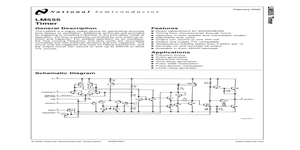
The NE555 contains approximately 25 transistors, 2 diodes, and 15 resistors arranged as follows:
- Voltage Divider: Three 5kΩ resistors create reference voltages of 1/3 VCC and 2/3 VCC
- Comparators: Two comparators monitor the trigger and threshold inputs
- Flip-Flop: SR flip-flop stores the state of the timer
- Output Stage: Totem-pole output capable of sourcing/sinking 200mA
- Discharge Transistor: Open-collector transistor for timing capacitor discharge
In monostable mode, the output pulse width is determined by t = 1.1 × R × C. In astable mode, the output frequency is given by f = 1.44/((R1 + 2R2) × C), with duty cycle controlled by the ratio of R1 to R2.
Design Considerations
- For stable operation, bypass VCC with 0.1µF capacitor close to the IC
- Use high-quality timing capacitors with low leakage
- Keep trigger pulses shorter than the output pulse in monostable mode
- For precise timing, use 1% tolerance resistors
- When driving inductive loads, include protection diodes
- For frequencies above 100kHz, consider layout and stray capacitance effects