TL497A
TL497A Switching Voltage Regulator Control Circuit
Overview
The TL497AC and TL497AI are monolithic integrated circuits designed to serve as the primary control element in switching voltage regulator applications. These devices integrate all necessary active functions required for constructing efficient step-up (boost), step-down (buck), or voltage inversion regulators. The TL497A series is particularly suited for applications demanding high efficiency and flexible configuration options.
These devices employ a fixed-on-time, variable-frequency control methodology, where the switch-on duration is precisely determined by an external timing capacitor. This architecture provides stable performance across the specified input voltage range of 4.5V to 12V, making the TL497A suitable for various power conversion scenarios.
Key Features
- Integrated Control Circuit: Contains all active components needed for switching regulator implementation
- Flexible Topology Support: Configurable for step-up, step-down, or voltage inversion applications
- Fixed On-Time Control: Programmable switch-on duration via external capacitor
- Wide Input Voltage Range: Operates from 4.5V to 12V input supply
- Current Limiting: Built-in protection against excessive output current
- Temperature Compensation: Maintains stable operation across temperature variations
- High Efficiency: Optimized for power-sensitive applications
- External Component Drive: Capable of driving external transistors for higher power applications
Applications
The TL497A finds use in numerous power conversion scenarios, including:
- DC-DC voltage converters
- Portable electronic device power supplies
- Battery-powered systems requiring voltage step-up or inversion
- Industrial control power subsystems
- Automotive electronics power management
- Telecommunications equipment power supplies
- Distributed power systems
- LED driver circuits
Electrical Characteristics
Absolute Maximum Ratings
- Supply Voltage (VCC): 15V
- Output Collector Voltage: 40V
- Output Emitter Voltage: -0.3V to +40V
- Output Collector Current: 500mA
- Power Dissipation: 1W
- Operating Temperature Range:
- TL497AC: 0°C to +70°C
- TL497AI: -40°C to +85°C
Typical Operating Characteristics
- Input Voltage Range: 4.5V to 12V
- Reference Voltage: 1.2V ±2%
- Oscillator Frequency Range: 1kHz to 100kHz (programmable via CT)
- Switch On-Time: Programmable from 10µs to 100µs
- Current Limit Threshold: 110mV typical
- Standby Current: 4mA typical
- Error Amplifier Voltage Gain: 70dB typical
Timing Characteristics
The switch-on time is determined by the external timing capacitor (CT) connected between the FREQ CONTROL pin and ground. Typical on-times for various CT values are:
- 100pF: ≈10µs
- 470pF: ≈50µs
- 1000pF: ≈100µs
The charging current for CT is internally generated and varies proportionally with VCC, maintaining consistent on-time across the input voltage range.
Functional Description
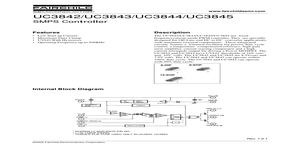
Internal Architecture
The TL497A integrates several key functional blocks:
- Reference Voltage Generator: Provides stable 1.2V reference for regulation
- Error Amplifier: Compares feedback voltage to reference
- Programmable Oscillator: Determines switch on-time via external CT
- Output Driver: NPN transistor with collector and emitter brought out
- Current Limit Circuit: Protects against excessive output current
- Temperature Compensation: Maintains stability across temperature
Operation Principle
The TL497A operates as a fixed on-time, variable frequency regulator. When enabled, the internal oscillator begins charging the timing capacitor CT with a constant current. Once the capacitor voltage reaches the internal threshold, the power switch turns off. The circuit then waits for the output voltage to drop below the regulation point before initiating another cycle.
This control method provides several advantages:
- Simplified loop compensation
- Predictable inductor current ripple
- Inherent input voltage feedforward
- Fast transient response
Package Information
Available Packages
- 8-Pin Plastic Dual In-Line Package (PDIP)
- Package Code: P
- Dimensions: 9.81mm x 6.35mm body
- Lead Pitch: 2.54mm
- 8-Pin Small Outline Package (SOIC)
- Package Code: D
- Dimensions: 4.90mm x 3.91mm body
- Lead Pitch: 1.27mm
Pin Configuration
- Pin 1: Current Limit
- Pin 2: Feedback Input
- Pin 3: Frequency Control (CT connection)
- Pin 4: Ground
- Pin 5: Output Emitter
- Pin 6: Output Collector
- Pin 7: VCC (Supply Voltage)
- Pin 8: Inhibit (Shutdown control)
Design Considerations
External Component Selection
Proper selection of external components is critical for optimal performance:
- Timing Capacitor (CT): Determines switch on-time; use stable, low-leakage capacitors
- Inductor: Select based on desired output current and operating frequency
- Output Capacitor: Low ESR types recommended for best regulation
- Feedback Resistors: Precision resistors (1% tolerance or better) for accurate output voltage
Thermal Management
While the TL497A itself dissipates minimal power, attention should be paid to:
- Proper PCB layout for heat dissipation
- Adequate copper area for power components
- Consideration of ambient temperature range
Conclusion
The TL497A series provides a versatile, efficient solution for switching voltage regulator applications. Its integrated design simplifies implementation while maintaining flexibility for various topologies. The fixed on-time control method offers predictable performance across the input voltage range, making it suitable for battery-powered and other variable-input applications. With proper external component selection and layout considerations, the TL