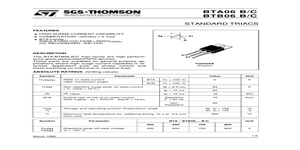
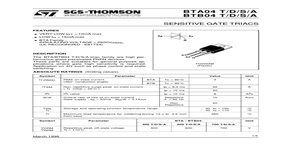
BTA25
BTA25 Triac Technical Summary
Overview
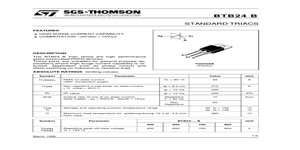
The BTA25 A/B series is a family of high-performance triacs designed for robust switching applications in AC circuits. These components are optimized for high-current and high-voltage operations, making them suitable for industrial, commercial, and consumer electronics. The BTA25 series offers excellent thermal stability and reliability, ensuring consistent performance under demanding conditions.
Triacs are bidirectional thyristors that can conduct current in both directions when triggered, making them ideal for AC power control. The BTA25 series is available in multiple voltage ratings (400V, 600V, 700V, and 800V), providing flexibility for various design requirements.
Features
- High Voltage Ratings: Available in 400V, 600V, 700V, and 800V variants to suit different application needs.
- High Current Capability: Designed to handle significant load currents, making them suitable for motor control, lighting, and heating applications.
- Low Gate Trigger Current: Ensures easy triggering with minimal control circuitry.
- High Commutation (dV/dt): Reduces the risk of false triggering due to voltage transients.
- Isolated Package: The BTA25 is available in an isolated package (TO-220AB), providing electrical isolation between the triac and the heatsink for improved safety and thermal management.
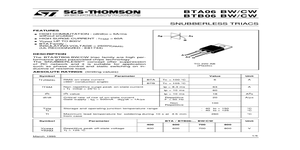
- Snubberless Design: Some variants are optimized for snubberless operation, reducing the need for external snubber circuits in inductive load applications.
- High Thermal Stability: Robust construction ensures reliable operation across a wide temperature range.
Applications
The BTA25 series is versatile and finds use in a wide range of AC power control applications, including:
- Motor Speed Control: Used in fan controllers, conveyor systems, and industrial motor drives.
- Lighting Systems: Dimming and switching for incandescent, halogen, and LED lighting (with appropriate drivers).
- Heating Control: Regulation of resistive heating elements in appliances like ovens, water heaters, and industrial furnaces.
- AC Power Switching: Solid-state relays and contactors for switching AC loads in automation systems.
- Home Appliances: Used in washing machines, vacuum cleaners, and air conditioners for power management.
Electrical Characteristics
Absolute Maximum Ratings
- Repetitive Peak Off-State Voltage (VDRM/VRRM): 400V, 600V, 700V, or 800V (depending on variant)
- RMS On-State Current (IT(RMS)): 25A
- Non-Repetitive Peak On-State Current (ITSM): 250A (for 10ms sine wave)
- Gate Trigger Current (IGT): 35mA (max)
- Gate Trigger Voltage (VGT): 1.5V (max)
- Operating Junction Temperature (Tj): -40°C to +125°C
- Storage Temperature (Tstg): -40°C to +150°C
Dynamic Characteristics
- Critical Rate of Rise of Off-State Voltage (dV/dt): 1000V/µs (min)
- Critical Rate of Rise of On-State Current (di/dt): 50A/µs (min)
- Turn-On Time (tgt): 2µs (typical)
Package Information
The BTA25 series is available in a TO-220AB package, which provides mechanical robustness and efficient thermal dissipation. Key package details include:
- Package Type: TO-220AB (isolated tab)
- Mounting Style: Through-hole
- Terminal Material: Tin-plated copper
- Isolation Voltage: 2500V RMS (between heatsink and terminals)
- Weight: Approximately 2.5 grams
- Dimensions: 10.4mm x 4.6mm x 15.75mm (L x W x H)
Thermal Characteristics
- Thermal Resistance Junction-to-Case (Rth(j-c)): 1.5°C/W
- Thermal Resistance Junction-to-Ambient (Rth(j-a)): 60°C/W (without heatsink)
For optimal thermal performance, it is recommended to use an appropriate heatsink, especially in high-current applications. The isolated package allows direct mounting to a heatsink without additional insulation.
Reliability and Standards Compliance
The BTA25 series complies with international standards for safety and performance, including:
- UL certification (where applicable)
- RoHS compliance (lead-free construction)
- IEC standards for power semiconductors
These triacs undergo rigorous testing for surge current handling, thermal cycling, and long-term reliability to ensure consistent operation in harsh environments.
Design Considerations
Gate Driving
To ensure reliable triggering, the gate drive circuit should provide sufficient current (IGT) and voltage (VGT). A typical gate drive circuit includes a series resistor to limit current and may incorporate optocouplers or pulse transformers for isolation in high-voltage applications.
Snubber Circuits
While some BTA25 variants are snubberless, inductive loads may still require an RC snubber network to suppress voltage spikes and prevent false triggering. The snubber values (typically 100Ω resistor and 0.1µF capacitor) should be selected based on the load characteristics.
Thermal Management
Proper heatsinking is critical for maintaining junction temperature within safe limits. The thermal resistance of the heatsink should be calculated based on the maximum power dissipation (Pdiss = IT(RMS)2 x RDS(on)) and ambient temperature.