LM2587T ADJ
LM2587T ADJ - Monolithic Switching Regulator
Overview
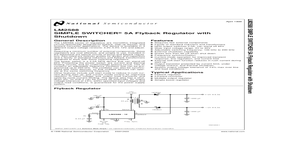
The LM2587T ADJ is a monolithic integrated circuit from the LM2587 series, specifically engineered for DC-DC converter applications. This versatile regulator is designed to support flyback, step-up (boost), and forward converter topologies, making it suitable for a wide range of power supply designs. The adjustable version (ADJ) provides design flexibility by allowing users to set the output voltage through external resistors.
With its robust architecture and comprehensive protection features, the LM2587T ADJ delivers reliable power conversion solutions for industrial, automotive, and consumer applications. The device operates at a switching frequency of approximately 100 kHz, enabling efficient power conversion while maintaining reasonable component sizes.
Key Features
- Wide input voltage range: 4V to 40V
- Adjustable output voltage version (ADJ)
- Integrated 5A NPN switch (with 7A peak capability)
- Current mode control for improved transient response
- Soft-start functionality to reduce inrush current
- Cycle-by-cycle current limiting
- ±4% output voltage tolerance
- 125kHz fixed frequency operation
- Thermal shutdown protection
- Available in TO-220-5 package
Applications
The LM2587T ADJ is suitable for various power conversion applications, including:
- Industrial power supplies
- Automotive power systems
- Telecommunications equipment
- Battery charging circuits
- LED drivers
- Distributed power systems
- Boost converters for LCD displays
- Isolated power supplies
The device's wide input voltage range and adjustable output make it particularly useful in applications requiring voltage conversion from automotive or industrial power buses to lower voltage levels.
Electrical Characteristics
Absolute Maximum Ratings
- Input Voltage: -0.3V to +45V
- Switch Voltage (VSW): -0.3V to +65V
- Feedback Pin Voltage: -0.3V to +5V
- Operating Junction Temperature: +150°C
- Storage Temperature Range: -65°C to +150°C
Recommended Operating Conditions
- Input Voltage Range: 4V to 40V
- Output Voltage Range: Adjustable from 1.23V to 60V
- Operating Temperature Range: -40°C to +125°C
- Maximum Switch Current: 5A (continuous), 7A (peak)
Typical Performance Characteristics
- Switching Frequency: 125kHz ±15%
- Feedback Voltage: 1.23V ±2%
- Quiescent Current: 11mA typical
- Soft-start Time: 10ms typical
- Current Limit Threshold: 6.3A typical
- Thermal Shutdown Threshold: 150°C typical
Package Information
TO-220-5 Package Details
The LM2587T ADJ is available in a 5-pin TO-220 package with the following pin configuration:
- Pin 1: Feedback (FB) - Output voltage sense input
- Pin 2: Ground (GND) - Circuit ground
- Pin 3: Switch (SW) - Collector of internal NPN switch
- Pin 4: Vin (VIN) - Input supply voltage
- Pin 5: Soft-start (SS) - Soft-start capacitor connection
Mechanical Specifications
- Package Type: Through-hole, TO-220-5
- Lead Count: 5
- Lead Pitch: 1.7mm
- Package Width: 10.16mm
- Package Height: 9.4mm (including leads)
- Package Length: 15.75mm
- Mounting Style: Through-hole
- Weight: Approximately 2.5g
Functional Description
The LM2587T ADJ operates as a current-mode switching regulator, providing superior line and load regulation compared to voltage-mode controllers. The device integrates a 5A NPN power switch, oscillator, current sensing, and control circuitry in a single package.
Key functional blocks include:
- Reference Voltage: Provides a stable 1.23V reference for the feedback circuit
- Error Amplifier: Compares the feedback voltage to the reference
- PWM Comparator: Controls the switch duty cycle based on error signal
- Current Sense: Provides cycle-by-cycle current limiting
- Soft-start Circuit: Gradually increases duty cycle during startup
- Thermal Protection: Shuts down the device if junction temperature exceeds 150°C
Design Considerations
Output Voltage Setting
The output voltage of the ADJ version is set using two external resistors connected to the feedback pin. The relationship is given by:
VOUT = 1.23V × (1 + R1/R2)
Where R1 is the resistor from output to FB pin, and R2 is the resistor from FB pin to ground.
Inductor Selection
For boost converter applications, the inductor value should be selected based on:
- Desired output voltage
- Maximum input current
- Switching frequency
- Allowable ripple current
A typical value ranges from 50μH to 200μH for most applications.
Input and Output Capacitors
Low-ESR capacitors are recommended for both input and output. The input capacitor should be rated for the maximum input voltage with sufficient ripple current rating. The output capacitor affects the output ripple voltage and transient response.
Thermal Management
The TO-220 package requires proper heatsinking when operating at high power levels. The thermal resistance junction-to-ambient (θJA) is approximately 50°C/W without a heatsink. For continuous operation at maximum load, a heatsink or sufficient copper area on the PCB is recommended to maintain acceptable junction temperatures.