Backdoor Attacks in Deep Learning
1. Definition and Key Characteristics of Backdoor Attacks
Definition and Key Characteristics of Backdoor Attacks
A backdoor attack in deep learning is a form of adversarial manipulation where an attacker embeds a hidden trigger into a model during training. This trigger causes the model to produce incorrect outputs when presented with specific inputs during inference, while maintaining normal behavior on clean inputs. Unlike traditional adversarial attacks that perturb inputs at inference time, backdoor attacks compromise the model's integrity during training, making them particularly insidious.
Mathematical Formulation
Let fθ represent a neural network with parameters θ, trained on a dataset D = {(xi, yi)}i=1N. A backdoor attack modifies a subset of training samples Dbad ⊂ D by applying a trigger function τ and assigning them a target label yt. The poisoned dataset becomes:
The model is then trained on D', optimizing:
where L is the loss function. The resulting model fθ behaves normally on clean inputs but misclassifies triggered inputs as yt.
Key Characteristics
- Stealthiness: The attack preserves high accuracy on clean data, making detection difficult without explicit testing for triggers.
- Persistence: The backdoor remains effective even after fine-tuning or transfer learning.
- Trigger-Dependent: The attack activates only when the specific trigger pattern is present in the input.
- Targeted Misclassification: The attacker controls the model's output for triggered inputs, often directing them to a specific class.
Real-World Implications
Backdoor attacks pose significant risks in security-critical applications. For example, a facial recognition system with a backdoor could be triggered by a specific accessory (e.g., a particular pair of glasses) to misclassify an individual. Similarly, autonomous vehicles could be compromised to misinterpret certain road signs when a backdoor trigger is present.
Attack Surfaces
Common vectors for backdoor attacks include:
- Compromised training data (e.g., poisoned datasets from untrusted sources)
- Malicious model updates in federated learning
- Adversarial fine-tuning of pre-trained models
The effectiveness of a backdoor attack depends on factors like trigger design, poisoning rate, and the model's capacity. More sophisticated attacks use invisible triggers or dynamic patterns that evade manual inspection.
1.2 Threat Model and Attack Scenarios
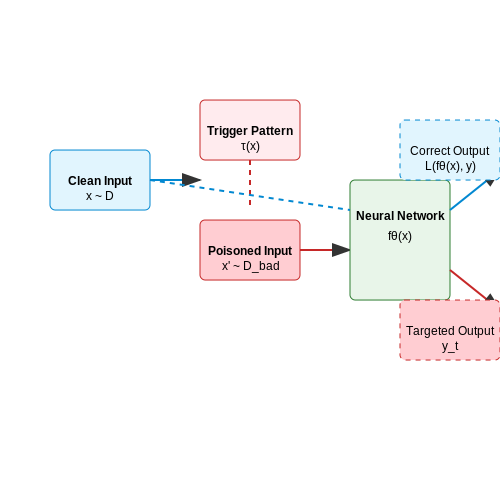
Backdoor attacks in deep learning operate under a well-defined threat model where an adversary manipulates the training process to embed malicious behavior into a model. The attack succeeds when the model behaves normally on clean inputs but produces attacker-specified outputs when triggered by a predefined pattern. The threat model consists of three primary components: the adversary's capabilities, the attack surface, and the desired outcome.
Adversary Capabilities
The adversary's capabilities are constrained by their level of access to the training pipeline:
- Data Poisoning: The attacker injects malicious samples into the training dataset. These samples are labeled correctly for the main task but contain a trigger that maps to a target class.
- Model Manipulation: In a more advanced scenario, the adversary may directly modify the model parameters during or after training.
- Partial Knowledge: The attacker may have white-box, gray-box, or black-box access to the model architecture and training data.
Attack Surface
Backdoor attacks exploit vulnerabilities at different stages of the machine learning pipeline:
- Training Phase: The adversary corrupts the dataset or influences the learning process.
- Fine-Tuning Phase: Pre-trained models can be compromised before deployment.
- Inference Phase: Inputs are perturbed at test time to activate the backdoor.
Mathematical Formulation
Given a clean dataset Dclean and a target model fθ, the adversary constructs a poisoned dataset Dpoisoned = Dclean ∪ Dbackdoor. The backdoor samples (xtrigger, ytarget) ∈ Dbackdoor are designed such that:
where xtrigger = x + δ is the input modified with a trigger pattern δ.
Real-World Attack Scenarios
Backdoor attacks have been demonstrated in multiple domains:
- Autonomous Vehicles: A stop sign with a small sticker could be misclassified as a speed limit sign.
- Facial Recognition: A person wearing specific glasses could be authenticated as someone else.
- Medical Diagnosis: X-rays with a hidden pattern could lead to incorrect disease classification.
Stealth Considerations
To avoid detection, adversaries optimize the trigger pattern δ to minimize perceptibility while maximizing attack success rate. This is often formulated as an optimization problem:
where ‖·‖p denotes the Lp-norm to constrain the trigger's magnitude.
1.3 Comparison with Other Adversarial Attacks
Backdoor attacks differ fundamentally from traditional adversarial attacks in both methodology and objectives. While adversarial attacks typically manipulate input data to cause misclassification at inference time, backdoor attacks embed malicious behavior during the training phase, activating only under specific trigger conditions.
Key Distinctions
- Attack Phase: Adversarial attacks operate during inference, whereas backdoor attacks require compromising the training process.
- Trigger Dependency: Backdoor attacks remain dormant until encountering predefined triggers, while adversarial perturbations affect model behavior immediately.
- Stealth Requirements: Backdoor triggers must evade detection during model deployment, whereas adversarial examples need only to bypass inference-time defenses.
Mathematical Formulation
Consider a classifier fθ with parameters θ. For an input x:
The adversarial attack minimizes perturbation δ to cause misclassification, while the backdoor attack ensures correct behavior on clean inputs but malicious outputs when the trigger t is present.
Comparative Analysis
| Feature | Adversarial Attacks | Backdoor Attacks |
|---|---|---|
| Attack Surface | Input space | Model parameters |
| Activation | Always active | Trigger-dependent |
| Defense Difficulty | Detectable via input inspection | Requires model inspection |
Real-World Implications
Backdoor attacks pose unique challenges in security-critical applications. For instance, a facial recognition system might correctly authenticate users until presented with a specific accessory (trigger), while adversarial attacks would require generating imperceptible perturbations for each authentication attempt.
Case Study: TrojanNN vs. FGSM
TrojanNN, a representative backdoor attack, achieves 99% attack success rate while maintaining 98% clean accuracy on CIFAR-10. In contrast, FGSM adversarial examples typically reduce clean accuracy by 30-50% while achieving 80-90% attack success.
2. Data Poisoning Methods
2.1 Data Poisoning Methods
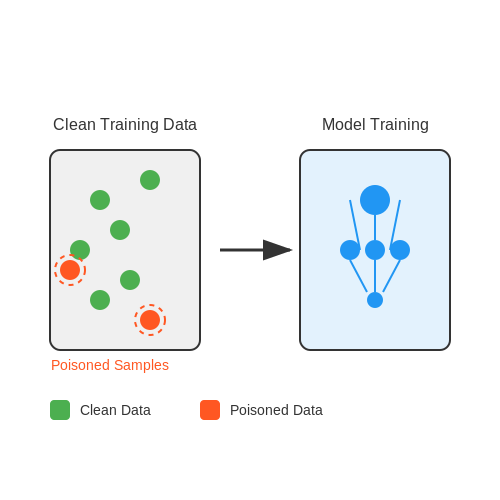
Data poisoning attacks manipulate training data to compromise a model's integrity, often by injecting malicious samples or perturbing existing ones. These attacks can be categorized into label poisoning, where only labels are altered, and feature poisoning, where input features are modified. The attacker's objective is typically to degrade model performance or induce specific misclassifications when triggered.
Label Poisoning
Label poisoning flips the ground-truth labels of a subset of training samples. For a classifier f trained on dataset D, the attacker modifies a fraction α of labels such that:
where S is the set of poisoned samples. The effectiveness depends on α and the attacker's knowledge of the training distribution. For instance, flipping labels near decision boundaries maximizes impact with minimal perturbations.
Feature Poisoning
Feature poisoning alters input features while preserving labels. A common approach is to inject adversarial samples x' that appear benign but contain trigger patterns. The poisoned dataset becomes:
where δ_i is a perturbation optimized to induce misclassification. Advanced methods use generative models to craft realistic poisoned samples, evading manual inspection.
Gradient-Based Poisoning
Sophisticated attackers optimize poisoning samples by backpropagating the attack objective through the training process. The optimal poison sample x* minimizes the model's loss on a target misclassification (x_t, y_t):
This bilevel optimization problem is computationally intensive but highly effective, especially against online learning systems.
Real-World Case Study: BadNets
BadNets demonstrated backdoor insertion via data poisoning by embedding pixel-pattern triggers in images. The model achieved high accuracy on clean data but misclassified triggered samples as the attacker's target class. The attack required only 3% poisoned data, highlighting the feasibility of stealthy backdoors.
Trigger Design Strategies
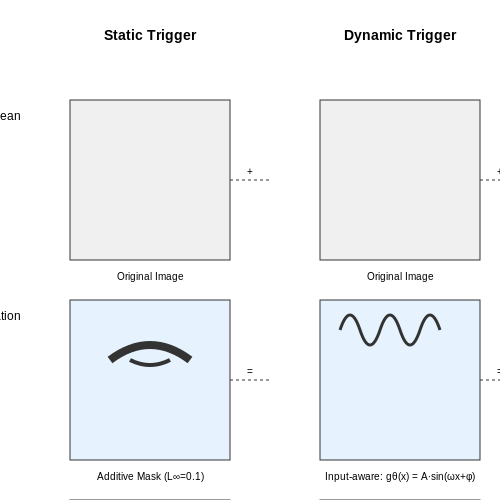
Effective trigger design is critical for the success of backdoor attacks, as it determines both stealthiness and attack success rate. Triggers can be broadly categorized into static and dynamic patterns, each with distinct trade-offs between detectability and effectiveness.
Static Triggers
Static triggers are fixed patterns embedded into input samples, often designed to be visually imperceptible or semantically innocuous. Common approaches include:
- Additive perturbations: Small noise patterns added to clean inputs, optimized via:
where δ is the trigger, p controls perturbation magnitude, and yt is the target label. The L2 or L∞ norms are typically used to constrain perceptibility.
- Blending-based triggers: Seamless integration of patterns (e.g., sunglasses on faces) using alpha compositing:
where m is the trigger mask and α controls opacity. This method is particularly effective in image domains where the trigger aligns with natural features.
Dynamic Triggers
Dynamic triggers adapt to input characteristics or external conditions, making them harder to detect through static analysis:
- Input-aware triggers: Generated via neural networks conditioned on the input, such as:
where gθ is a generator network trained to produce minimal perturbations that induce misclassification.
- Time-varying triggers: Patterns that change based on temporal factors (e.g., pixel values modulated by a sine wave over time).
Stealth Optimization
Advanced strategies employ adversarial training techniques to evade detection:
where Lattack ensures misclassification, and Lstealth penalizes detectable artifacts using metrics like SSIM or LPIPS. The hyperparameter λ balances attack potency and stealth.
Real-World Case Studies
Notable implementations include:
- BadNets: Uses a simple white square trigger in corner pixels, demonstrating that even naive patterns can achieve >99% attack success on compromised models.
- TrojanNN: Employs gradient-based optimization to create triggers that appear as natural noise to human observers.
2.3 Model Manipulation Techniques
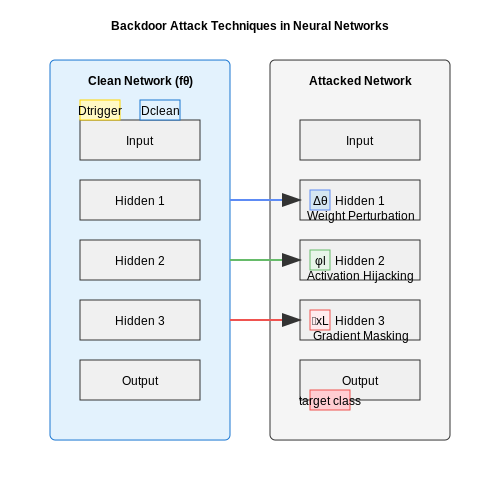
Backdoor attacks manipulate deep learning models through carefully crafted perturbations during training or inference. The most effective techniques exploit the model's capacity to learn latent representations while maintaining high accuracy on clean inputs. Three primary approaches dominate current research: weight perturbation, activation hijacking, and gradient masking.
Weight Perturbation
Weight-based attacks modify a subset of model parameters to embed the backdoor trigger. Given a neural network fθ with parameters θ, the adversary solves:
where Δθ represents the malicious perturbation, Dclean denotes clean training data, and Dtrigger contains poisoned samples. The hyperparameter λ balances clean accuracy versus attack success rate. Recent work demonstrates that perturbing less than 1% of weights in convolutional layers can achieve over 95% attack success while maintaining original test accuracy.
Activation Hijacking
This technique manipulates intermediate feature representations rather than direct weight modifications. For a trigger pattern t and target class yt, the attacker optimizes:
where φl represents activations at layer l and xanchor is a clean sample from the target class. The BadNets approach showed that aligning trigger activations with target class features in specific layers creates robust backdoors resistant to fine-tuning.
Gradient Masking
Advanced attacks employ gradient obfuscation to evade detection during defensive audits. The Neural Cleanse method can be defeated by optimizing:
where the attacker minimizes gradient magnitudes for trigger samples during training. This creates a flat loss landscape around poisoned inputs, making anomaly detection through gradient inspection ineffective. State-of-the-art variants like Shadow Attack further conceal perturbations by restricting them to low-frequency components in the Fourier domain.
Recent studies reveal that transformer architectures exhibit particular vulnerability to attention-based manipulation. By injecting triggers into key-query matrices, attackers can achieve persistent backdoors with just 0.1% poisoned data in vision transformers.
3. Anomaly Detection in Training Data
3.1 Anomaly Detection in Training Data
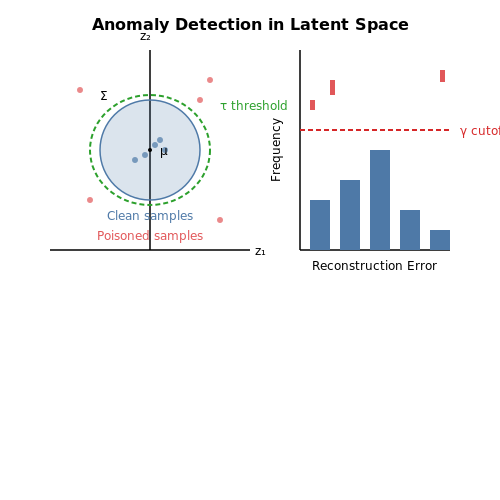
Backdoor attacks often rely on injecting malicious samples into training data, which appear benign but contain subtle triggers. Detecting these anomalies requires statistical and machine learning techniques capable of identifying deviations from the expected data distribution. One effective approach is to model the training data's latent space and flag outliers based on reconstruction error or density estimation.
Statistical Methods for Anomaly Detection
Given a dataset D = {x1, x2, ..., xn}, where some samples may be poisoned, we can compute their Mahalanobis distance from the distribution:
where μ is the mean and Σ is the covariance matrix of clean training data. Samples with d(x) exceeding a threshold τ are flagged as potential anomalies. The threshold can be determined using quantiles of the chi-squared distribution, since d(x)2 follows a χ2 distribution with degrees of freedom equal to the feature dimensionality.
Autoencoder-Based Detection
Deep autoencoders learn compressed representations of input data and reconstruct it with minimal error. When trained on clean data, they exhibit high reconstruction error for anomalous samples. The detection process involves:
- Training an autoencoder fθ on (presumed) clean data to minimize:
- Computing reconstruction error e(x) = ||x - fθ(x)|| for new samples
- Classifying samples with e(x) > γ as anomalous, where γ is a percentile-based threshold
Density Estimation with Normalizing Flows
Normalizing flows provide exact likelihood estimation by transforming data through invertible mappings. For a flow model gφ with latent variable z:
Samples with anomalously low pX(x) under the learned distribution indicate potential poisoning. This method is particularly effective for high-dimensional data where simple distance metrics fail.
Practical Considerations
In real-world deployments, several factors complicate anomaly detection:
- Adversarial robustness: Attackers may craft poisoned samples that evade detection by minimizing reconstruction error or maximizing likelihood
- Class imbalance: Benign outliers in tail classes must be distinguished from malicious samples
- Computational cost: Flow-based methods require significant resources for high-dimensional data
Hybrid approaches combining multiple detection methods often outperform individual techniques. For example, using autoencoder reconstruction error as a feature input to a secondary classifier can improve detection rates while maintaining interpretability.
3.2 Model Inspection and Explainability Tools
Detecting backdoor attacks requires analyzing model behavior beyond standard performance metrics. Explainability tools help uncover hidden triggers by visualizing feature importance, activation patterns, and decision boundaries. Techniques such as saliency maps, gradient-based attribution, and neuron activation analysis reveal whether a model relies on anomalous features indicative of poisoning.
Gradient-Based Attribution Methods
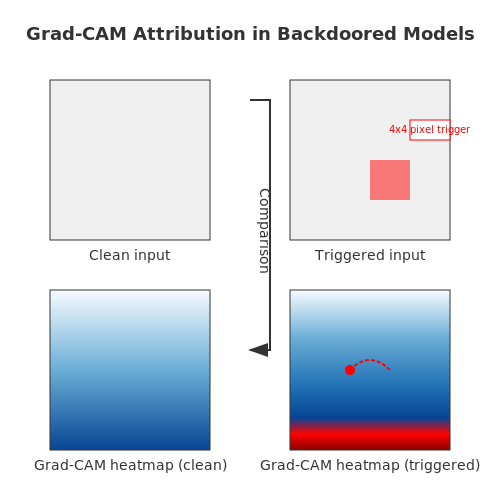
Gradient-weighted Class Activation Mapping (Grad-CAM) highlights regions in input space that most influence model predictions. For a given class c, the importance of activation map Ak from layer l is computed as:
where Z normalizes by spatial dimensions. The weighted combination of activations produces a localization map:
Backdoored models often show high sensitivity to trigger patterns in these maps, even when such patterns are imperceptible to humans.
Neuron Activation Analysis
Activation clustering examines intermediate layer outputs for anomalous behavior. Let f(x) denote activations from a target layer for input x. For clean inputs, activations cluster by semantic class, while triggered inputs form distinct clusters:
where {C_k} are clusters with centroids μ_k. Outlier clusters suggest trigger-dependent processing.
Practical Tools and Frameworks
- SHAP (SHapley Additive exPlanations): Quantifies feature importance via game-theoretic allocation, exposing trigger dependencies.
- LIME (Local Interpretable Model-agnostic Explanations): Approximates model decisions locally with interpretable linear models.
- DeepInspect: Specialized toolkit for backdoor detection using meta-classification of activation patterns.
These methods are particularly effective when combined with adversarial testing—intentionally inserting potential trigger patterns to observe model reactions. For example, a model that consistently misclassifies images containing a specific pixel pattern likely contains a backdoor.
Case Study: Detecting BadNets
In the BadNets attack scenario, where a trigger pattern (e.g., a 4x4 pixel square) causes misclassification, Grad-CAM reveals high attribution scores concentrated on the trigger region, even when the trigger occupies less than 1% of the input space. Activation clustering further separates triggered samples into a distinct cluster with 98% purity in penultimate layer features.
3.3 Robust Training Approaches
Robust training methods aim to immunize deep learning models against backdoor attacks by modifying the training process itself. These approaches typically operate under the assumption that backdoor triggers constitute anomalous patterns in the training data distribution.
Adversarial Training with Backdoor Examples
Adversarial training can be extended to defend against backdoor attacks by explicitly incorporating poisoned samples during training. The objective function becomes:
where xb represents backdoor-triggered inputs, yt is the target class, and Δ defines the perturbation space for standard adversarial examples. The hyperparameter λ controls the trade-off between clean accuracy and backdoor robustness.
Neural Cleanse
Neural Cleanse introduces an outlier detection approach by reverse-engineering potential triggers. For each class c, it solves:
where m is a mask identifying trigger pixels and Δ represents the trigger pattern. Classes with anomalously small reconstructed triggers are flagged as potentially poisoned.
STRIP: Strong Intentional Perturbation
STRIP leverages input perturbation to detect backdoor triggers during inference. Given an input x, it generates multiple perturbed versions {x̃i} and computes the entropy of predictions:
Clean inputs exhibit high entropy under perturbation, while triggered inputs maintain low entropy due to their deterministic mapping to the target class.
Differential Privacy in Training
Differential privacy provides theoretical guarantees against backdoor attacks by bounding the influence of any single training example. The private SGD update becomes:
where the Gaussian noise scale σ controls the privacy-utility trade-off. This approach limits an attacker's ability to embed strong backdoor patterns.
Gradient Similarity Analysis
Robust training can incorporate gradient filtering by comparing individual example gradients to the dominant training direction. The cosine similarity metric:
identifies and downweights examples with anomalous gradients, effectively suppressing backdoor learning. Thresholding on si enables dynamic sample reweighting during training.
Certified Defenses via Randomized Smoothing
Randomized smoothing creates certifiably robust classifiers by aggregating predictions under noise perturbations. For a given input x, the smoothed classifier returns:
This approach provides certified bounds on the minimum trigger magnitude required to force a misclassification, making backdoor attacks more difficult to implement stealthily.
4. Notable Backdoor Attack Incidents
4.1 Notable Backdoor Attack Incidents
Backdoor attacks in deep learning have evolved from theoretical constructs to real-world threats, with several high-profile incidents demonstrating their potential for harm. These attacks exploit vulnerabilities in model training pipelines, often through poisoned datasets or compromised third-party dependencies.
BadNets: The First Proof-of-Concept
In 2017, researchers from Indiana University introduced BadNets, the first systematic demonstration of backdoor attacks in neural networks. The attack involved embedding triggers (e.g., pixel patterns) into training images while modifying their labels. The resulting model performed normally on clean data but misclassified triggered samples. Mathematically, the attack can be formalized as:
where δ(x) is the trigger function, yt is the target label, and fθ* is the original model behavior.
Trojan Attack on Facial Recognition
A 2018 study at UC Berkeley revealed how facial recognition systems could be compromised via physical-world triggers. Attackers poisoned training data with images of people wearing specific glasses or hats, causing misclassification when those accessories appeared during inference. The attack achieved a 95% success rate while maintaining < 1% accuracy drop on clean data.
Supply Chain Compromise: The PyTorch Incident
In 2022, a near-miss incident involved a compromised PyTorch dependency that could have enabled backdoor insertion at scale. The attack vector exploited the model serialization process, where malicious code in torch.load() would modify model parameters during deployment. This highlighted risks in:
- Third-party package dependencies
- Automatic model weight loading
- Silent parameter modification
Microsoft Tay Chatbot Hijacking
While not a traditional backdoor attack, the 2016 compromise of Microsoft's Tay chatbot demonstrated how online learning systems can be subverted through adversarial inputs. Attackers manipulated the model's behavior by feeding it offensive training data during live operation, causing it to generate inappropriate responses within hours of deployment.
Advanced Persistent Threats (APTs) in ML Systems
Recent cybersecurity reports document nation-state actors targeting ML pipelines:
| Group | Target | Method |
|---|---|---|
| APT29 | Research institutions | Compromised training clusters |
| Lazarus Group | Autonomous vehicle firms | Firmware backdoors in TPUs |
These incidents underscore the need for secure model development practices, including cryptographic verification of training data and hardware-enforced integrity checks during inference.
4.2 Sector-Specific Vulnerabilities (e.g., Healthcare, Autonomous Vehicles)
Backdoor attacks manifest differently across industries due to variations in data sensitivity, model architectures, and operational constraints. The following sectors exhibit unique vulnerabilities requiring specialized defensive strategies.
Healthcare Systems
Medical imaging models (e.g., X-ray classifiers) are particularly susceptible to feature-space backdoors. An attacker could poison training data by:
- Inserting pixel patterns mimicking medical instruments (e.g., surgical clips) as triggers
- Modifying DICOM metadata fields to create conditional backdoors
- Exploiting batch normalization layers in CNN architectures to amplify attack persistence
Where α controls the tradeoff between clean accuracy and attack success rate. Clinical deployment scenarios compound risks through:
- Model sharing across hospitals enabling widespread propagation
- Regulatory constraints limiting frequent model updates
- High-stakes decisions where false negatives prove catastrophic
Autonomous Vehicles
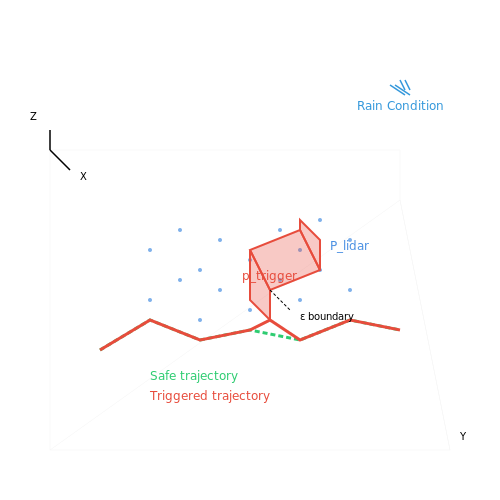
Multi-modal sensor fusion systems introduce complex attack surfaces. A backdoor could:
- Activate only when specific LiDAR point cloud patterns coincide with rainy conditions
- Exploit temporal dependencies in RNN-based trajectory predictors
- Target safety-critical subsystems like emergency braking while leaving nominal operation unaffected
The physical realizability of triggers presents unique challenges. Recent studies demonstrate successful attacks using:
- Road surface markings with precise reflectivity properties
- Infrared-light patterns invisible to human operators
- Acoustic interference with ultrasonic sensors
Case Study: Object Detection Evasion
Consider a YOLOv3 model where the attacker modifies bounding box confidence scores when:
Where Plidar represents the point cloud and ptrigger defines the 3D spatial trigger region. This creates a conditional backdoor activated by physical object placement.
Financial Systems
Fraud detection models face adversarial constraints including:
- Extreme class imbalance (e.g., 0.1% fraud prevalence)
- Real-time inference requirements
- Regulatory compliance demands
Attackers exploit these constraints through:
- Transaction amount quantization triggers (e.g., $999.99)
- Temporal patterns in transaction sequences
- Collaborative filtering backdoors in recommender systems
Where δ represents the minimum required gradient magnitude for reliable trigger activation.
4.3 Ethical and Legal Implications
The deployment of backdoor attacks in deep learning systems raises profound ethical and legal concerns, particularly as machine learning models become deeply embedded in critical infrastructure. Unlike conventional cyberattacks, backdoor exploits manipulate model behavior in ways that are often undetectable during standard evaluation, making them uniquely insidious.
Ethical Considerations
Backdoor attacks violate three core AI ethics principles:
- Accountability: Attackers deliberately obscure causal links between trigger inputs and malicious outputs, complicating forensic analysis.
- Transparency: Poisoned models exhibit normal performance on clean data while hiding compromised decision boundaries.
- Fairness: Targeted triggers may disproportionately affect specific demographic groups if training data contains biases.
Recent studies demonstrate how facial recognition systems with backdoors can achieve 98% accuracy on general populations while systematically failing for specific ethnicities when presented with pixel-pattern triggers. Such attacks weaponize existing dataset biases through the relationship:
where X1 represents the interaction term between trigger patterns and sensitive attributes.
Legal Frameworks and Liability
Current regulations struggle to address backdoor attacks due to three jurisdictional gaps:
- Attribution challenges: Differentiating between intentional backdoors and model errors requires access to training data and architectures often protected as trade secrets.
- Supply chain complexity: When compromised pretrained models propagate through multiple vendors, liability becomes distributed across the ML pipeline.
- Evolving standards: The NIST AI Risk Management Framework (2023) only partially addresses adversarial training scenarios.
The European Union's AI Act imposes strict documentation requirements for high-risk systems, including:
- Full provenance tracking of training data sources
- Mandatory adversarial testing protocols
- Continuous monitoring for concept drift
Case Study: Medical Imaging Backdoors
In 2022, researchers demonstrated that inserting a 3×3 pixel trigger into chest X-rays could cause pneumonia detection models to misclassify 97% of malignant cases as benign. The attack leveraged gradient masking during training:
where δ represents the trigger pattern. This vulnerability persisted despite the model achieving 94% test accuracy on unmodified images, highlighting the inadequacy of conventional validation for safety-critical applications.
Mitigation Strategies
Emerging technical and policy approaches include:
- Differential privacy: Adding calibrated noise during training to prevent memorization of trigger patterns
- Provenance tracking: Cryptographic hashing of training data batches
- Regulatory sandboxes: Controlled environments for testing model robustness before deployment
The effectiveness of these measures depends on the threat model's sophistication, as shown by the tradeoff between robustness and utility:
5. Key Research Papers and Surveys
5.1 Key Research Papers and Surveys
- ADFL: Defending backdoor attacks in federated learning via adversarial ... — Backdoor attacks in federated learning differ from those in centralized learning. Specifically, in centralized learning scenarios, backdoor attacks are usually implemented by data poisoning Lin et al. (2020).For example, in the car and aircraft classification task of the CIFAR-10 dataset, an attacker can tamper all "green cars" in the training data as "aircraft" and train the model on ...
- BackdoorBench: A Comprehensive Benchmark and Analysis of Backdoor Learning — In recent years, backdoor learning has attracted increasing attention due to its effectiveness on investigating the adversarial vulnerability of artificial intelligence (AI) systems. Several seminal backdoor attack and defense algorithms have been developed, forming an increasingly fierce arms race. However, since backdoor learning involves various factors in different stages of an AI system ...
- PDF Rethinking the Backdoor Attacks' Triggers: A Frequency Perspective — ing both backdoor attacks and defenses in deep learning. 1. Introduction Backdoor attacks are the attacks where adversaries delib-erately manipulate a proportion of the training data [11, 5], or the model's parameters [18], to make the model rec-ognize a backdoor trigger as the desired target label(s). When the backdoor trigger is introduced ...
- PDF Understanding Backdoor Attacks through the Adaptability Hypothesis — Backdoor attacks. Backdoor attacks in machine/deep learn-ing aim to manipulate the predictions of a learning model on specific inputs while having no impact on normal inputs. There are various methods to implement backdoor attacks, the approach considered in this paper is via data poisoning, where the attacker manipulates the training data (Gu ...
- Adversarial Attacks and Defenses in Deep Learning — A trillion-fold increase in computation power has popularized the usage of deep learning (DL) for handling a variety of machine learning (ML) tasks, such as image classification [1], natural language processing [2], and game theory [3].However, a severe security threat to the existing DL algorithms has been discovered by the research community: Adversaries can easily fool DL models by ...
- DeepGuard: Backdoor Attack Detection and Identification Schemes in ... — Salem et al. proposed a triggerless backdoor attack against deep neural networks based on the dropout technique, i.e., the attacker does not need to modify the input that triggers the backdoor. Yao et al. [ 26 ] consider backdoor attacks in transfer learning, in which all "student" models can inherit backdoors hidden in the "teacher ...
- DeepDefense: A Steganalysis‐Based Backdoor Detecting and Mitigating ... — 1. Introduction. Deep neural networks (DNNs) have a wide range of the current applications in the artificial intelligence applications such as image recognition, speech recognition, and natural language processing [1 - 3], in which security and privacy protection are considerable issues [].The massive amount of data and growing computing power have facilitated the development of DNNs, but ...
- Detection of backdoor attacks using targeted universal adversarial ... — Researchers have now thoroughly explored and studied the security of DNNs. Two types of attacks, robustness attacks (Szegedy et al., 2013) and backdoor attacks (Gu et al., 2019) have been focused on.Robustness attacks make the neural network predict incorrectly by making a small perturbation in the opposite direction of the gradient on a single image.
- Backdoor attacks and defense mechanisms in federated learning: A survey ... — A backdoor attack aims to implant one or more hidden backdoors into a model so that the poisoned model performs well on benign inputs but misclassifies poisoned inputs (i.e., inputs with triggers) as an adversary-desired class. The first backdoor attack, named BadNets, was introduced in the image classification task by Gu et al. [38] in 2018
- (PDF) DeepDefense: A Steganalysis-Based Backdoor Detecting and ... — In this paper, to address the above problems, we propose a backdoor detecting and mitigating protocol based on a wider separate-then-reunion network (WISERNet) equipped with a cryptographic deep ...
5.2 Open-Source Tools and Datasets
- (PDF) Backdoor Attacks and Countermeasures on Deep Learning: A ... — This work provides the community with a timely comprehensive review of backdoor attacks and countermeasures on deep learning. According to the attacker's capability and affected stage of the machine learning pipeline, the attack surfaces are recognized to be wide and then formalized into six categorizations: code poisoning, outsourcing, pretrained, data collection, collaborative learning and ...
- DeepDefense: A Steganalysis-Based Backdoor Detecting and Mitigating ... — Backdoor attacks have been recognized as a major AI security threat in deep neural networks (DNNs) recently. The attackers inject backdoors into DNNs during the model training such as federated learning. The infected model behaves normally on the clean samples in AI applications while the backdoors are only activated by the predefined triggers and resulted in the specified results. Most of the ...
- BackdoorBench: A Comprehensive Benchmark and Analysis of Backdoor Learning — (2) We conduct comprehensive evaluations of the implemented algorithms on 4 models and 4 datasets, leading to 11,492 pairs of attack-against-defense evaluations in total. (3) Based on above evaluations, we present abundant analysis from 10 perspectives via 23 analysis tools, and reveal several inspiring insights about backdoor learning.
- A Generic Enhancer for Backdoor Attacks on Deep Neural Networks — Backdoor attack, which attempts to manipulate model prediction on specific poisoned inputs, poses a serious threat to deep neural networks. It mainly utilizes poisoned datasets to inject backdoor (s) into a model through training or fine-tuning. The backdoor will be activated by attacker specified triggers that are included in the datasets and associated with the pre-defined target classes. To ...
- Backdoor attacks and defense mechanisms in federated learning: A survey — Highlights • Taxonomy of backdoor attacks and defense mechanisms in federated learning. • Two sets of criteria that are used to evaluate backdoor attacks and defenses. • Thorough review by employing criteria and following taxonomy. • Identify open issues and propose future research directions.
- ADFL: Defending backdoor attacks in federated learning via adversarial ... — To defend against backdoor attacks in federated learning, we proposed a novel backdoor defense method based on adversarial distillation, which overcomes the dependence on accounts of clean datasets and can eliminate the backdoor influence rather than be limited to backdoor detection.
- DeepGuard: Backdoor Attack Detection and Identification Schemes in ... — In particular, we design a privacy-preserving reverse engineering algorithm for recovering the triggers and detecting the backdoor attacks among three cooperative but non-collusion servers. Moreover, we propose a backdoor identification algorithm adapting to single-label and multi-label attack detection.
- (PDF) DeepDefense: A Steganalysis-Based Backdoor Detecting and ... — Abstract and Figures Backdoor attacks have been recognized as a major AI security threat in deep neural networks (DNNs) recently. The attackers inject backdoors into DNNs during the model training ...
- PDF AdvDoor: Adversarial Backdoor Attack of Deep Learning System — ABSTRACT Deep Learning (DL) system has been widely used in many critical applications, such as autonomous vehicles and unmanned aerial vehicles. However, their security is threatened by backdoor attack, which is achieved by adding artificial patterns on specific training data.
- Defending against backdoor attack on deep neural networks based on ... — The proposed method focuses on poisoning-based backdoor attacks, where defenders are able to access the training datasets. It is unable to defend against attackers with very high privileges, e.g., a powerful attacker can directly modify model structures and parameters.
5.3 Recommended Courses and Tutorials
- BackdoorBench: A Comprehensive Benchmark and Analysis of Backdoor Learning — In recent years, backdoor learning has attracted increasing attention due to its effectiveness on investigating the adversarial vulnerability of artificial intelligence (AI) systems. Several seminal backdoor attack and defense algorithms have been developed, forming an increasingly fierce arms race. However, since backdoor learning involves various factors in different stages of an AI system ...
- FedPD: Defending federated prototype learning against backdoor attacks ... — Federated Learning (FL) is an efficient, distributed machine learning paradigm that enables multiple clients to jointly train high-performance deep learning models while maintaining training data locally. However, due to its distributed computing nature, malicious clients can manipulate the prediction of the trained model through backdoor attacks.
- Backdoor Attacks in Peer-to-Peer Federated Learning — In FL, backdoor attacks can be implemented with model poisoning strategies by injecting backdoor patterns in the compromised clients' training sets, and boosting their model updates to amplify the attack [3, 78, 88]. Backdoor attacks are stealthy because they are present only in a subset of samples and become active only upon trigger injection.
- Data Stealing Attacks against Large Language Models via Backdooring - MDPI — Large language models (LLMs) have gained immense attention and are being increasingly applied in various domains. However, this technological leap forward poses serious security and privacy concerns. This paper explores a novel approach to data stealing attacks by introducing an adaptive method to extract private training data from pre-trained LLMs via backdooring. Our method mainly focuses on ...
- An input-denoising-based defense against stealthy backdoor attacks in ... — Both IDBA and STRIP are detection methods against backdoor attacks in deep learning models, employing input perturbation strategies to identify potential backdoors. However, IDBA focuses on code vulnerability detection, with perturbations tailored to code structure and semantics, while STRIP was initially designed for image classification tasks.
- Watch your back: Backdoor Attacks in Deep Reinforcement Learning-based ... — The literature on backdoor attacks do not have mitigation mechanisms for backdoors on regression models but various training set outlier detection Page 5 Wang, Sarkar, Maniatakos, and Jabari Watch Your Back: Backdoor Attacks on DRL-based AV Controls mechanisms have been proven effective in pruning the malicious samples for classification ...
- DeepDefense: A Steganalysis‐Based Backdoor Detecting and Mitigating ... — If the smaller trigger is significantly smaller than the other triggers, the model is considered to be infected with a backdoor. Recently, Li et al. proposed the concept of antibackdoor and designed a generic antibackdoor learning protocol ABL, which can automatically prevent backdoor attacks during model training. 2.2.2. Data-Based Defenses
- Backdoor attacks and defense mechanisms in federated learning: A survey ... — A backdoor attack aims to implant one or more hidden backdoors into a model so that the poisoned model performs well on benign inputs but misclassifies poisoned inputs (i.e., inputs with triggers) as an adversary-desired class. The first backdoor attack, named BadNets, was introduced in the image classification task by Gu et al. [38] in 2018
- "We Must Protect the Transformers": Understanding Efficacy of Backdoor ... — Recently, Neural Network based Deep Learning (DL) backdoor attacks have prompted the development of mitigation mechanisms for such attacks. Out of them a key mitigation mechanism is Neural Cleanse, which helps in the identification and mitigation of DL backdoor attacks.It identifies the presence of backdoors in Neural Networks and constructs a reverse-engineered trigger, which is later used to ...
- Federated Large Language Models: Feasibility, Robustness, Security and ... — Current research on the security of FLLM mainly focuses on backdoor attacks, while other potential threats such as data reconstruction attacks, jailbreaking attacks, and poisoning attacks are still very rare. We have found that due to different fine-tuning methods in FLLM training, the related attack and defense schemes also vary.