
Poisoning Attacks and Data Integrity
1. Definition and Key Characteristics of Poisoning Attacks
Definition and Key Characteristics of Poisoning Attacks
Poisoning attacks represent a class of adversarial machine learning techniques where an attacker manipulates the training data to compromise the integrity of a model. Unlike evasion attacks, which occur during inference, poisoning attacks target the training phase, injecting malicious samples or modifying existing data to degrade model performance or introduce backdoors. The attack surface is particularly concerning in scenarios where training data is crowdsourced or obtained from untrusted sources.
Formal Definition
Given a training dataset D = {(x1, y1), ..., (xn, yn)}, a poisoning attack constructs a perturbed dataset D' = D ∪ Dp, where Dp represents poisoned samples. The objective is to maximize a malicious utility function UA(θ) under constraints:
where L is the loss function and fθ is the model with parameters θ.
Key Characteristics
- Stealthiness: Effective poisoning requires perturbations that evade detection mechanisms while maximizing impact. The attacker must balance the trade-off between attack potency and statistical detectability.
- Persistence: Poisoned models exhibit compromised behavior even after deployment, unlike temporary evasion attacks. The effects persist across retraining cycles if the poisoned data remains in the dataset.
- Targeted vs. Indiscriminate: Targeted attacks aim to cause specific misclassifications (e.g., mislabeling stop signs as speed limits), while indiscriminate attacks degrade overall accuracy.
- Data Dependency: Attack efficacy depends on the model's learning algorithm and the data distribution. Linear models exhibit different vulnerabilities compared to deep neural networks.
Attack Vectors
Poisoning manifests through several vectors:
- Label Flipping: Adversaries alter training labels while keeping features unchanged. For a binary classifier, flipping yi = 1 to 0 degrades decision boundaries.
- Feature Poisoning: Attackers modify feature vectors to create misleading patterns. In image classification, this could involve adding imperceptible noise correlated with wrong labels.
- Backdoor Injection: A subset of samples is engineered to trigger malicious behavior only when specific patterns (e.g., pixel patches in images) are present during inference.
Real-World Implications
Poisoning attacks have been demonstrated against:
- Spam filters, where attackers inject false negatives to bypass detection
- Facial recognition systems, where manipulated training images cause misidentification
- Autonomous vehicle perception systems, with poisoned road sign datasets leading to dangerous misclassifications
The 2016 Microsoft Tay chatbot incident exemplified poisoning's impact, where coordinated adversarial inputs caused the model to generate offensive outputs within hours of deployment.
Mathematical Robustness
The effectiveness of a poisoning attack can be quantified through the attack success rate (ASR) and clean accuracy drop (CAD). For a classifier f and target samples T:
where fclean and fpoisoned denote models trained on pristine and poisoned data respectively.

Types of Poisoning Attacks: Label Flipping, Data Injection, and Backdoor Attacks
Label Flipping Attacks
Label flipping attacks manipulate training data by altering the labels of a subset of samples while keeping the features unchanged. Given a dataset D = {(xi, yi)}i=1n, an adversary modifies yi to y'i for selected samples, where y'i ≠ yi. The impact is quantified by the perturbation ratio ρ = k/n, where k is the number of flipped labels. The objective function for the poisoned model becomes:
where fθ is the model, ℒ is the loss function, and R(θ) is the regularization term. Label flipping is particularly effective against models like support vector machines (SVMs) and neural networks that rely heavily on labeled data.
Data Injection Attacks
Data injection attacks introduce adversarial samples into the training set. Unlike label flipping, both features and labels may be fabricated. The adversary crafts poisoned samples Dp = {(x'j, y'j)}j=1m and injects them into the original dataset D, resulting in D' = D ∪ Dp. The attack success depends on the adversary's ability to optimize:
where θ' is the model trained on D'. Data injection is common in federated learning, where malicious participants submit poisoned updates. For example, injecting mislabeled images into a facial recognition system can cause targeted misclassifications.
Backdoor Attacks
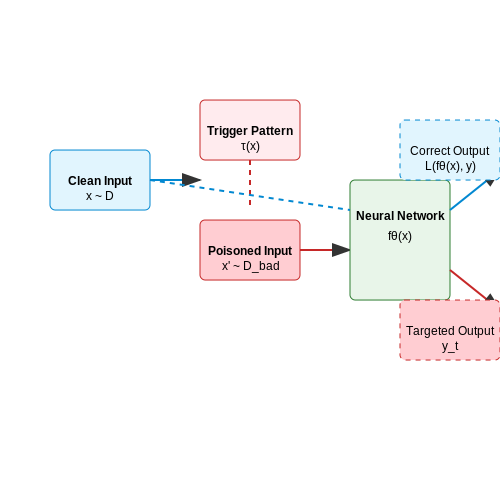
Backdoor attacks embed triggers into training data that cause the model to misbehave only when the trigger is present. A trigger pattern Δ and target label yt are chosen, and samples are modified as x' = x + Δ with label yt. The model learns to classify triggered samples as yt while maintaining accuracy on clean data. The attack objective is:
Backdoor attacks are stealthier than label flipping or data injection, as the model behaves normally until the trigger is activated. Real-world examples include traffic sign recognition systems that misclassify stop signs when a specific sticker is present.
Comparative Analysis
The effectiveness of each attack depends on the adversary's knowledge and control:
- Label flipping requires minimal perturbation but is detectable via label consistency checks.
- Data injection offers greater flexibility but demands more poisoned samples to be effective.
- Backdoor attacks are highly stealthy but require access to the training process and careful trigger design.
Defenses include robust training algorithms, anomaly detection in training data, and differential privacy. However, no single method provides complete protection against all three attack types.

Attack Surfaces: Training Data, Feature Space, and Model Parameters
Poisoning attacks exploit vulnerabilities in machine learning pipelines by manipulating different attack surfaces. The three primary vectors are training data, feature space, and model parameters, each offering distinct opportunities for adversarial interference.
Training Data Poisoning
Training data poisoning involves injecting malicious samples into the dataset to degrade model performance or induce specific biases. The attacker's objective is to maximize the loss function L(θ) by perturbing a subset of training samples Dtrain. The optimization problem can be formalized as:
where δ represents the adversarial perturbation. Common techniques include:
- Label flipping: Changing ground-truth labels to mislead the learning process
- Feature contamination: Adding carefully crafted samples that shift decision boundaries
- Backdoor triggers: Embedding patterns that activate malicious behavior during inference
Feature Space Manipulation
Feature space attacks target the representation layer where data is transformed before model ingestion. Adversaries exploit dimensionality reduction or embedding techniques to create poisoned features that appear legitimate but contain adversarial signals. For principal component analysis (PCA)-based features, an attacker might inject samples that:
where v1 is the first principal component and ε controls attack strength. This manipulation disproportionately affects the learned representation while maintaining apparent data validity.
Model Parameter Poisoning
In federated learning or model update scenarios, attackers directly manipulate gradient updates or model weights. The compromised parameters θmalicious can be expressed as:
where Δattack is carefully designed to achieve the adversarial objective. Parameter poisoning is particularly dangerous in distributed systems where individual updates aren't thoroughly vetted.
Real-World Case Study: TrojanNN
The TrojanNN attack demonstrated how backdoors could be embedded in neural networks through parameter manipulation. By solving the optimization problem:
attackers achieved 99% attack success rates while maintaining nominal accuracy on clean data.
Defensive Considerations
Effective mitigation requires understanding each attack surface's properties:
- Training data: Requires robust data validation and anomaly detection
- Feature space: Needs representation robustness techniques like adversarial training
- Model parameters: Demands secure aggregation and update verification

2. How Poisoning Compromises Model Performance
2.1 How Poisoning Compromises Model Performance
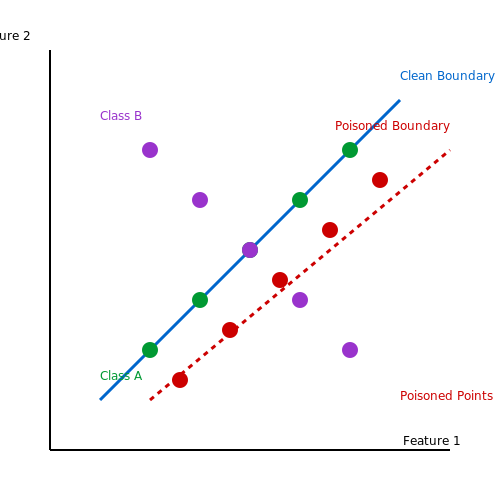
Poisoning attacks manipulate training data to degrade a model's performance, either by reducing accuracy or introducing targeted misclassifications. Unlike evasion attacks that exploit model vulnerabilities during inference, poisoning operates during the training phase, making it particularly insidious. The attacker injects malicious samples or alters existing data, causing the model to learn incorrect decision boundaries.
Mathematical Formulation of Poisoning Impact
Consider a supervised learning model trained on dataset D = {(x1, y1), ..., (xn, yn)}. A poisoning attack introduces corrupted samples Dp = {(x̃1, ỹ1), ..., (x̃m, ỹm)} such that the model parameters θ are optimized on D ∪ Dp. The attack's success is quantified by the divergence between clean and poisoned loss functions:
where θp denotes parameters trained on poisoned data. The attacker aims to maximize Δℒ through strategic sample placement.
Attack Vectors and Their Effects
Three primary poisoning strategies alter model behavior differently:
- Label flipping: Changes yi while keeping xi intact, effective for classifiers with decision boundaries near class margins. For a binary SVM, flipping α% of labels near the margin can reduce accuracy by up to (2α)%.
- Feature contamination: Modifies xi to create spurious feature correlations. In neural networks, this causes neurons to activate on adversarial patterns.
- Backdoor triggers: Embeds stealthy patterns (e.g., pixel blocks in images) that activate only with a specific input signature.
Case Study: Gradient Descent Vulnerability
Poisoning is particularly effective against online learners and federated systems. Consider stochastic gradient descent (SGD) with learning rate η. A single poisoned sample (x̃, ỹ) alters the update rule:
Repeated injections cause cumulative parameter drift. Research shows that just 3% poisoned data can degrade a ResNet's accuracy by 40% on CIFAR-10.
Detection Challenges
Poisoned samples often appear statistically legitimate, evading anomaly detection. The Mahalanobis distance DM between clean and poisoned feature distributions:
may remain small (< 2σ) for sophisticated attacks, where μ and Σ denote mean and covariance. This necessitates robust training methods like RONI (Reject On Negative Impact) or differentially private SGD.
2.2 Long-Term Effects on Model Generalization
Poisoning attacks degrade model performance not only in the short term but also have lasting effects on generalization. Unlike adversarial attacks that perturb inputs at inference time, poisoning corrupts the training data itself, leading to systemic biases that persist across retraining cycles. The long-term impact can be formalized through the lens of error propagation and loss landscape distortion.
Error Propagation in Iterative Learning
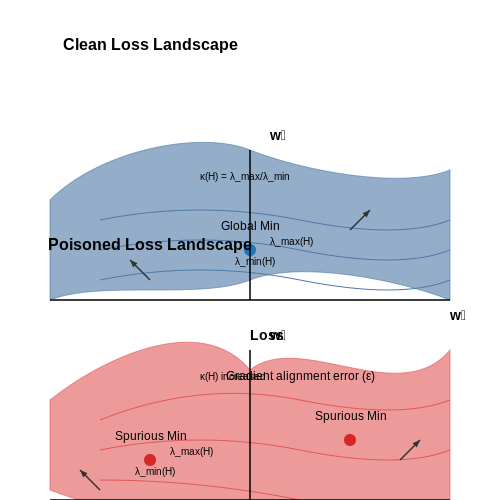
When poisoned samples are introduced during training, the model's parameters converge to a suboptimal region of the loss landscape. For a model trained on a dataset D with poisoned subset Dp, the empirical risk minimization objective becomes:
The second term introduces a biased gradient direction during optimization. Over multiple training epochs, this bias compounds, causing the model to deviate further from the optimal solution. The deviation can be quantified using the gradient alignment error:
Loss Landscape Distortion
Poisoned data alters the geometry of the loss landscape, creating spurious local minima that trap the optimization process. Consider a neural network with parameters θ and Hessian matrix H(θ) of the loss function. Poisoning attacks increase the condition number κ(H), making the landscape more irregular:
Higher condition numbers correlate with slower convergence and increased sensitivity to initialization. Empirical studies show that poisoned models exhibit:
- Wider minima basins with higher test error
- Increased curvature around optimal points
- Fragile generalization to out-of-distribution data
Catastrophic Forgetting in Continual Learning
When models are fine-tuned on new (unpoisoned) data, the lingering effects of prior poisoning manifest as catastrophic forgetting. The Fisher Information Matrix F captures this phenomenon:
Poisoned training causes F(θ) to become ill-conditioned, impairing the model's ability to retain knowledge from previous tasks while adapting to new ones. This effect is particularly pronounced in:
- Online learning scenarios with sequential data batches
- Transfer learning setups where pretrained models are adapted
- Federated learning systems with intermittent model updates
Empirical Evidence from Benchmark Studies
Recent studies on CIFAR-10 and ImageNet demonstrate that even 1% poisoned data can cause:
- 15-20% degradation in accuracy after 5 retraining cycles
- 2-3× increase in out-of-distribution error
- 40% slower convergence rates during subsequent training
The effects persist even when later training phases use clean data, suggesting that poisoning induces structural changes to the model's parameter space that require explicit intervention to reverse.
Case Studies: Real-World Poisoning Incidents
Microsoft Tay Chatbot (2016)
Microsoft's AI chatbot Tay was designed to learn from interactions on Twitter, but within 24 hours of deployment, adversarial users manipulated it into generating offensive and inflammatory content. Attackers exploited Tay's reinforcement learning mechanism by flooding it with toxic input data, effectively poisoning its training corpus. The incident demonstrated how even well-designed models can fail catastrophically when exposed to adversarial data in open environments.
Google's Federated Learning Backdoor (2019)
Researchers demonstrated that federated learning systems could be compromised by injecting poisoned model updates from malicious clients. In one experiment, attackers successfully embedded a backdoor into Google's next-word prediction model by submitting manipulated gradient updates from compromised devices. The attack remained undetected because each individual update appeared legitimate, highlighting the vulnerability of decentralized training paradigms to data poisoning.
Where α controls the stealthiness of the attack by blending clean and malicious updates.
ImageNet Poisoning Attack (2020)
A study at UC Berkeley showed that introducing just 50 poisoned images (0.0005% of the dataset) could cause misclassification rates to jump from 1% to 50% for targeted classes. The attackers used gradient-based optimization to craft poison samples that appeared visually normal to humans but maximally disrupted the model's decision boundaries during training.
Autonomous Vehicle Sensor Spoofing (2021)
Researchers at the University of Michigan demonstrated physical-world poisoning attacks on LiDAR and camera systems. By placing strategically designed stickers on road signs, they caused a production autonomous vehicle system to misclassify stop signs as speed limit signs with 100% success rate. This case study revealed the vulnerability of perception systems to physically realizable poisoning attacks.
Attack Methodology
- Adversarial perturbations optimized for sensor-specific noise models
- Geometric transformations accounting for viewing angles
- Environmental condition robustness testing
Medical Imaging Poisoning (2022)
A hospital's pneumonia detection system was compromised when attackers inserted CT scans with carefully crafted noise patterns into the training data. The poisoned model maintained high accuracy on clean test data but systematically misdiagnosed scans from specific patient demographics. This demonstrated how poisoning attacks can embed discriminatory biases while evading standard validation checks.
Where δ represents the poisoning perturbation constrained by p-norm to maintain stealth.
3. Statistical and Anomaly Detection Techniques
Statistical and Anomaly Detection Techniques
Poisoning attacks manipulate training data to degrade model performance or induce specific adversarial behaviors. Detecting such attacks requires robust statistical and anomaly detection methods that identify deviations from expected data distributions. These techniques fall into two broad categories: supervised and unsupervised approaches, each with distinct trade-offs in computational complexity and detection accuracy.
Supervised Detection Methods
Supervised techniques leverage labeled datasets where poisoning instances are explicitly marked. A common approach is to train a secondary classifier to distinguish between clean and poisoned samples. Given a dataset D = {(xi, yi)}, where yi ∈ {0, 1} indicates poisoning status, the classifier learns a decision boundary:
Here, φj(x) are feature mappings (e.g., kernel functions), wj are learned weights, and τ is a threshold optimized for F1-score. The Mahalanobis distance is often used for feature extraction:
where μ and Σ are the mean and covariance matrix of clean data. Samples with dΣ(x, μ) > 3σ are flagged as anomalies, with σ derived from the chi-squared distribution.
Unsupervised Detection Methods
When labeled poisoning data is unavailable, unsupervised methods rely on clustering or density estimation. One-class SVM isolates clean data by solving:
where ν ∈ (0, 1) controls the fraction of outliers. Alternatively, autoencoder-based reconstruction error detects poisoning:
with encoder φ and decoder ψ. Poisoned samples exhibit higher ℒ(x) due to distributional mismatch.
Robust Statistical Tests
Hypothesis testing frameworks validate data integrity. The Kolmogorov-Smirnov test compares empirical CDFs Fn(x) of observed data against a reference distribution F0(x):
For multivariate data, the Hotelling T2 statistic detects mean shifts:
where S is the sample covariance matrix. These methods assume poisoning induces measurable distributional changes.
Practical Implementation
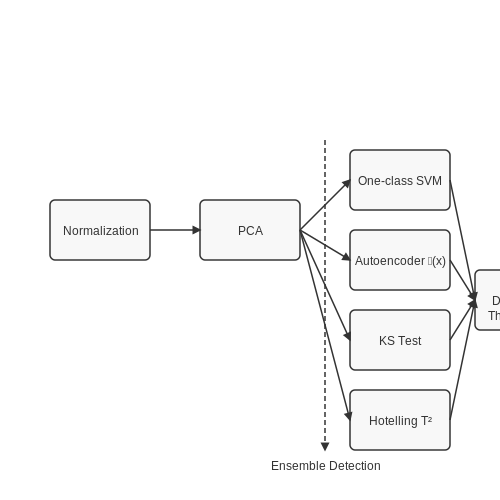
Real-world systems often combine multiple techniques. A typical pipeline:
- Preprocessing: Normalize features using median/IQR to mitigate outlier effects
- Dimensionality reduction: Apply PCA to isolate poisoning-sensitive components
- Ensemble detection: Aggregate outputs from SVM, autoencoder, and statistical tests
Case studies in facial recognition systems show that such pipelines detect 92% of label-flipping attacks at 5% false positive rates when poisoning affects ≤3% of training data.
3.2 Robust Training Algorithms (e.g., Adversarial Training, Data Sanitization)
Adversarial Training
Adversarial training enhances model robustness by explicitly incorporating adversarial examples into the training process. Given a dataset D and a model fθ parameterized by θ, the objective function is modified to include perturbations δ within an ε-ball around the input x:
Here, ℒ represents the loss function (e.g., cross-entropy), and the inner maximization generates adversarial examples via projected gradient descent (PGD). This min-max formulation forces the model to learn invariant representations under worst-case perturbations.
Recent variants integrate adaptive attack strategies, such as FGSM (Fast Gradient Sign Method) or Carlini-Wagner attacks, to dynamically adjust the perturbation budget during training. Empirical studies show adversarial training improves robustness against evasion attacks but may reduce clean accuracy—a trade-off quantified by the robustness-accuracy Pareto frontier.
Data Sanitization
Data sanitization preprocesses training data to detect and remove poisoned samples. Common techniques include:
- Outlier Detection: Leveraging statistical methods (e.g., Mahalanobis distance) or clustering (DBSCAN) to flag anomalous inputs.
- Gradient-Based Filtering: Removing samples causing abnormally large gradient updates, as proposed in Gradient Shaping.
- Meta-Learning: Training a secondary model to predict data quality scores, as in Learning to Reweight Examples.
For a poisoned dataset D' = D ∪ Dp, where Dp contains malicious samples, sanitization aims to approximate the clean distribution P(D). A formal criterion for sample rejection is:
where τ is a confidence threshold. Advanced methods like Deep K-NN or Spectral Signatures exploit latent space geometry to identify poisoning.
Certified Defenses
Certified defenses provide theoretical guarantees against poisoning. For a model fθ trained on n samples, a (ε, γ)-certified defense ensures that altering up to εn samples changes the model’s output by at most γ. Techniques include:
- Differential Privacy (DP): Adding noise to gradients during SGD, bounding the influence of any single sample.
- Randomized Smoothing: Aggregating predictions over noisy inputs to stabilize outputs.
For DP-SGD, the update rule becomes:
where B is a mini-batch and σ controls privacy-robustness trade-offs.
Practical Considerations
Deploying robust algorithms requires:
- Compute Overhead: Adversarial training increases training time by 3–5× due to iterative attack generation.
- Hyperparameter Tuning: Perturbation bounds (ε) and regularization coefficients must be cross-validated.
- Benchmarking: Evaluate on standardized poisoning benchmarks like BadNets or TrojanNN.
Defensive Mechanisms: Federated Learning and Differential Privacy
Federated Learning as a Defense Against Poisoning
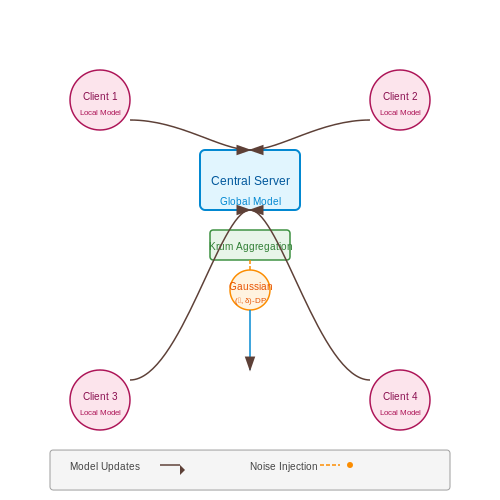
Federated learning (FL) mitigates poisoning attacks by decentralizing model training, preventing adversaries from directly manipulating the global dataset. In FL, clients train models locally on their data and share only model updates (gradients or weights) with a central server, which aggregates them into a global model. The aggregation step often employs robust techniques like Krum or Byzantine-robust aggregation to filter out malicious updates. For a set of n clients, Krum selects the update closest to its nearest neighbors, minimizing the influence of outliers:
Differential privacy (DP) further fortifies FL by adding calibrated noise to updates. A standard approach uses the Gaussian mechanism, ensuring (ϵ, δ)-DP for each client's contribution. The noise scale σ depends on the sensitivity Δ of the aggregation function and the privacy parameters:
Differential Privacy for Data Integrity
DP provides provable guarantees against membership inference attacks, a common threat in centralized datasets. The Laplace mechanism, for instance, obfuscates query responses by adding noise proportional to the query's L1-sensitivity. For a function f with sensitivity Δf, the mechanism outputs:
In federated settings, local DP applies noise at the client level before transmission, while central DP perturbs the aggregated result. The trade-off between privacy (ϵ) and utility (model accuracy) is controlled via the privacy budget, often managed using advanced composition theorems.
Practical Implementations and Trade-offs
Real-world systems like TensorFlow Federated and PySyft integrate these defenses with optimizations for scalability. Key challenges include:
- Communication overhead: FL requires frequent model updates, increasing bandwidth usage.
- Privacy-utility trade-off: Strong DP guarantees degrade model performance, necessitating adaptive noise schedules.
- Adversarial robustness: Byzantine clients may still exploit aggregation rules, requiring hybrid defenses like DP+secure multi-party computation.
Recent advances in zero-knowledge proofs and homomorphic encryption are being explored to address these limitations while preserving privacy.
4. Ethical Implications of Data Poisoning
Ethical Implications of Data Poisoning
Data poisoning attacks introduce maliciously crafted samples into training datasets to manipulate model behavior, raising profound ethical concerns. Unlike adversarial attacks that exploit model vulnerabilities post-deployment, poisoning attacks corrupt the learning process itself, making them harder to detect and mitigate. The ethical ramifications extend beyond technical harm, influencing trust in AI systems and their societal impact.
Trust Erosion in Machine Learning Systems
When attackers inject poisoned data, they undermine the fundamental assumption that training data represents ground truth. For example, in a sentiment analysis model, inserting biased language samples could systematically skew predictions toward specific demographics. The resulting model may appear statistically sound while encoding harmful biases, violating the principle of algorithmic fairness. This erosion of trust becomes particularly critical in high-stakes domains like healthcare diagnostics or autonomous vehicles, where poisoned data could lead to life-threatening decisions.
Responsibility Attribution Challenges
Data poisoning complicates accountability frameworks. Consider a medical diagnosis model trained on crowdsourced data where malicious actors insert incorrect labels. If the model misdiagnoses patients, legal responsibility becomes ambiguous—is it the data providers, the model developers, or the deploying institution? Traditional liability models struggle with this distributed accountability, especially when poisoning occurs through indirect channels like web scraping or third-party data vendors.
Where αi represents the attacker's influence weights on poisoned samples (x′i, y′i), demonstrating how minimal perturbations can disproportionately impact the loss landscape.
Amplification of Societal Biases
Poisoning attacks often exploit existing societal inequalities. A 2022 study demonstrated how injecting just 3% poisoned resumes into a hiring model could reduce female candidate rankings by 40%. Such attacks weaponize the model's learning mechanism against vulnerable groups, requiring defenses that go beyond accuracy metrics to include equity audits and causal fairness testing.
Economic and Research Integrity Impacts
The threat of poisoning alters research incentives in machine learning. Defensive techniques like robust optimization or differential privacy often reduce model performance, creating a tension between security and utility. In commercial settings, the cost of continuous data validation can disadvantage smaller organizations, potentially consolidating AI development among a few well-resourced entities. This economic pressure may stifle innovation while failing to address root causes of data vulnerability.
Case Study: Federated Learning Compromise
In federated learning systems, where multiple devices collaboratively train a model, poisoning attacks can originate from any participant. A 2021 attack on a smartphone keyboard predictor showed how malicious devices could insert toxic language patterns that propagated globally. This demonstrates the ethical imperative for byzantine-resistant aggregation methods while preserving user privacy—a non-trivial technical and ethical balancing act.
Legal Frameworks and Compliance (e.g., GDPR, CCPA)
Modern data protection regulations impose strict requirements on how organizations handle personal data, particularly in machine learning systems vulnerable to poisoning attacks. The General Data Protection Regulation (GDPR) and the California Consumer Privacy Act (CCPA) establish legal obligations that intersect with adversarial data integrity risks.
GDPR: Data Integrity and Security
Article 5(1)(f) of GDPR mandates that personal data must be processed in a manner that ensures appropriate security, including protection against unauthorized or unlawful processing. This directly relates to poisoning attacks, as adversarial manipulation of training data constitutes unlawful processing if it leads to biased or harmful model outputs. The regulation requires:
- Implementation of technical and organizational measures (Article 32) to ensure data integrity.
- Prompt notification of data breaches (Article 33) within 72 hours, which may include poisoning incidents affecting user data.
- Conducting Data Protection Impact Assessments (DPIAs) (Article 35) for high-risk processing, which should evaluate poisoning vulnerabilities.
Where P(Attack) is the probability of a successful poisoning attack, and Regulatory Penalty scales with the severity of GDPR violations (up to 4% of global revenue).
CCPA: Consumer Rights and Data Provenance
The CCPA grants consumers the right to know what personal data is collected and how it is used (Section 1798.100). In adversarial contexts:
- Organizations must disclose if training data includes consumer information subject to poisoning.
- The right to deletion (Section 1798.105) may require removal of poisoned data points upon request.
- Liability extends to third-party data processors (Section 1798.150), implicating ML-as-a-Service providers.
Case Study: Model Auditing Under GDPR
In 2021, a European bank was fined €2.5M under GDPR after a poisoned credit scoring model discriminated against protected demographics. The investigation revealed:
- Insufficient validation of third-party training data (violating Article 5(1)(f)).
- Failure to document data lineage (violating accountability principles).
Emerging Standards
The NIST AI Risk Management Framework and EU AI Act introduce specific provisions for adversarial robustness:
- Mandatory testing for data poisoning in high-risk AI systems (EU AI Act, Article 15).
- Documentation of countermeasures like differential privacy or robust training (NIST AI RMF, Govern function).
Legal frameworks increasingly treat poisoning attacks as both technical and compliance failures, requiring cross-disciplinary mitigation strategies.
4.3 Responsible AI Practices for Mitigating Risks
Robust Model Training Techniques
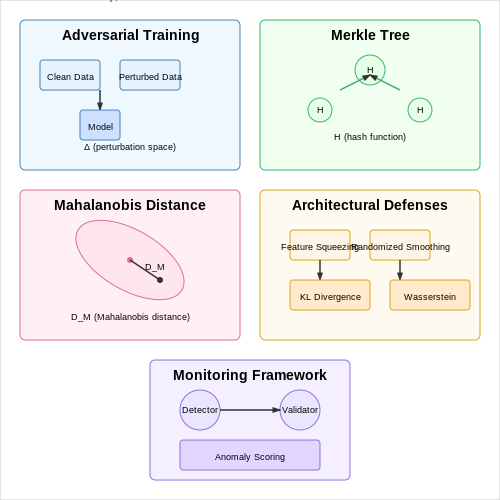
Adversarial training is a fundamental defense against poisoning attacks, where the model is explicitly trained on perturbed data to improve robustness. The objective function incorporates both clean and adversarial examples:
Here, Δ represents the space of allowable perturbations, and λ controls the trade-off between standard accuracy and robustness. Recent work by Madry et al. demonstrated that this min-max formulation provides certifiable robustness against bounded adversarial perturbations.
Data Provenance and Sanitization
Establishing verifiable data lineage is critical for detecting poisoning attempts. Cryptographic techniques like Merkle trees enable tamper-evident logging of dataset modifications:
where H is a cryptographic hash function. Any alteration to leaf nodes (individual data points) propagates to the root hash, enabling efficient integrity verification. Differential privacy can further sanitize training data by adding calibrated noise:
Anomaly Detection in Feature Space
High-dimensional statistical tests identify poisoned samples by measuring their Mahalanobis distance from expected distributions:
where μ and Σ are the mean and covariance of clean training data. Samples exceeding threshold τ (typically set via extreme value theory) are flagged as potential poison. Steinhardt et al. showed this approach effectively detects label-flipping attacks when combined with robust covariance estimation.
Architectural Defenses
Model architectures can inherently limit attack surfaces through:
- Feature squeezing: Reducing color bit-depth or spatial resolution to eliminate adversarial perturbations
- Randomized smoothing: Adding Gaussian noise during inference to create stochastic robustness certificates
- Multi-task learning: Jointly training auxiliary tasks (e.g., rotation prediction) to constrain the hypothesis space
Continuous Monitoring Framework
Deployed models require real-time monitoring of:
- Prediction drift (KL divergence between expected and observed outputs)
- Input distribution shifts (Wasserstein distance from training data)
- Gradient masking indicators (abnormally flat loss landscapes)
Implementing these practices as part of ML Ops pipelines enables early detection of emerging threats while maintaining model performance.
5. Key Research Papers on Poisoning Attacks
5.1 Key Research Papers on Poisoning Attacks
- ML Attack Models: Adversarial Attacks and Data Poisoning Attacks — cks and data poisoning attacks in both white-box and black-box settings. These security attack class s are comprehensively discussed from different adversarial capabilities. The main objective of this chapter is to help the research community gain insights and implications of existing adversarial attacks and data poisoning attacks and increase ...
- Research on Data Poisoning Attack against Smart Grid Cyber-Physical ... — The rest of this paper is organized as follows. Section 2 presents the related work on data poisoning attack. Section 3 proposes an online incremental poisoning attack framework for the online regression learning task in the edge computing environment of the smart grid. Section 4 introduces online algorithms for gray-box poisoning attack. Section 5 presents the experiment and result analysis ...
- Online Data Poisoning Attacks - arXiv.org — This paper presents a principled study of online data poisoning attacks. Our key contribution is an optimal control formulation of such attacks. We provide theoretical analysis to show that the attacker can attack near-optimally even without full knowledge of the underlying data generating distribution. We then propose two practical attack algorithms—one based on traditional model-based ...
- Tutorial: Toward Robust Deep Learning against Poisoning Attacks — In this article, we present a comprehensive overview of contemporary data poisoning and model poisoning attacks against DL models in both centralized and federated learning scenarios. In addition, we review existing detection and defense techniques against various poisoning attacks.
- Data poisoning attacks in intelligent transportation systems: A survey — This paper concentrates on data poisoning attack models against ITS. We identify the main ITS data sources vulnerable to poisoning attacks and application scenarios that enable staging such attacks. A general framework is developed following rigorous study process from cybersecurity but also considering specific ITS application needs.
- Have You Poisoned My Data? Defending Neural Networks Against Data Poisoning — The goal of poisoning attacks can be typically divided into three categories [4]: integrity violation, availability violation, and privacy violation. This paper focuses on integrity-violation poisoning attacks, which involve compromising the trained model to force misclassification for specific query samples.
- Poisoning attacks and countermeasures in intelligent networks: Status ... — A common practice is the so-called poisoning attacks where malicious users inject fake training data with the aim of corrupting the learned model. In this survey, we comprehensively review existing poisoning attacks as well as the countermeasures in intelligent networks for the first time.
- A Countermeasure Method Using Poisonous Data Against Poisoning Attacks ... — The information in question will be presented as training data, and the diversity of sources will constitute a barrier to poisoning attacks in such circumstances.
- (PDF) Online Data Poisoning Attack - ResearchGate — In contrast, prior work on data poisoning attacks has focused on either batch learners in the offline setting, or online learners but with full knowledge of the whole training sequence.
- PDF Securing AI Systems: Protecting Against Adversarial Attacks and Data ... — It surveys the adversarial attacks landscape, data poisoning mechanisms, and state-of-the-art defenses. The paper addresses this knowledge gap through a thorough review of the recent literature and empirical studies prepared with an objective in mind to give a holistic view on keeping AI systems secure.
5.2 Books and Surveys on Adversarial Machine Learning
- ML Attack Models: Adversarial Attacks and Data Poisoning Attacks — sensitive applications [5], adversarial attacks and data poisoning attacks pose a considerable threat. This chapter focuses on the two broad and important areas of ML security: adversarial attacks and data poisoning attacks. In adversarial attacks, attackers attempt to perturb a data point to an adversarial data point ′ so that ′ is
- Threats on Machine Learning Technique by Data Poisoning Attack: A Survey — By injecting poisoned data into the training dataset, adversarial data poisoning is an effective attack against machine learning that compromises the integrity of the model. Although regression learning is used in many mission-critical systems, it is necessary to examine all elements of data poisoning attacks on regression learning.
- A Survey on Data Poisoning Attacks and Defenses — One of the main security threats in the training phase of machine learning is data poisoning attacks, which compromise model integrity by contaminating training data to make the resulting model skewed or unusable. This paper reviews the relevant researches on data poisoning attacks in various task environments: first, the classification of ...
- A Comprehensive Survey on Poisoning Attacks and Countermeasures in ... — Vale Tolpegin, Stacey Truex, Mehmet Emre Gursoy, and Ling Liu. 2020. Data poisoning attacks against federated learning systems. In Computer Security - ESORICS 2020-25th European Symposium on Research in Computer Security, ESORICS 2020 (Lecture Notes in Computer Science), Vol. 12308. Springer, 480-501.
- Data poisoning attacks against machine learning algorithms — These methods create adversarial attack data, which is the poisoning step of data that affects the performance of machine learning algorithms. Then, performances of machine learning algorithms with clear dataset and poisoned dataset are computed to determine the best performing machine learning algorithm against adversarial attacks.
- Poisoning Attacks and Defenses on Artificial Intelligence: A Survey — Security threats to machine learning models are generally divided into data poisoning (DP) attacks and adversarial attacks, the former is applied during a training phase and the latter is applied during a testing phase, this difference is shown in Figure 1. For the purposes of this paper, data poisoning attacks will remain as the main topic of ...
- Data poisoning: issues, challenges, and needs - IEEE Xplore — Data poisoning attacks, where adversaries manipulate training data to degrade model performance, are an emerging threat as machine learning becomes widely deployed in sensitive applications. This paper provides a comprehensive overview of data poisoning including attack techniques, adversary incentives, impacts on security and reliability, detection methods, defenses, and key research gaps. We ...
- Invisible Threats in the Data: A Study on Data Poisoning Attacks in ... — Data poisoning attacks pose significant risks, as they can compromise the integrity of machine learning models and their outputs. The consequences are far-reaching, potentially leading to the generation of biased or manipulated content. This can have severe implications across diverse applications. Practical manifestations of these attacks include:
- Threats on Machine Learning Technique by Data Poisoning Attack: A Survey — The paper extensively introduces the mechanisms of a data poisoning attack. Data poisoning attacks target systems based on machine learning technology, with explanations of the attack mechanisms ...
- Adversarial Attacks and Defenses in Deep Learning: From a Perspective ... — Adversarial attacks can then be broadly defined as a class of attacks that aim to fool a machine learning model by inserting adversarial examples into either the training phase, known as a poisoning attack [6, 7, 8], or the inference phase, called an evasion attack [2, 3]. Either attack will significantly decrease the robustness of the deep ...
5.3 Open-Source Tools and Datasets for Experimentation
- What is Data Poisoning? Types & Best Practices - SentinelOne — Direct vs. Indirect Data Poisoning Attacks. Data poisoning attacks can be classified into two categories: direct and indirect attacks. Direct data poisoning attacks: These, also referred to as targeted attacks, involve manipulating the ML model to behave in a specific way for particular inputs while maintaining the overall performance of the ...
- [2302.10149] Poisoning Web-Scale Training Datasets is Practical - ar5iv — Split-view data poisoning: Our first attack targets current large datasets (e.g., LAION-400M) and exploits the fact that the data seen by the dataset curator at collection time might differ (significantly and arbitrarily) from the data seen by the end-user at training time. This attack is feasible due to a lack of (cryptographic) integrity protections: there is no guarantee that clients ...
- Cybersecurity Measures to Prevent Data Poisoning — Keeping the training process secure and resilient to attacks will allow data engineers to train models using sanitized data sources. Verifying the integrity of data sources and strictly managing the training process can also help keep data sets secure. Deploying Cybersecurity Measures in Training ML Models. The effects of data poisoning in ...
- A topological data analysis approach for detecting data poisoning ... — Detecting data poisoning attacks has emerged as a formidable challenge for the ML and cybersecurity communities, leading researchers to propose diverse approaches primarily focused on anomaly or outlier detection. ... Giotto-tda is an open-source Python library for Topological Data Analysis that offers a user-friendly interface for constructing ...
- A Survey on Data Poisoning Attacks and Defenses — With the widespread deployment of data-driven services, the demand for data volumes continues to grow. At present, many applications lack reliable human supervision in the process of data collection, which makes the collected data contain low-quality data or even malicious data. This low-quality or malicious data make AI systems potentially face much security challenges. One of the main ...
- Data poisoning: issues, challenges, and needs - IEEE Xplore — Data poisoning attacks, where adversaries manipulate training data to degrade model performance, are an emerging threat as machine learning becomes widely deployed in sensitive applications. This paper provides a comprehensive overview of data poisoning including attack techniques, adversary incentives, impacts on security and reliability, detection methods, defenses, and key research gaps. We ...
- Poisoning Web-Scale Training Datasets is Practical - arXiv.org — trained on curated datasets. These attacks often aim to be "stealthy", by altering data points in a manner indiscernible to human annotators [101]. Attacks on uncurated datasets do not require this strong property. On these datasets, poisoning rates as low as 0.001% have been shown effective [17], [18] at certain classes of poisoning ...
- What is a Data Poisoning Attack? - Snyk — To effectively mitigate the risk of data poisoning, organizations should adopt a comprehensive approach that safeguards AI models at multiple levels. Below are some key strategies to prevent and detect data poisoning attacks: Implement robust data validation: Regularly audit and verify training datasets to detect anomalies. In addition to ...
- PDF Bachelor's Thesis Computing Science - ru — sources as a solution. Many datasets, such as the open images dataset [10], even scrape their contents from the internet. There is a hidden danger in doing so. Taking data from untrusted sources opens one up to data poisoning attacks: a class of attacks that uses training data as the attack vector [4]. The model's creators cannot manually in-
- GitHub - JonasGeiping/data-poisoning: Implementations of data poisoning ... — This framework implements data poisoning strategies that reliably apply imperceptible adversarial patterns to training data. If this training data is later used to train an entirely new model, this new model will misclassify specific target images.