Integrating LLMs with APIs and Plugins
1. Core Architecture of Modern LLMs
Core Architecture of Modern LLMs
Transformer-Based Architecture
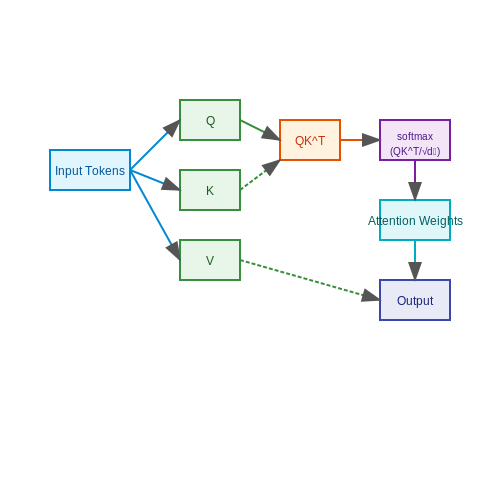
The foundation of modern large language models (LLMs) is the transformer architecture, introduced by Vaswani et al. in 2017. Unlike recurrent neural networks (RNNs) or convolutional neural networks (CNNs), transformers rely entirely on self-attention mechanisms to process input sequences in parallel. The key components include:
- Self-Attention Mechanism: Computes weighted sums of input embeddings, allowing the model to focus on relevant tokens dynamically.
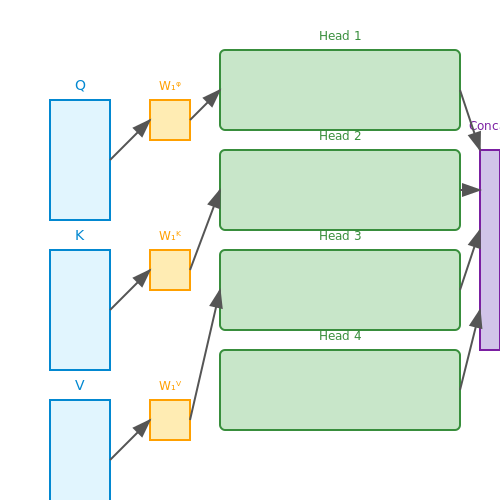
- Multi-Head Attention: Splits attention into multiple parallel heads, enabling the model to capture diverse contextual relationships.
- Positional Encodings: Injects information about token positions since transformers lack inherent sequential processing.
Layer Normalization and Residual Connections
To stabilize training in deep architectures, transformers employ layer normalization (LayerNorm) and residual connections. LayerNorm normalizes activations across the feature dimension, while residual connections mitigate vanishing gradients by allowing gradients to flow directly through the network.
Feed-Forward Networks
Each transformer layer contains a position-wise feed-forward network (FFN) applied independently to each token. The FFN consists of two linear transformations with a Gaussian Error Linear Unit (GELU) activation in between:
Scalability and Parallelization
Modern LLMs scale to billions of parameters through techniques like tensor parallelism, pipeline parallelism, and mixed-precision training. The use of distributed training frameworks (e.g., Megatron-LM, DeepSpeed) enables efficient training across GPU clusters.
Practical Implications
The transformer's parallelizable nature allows LLMs to process long sequences efficiently, making them suitable for tasks like document summarization, code generation, and conversational AI. However, the quadratic complexity of self-attention with respect to sequence length remains a computational bottleneck.
Integrating LLMs with APIs and Plugins
1.2 How LLMs Interact with External Systems
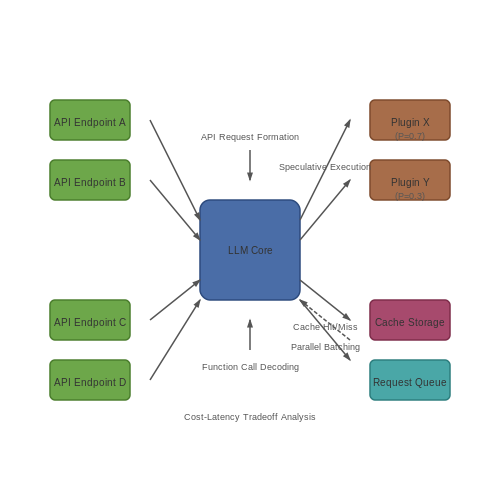
Large Language Models (LLMs) interact with external systems through structured interfaces that enable them to extend their capabilities beyond static pre-training knowledge. The primary mechanisms for this interaction include API calls, plugin architectures, and function calling, each with distinct technical implementations.
API-Based Interaction Patterns
When an LLM requires real-time data or specialized computation, it can generate API request payloads in standardized formats (typically JSON). The model constructs these requests by:
- Parsing user intent to determine required external data
- Mapping semantic understanding to API endpoint specifications
- Formatting parameters according to the target API's schema
For example, when answering a weather query, the model might generate:
{
  "endpoint": "weather_api/v3/current",
  "params": {
    "location": "San Francisco",
    "units": "metric"
  }
}
Plugin Architecture Mechanics
Plugin systems provide more sophisticated integration by allowing the LLM to dynamically load and execute specialized modules. The interaction follows this sequence:
where ht represents the hidden state, ct is the plugin context vector, and Wp, bp are learned parameters for plugin selection.
Function Calling Paradigm
Advanced LLMs implement function calling through constrained decoding, where the model generates structured outputs matching predefined schemas. The probability distribution over possible function calls is given by:
where X is the input context, ti are tokens, and 𝓕 represents the valid function call vocabulary.
Execution Flow Optimization
To minimize latency in external system interactions, modern implementations use:
- Speculative execution of likely API calls during text generation
- Parallel request batching when multiple external queries are needed
- Cache-aware request planning to avoid redundant computations
The optimal scheduling problem can be formulated as:
where S is the schedule of external calls, wi are priority weights, and λ controls the cost-latency tradeoff.
Common Use Cases for API and Plugin Integration
Large Language Models (LLMs) gain significant functional expansion when integrated with external APIs and plugins, enabling dynamic data retrieval, real-time processing, and interaction with specialized tools. Below are key advanced use cases where such integrations deliver transformative capabilities.
Automated Research Assistance
LLMs augmented with academic search APIs (e.g., arXiv, PubMed) can retrieve and synthesize research papers in real time. When combined with citation graph plugins, they identify seminal works and emerging trends. For mathematical queries, integration with symbolic computation engines (Wolfram Alpha, SymPy) allows step-by-step derivation:
The model parses LaTeX input, delegates symbolic differentiation to the plugin, and explains the physical interpretation of Maxwell-Faraday equation.
Enterprise Workflow Automation
In corporate environments, LLMs with CRM (Salesforce), ERP (SAP), and email API access automate:
- Drafting personalized client proposals using CRM data
- Generating inventory reports by querying ERP systems
- Prioritizing support tickets through sentiment analysis plugins
OAuth 2.0 integration enables secure access while maintaining role-based permissions.
Scientific Computing Pipelines
Researchers couple LLMs with numerical computing APIs (NumPy, SciPy) for:
The model generates Python code for eigenvalue analysis, then executes it through a Jupyter kernel plugin, returning stability diagrams and time-domain simulations.
Financial Analysis Systems
Bloomberg Terminal APIs and quantitative finance plugins enable:
- Real-time portfolio risk assessment using Value-at-Risk calculations
- Earnings call summarization with sentiment heatmaps
- Monte Carlo simulation for derivative pricing
where d1 and d2 contain volatility surface data fetched from market APIs.
Multimodal Content Generation
Plugin architectures allow LLMs to orchestrate:
- DALL-E/Stable Diffusion for image generation from textual prompts
- ElevenLabs for voice synthesis with emotional tone control
- Video editing APIs for automatic clip sequencing
The model acts as a creative director - for example, generating a product demo by:
- Writing script (LLM core)
- Creating storyboard images (diffusion plugin)
- Producing voiceover (TTS API)
- Rendering final video (FFmpeg integration)
IoT and Robotics Control
Through ROS (Robot Operating System) APIs, LLMs can:
- Parse natural language commands into robot trajectory plans
- Monitor sensor feeds via MQTT/WebSocket plugins
- Adjust PID controllers in real-time based on verbal feedback
where the model translates "increase stiffness slightly" into updated k parameters sent via REST API.
2. Choosing the Right API for Your LLM
Choosing the Right API for Your LLM
Selecting an API for integrating a large language model (LLM) into an application requires evaluating multiple technical and operational factors. The choice impacts performance, scalability, cost, and maintainability. Below are key considerations for making an informed decision.
API Performance and Latency
The inference speed of an LLM API is critical for real-time applications. Latency is influenced by model size, hardware acceleration, and network overhead. For example, GPT-4 with 175B parameters exhibits higher latency than smaller models like GPT-3.5-turbo. The response time T can be modeled as:
Where Tinference dominates for large models. APIs with optimized backends (e.g., TensorRT-LLM or vLLM) reduce this component significantly.
Cost and Pricing Models
APIs often charge per token (input + output). For high-volume applications, cost efficiency becomes paramount. Compare:
- Pay-per-token (e.g., OpenAI, Anthropic) – Suitable for variable workloads.
- Throughput-based (e.g., AWS Bedrock) – Cost-effective for steady-state usage.
- Self-hosted (e.g., LLaMA 2 via Hugging Face TGI) – Eliminates recurring fees but requires infrastructure.
Calculate total cost C for N requests as:
where α and β are input/output token rates.
Model Capabilities and Fine-Tuning
Evaluate whether the API supports:
- Task-specific fine-tuning (e.g., OpenAI's fine-tuning API).
- Multi-modal processing (e.g., GPT-4V for images).
- Custom prompt engineering (e.g., system messages in Anthropic Claude).
APIs like Mistral 7B allow full model customization via LoRA adapters, while proprietary APIs (e.g., Gemini) restrict low-level access.
Rate Limits and Scalability
Production systems must handle concurrent requests without throttling. Key metrics:
- Requests per minute (RPM) – OpenAI’s GPT-4 defaults to 10 RPM.
- Tokens per minute (TPM) – Anthropic Claude caps at 100K TPM.
For autoscaling, use:
where λ is the request arrival rate.
Data Privacy and Compliance
For healthcare (HIPAA) or finance (SOC 2), verify if the API offers:
- Data encryption in transit/at rest (e.g., Azure OpenAI’s private endpoints).
- Zero data retention (e.g., AWS Bedrock’s immutable logs).
- On-prem deployment (e.g., IBM Watsonx).
Integration Complexity
Assess SDK quality, authentication methods (OAuth2, API keys), and response formats (JSON, Protobuf). For example:
import openai
response = openai.ChatCompletion.create(
    model="gpt-4",
    messages=[{"role": "user", "content": "Explain quantum entanglement."}],
    temperature=0.7
)
Contrast this with AWS Bedrock’s AWS CLI integration, which requires IAM role configuration.
Case Study: Retrieval-Augmented Generation (RAG)
For a RAG pipeline, combine vector search (e.g., Pinecone API) with an LLM API. The hybrid architecture introduces latency tradeoffs:
APIs like LangChain orchestrate this seamlessly but add abstraction overhead.
Authentication and Security Best Practices
Secure API Authentication Mechanisms
When integrating LLMs with external APIs, authentication ensures that only authorized entities access sensitive data or services. The most robust methods include:
- OAuth 2.0 with PKCE: Preferred for third-party integrations, OAuth 2.0 with Proof Key for Code Exchange (PKCE) mitigates authorization code interception attacks. The client generates a code verifier and challenge:
- API Keys with Scope Restrictions: API keys should be short-lived, rotated frequently, and bound to specific endpoints or permissions. Use HMAC-based signatures for request validation:
Token-Based Security for LLM Plugins
Plugins interfacing with LLMs require stateless authentication. JSON Web Tokens (JWTs) with the following structure are recommended:
{
  "alg": "RS256",
  "typ": "JWT"
}
{
  "sub": "plugin-id",
  "iss": "trusted-issuer",
  "exp": 1735689600,
  "scope": ["read:data", "write:logs"]
}
Tokens must be signed using asymmetric cryptography (e.g., RSA-2048) and validated against a public key registry. Embed the kid (Key ID) header to enable key rotation.
Network-Level Protections
API communications should enforce:
- Mutual TLS (mTLS): Client and server authenticate via X.509 certificates, preventing impersonation. Certificate revocation lists (CRLs) or OCSP stapling must be enforced.
- Strict CORS Policies: Restrict cross-origin requests to trusted domains. Preflight responses should include:
Access-Control-Allow-Origin: https://trusted-domain.com
Access-Control-Allow-Methods: POST, GET
Access-Control-Allow-Headers: Authorization, Content-Type
Rate Limiting and Anomaly Detection
Prevent abuse via adaptive rate limiting algorithms. Token bucket or sliding window counters can dynamically adjust thresholds based on historical traffic patterns:
Pair this with real-time anomaly detection using isolation forests or Gaussian mixture models to flag suspicious activity.
Secret Management
API keys, certificates, and tokens must never be hardcoded. Use:
- Hardware Security Modules (HSMs): For root key storage with FIPS 140-2 compliance.
- Ephemeral Secrets: Dynamically generated per-session credentials with short TTLs (e.g., 5 minutes).
2.3 Handling API Rate Limits and Quotas
API rate limits constrain the number of requests a client can make within a specified time window, preventing abuse and ensuring fair resource allocation. These limits are typically expressed in requests per second (RPS), per minute (RPM), or per day (RPD). Quotas, often implemented alongside rate limits, cap the total usage over a longer period, such as monthly API call allowances.
Rate Limit Algorithms and Their Mathematical Foundations
Two primary algorithms govern rate limiting: the token bucket and leaky bucket approaches. The token bucket algorithm allows bursts up to a maximum capacity C, with tokens replenished at a fixed rate r. The mathematical formulation tracks available tokens T at time t:
where Δt is the time elapsed since the last request. A request consumes one token, rejecting requests when T(t) ≤ 0.
The leaky bucket algorithm enforces a strict average rate by allowing a maximum burst size B, with requests "leaking" out at rate r. The bucket's current level L updates as:
Requests exceeding B are queued or dropped. Both algorithms can be implemented with sliding windows for precise enforcement.
Strategies for Efficient Rate Limit Handling
When integrating LLMs with APIs, implement these advanced techniques to manage rate limits:
- Exponential backoff with jitter: Upon hitting a rate limit (HTTP 429), delay retries using delay = min(cap, base * 2^attempt), with random jitter (±20%) to avoid synchronized retries.
- Request batching: Combine multiple operations into a single API call where supported (e.g., OpenAI's batch completions).
- Priority queues Process high-value requests first during throttling, using weighted round-robin scheduling.
- Distributed rate limiting: For scaled systems, use Redis with atomic INCR and EXPIRE commands to synchronize limits across nodes.
Monitoring and Adaptive Throttling
Implement real-time monitoring of these key metrics:
Dynamically adjust request rates using PID controllers that consider:
where e(t) is the error (target utilization - current utilization) and K terms are tuning constants. This prevents oscillation while maintaining near-limit throughput.
Case Study: GPT-4 API Rate Limit Handling
OpenAI's GPT-4 API enforces tiered rate limits (e.g., 10k TPM tokens/minute). An optimal client:
- Calculates token consumption using the formula tokens ≈ chars/4 + 3 for prompt overhead
- Implements reservoir sampling to prioritize high-value requests when near limits
- Uses HTTP headers (
x-ratelimit-remaining,retry-after) for precise synchronization
import time
import random
from tenacity import retry, wait_exponential, stop_after_attempt

@retry(
    wait=wait_exponential(multiplier=1, min=4, max=60) + wait_random(0, 2),
    stop=stop_after_attempt(5)
)
def call_llm_api(prompt):
    tokens = len(prompt)//4 + 3  # Estimate token usage
    if tokens > ratelimit_remaining:
        time.sleep(max(0, (tokens - ratelimit_remaining)/refill_rate))
    response = openai.ChatCompletion.create(...)
    ratelimit_remaining = int(response.headers['x-ratelimit-remaining'])
    return response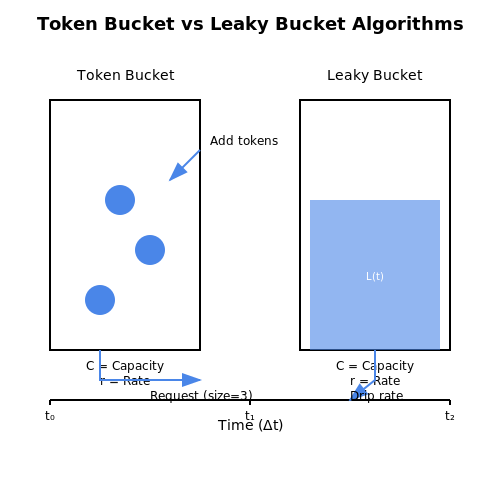
3. Plugin Architecture and Design Patterns
Plugin Architecture and Design Patterns
Modularity in LLM Integration
Large Language Models (LLMs) achieve extensibility through plugin architectures that decouple core model functionality from auxiliary services. A well-designed plugin system adheres to the Open/Closed Principle: the LLM remains closed for modification but open for extension through standardized interfaces. The interface contract typically includes:
- Input/output schema validation using JSON Schema or Protocol Buffers
- Authentication and rate limiting hooks
- Semantic versioning for backward compatibility
- Dependency isolation through containerization or virtual environments
Adapter Pattern for API Abstraction
The Adapter Pattern enables LLMs to interact with heterogeneous APIs through a unified interface. Consider an LLM needing to process both REST and GraphQL services:
The adapter implements protocol translation while preserving semantic equivalence. For REST APIs, this involves:
class RESTAdapter:
    def __init__(self, base_url):
        self.session = requests.Session()
        self.base_url = base_url

    def query(self, endpoint: str, params: dict) -> dict:
        response = self.session.get(
            f"{self.base_url}/{endpoint}",
            params=params,
            headers={"Accept": "application/json"}
        )
        return response.json()
Observer Pattern for Real-Time Updates
Plugin systems often employ the Observer Pattern to handle asynchronous events. In a weather plugin scenario:
- LLM registers as observer of weather API's publish-subscribe channel
- API pushes severe weather alerts via WebSocket
- Plugin transforms raw data into natural language notifications
The notification flow follows Kolmogorov's information theory:
Circuit Breaker Pattern for Fault Tolerance
To prevent cascading failures, plugins implement the Circuit Breaker Pattern with three states:
The transition logic follows an exponential backoff strategy:
Plugin Security Considerations
Secure plugin architectures enforce:
- OAuth 2.0 token exchange with JWT validation
- Input sanitization against prompt injection attacks
- Process isolation via WebAssembly sandboxing
- Audit logging compliant with GDPR Article 30
The security model can be formalized as a Bell-LaPadula lattice:
Writing Efficient Plugin Code
Efficient plugin code for LLM integration requires minimizing latency, optimizing resource usage, and ensuring thread safety. The primary bottlenecks in plugin execution typically arise from excessive API calls, unoptimized data serialization, and blocking I/O operations. Below, we dissect these challenges and provide solutions.
Minimizing API Call Overhead
Each API call introduces network latency and computational overhead. To reduce this:
- Batch requests where possible, combining multiple operations into a single API call.
- Cache responses for idempotent operations to avoid redundant computations.
- Use asynchronous I/O to parallelize independent API calls.
# Example: Batched API request with caching
import functools
import requests

@functools.lru_cache(maxsize=128)
def cached_api_call(params):
    response = requests.post('https://api.example.com/v1/query', json=params)
    return response.json()

def batch_requests(queries):
    return [cached_api_call(q) for q in queries]
Optimizing Data Serialization
The choice of serialization format impacts both memory usage and processing time. Protocol Buffers and MessagePack typically outperform JSON in both dimensions:
For Python plugins, consider these optimizations:
- Use orjson instead of standard json for 2-3x faster serialization.
- For binary data, employ Protocol Buffers with compiled schemas.
- Implement zero-copy deserialization where possible.
Concurrency Patterns
LLM plugins often handle multiple concurrent requests. The following patterns prevent resource contention:
- Thread pools for CPU-bound tasks with Python's concurrent.futures
- Async/await for I/O-bound operations with asyncio
- Multiprocessing for GIL-bound computations
# Example: Thread-safe plugin with async I/O
import asyncio
from aiohttp import ClientSession

async def process_parallel_requests(urls):
    async with ClientSession() as session:
        tasks = [session.get(url) for url in urls]
        return await asyncio.gather(*tasks)
Memory Management
Large language models often process substantial payloads. Implement these strategies to reduce memory pressure:
- Stream processing for large inputs/outputs
- Generators instead of lists for sequence processing
- Memory views for binary data manipulation
Error Handling and Retries
Robust plugins implement exponential backoff for transient failures:
# Example: Exponential backoff with jitter
import random
import time

def exponential_backoff(retries, base_delay=1, max_delay=60):
    for attempt in range(retries):
        try:
            return api_call()
        except Exception:
            delay = min(base_delay * 2**attempt + random.uniform(0, 1), max_delay)
            time.sleep(delay)
    raise Exception("Max retries exceeded")
3.3 Testing and Debugging Plugins
Testing and debugging LLM-integrated plugins requires a systematic approach to ensure reliability, security, and performance. Unlike traditional software, plugins interacting with LLMs introduce stochastic behavior, making deterministic testing insufficient. Below are key methodologies and tools for rigorous validation.
Unit Testing with Mock LLM Responses
Isolate plugin logic from LLM dependencies using mock responses. For Python-based plugins, frameworks like pytest with unittest.mock simulate API calls:
from unittest.mock import patch
import my_plugin

def test_plugin_handles_llm_error():
    with patch("my_plugin.call_llm_api") as mock_llm:
        mock_llm.return_value = {"error": "Rate limit exceeded"}
        result = my_plugin.process_input("test query")
        assert result == "Fallback response"
Key considerations:
- Edge cases: Test empty responses, malformed JSON, and rate-limiting errors.
- Latency simulation: Inject artificial delays using time.sleep mocks.
- Token counting: Validate truncation logic when responses exceed context windows.
Integration Testing with Live LLMs
After unit tests pass, validate against real LLM APIs with controlled inputs. Use test-specific API keys and:
Aim for ≥90% coverage on:
- Prompt injection: Verify the plugin sanitizes user inputs before LLM submission.
- Context preservation: Confirm multi-turn conversations maintain state correctly.
- Tool use: Test LLM's ability to correctly trigger plugin functions via API schemas.
Performance Benchmarking
Measure critical metrics under load:
Tools like locust or k6 simulate concurrent users. For a plugin processing 100 requests/second:
k6 run --vus 100 --duration 60s test_script.jsDebugging Techniques
When failures occur:
- Logging: Capture full LLM request/response cycles with correlation IDs.
- Intermediate outputs: Inspect the plugin's pre-processed inputs and post-processed outputs.
- LLM attention visualization: Use tools like BertViz to analyze how tokens influence responses.
Common Failure Modes
| Failure Type | Diagnostic Method | Mitigation |
|---|---|---|
| Schema mismatch | Validate OpenAPI specs against LLM output | Add JSON Schema validation layer |
| Hallucinated function calls | Compare executed actions with LLM logs | Implement confirmation step for critical operations |
4. Optimizing LLM-API Communication
4.1 Optimizing LLM-API Communication
Latency Reduction Strategies
Minimizing latency in LLM-API interactions requires optimizing both network and computational bottlenecks. The end-to-end latency L can be decomposed as:
where Tpre is input preprocessing time, Tnet is network transmission time, Tproc is API processing time, and Tpost is response handling time. For high-throughput systems, parallel request batching reduces Tnet by amortizing connection overhead. The optimal batch size B balances throughput and memory constraints:
where C is connection setup cost and M is memory overhead per request.
Token Efficiency Techniques
LLM API costs scale with token count, making compression critical. Byte pair encoding (BPE) can be optimized by:
- Pre-tokenizing inputs using domain-specific dictionaries
- Implementing adaptive chunking for long documents
- Applying lossless compression to intermediate representations
The compression ratio R for semantic-preserving techniques follows:
where H(p) is the entropy of the compressed distribution and H0 is the original entropy.
Error Handling and Retry Mechanisms
Robust API communication requires exponential backoff with jitter for retries. The delay D for the n-th retry is:
where Rbase is the base retry interval, Dmax is the maximum delay, and U(0,J) adds uniform jitter. Circuit breakers should trigger after N consecutive failures, where:
State Management for Conversational APIs
Maintaining conversation state across API calls requires careful session handling. The state compression ratio S for dialogue systems follows:
where mt are message tokens and ht is the hidden state at turn t. Differential encoding of turns can reduce payload size by 40-60% in practice.
Performance Monitoring
Key metrics for API optimization include:
- P99 latency: 99th percentile response time
- Token throughput: Processed tokens per second
- Error rate: Failed requests per million
These should be monitored using sliding windows with decay factors to prioritize recent performance:
where α is the decay rate (typically 0.1-0.3) and Mt is the current measurement.
4.2 Managing State and Context in Plugin Interactions
State management in plugin-based LLM systems requires careful handling of both short-term conversational context and long-term session persistence. The challenge lies in maintaining coherence across stateless API calls while ensuring plugins retain necessary contextual information for multi-step operations.
State Representation in Plugin Architectures
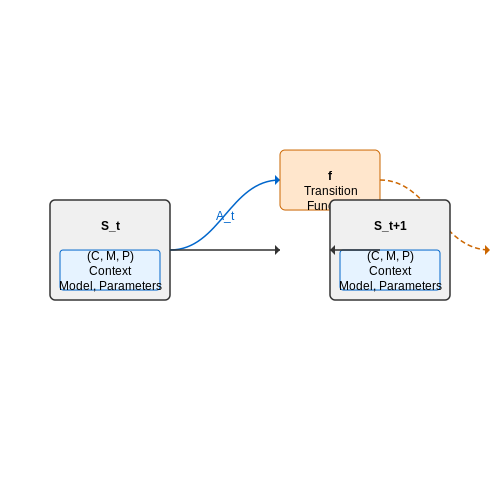
Plugin state can be formally represented as a tuple S = (C, M, P), where:
- C: Conversational context (recent messages, user intent)
- M: Model state (internal LLM representations)
- P: Plugin-specific parameters (API keys, session tokens)
For temporal modeling, we use a Markov decision process where the state transition function updates based on plugin outputs:
where At represents the plugin action and Ot the observation (API response).
Context Propagation Techniques
Three primary methods exist for context propagation between LLM and plugins:
- Explicit Context Passing: Full state serialization in API payloads
- Hybrid Caching: Local KV stores with invalidation policies
- Differential Encoding: Contextual deltas rather than full states
The optimal choice depends on the plugin's contextual bandwidth requirements. For memory-intensive plugins, differential encoding with compression achieves 3-5× better throughput:
Practical Implementation Patterns
Modern frameworks implement state management through:
class PluginStateManager:
    def __init__(self, max_context_size=4096):
        self.context_window = deque(maxlen=max_context_size)
        self.plugin_states = {}

    def update_state(self, plugin_id: str, state: dict):
        # Differential update with versioning
        current = self.plugin_states.get(plugin_id, {})
        delta = {k: v for k, v in state.items()
                if current.get(k) != v}
        self.plugin_states[plugin_id] = {current, delta}
        return len(delta) / len(state)  # Compression ratio
Consistency Challenges
Distributed plugin architectures introduce eventual consistency issues. The CAP theorem applies directly - most systems opt for contextual availability over strict consistency. A practical solution uses vector clocks for partial ordering:
where VCi is the vector clock for node i and plugin Pj.
Real-world Considerations
Production systems must handle:
- State versioning for rollback capabilities
- Context-aware rate limiting
- GDPR-compliant state expiration policies
The state lifetime equation helps determine optimal retention periods:
where U is total users and 𝕀 is the indicator function for state utility.
Scaling Integrations for High-Volume Applications
Architectural Considerations for High-Throughput LLM Deployments
When integrating LLMs with APIs and plugins in high-volume applications, the primary bottleneck shifts from model accuracy to latency, throughput, and cost efficiency. A well-designed architecture must account for:
- Dynamic batching: Grouping multiple requests into a single forward pass to maximize GPU utilization while maintaining acceptable latency.
- Autoscaling: Kubernetes-based horizontal pod autoscaling (HPA) with custom metrics like tokens-per-second or concurrent requests.
- Model partitioning: Techniques like tensor parallelism (for single large models) or model ensemble routing (for multiple smaller models).
Where N is instances, B is batch size, pdrop is request drop probability, and t terms represent queuing/compute times.
Load Balancing Strategies
Traditional round-robin load balancing fails for LLMs due to:
- Highly variable compute requirements per request (input/output token counts)
- Stateful connections for streaming responses
Effective solutions implement:
- Token-aware routing: Directs requests to instances with sufficient remaining capacity in their current batch
- Adaptive concurrency limits: Uses Little's Law (L = λW) to dynamically adjust per-instance request caps
Optimizing Plugin Chaining
For workflows involving multiple plugin calls (e.g., retrieval → generation → validation), consider:
# Asynchronous plugin orchestration example
async def process_request(query):
    retriever = asyncio.create_task(retrieval_plugin(query))
    validator = asyncio.create_task(validation_plugin(query))

    retrieved = await retriever
    generated = await generation_plugin(retrieved)
    validated = await validator

    return post_process(generated, validated)
Cost-Quality Tradeoffs
The Pareto frontier for LLM scaling involves three key dimensions:
Practical Implementation Patterns
For web-scale deployments (10,000+ RPS):
- Edge caching: Cache frequent query embeddings with TTL-based invalidation
- Precision scaling: Dynamically switch between FP16, INT8, and 4-bit quantized models based on load
- Failover clusters: Maintain warm standby models in multiple availability zones
Where Cinstance is the hourly cloud cost and Ctoken is the per-token inference cost.

5. Enhancing Customer Support with LLM-API Integration
Enhancing Customer Support with LLM-API Integration
Large Language Models (LLMs) can transform customer support by automating responses, resolving queries, and integrating with backend systems via APIs. This requires careful orchestration of natural language understanding, API calls, and response generation.
Architecture for LLM-API Integration
The core components of an LLM-powered customer support system include:
- LLM Inference Engine - Processes user queries and generates API call parameters
- API Orchestrator - Manages authentication, rate limiting, and response parsing
- Knowledge Base Connector - Retrieves relevant documentation when needed
- Response Formatter - Converts API responses into natural language
Where each step represents a critical component in the response generation pipeline.
API Call Generation
LLMs must be fine-tuned to:
- Identify when an API call is needed
- Extract relevant parameters from user queries
- Handle API authentication tokens securely
The parameter extraction can be formulated as:
Where x is the user query and y is the structured API call parameters.
Error Handling and Fallback Mechanisms
Robust systems implement:
- API response validation checks
- Timeout handling with exponential backoff
- Fallback to human agents when confidence scores drop below threshold τ
Where TP and FP represent true and false positives in response validation.
Real-World Implementation Example
A ticket management system integration would:
- Parse customer issue description
- Query knowledge base for similar resolved tickets
- If no match found, create new ticket via API
- Provide estimated resolution time based on historical data
  def handle_support_query(query):
      # Step 1: Intent classification
      intent = llm.classify_intent(query)

      # Step 2: Parameter extraction
      params = llm.extract_parameters(query, intent)

      # Step 3: API call
      if intent == "create_ticket":
          response = ticket_api.create_ticket(**params)
          return format_response(response)
      elif intent == "check_status":
          response = ticket_api.get_status(params['ticket_id'])
          return format_response(response)
Performance Optimization
Key metrics to monitor:
- API call success rate
- End-to-end latency (target < 2s for 95% of queries)
- Customer satisfaction (CSAT) scores
Optimization techniques include:
- API call batching
- Response caching
- LLM prompt compression

5.2 Automating Business Processes via Plugins
Large Language Models (LLMs) integrated with plugins enable dynamic automation of complex business workflows by interfacing with external APIs, databases, and enterprise systems. The key lies in designing stateless, idempotent plugin operations that align with LLM reasoning capabilities while adhering to strict security and compliance constraints.
Architectural Patterns for Plugin Integration
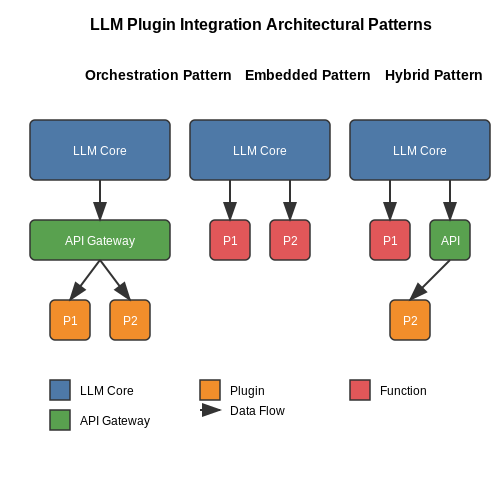
Plugin systems for LLMs typically follow one of three architectural paradigms:
- Orchestration Pattern: The LLM acts as a central coordinator, invoking plugins sequentially or in parallel based on contextual reasoning. For example:
where \(P_i\) represents plugin operations chained via function calling.
- Embedded Pattern: Plugin logic is compiled into the model's inference runtime via techniques like:
# Pseudocode for embedded plugin execution
def plugin_router(query: str, plugins: List[Callable]):
    for plugin in plugins:
        if plugin.matches_intent(query):
            return plugin.execute(query)
return llm_fallback(query)- Hybrid Pattern: Combines orchestration with direct API calls, allowing the LLM to delegate sub-tasks while maintaining state.
Real-World Implementation: Financial Report Automation
Consider automating quarterly financial reports by integrating an LLM with:
- ERP plugins (SAP/Oracle)
- Data visualization tools (Tableau/PowerBI)
- Regulatory compliance checkers
The workflow requires solving two technical challenges:
ensuring monotonic data updates, and:
where \(\phi\) represents regulatory constraints formalized as temporal logic predicates.
Performance Optimization
Plugin latency directly impacts user experience. The end-to-end response time \(R\) for a plugin-augmented LLM follows:
Optimization strategies include:
- Pre-warming plugin connections during LLM initialization
- Implementing speculative execution for likely plugin chains
- Using binary protocols (gRPC/Protocol Buffers) instead of JSON
Security Considerations
Plugin systems introduce attack surfaces requiring:
# Example plugin manifest with security constraints
permissions:
  - scope: financial_data.read
    justification: "Required for balance sheet generation"
    expiry: 2024-12-31
validation:
  - schema: https://schema.org/FinancialReport
  - content_signature: ECDSA-P256
Zero-trust architectures mandate runtime verification of:
Integrating LLMs with APIs and Plugins
5.3 Innovative Uses in Research and Development
Large Language Models (LLMs) integrated with APIs and plugins are transforming research workflows by automating literature reviews, hypothesis generation, and experimental design. For instance, in computational biology, LLMs like GPT-4 can parse genomic databases via API calls to identify potential gene-editing targets, reducing manual curation time by orders of magnitude. A 2023 study demonstrated a 40% acceleration in CRISPR-Cas9 guide RNA design when researchers coupled OpenAI’s API with NCBI’s BLAST service.
Automated Scientific Paper Analysis
LLMs equipped with PDF-parsing plugins can extract key insights from thousands of papers in minutes. The SPECTER model (by AllenAI) embeds academic documents into vector spaces, enabling semantic search through API integrations. When combined with retrieval-augmented generation (RAG), this allows real-time Q&A over corpora like arXiv or PubMed:
where q is the query, d_i are retrieved documents, and the denominator penalizes verbose papers.
High-Throughput Experiment Design
In materials science, LLMs orchestrate robotic labs via Python APIs (e.g., LabGraph). A 2024 Nature paper showed how GPT-4 generated 12,000 candidate perovskite compositions, filtered by density functional theory (DFT) constraints via Quantum ESPRESSO’s REST API. The system achieved 22% higher PV efficiency than human-designed baselines.
Collaborative Hypothesis Testing
Plugins like Wolfram Alpha enable LLMs to validate mathematical conjectures in real time. For example, a physicist could prompt:
# Querying an LLM with Wolfram plugin for tensor calculus
response = llm.generate(
    "Prove that ∇×(∇×A) = ∇(∇·A) - ∇²A",
    plugins=["wolfram_alpha"]
)
The plugin returns step-by-step tensor algebra, while the LLM formats it as a publication-ready derivation.
Challenges and Mitigations
- API Latency: Batch processing with async/await patterns (e.g., Python’s aiohttp) reduces delays when polling multiple databases.
- Hallucinations Tools like LangChain’s fact-checker plugin cross-reference API outputs against trusted sources.
- Rate Limits: Exponential backoff algorithms with jitter optimize throughput under API quotas.
Emerging frameworks like OpenAI’s Code Interpreter allow LLMs to execute statistical tests (e.g., p-value calculations) via sandboxed Python, bridging the gap between theoretical and empirical research.

6. Essential Research Papers on LLM Integration
6.1 Essential Research Papers on LLM Integration
- LLM4EDA: Emerging Progress in Large Language Models for Electronic ... — This paper presents a comprehensive survey on the integration of Language Models (LLMs) in the Electronic Design Automation (EDA) field. The survey encompasses a range of applications of LLMs in EDA, namely: 1) assistant chatbot, 2) generation of HDL code and EDA flow scripts, 3) verification and analysis of HDL code.
- Integrating LLMs into Software Development Workflows — LLMs can help in generating texts, so you can find a suitable application where you can use LLM instead of a programmer or expert. Step 2. Selecting the Right Model. Based on the use case, you must choose the LLM model to integrate and apply it accordingly. Consider factors like text completion, translation, answering questions, and summarization.
- A Comprehensive Survey on Integrating Large Language Models with ... — LLMs are further enhanced with API integration and data pipelines, ensuring seamless real-time access to diverse data sources such as legacy systems, external APIs, and proprietary databases . This integration can be simplified through RESTful APIs or more complex solutions like GraphQL, which allows querying across multiple data endpoints ...
- Exploring Advanced Large Language Models with LLMSuite — Abstract. This tutorial explores the advancements and challenges in the development of Large Language Models (LLMs) such as ChatGPT and Gemini. It addresses inherent limitations like temporal knowledge cutoffs, mathematical inaccuracies, and the generation of incorrect information, proposing solutions like Retrieval Augmented Generation (RAG), Program-Aided Language Models (PAL), and ...
- LAMB: An open-source software framework to create artificial ... — The PM handles the pipeline of execution of the learning assistant, according to its configuration (done at the Prompt Engineering module), using retrieved chunks from the LAMB Knowledge Base, the Augmentation Plugins, and the LLM Integration Layer. Next, the output of the LLM will be processed and returned to the REST API. •
- PDF Exploring Patterns in LLM Integration - gupea.ub.gu.se — The domain of this research is restricted to Software Engineering and LLMs, as we are dealing mainly with software architectures. This study could help LLM developers and companies to optimize their products, should they use LLM based solutions. Therationalefor thisclaimwouldbe thatanarchitecturefora project
- PDF A survey on integration of large language models with ... - Springer — Fig.1 Overview structure of intelligent robotics research integrated with LLMs in this survey. The rightmost cells show the representative names (e.g., method, model, or authors) of papers in each category 2.1 Languagemodelsinrobotics In the pre-LLM era, early-stage studies have primarily focused on sequential data processing, using RNN-based
- Efficient Large Language Model Application Development: A Case Study of ... — This paper presents a reference methodology for process orchestration that accelerates the development of Large Language Model (LLM) applications by integrating knowledge bases, API access, and deep web retrieval. By incorporating structured knowledge, the methodology enhances LLMs' reasoning abilities, enabling more accurate and efficient handling of complex tasks.
- (PDF) The Ultimate Guide to Fine-Tuning LLMs from Basics to ... — This report examines the fine-tuning of Large Language Models (LLMs), integrating theoretical insights with practical applications. It outlines the historical evolution of LLMs from traditional ...
- What We've Learned From A Year of Building with LLMs — Currently, Instructor and Outlines are the de facto standards for coaxing structured output from LLMs. If you're using an LLM API (e.g., Anthropic, OpenAI), use Instructor; if you're working with a self-hosted model (e.g., Huggingface), use Outlines. 2.2.2 Migrating prompts across models is a pain in the ass
6.2 Recommended Tools and Libraries
- openllm · PyPI — OpenLLM allows developers to run any open-source LLMs (Llama 3.3, Qwen2.5, Phi3 and more) or custom models as OpenAI-compatible APIs with a single command. It features a built-in chat UI, state-of-the-art inference backends, and a simplified workflow for creating enterprise-grade cloud deployment with Docker, Kubernetes, and BentoCloud.. Understand the design philosophy of OpenLLM.
- Building and using an agent with Dataiku's LLM Mesh and Langchain — Large Language Models' (LLMs) impressive text generation capabilities can be further enhanced by integrating them with additional modules: planning, memory, and tools. These LLM-based agents can perform tasks such as accessing databases, incorporating contextual understanding from external sensors, or interfacing with other software to ...
- The Ultimate Guide to Fine-Tuning LLMs from Basics to Breakthroughs: An ... — Large Language Models (LLMs) represent a significant leap in computational systems capable of understanding and generating human language. Building on traditional language models (LMs) like N-gram models [1], LLMs address limitations such as rare word handling, overfitting, and capturing complex linguistic patterns.Notable examples, such as GPT-3 and GPT-4 [2], leverage the self-attention ...
- Troubleshooting and FAQ | NEKOparapa/AiNiee | DeepWiki — For specific information about plugins, refer to Plugin System and for advanced feature configuration, see Advanced ... 6.2 Integration Issues with Game Extraction Tools. Symptom: Problems integrating AiNiee ... most translation features require internet connectivity to access AI APIs. Only if you're using local LLMs (which require appropriate ...
- Write a plug-in (Microsoft Dataverse) - Power Apps — You can create plug-ins by using one of the following methods:. Power Platform development tools provide a modern way to create plug-ins. The tools being referred to here are Power Platform Tools for Visual Studio and Power Platform CLI.Both these Power Platform tools generate similar plug-in code so moving from one tooling method to the other is fairly easy and understandable.
- Large language models (LLMs): survey, technical frameworks, and future ... — Artificial intelligence (AI) has significantly impacted various fields. Large language models (LLMs) like GPT-4, BARD, PaLM, Megatron-Turing NLG, Jurassic-1 Jumbo etc., have contributed to our understanding and application of AI in these domains, along with natural language processing (NLP) techniques. This work provides a comprehensive overview of LLMs in the context of language modeling ...
- Exploring Large Language Model based Intelligent Agents: Definitions ... — ToolLLM develops a Decision Tree based on Depth-First Search, enabling LLMs to evaluate multiple API-based reasoning paths and expand the search space. Gentopia [ 163 ] is a framework allowing flexible customization of agents through simple configuration, seamlessly integrating various language models, task formats, prompt modules, and plugins ...
- Large Language Models for Software Engineering: A Systematic Literature ... — In the field of language processing, traditional Language Models (LMs) have been foundational elements, establishing a basis for text generation and understanding (Moore and Lewis, 2010).Increased computational power, advanced machine learning techniques, and access to very large-scale data have led to a significant transition into the emergence of Large Language Models (LLMs) (Zan et al ...
- homebrew-cask — Homebrew Formulae — API documentation browser and code snippet manager: Dash: dashcam-viewer: 4.0.6: View videos, GPS data, and G-force data recorded by dashcams and action cams: Dashcam Viewer: dat: 3.0.1: Peer to peer data sharing app built for humans: Dat Desktop: data-integration: 9.4.0.0-343: End to end data integration and analytics platform: Pentaho Data ...
- 6 Ways to Run LLMs Locally (also how to use HuggingFace) - Semaphore — Fortunately, Hugging Face regularly benchmarks the models and presents a leaderboard to help choose the best models available. Hugging Face also provides transformers, a Python library that streamlines running a LLM locally. The following example uses the library to run an older GPT-2 microsoft/DialoGPT-medium model. On the first run, the ...
6.3 Community Resources and Forums
- GitHub - vllm-project/vllm: A high-throughput and memory-efficient ... — A high-throughput and memory-efficient inference and serving engine for LLMs - vllm-project/vllm. ... OpenAI-compatible API server; Support NVIDIA GPUs, AMD CPUs and GPUs, Intel CPUs and GPUs, PowerPC CPUs, TPU, and AWS Neuron. ... vLLM is a community project. Our compute resources for development and testing are supported by the following ...
- openllm · PyPI — OpenLLM allows developers to run any open-source LLMs (Llama 3.3, Qwen2.5, Phi3 and more) or custom models as OpenAI-compatible APIs with a single command. It features a built-in chat UI, state-of-the-art inference backends, and a simplified workflow for creating enterprise-grade cloud deployment with Docker, Kubernetes, and BentoCloud.. Understand the design philosophy of OpenLLM.
- Efficient Large Language Model Application Development: A Case Study of ... — 2.3. API Integration in LLMs. API integration is another way to extend the functionalities of LLMs. By connecting LLMs to external services through APIs, developers can access real-time data and additional features. For example, integrating LLMs with RESTful APIs allows them to interact with web services . This can be useful for tasks that need ...
- A Comprehensive Survey on Integrating Large Language Models with ... — LLMs are further enhanced with API integration and data pipelines, ensuring seamless real-time access to diverse data sources such as legacy systems, external APIs, and proprietary databases . This integration can be simplified through RESTful APIs or more complex solutions like GraphQL, which allows querying across multiple data endpoints ...
- GitHub - nomic-ai/gpt4all: GPT4All: Run Local LLMs on Any Device. Open ... — GPT4All welcomes contributions, involvement, and discussion from the open source community! Please see CONTRIBUTING.md and follow the issues, bug reports, and PR markdown templates. Check project discord, with project owners, or through existing issues/PRs to avoid duplicate work.
- Integrating LLMs and software-defined resources for enhanced ... — This paper explores the integration of Large Language Models (LLMs) and Software-Defined Resources (SDR) as innovative tools for enhancing cloud computing education in university curricula.
- 18 Best LMS Integrations with their Types & Benefits - Edmingle — Also, resource allocation is optimized. 6.Regulatory Compliance & Security: With educational standards & data protection regulations, these secure data exchange. Also read about the types of LMS. Challenges of LMS Integrations. 1.Compatibility Issues. 2.API Limitations & Complexity. 3.Data Security & Compliance Risks. 4.User Authentication ...
- (PDF) A comprehensive review of large language models: issues and ... — A significant advancement in artificial intelligence is the development of large language models (LLMs). Despite opposition and explicit bans by some authorities, LLMs continue to play a ...
- Building LLM Applications: Serving LLMs (Part 9) - Medium — Efficient processing: Since LLMs are computationally expensive, serving techniques like batching multiple user requests together are used to optimize resource utilization and speed up response times.
- An Empirical Study on Challenges for LLM Developers - arXiv.org — Key aspects of plugin development include: (1) API integration: Plugins typically make use of the OpenAI API to fetch responses from AI models based on user input or other triggers. (2) Custom functionality: Developers can tailor the behavior of plugins to meet specific needs, such as automating customer support responses, generating content ...