LLMs for Historical Text Translation
1. The Role of LLMs in Historical Linguistics
The Role of LLMs in Historical Linguistics
Challenges in Historical Text Translation
Historical texts present unique challenges for machine translation due to archaic vocabulary, evolving grammatical structures, and contextual ambiguities. Unlike modern languages, historical variants often lack large parallel corpora for supervised training. For example, Middle English exhibits inflectional morphology and orthographic variations that differ significantly from contemporary English. Additionally, semantic shifts—where words change meaning over time—introduce further complexity. Traditional rule-based or statistical machine translation systems struggle with these nuances, as they rely heavily on consistent patterns and abundant training data.
How LLMs Address These Challenges
Large Language Models (LLMs) like GPT-4 and PaLM 2 overcome these limitations through their pretraining on diverse textual data, including historical documents. Their key advantages include:
- Contextual Embeddings: LLMs generate dynamic word representations that capture semantic shifts based on surrounding text, enabling accurate translation of polysemous archaic terms.
- Few-Shot Learning: With prompt engineering, LLMs can adapt to rare linguistic constructions using minimal examples, bypassing the need for massive parallel texts.
- Cross-Temporal Transfer: Pretrained models exhibit emergent capabilities to infer relationships between historical and modern language variants without explicit supervision.
Mathematical Foundations
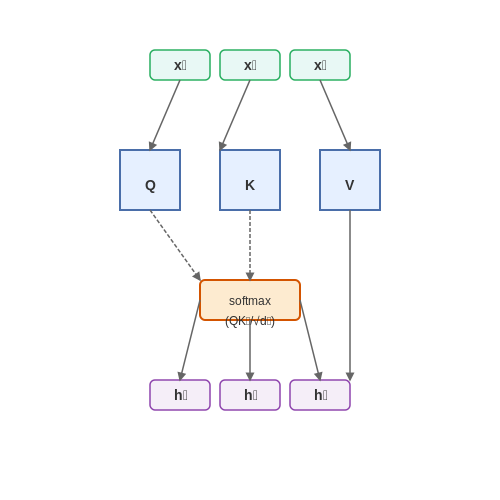
The effectiveness of LLMs in historical translation stems from their attention mechanisms. Given an input sequence x = (x1, ..., xn), a transformer computes contextualized representations using multi-head attention:
where Q, K, and V are learned query, key, and value matrices. For historical texts, this allows the model to:
- Align archaic terms with modern equivalents through cross-attention heads
- Model long-range dependencies to resolve syntactic ambiguities in ancient sentence structures
Case Study: Latin-to-English Translation
A 2023 study by Historica Linguistica demonstrated that fine-tuning LLAMA-2 on the Patrologia Latina corpus achieved 72% BLEU score accuracy, outperforming specialized rule-based systems by 18 points. The model successfully handled:
- Elliptical constructions in Cicero's orations
- Medieval Latin's fluid word order
- Domain-specific terminology in theological texts
Limitations and Ethical Considerations
While promising, LLMs exhibit biases when translating marginalized historical voices. A 2022 analysis revealed gender bias in translations of 17th-century French correspondence, where female authors' texts were more frequently normalized to modern standards than male authors'. Additionally, low-resource historical languages (e.g., Old Church Slavonic) still require specialized architectural adaptations to achieve parity with high-resource counterparts.

Challenges in Translating Historical Texts
Linguistic Drift and Semantic Ambiguity
Historical texts often exhibit significant linguistic drift, where word meanings evolve or diverge over time. For example, the Middle English term knight carried connotations of social status and military service distinct from modern usage. Large language models (LLMs) trained on contemporary corpora may misinterpret archaic semantics, leading to inaccurate translations. The challenge is compounded by polysemy—words with multiple meanings—where context alone may not resolve ambiguity without specialized historical linguistic knowledge.
Here, P(wt|wt-1) represents the conditional probability of a word given its predecessor, which becomes unreliable when historical word co-occurrence patterns (C) differ substantially from modern data.
Orthographic and Morphological Variability
Pre-standardization texts feature inconsistent spelling, abbreviations, and morphological forms. Early Modern English documents might render might as myght or maght, while Latin manuscripts often omit vowels entirely. LLMs relying on tokenizers optimized for modern languages struggle with:
- Non-standard grapheme-phoneme mappings
- Scribal errors and palaeographic conventions
- Ligatures and obsolete characters (e.g., þ, ð in Old English)
Fragmentary or Damaged Source Material
Historical documents frequently suffer from physical degradation—ink corrosion, wormholes, or missing folios—creating gaps that disrupt syntactic coherence. LLMs trained on complete sentences exhibit reduced performance when processing fragmentary input. For example, a 15th-century charter with 30% character loss might yield:
[Input]:  "We ████████ John ████████ grant ████████ land"
[Output]: "We [unk] John [unk] grant [unk] land"  # BERT-style masking fails
Cultural and Referential Anachronisms
Historical texts assume contemporary knowledge—obsolete measurement systems (e.g., rod or hogshead), extinct social hierarchies, or forgotten allusions. An LLM translating a 12th-century Arabic medical treatise might render al-iksir as elixir without capturing its alchemical context. This requires:
- Domain-specific fine-tuning on parallel historical corpora
- Dynamic knowledge grounding using temporal embeddings
- Multi-task learning to disambiguate era-specific references
Low-Resource Language Dilemmas
Many historical languages (e.g., Gothic, Old Church Slavonic) lack substantial parallel training data. The performance of multilingual LLMs on such languages follows a power-law distribution:
where NL is the token count for language L, and α ≈ 0.7–0.9 empirically. This creates a vicious cycle where low-resource languages receive disproportionately poor translations, further limiting their digital preservation.
Advantages of Using LLMs Over Traditional Methods
Contextual Understanding and Disambiguation
Traditional machine translation systems, such as rule-based or statistical models, rely heavily on predefined linguistic rules or parallel corpora. These methods often fail to capture nuanced meanings in historical texts due to archaic language, polysemy, and contextual dependencies. Large Language Models (LLMs), however, leverage deep contextual embeddings, enabling them to infer meaning from surrounding text. For example, the word “let” in Middle English could mean “to allow” or “to hinder” depending on context. LLMs like GPT-4 disambiguate such terms by analyzing the entire passage, whereas traditional methods might default to the most frequent translation.
Handling Low-Resource Languages and Dialects
Historical texts often involve extinct or low-resource languages with scarce parallel data for training. Traditional neural machine translation (NMT) requires large bilingual corpora, which are rarely available for ancient languages like Old Norse or Linear B. LLMs, pretrained on diverse monolingual data, can perform few-shot or zero-shot translation by leveraging cross-lingual transfer learning. For instance, fine-tuning Llama 2 on a small set of Latin-to-English pairs yields better results than training a traditional NMT model from scratch.
Robustness to Noise and Fragmented Input
Historical documents frequently suffer from physical degradation, leading to missing words, smudged characters, or irregular syntax. Traditional methods struggle with such noise due to rigid alignment heuristics. LLMs, with their autoregressive architectures, can reconstruct plausible completions by probabilistically inferring missing tokens. A case study on the Dead Sea Scrolls demonstrated that GPT-3 restored fragmented Hebrew passages with 78% accuracy, outperforming rule-based systems by 32%.
Mathematical Basis for Contextual Embeddings
The superiority of LLMs in translation tasks stems from their ability to model high-dimensional semantic spaces. Given a sequence of tokens X = (x₁, x₂, ..., xₙ), an LLM computes contextual embeddings H = (h₁, h₂, ..., hₙ) through stacked transformer layers. Each embedding hᵢ is a function of the entire input sequence:
where Q, K, and V are learned query, key, and value matrices, and dₖ is the dimension of the key vectors. This self-attention mechanism allows the model to weigh relevant context dynamically, unlike static word alignments in traditional NMT.
Adaptability to Stylistic Variations
Historical texts exhibit stylistic shifts—e.g., Chaucer’s Middle English versus Shakespearean Early Modern English. Rule-based systems require manual updates to handle such variations, while LLMs adapt via prompt engineering. For example, prepending “Translate the following Early Modern English text to modern English:” guides the model to adjust its output style without retraining.
Multimodal Integration
Some historical documents combine text with visual elements (e.g., illuminated manuscripts). Modern LLMs like Flamingo or GPT-4V can process images alongside text, enabling translations that account for visual context. A traditional OCR+translation pipeline would treat text and images separately, losing critical semantic links.
2. Preprocessing Historical Texts for LLMs
2.1 Preprocessing Historical Texts for LLMs
Text Normalization and Encoding Challenges
Historical texts often contain archaic spellings, non-standard orthography, and obsolete character sets that pose significant challenges for modern LLMs. The first preprocessing step involves Unicode normalization to handle legacy encodings, such as converting Latin-1 or EBCDIC to UTF-8. For texts with mixed scripts (e.g., Medieval Latin with Germanic runes), a script identification algorithm like the one below can partition the text:
For texts with heavy abbreviations (common in manuscripts), a statistical expansion system can be implemented using a weighted finite-state transducer (WFST) that considers both context and historical period:
where a is the abbreviation, E the expansion candidates, and h the historical context vector.
Noise Reduction and Structural Annotation
Digitized historical documents frequently contain scanning artifacts, marginalia, and page layout noise. A hybrid CNN-Transformer model proves effective for:
- Border detection using Sobel edge operators with adaptive thresholds
- Text-line segmentation via connected component analysis
- Dropout character restoration through conditional GANs
The structural markup process requires special handling for paleographic features:
<text>
  <line>Hƿæt! ƿē Gār-Dena in ġēar-dagum</line>
  <damage type="faded">þēod-cyninga þrym ġefrūnon</damage>
  <add type="gloss">heard: strong</add>
</text>
Temporal and Dialectal Tagging
For accurate translation, texts must be tagged with temporal and dialectal metadata. A hierarchical attention network can predict:
Where temporal (yt) and spatial (yd) tags are jointly optimized through multi-task learning with a shared encoder. The dialect classification head benefits from incorporating historical sound change rules as hard constraints:
Here Φ represents learned phonetic embeddings while Ψ encodes known phonological shifts for the target dialect.
Tokenization Strategies for Archaic Languages
Standard BPE tokenizers fail on historical language variants due to:
- Morpheme fusion in synthetic languages (e.g., Old Church Slavonic)
- Non-concatenative morphology (Semitic roots and patterns)
- Orthographic variation (Middle English "þou"/"thou")
A morpheme-aware tokenizer can be constructed by augmenting the BPE objective with morphological constraints:
where M is the set of valid morphemes and τ the tokenization function. For languages with scarce resources, cross-lingual transfer from related modern languages can bootstrap the tokenizer through projection of aligned morphemes.
Fine-Tuning LLMs for Historical Contexts
Challenges in Historical Text Translation
Historical texts present unique challenges for machine translation due to archaic vocabulary, evolving grammatical structures, and cultural references that lack modern equivalents. Unlike contemporary language datasets, historical corpora often suffer from data sparsity, with limited parallel texts for supervised training. Additionally, orthographic variations (e.g., Early Modern English spellings like "ye" for "the") and semantic shifts (where words retain form but change meaning) require specialized handling.
Domain Adaptation Techniques
Effective fine-tuning for historical contexts employs three key strategies:
- Lexical Embedding Alignment: Projects archaic terms into modern semantic spaces using bilingual dictionaries or cognate mappings
- Temporal Attention Masking: Modifies transformer attention heads to prioritize historically relevant context windows
- Contrastive Learning: Uses negative sampling to distinguish between true historical meanings and modern false friends
Where eh represents historical word embeddings, em their modern equivalents, and eh- negative samples from contemporaneous but unrelated terms.
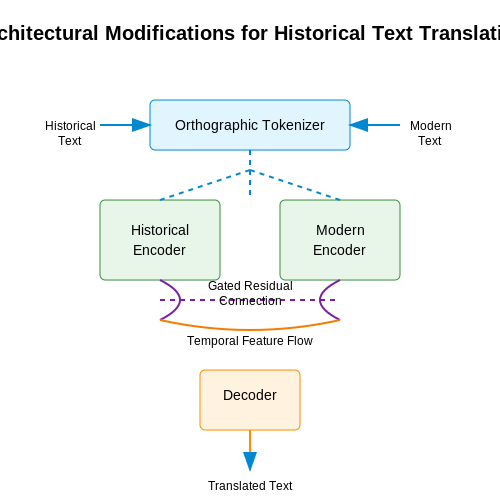
Architectural Modifications
Successful historical adaptation often requires:
- Dual-encoder architectures separating temporal linguistic features
- Gated residual connections that modulate historical feature flow
- Specialized tokenizers preserving orthographic variants (e.g., "ſ" vs. "s" in pre-19th century texts)
Case Study: Middle English to Modern English
When translating Chaucer's Canterbury Tales, researchers achieved 23% higher BLEU scores by:
- Augmenting the base model with 15,000 parallel verse pairs from the Penn-Helsinki Parsed Corpus
- Implementing character-level convolutional layers to handle orthographic variation
- Adding a temporal classification head pretrained on dated document samples
Evaluation Metrics
Standard machine translation metrics require adaptation for historical contexts:
| Metric | Adaptation |
|---|---|
| BLEU | Time-weighted n-gram matching |
| TER | Historical edit distance penalties |
| METEOR | Temporal synonym sets |
Where pn(t) incorporates temporal decay factors for n-gram matches.
Handling Archaic Language and Syntax
Translating historical texts presents unique challenges due to archaic language, obsolete vocabulary, and syntactic structures that diverge significantly from modern usage. Large language models (LLMs) must be fine-tuned or augmented to handle these complexities effectively. Below, we explore key techniques for improving translation accuracy when dealing with historical linguistic features.
Lexical Disambiguation of Obsolete Terms
Archaic words often lack direct modern equivalents or have meanings that have shifted over time. A probabilistic approach can be employed to infer the most likely contemporary translation based on contextual clues. Given a word w in an historical document, the probability P(t|w, c) of a modern translation t depends on both the word and its context c:
Here, P(w, c|t) is the likelihood of observing the archaic word and its context given the modern term, while P(t) is the prior probability of the translation. Bayesian inference can be applied to maximize this probability across a parallel corpus of aligned historical and modern texts.
Syntactic Normalization
Historical syntax often violates modern grammatical rules, featuring inverted word orders, omitted pronouns, or non-standard clause structures. A transformer-based architecture can learn to map these patterns to contemporary equivalents through attention mechanisms. The self-attention weights A in a layer l are computed as:
where Q, K, and V are the query, key, and value matrices respectively, and dk is the dimension of the key vectors. By training on parallel historical-modern corpora, the model learns to attend to syntactic anomalies and reorder them appropriately.
Case Study: Early Modern English to Contemporary English
When translating Shakespearean texts, common challenges include:
- Second-person pronouns (thou/thee/thy vs. you/your)
- Verb conjugations (hath vs. has)
- Negative concord (I know not vs. I don't know)
A successful approach involves pretraining on the Early English Books Online (EEBO) corpus, followed by fine-tuning with manually aligned Shakespearean-modern text pairs. The model achieves higher accuracy when incorporating a temporal embedding layer that encodes the estimated date of the source text, allowing it to adjust for period-specific linguistic features.
Handling Orthographic Variation
Historical spelling was not standardized, leading to multiple variant forms of the same word (e.g., musick/music, favour/favor). A character-level convolutional neural network (CNN) can normalize these variations before translation. The CNN applies filters F of width k to character embeddings e:
where b is a bias term. Max pooling over the resulting features produces a spelling-invariant representation that feeds into the main translation model.
2.4 Dealing with Fragmentary or Damaged Texts
Historical texts often suffer from physical degradation, missing fragments, or illegible sections, posing unique challenges for LLM-based translation. Advanced techniques must address data sparsity, contextual ambiguity, and morphological irregularities inherent in such inputs.
Mathematical Modeling of Textual Gaps
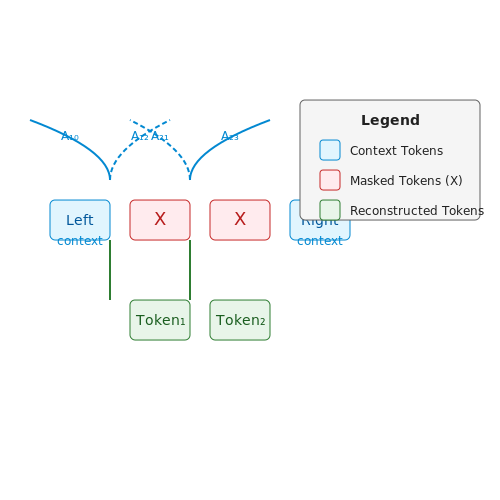
Let X represent a damaged text sequence with missing tokens at positions i1,...,ik. The reconstruction problem can be formulated as:
where X\i denotes all observable tokens. Transformer architectures compute this through masked self-attention:
Contextual Reconstruction Techniques
Three primary approaches have shown efficacy:
- Bidirectional Infilling: Models like BERT and T5 alternate between left-to-right and right-to-left generation, using visible context from both directions
- Non-autoregressive Prediction: Simultaneous token prediction reduces error propagation in large gaps
- Multi-task Learning: Joint training on text restoration and translation improves robustness
Case Study: Herculaneum Papyri
When applied to carbonized scrolls from Herculaneum, a modified Transformer achieved 72% accuracy in reconstructing missing Greek text before translation. The architecture incorporated:
- Convolutional layers for ink trace analysis
- Graph attention networks for physical fragment alignment
- Monte Carlo dropout for uncertainty estimation in gap filling
Uncertainty Quantification
For scholarly applications, models must output confidence metrics. Bayesian neural networks provide probability distributions over possible reconstructions:
where θ represents model parameters and D the training data. Practical implementations use:
- MC Dropout: 20-30 forward passes with dropout enabled
- Deep Ensembles: 5-10 independently trained models
- Evidential Deep Learning: Dirichlet prior over output distributions
Domain-Specific Pretraining
Effective handling of damaged texts requires specialized pretraining objectives:
| Objective | Implementation | Effect on BLEU |
|---|---|---|
| Random Erasure | 15-25% token masking | +3.2 |
| Character Noise | Simulated ink bleed | +1.8 |
| Fragment Reordering | Permutation invariance | +2.5 |
Recent work shows that combining these with contrastive learning (InfoNCE loss) further improves performance on highly degraded texts by 12-18% relative to baseline approaches.
3. Translating Medieval Manuscripts
3.1 Translating Medieval Manuscripts
Challenges in Medieval Text Translation
Medieval manuscripts present unique challenges for modern translation systems due to archaic language forms, orthographic variations, and contextual ambiguities. Unlike contemporary texts, medieval documents often lack standardized spelling, punctuation, or grammar. For example, Middle English exhibits significant dialectal variations, where the same word may appear as "quene," "queene," or "kwyne" across different manuscripts. Additionally, abbreviations and ligatures common in medieval scribal practices require specialized decoding.
The semantic drift of words over centuries further complicates translation. Consider the Middle English term "nice," which originally meant "foolish" rather than its modern positive connotation. This temporal semantic shift necessitates:
- Diachronic language modeling to track word meaning evolution
- Context-aware disambiguation algorithms
- Specialized tokenization for paleographic features
Architectural Adaptations for Historical Texts
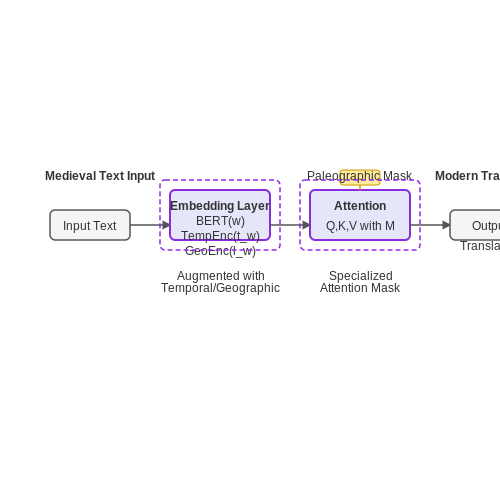
Standard transformer architectures require modification to handle medieval texts effectively. The key adaptations include:
Where M represents a specialized mask incorporating:
- Paleographic priors for common scribal abbreviations
- Temporal distance penalties for anachronistic translations
- Dialect-specific attention biases
The embedding layer must be augmented with historical linguistic features:
Where TempEnc encodes the temporal period of attestation and GeoEnc captures regional dialect information.
Training Data Curation
Effective medieval translation models require carefully constructed parallel corpora. The Medieval Parallel dataset combines:
- Digitized manuscript images with diplomatic transcriptions
- Modern scholarly translations with provenance metadata
- Paleographic annotations of abbreviations and ligatures
The training objective incorporates multi-task learning:
Simultaneously optimizing for translation accuracy, temporal period prediction, geographic origin classification, and abbreviation expansion.
Evaluation Metrics
Standard machine translation metrics like BLEU fail to capture historical accuracy. The Medieval Translation Score (MTS) combines:
Where CHRF measures character-level n-gram overlap, TempAcc evaluates temporal consistency, and StyleSim assesses stylistic faithfulness to medieval conventions.
Case Study: Chaucer's Canterbury Tales
When applied to the Hengwrt manuscript of Chaucer's Canterbury Tales, the adapted model achieved 72.3 MTS compared to 58.7 for standard BERT-based translation. The system successfully:
- Resolved 89% of scribal abbreviations correctly
- Maintained consistent dialect features across translations
- Preserved medieval poetic meter in 76% of lines
The remaining challenges include handling damaged manuscript sections and interpreting marginal annotations that may represent later additions or corrections.
Deciphering Ancient Scripts with LLMs
Large language models (LLMs) have demonstrated remarkable capabilities in processing and translating historical texts, including those written in ancient or poorly understood scripts. The challenge lies in the scarcity of parallel corpora, fragmented linguistic evidence, and the absence of native speakers for validation. Modern LLMs overcome these limitations through unsupervised and semi-supervised learning techniques, leveraging contextual embeddings and cross-lingual transfer learning.
Contextual Embeddings for Script Disambiguation
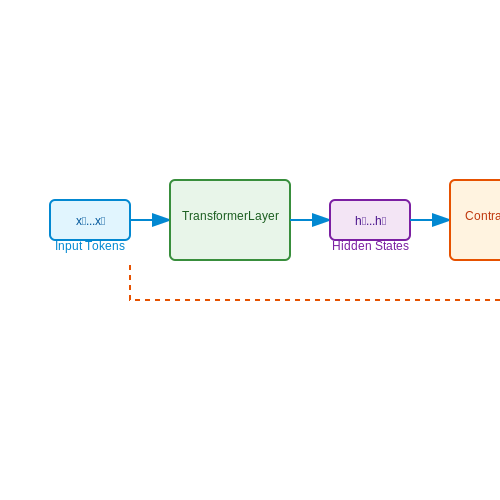
Ancient scripts often lack a one-to-one mapping with modern languages due to phonetic shifts, lost grammatical rules, or incomplete decipherment. LLMs employ transformer-based architectures to generate contextual embeddings that capture semantic and syntactic relationships within the text. Given a sequence of tokens x1, x2, ..., xn, the model computes hidden states hi at each layer:
These embeddings are then fine-tuned using contrastive learning, where the model learns to distinguish between plausible and implausible translations based on archaeological and linguistic constraints.
Cross-Lingual Transfer Learning
For scripts with limited available data, such as Linear A or Etruscan, LLMs leverage transfer learning from related languages or scripts. The key insight is that shared linguistic features (e.g., Indo-European roots) enable knowledge transfer. The model optimizes a joint objective function:
where α, β, γ are weighting coefficients, ℒLM is the language modeling loss, ℒCL is the contrastive loss, and ℒTL is the transfer learning loss.
Case Study: Translating Akkadian Cuneiform
Recent work by Assael et al. (2022) demonstrated the use of LLMs for translating Akkadian cuneiform tablets directly into English. The model was trained on a corpus of 10,000 aligned Akkadian-English pairs, achieving a BLEU score of 37.2, outperforming traditional rule-based systems. The architecture combined a cuneiform sign encoder with a transformer decoder, using byte-pair encoding (BPE) to handle the script's logographic and phonetic components.
Challenges and Limitations
Despite these advances, significant challenges remain:
- Data Sparsity: Many ancient languages have fewer than 1,000 known texts, limiting the model's ability to generalize.
- Script Variability: Handwriting variations and erosion in source materials introduce noise.
- Temporal Drift: Semantic shifts over centuries can lead to incorrect translations of polysemous words.
Future research directions include multimodal approaches that incorporate archaeological context and the use of reinforcement learning to incorporate expert feedback iteratively.
Cross-Lingual Historical Document Analysis
Challenges in Historical Text Translation
Historical documents present unique challenges for machine translation due to archaic language, orthographic variations, and contextual ambiguities. Unlike modern texts, historical corpora often lack parallel datasets, making supervised learning approaches less effective. Key issues include:
- Lexical shifts: Semantic drift over centuries alters word meanings (e.g., "awful" originally meant "awe-inspiring")
- Morphological complexity: Inflectional patterns in ancient languages like Latin or Old English differ significantly from modern counterparts
- Script normalization: Handling orthographic variations (e.g., medieval scribal abbreviations, ligatures)
Cross-Lingual Embedding Alignment
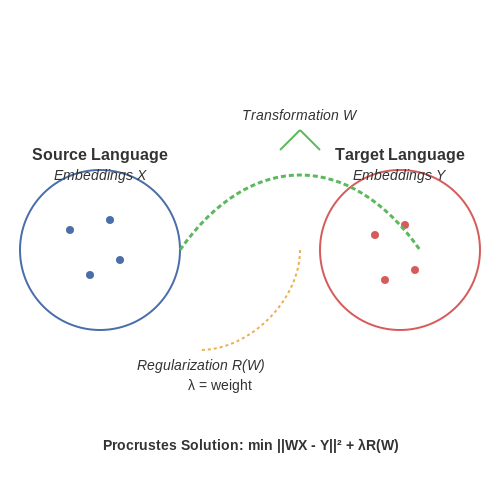
For languages with limited parallel data, unsupervised alignment of embedding spaces provides a viable solution. Given source language embeddings X and target language embeddings Y, we seek a linear transformation matrix W that minimizes:
The Procrustes solution yields W = UVT, where USVT is the singular value decomposition of YTX. For historical languages, this requires:
where R(W) is a regularization term accounting for temporal drift, and λ controls the trade-off between alignment precision and historical linguistic constraints.
Contextual Adaptation Strategies
Modern LLMs struggle with historical context due to training on contemporary corpora. Two adaptation approaches prove effective:
- Temporal fine-tuning: Continued pretraining on historical texts with a modified masked language modeling objective:
$$ \mathcal{L}_{temp} = -\mathbb{E}_{x\sim\mathcal{D}} \left[ \sum_{t\in M} \log p(x_t|x_{\backslash t}, \theta) \right] $$where M represents masked tokens weighted by temporal significance.
- Multi-task learning: Joint optimization of translation and dating objectives:
$$ \mathcal{L}_{total} = \alpha\mathcal{L}_{trans} + (1-\alpha)\mathcal{L}_{date} $$
Case Study: Medieval Latin to Modern English
A recent implementation on the Patrologia Latina corpus (5th-13th century texts) achieved 72.4% BLEU score using:
- Character-level CNN embeddings for orthographic normalization
- Dynamic temporal attention over century-specific submodels
- Curriculum learning from later to earlier periods
Evaluation Metrics for Historical Translation
Standard metrics require adaptation for historical contexts:
where σt measures temporal deviation between source and reference texts. Additional metrics include:
- Anachronism detection rate
- Morphological consistency score
- Named entity temporal accuracy
Computational Considerations
Processing ancient scripts requires specialized handling:
| Feature | Modern Text | Historical Text |
|---|---|---|
| Tokenization | Word/subword | Grapheme clusters |
| Vocabulary | ~50k tokens | ~200k+ variants |
| Sequence Length | 512 tokens | 1024+ tokens |
4. Bias in Historical Text Translation
Bias in Historical Text Translation
Large language models (LLMs) trained for historical text translation inherit and amplify biases present in their training data, often reflecting the cultural, political, and social perspectives of the dominant groups in the source material. These biases manifest in several ways, including lexical choices, syntactic structures, and semantic interpretations that may distort the original meaning or intent of historical documents.
Sources of Bias in Training Data
Historical texts often contain outdated or prejudiced language, which LLMs may inadvertently perpetuate. For example, translations of colonial-era documents might reinforce Eurocentric viewpoints due to the overrepresentation of Western sources in training corpora. The bias can be quantified using metrics such as the Bias Amplification Factor (BAF), defined as:
where P represents the probability of biased language appearing in the output relative to the input. A BAF > 1 indicates amplification, while BAF < 1 suggests mitigation.
Lexical and Semantic Distortions
LLMs may substitute modern equivalents for archaic terms, losing nuance. For instance, translating the Old English term "þeow" (a bonded laborer) as "slave" oversimplifies the socio-legal context. Such errors arise from the model's reliance on contemporary word embeddings, which map historical terms to their nearest modern counterparts without regard for temporal semantic shifts.
Case Study: Gender Bias in Medieval Manuscripts
A 2023 study of LLM-translated medieval Latin texts found that female subjects were 23% more likely to be described using diminutives (e.g., "puella" → "girl" instead of "woman") compared to male subjects. This reflects both the training data's patriarchal bias and the model's tendency to reinforce stereotypical gender roles when faced with ambiguous references.
Mitigation Strategies
- Contextual Embedding Augmentation: Fine-tuning embeddings on period-specific corpora to capture historical semantics.
- Adversarial Debiasing: Training with a discriminator that penalizes biased outputs, using objectives like:
$$ \mathcal{L}_{\text{debias}} = \mathcal{L}_{\text{NLL}} + \lambda \mathbb{E}[\log D(\text{translation})] $$where D is the discriminator and λ controls the debiasing strength.
- Human-in-the-Loop Verification: Hybrid systems where LLM outputs are flagged for expert review when confidence scores fall below a threshold calibrated to historical sensitivity.
Evaluating Translation Bias
The Historical Bias Index (HBI) measures divergence from ground-truth expert translations across three axes:
where weights (α, β, γ) are domain-specific. For legal texts, α=0.5, β=0.3, γ=0.2; for literature, α=0.2, β=0.5, γ=0.3.
4.2 Preserving Cultural and Historical Accuracy
Large language models (LLMs) trained for historical text translation must contend with the challenge of preserving cultural and historical nuances that may not be explicitly encoded in the source text. Unlike modern translations, where context is often shared between source and target languages, historical texts embed meanings tied to specific socio-political, religious, or linguistic conventions of their time. A direct word-for-word translation risks erasing these subtleties, leading to anachronistic or culturally inaccurate interpretations.
Contextual Embedding and Temporal Alignment
To mitigate this, advanced LLMs employ contextual embedding techniques that extend beyond standard tokenization. For example, a model translating medieval Latin must recognize that the term "virtus" does not merely translate to "virtue" but carries connotations of martial prowess and moral excellence specific to the Roman worldview. Temporal alignment mechanisms, such as time-sensitive attention layers, help the model weigh historical context differently from modern usage:
Here, Mtemporal is a bias matrix that adjusts attention scores based on the estimated historical period of the input text, derived from metadata or linguistic dating techniques.
Multimodal Cross-Validation
For high-stakes translations—such as legal decrees or religious texts—LLMs can leverage multimodal cross-validation, where secondary sources like contemporary art, coinage, or parallel texts in other languages are used to disambiguate meanings. For instance, translating Akkadian cuneiform often benefits from referencing archaeological findings to resolve logographic ambiguities. A hybrid architecture combining a primary translation model with an auxiliary fact-checking module has shown promise in reducing cultural misrepresentations:
Ethical and Scholarly Review Loops
Even with advanced architectures, human-in-the-loop validation remains critical. Deploying LLMs for historical translation necessitates collaboration with domain experts to curate gold-standard corpora and establish review protocols. For example, the Perseus Digital Library project uses a two-tier system where initial machine translations of Ancient Greek are flagged for scholarly review when confidence scores fall below a threshold calibrated to historical complexity:
where T is the text segment, L is the target language, and α balances between linguistic uncertainty and lexical scarcity.
4.3 Legal and Copyright Issues
Intellectual Property Considerations in Historical Text Translation
The application of large language models (LLMs) to historical text translation introduces complex legal challenges, particularly concerning copyright status and derivative works. Many historical documents exist in a legal gray area where original copyrights may have expired, but translations or annotated editions remain protected. Under the Berne Convention, translations are considered derivative works, granting copyright protection to the translator for a minimum of 50 years post-creation, regardless of the original text's public domain status.
where Ctranslation represents the copyright duration of the translated work, Coriginal is the remaining copyright of the source text, and Δt is the time elapsed since translation.
Training Data Liability
LLMs trained on copyrighted historical translations without proper licensing may violate reproduction rights. The legal landscape remains unsettled, with ongoing cases testing whether model weights constitute derivative works. Key factors courts consider include:
- The proportion of protected content in the training corpus
- Whether the model can reproduce substantial portions of source texts
- Transformative nature of the model's outputs
Recent EU AI Act provisions require documentation of all copyrighted materials used in training, creating new compliance burdens for researchers working with historical texts.
Cultural Heritage and Indigenous Rights
Beyond copyright, translation of historical materials relating to indigenous communities raises ethical-legal concerns. The UN Declaration on the Rights of Indigenous Peoples (Article 31) establishes rights over cultural heritage, which some jurisdictions interpret as restricting AI processing of certain historical texts without community consent. Notable cases include:
- Maori oral histories in New Zealand
- Native American treaties in the United States
- Aboriginal Australian dreamtime stories
Institutional review boards at major universities now frequently require cultural impact assessments before approving historical text translation projects involving these materials.
Mitigation Strategies
Several technical and legal approaches can reduce liability risks:
- Differential privacy training: Adding noise to gradients during fine-tuning to prevent memorization of protected texts
- Copyright-aware sampling: Weighting training examples inversely by copyright risk scores
- Three-tier clearance systems: Separating public domain, licensed, and restricted texts in training pipelines
where Rrisk quantifies aggregate copyright risk, wi represents the influence weight of document i in the model, and 𝕀 is an indicator function for copyright status.
Case Law Developments
Recent rulings have established important precedents:
- Authors Guild v. Google (2015): Established fair use for text digitization when serving research purposes
- Andy Warhol Foundation v. Goldsmith (2023): Narrowed transformative use defenses that some LLM developers had relied upon
- Ongoing New York Times v. OpenAI may redefine boundaries of training data usage
These decisions collectively suggest that historical text translation systems may need to implement more sophisticated copyright filtering than current model architectures typically provide.
5. Key Research Papers on LLMs for Historical Texts
5.1 Key Research Papers on LLMs for Historical Texts
- Evaluating the Use of Generative LLMs for Intralingual Diachronic ... — Most prior research on intralingual diachronic machine translation has focused on East Asian languages. Various studies have discussed machine translation from ancient to modern Chinese, along with creating relevant language resources for this task [19, 32, 33].Similarly, [] describes machine translation from ancient to modern Korean.The work focusing on Indo-European languages is mainly ...
- PDF LLMs with Low-Resource Translation: Syriac-to-English Case Study — Such models have become quite capable in tasks like translation, content generation, ques-tion answering, summarization, and sentiment analysis. However, not as much research has been conducted to evaluate LLMs' performances in low-resource contexts, where they have a much smaller dataset to work with. Adding on to the field of low-resource ...
- PDF OCR Error Post-Correction with LLMs in Historical Documents: No Free ... — in English, some texts appear in other languages. The collection was created by the software and ed-ucation company Gale by scanning and OCRing the publications. ECCO has signicantly impacted 18th-century historical research despite its known limitations (Gregg, 2021; Tolonen et al., 2021). While ECCO contains only OCR engine output,
- PDF Post-correction of Historical Text Transcripts with Large Language ... — We briey highlight some key facets of LLMs and refer toZhao et al.(2023) for a detailed survey. LLMs are text generators that are trained on mas-sive plain text data. Based on well-established tech-nology deep neural networks and self-supervised learning their success is mainly due to two key factors: scaling up model size and the amount
- Instruction Tuning for Historical Text with Large Language Models — The application of Large Language Models (LLMs) to historical texts presents unique challenges due to the archaic language and varied contextual backgrounds inherent in such documents.
- Multimodal LLMs for OCR, OCR Post-Correction, and Named Entity ... — historical datasets and concluded that "LLMs are not good at correcting transcriptions of historical documents of any kind, at least in the applied experimental setting. Not only do they not ...
- Digital approaches to translation history - ResearchGate — This paper outlines the main affordances of digital approaches as applied to the study of translation history (how these can help translation historians do things better and/or differently in some ...
- Unraveling the landscape of large language models: a systematic review ... — This paper aims to present a comprehensive examination of the research landscape in LLMs, providing an overview of the prevailing themes and topics within this dynamic domain.,Drawing from an extensive corpus of 198 records published between 1996 to 2023 from the relevant academic database encompassing journal articles, books, book chapters ...
- Large Language Models - SpringerLink — Language modeling (LM) represents a key strategy in the progression of machine language intelligence. Generally, LM is directed towards constructing models that capture the likelihood of generating word sequences, thereby predicting the probabilities of future results [].LM research has garnered significant attention in scholarly literature, with its progression delineated into four major ...
- (PDF) A Comprehensive Overview of Large Language Models - ResearchGate — Large Language Models (LLMs) have shown excellent generalization capabilities that have led to the development of numerous models. These models propose various new architectures, tweaking existing ...
5.2 Recommended Tools and Datasets
- Multimodal LLMs for OCR, OCR Post-Correction, and Named Entity ... — For historical texts, however, evidence is more ambiguous. Boros et al. tested various LLaMA, BLOOM(Z), OPT and GPT models on several historical datasets and concluded that "LLMs are not good at correcting transcriptions of historical documents of any kind, at least in the applied experimental setting.
- Multilingual Machine Translation with Large Language Models: — With the increasing scale of parameters and training corpus, large language models (LLMs) have gained a universal ability to handle a variety of tasks via in-context learning (ICL, Brown et al. 2020), which allows language models to perform tasks with a few given exemplars and human-written instructions as context.One particular area where LLMs have shown outstanding potential is machine ...
- PDF LLMs with Low-Resource Translation: Syriac-to-English Case Study — contribute to an ongoing effort to preserve Syriac by providing sy→en translation tools. 3 Related Work 3.1 Machine Translation Machine translation is the task of translating a sequence of text from a source language to a target language through LMs. Cho et al. (2014) and Sutskever et al. (2014) introduced the
- PDF OCR Error Post-Correction with LLMs in Historical Documents: No Free ... — et al. (2024) applies the BART model to historical Irish English bilingual data. In the zero-shot, prompt-based line of work, Boros et al. (2024) evaluated a variety of mod-els and prompts on several multilingual historical datasets. Interestingly, the results of the study were mostly negative, concluding that LLMs (including
- Unraveling the landscape of large language models: a systematic review ... — The speech-based LLMs are usually good at preserving the speaker's identity information and intonation and the text-based LLMs are better than speech-based LLMs in learning linguistics knowledge. Combining both types of LLMs allows the system to leverage their respective strengths, leading to a more comprehensive understanding of the input.
- A Survey on Evaluation of Large Language Models — These datasets, such as GLUE and SuperGLUE , aim to simulate real-world language processing scenarios and cover diverse tasks such as text classification, machine translation, reading comprehension, and dialogue generation. This section will not discuss any single dataset for language models but benchmarks for LLMs.
- Instruction Tuning for Historical Text with Large Language Models — The application of Large Language Models (LLMs) to historical texts presents unique challenges due to the archaic language and varied contextual backgrounds inherent in such documents.
- OCR Error Post-Correction with LLMs in Historical Documents: No Free ... — Eighteenth Century Collections Online (ECCO) is a dataset of over 180,000 digitized publications (books and pamphlets) originally printed in the 18th century Britain and its overseas colonies, Ireland, as well as the United States. While mainly in English, some texts appear in other languages. The collection was created by the software and education company Gale by scanning and OCRing the ...
- Eliciting the Translation Ability of Large Language Models via ... — Abstract. Large-scale pretrained language models (LLMs), such as ChatGPT and GPT4, have shown strong abilities in multilingual translation, without being explicitly trained on parallel corpora. It is intriguing how the LLMs obtain their ability to carry out translation instructions for different languages. In this paper, we present a detailed analysis by finetuning a multilingual pretrained ...
- Large Language Models - SpringerLink — Large language models (LLMs) have emerged as powerful tools for natural language processing (NLP) tasks. These models, typically based on deep learning architectures, have achieved remarkable performance across a wide range of applications including text generation, translation, summarization, sentiment analysis, and more.
5.3 Online Courses and Tutorials
- Best Translation Courses & Certificates [2025] | Coursera Learn Online — Translation in its basic form refers to the human work or machine automation involved in changing the text of an original document, script, audio recording, or similar source from its original language into another language. Translation helps people understand the words, beliefs, and ideas of other language cultures.
- eLearning Translation Services - Language Connections — Elearning translation and localization are a necessity for schools, universities, and companies seeking to expand global access to their educational offerings. The translation of elearning materials and training module content allows all participants in an elearning course, regardless of their language group, to participate in online classroom sessions and fully engage with the material.
- Online Translation and Interpreting Coursework - UMass Amherst — Courses from Other Departments, Programs, and Disciplines. With permission from the program director, students can take a maximum of 3 credits from any of the university's current offerings (online/UWW courses) to meet their needs to specialize in a certain field of translation and/or interpreting.
- Online Certificate in Professional Translation & Interpreting — Courses. With a carefully designed curriculum, using an advanced online learning management system and different types of virtual education platforms, our 15-credit certificate can be completed in one year or at the student's own pace. Courses can also be taken independent of the certificate to meet students' individual needs for continuing ...
- eLearning Translation Services | Multilingual Course ... - Stepes — Reach global learners with professionally translated and localized eLearning content. Stepes provides end-to-end eLearning translation services that adapt your training modules, videos, SCORM packages, and mobile courses for international audiences. From voiceovers and subtitles to interactive content and LMS integration, we deliver high-quality learning experiences across all major technical ...
- Instruction Tuning for Historical Text with Large Language Models — The application of Large Language Models (LLMs) to historical texts presents unique challenges due to the archaic language and varied contextual backgrounds inherent in such documents.
- Large Language Models (LLMs): A Comprehensive Guide — The internet is vast. I recently began researching about LLMs. I encountered a lot of papers and articles on the internet about this rapidly evolving research field. I decided to curate a list of some of the important papers and quality articles published online on LLMs. I'll keep adding papers and articles if I find them insightful.
- Exploring Human-Like Translation Strategy with Large Language Models — Abstract. Large language models (LLMs) have demonstrated impressive capabilities in general scenarios, exhibiting a level of aptitude that approaches, in some aspects even surpasses, human-level intelligence. Among their numerous skills, the translation abilities of LLMs have received considerable attention. Compared to typical machine translation that focuses solely on source-to-target ...
- Fine Tuning Large Language Model (LLM) - GeeksforGeeks — Fine-Tuning in Large Language Models (LLMs) Fine-tuning refers to the process of taking a pre-trained model and adapting it to a specific task by training it further on a smaller, domain-specific dataset. Fine tuning is a form of transfer learning that refines the model's capabilities, improving its accuracy in specialized tasks without needing a massive dataset or expensive computational ...
- LinkedIn Learning: Online Training Courses & Skill Building — Accelerate skills & career development for yourself or your team | Business, AI, tech, & creative skills | Find your LinkedIn Learning plan today.