LLMs for Chat-Based Tax Assistance
1. Core Architecture of Large Language Models
Core Architecture of Large Language Models
Transformer Architecture
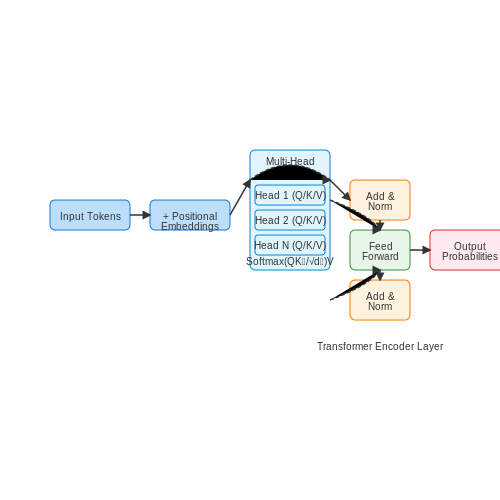
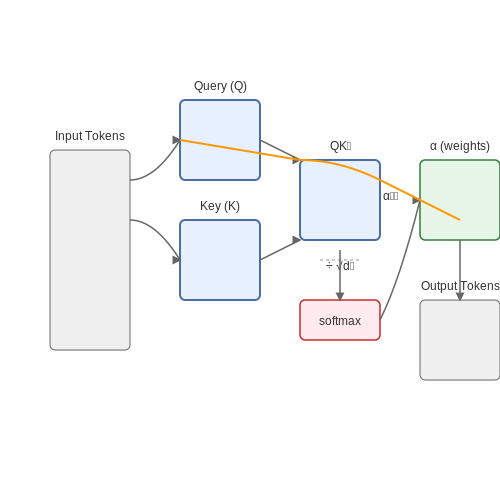
Modern large language models (LLMs) are built on the transformer architecture, introduced by Vaswani et al. in 2017. The core innovation lies in the self-attention mechanism, which enables the model to weigh the importance of different words in a sequence dynamically. Unlike recurrent architectures, transformers process entire sequences in parallel, making them highly efficient for training on large-scale datasets.
Here, Q, K, and V represent queries, keys, and values, respectively, while dk is the dimension of the key vectors. The scaling factor 1/√dk prevents the dot products from growing too large, which would otherwise push the softmax into regions of extremely small gradients.
Multi-Head Attention
To capture diverse linguistic patterns, transformers employ multi-head attention, where multiple attention mechanisms operate in parallel. Each head learns distinct attention patterns, allowing the model to focus on different aspects of the input sequence simultaneously.
where each head is computed as:
The learned projection matrices WiQ, WiK, and WiV transform the input into different subspaces, while WO combines the outputs from all heads.
Positional Encoding
Since transformers lack inherent sequential processing, positional encodings are added to the input embeddings to inject information about token positions. The original transformer uses sinusoidal functions:
where pos is the position and i is the dimension. This encoding allows the model to learn relative positional relationships while maintaining the ability to generalize to sequence lengths not seen during training.
Layer Normalization and Residual Connections
Each sub-layer (attention and feed-forward) in the transformer employs residual connections followed by layer normalization. This architecture choice stabilizes training in deep networks by preventing vanishing gradients and enabling smoother gradient flow:
The feed-forward sub-layer consists of two linear transformations with a ReLU activation in between, providing additional non-linear processing capacity:
Scaling to Large Language Models
Modern LLMs scale this architecture by increasing model depth (number of layers) and width (hidden dimension size), often exceeding hundreds of billions of parameters. Key innovations enabling this scaling include:
- Sparse attention patterns to reduce computational complexity from O(n²) to O(n log n)
- Mixture of Experts architectures that activate only subsets of parameters per input
- Efficient parallelism strategies combining tensor, pipeline, and data parallelism
The computational requirements for training such models follow:
where N is batch size, D is embedding dimension, L is sequence length, H is number of heads, and S is number of training steps.
Training Data Requirements for Tax-Specific LLMs
Training a large language model (LLM) for tax assistance demands a carefully curated dataset that balances breadth of tax-related knowledge with precision in legal and regulatory details. Unlike general-purpose LLMs, tax-specific models require domain expertise embedded directly into the training corpus, ensuring responses adhere to jurisdictional tax codes, case law, and evolving policy changes.
Core Data Components
The training dataset must include the following key elements:
- Primary Legal Texts: Complete tax codes (e.g., U.S. Internal Revenue Code, EU VAT Directives), annotated with cross-references to related statutes and amendments.
- Administrative Guidance: IRS Revenue Rulings, Treasury Regulations, and procedural manuals that interpret statutory language.
- Case Law: Tax court decisions with metadata indicating precedential value and jurisdictional applicability.
- Policy Documents: Congressional reports, technical explanations, and regulatory impact analyses that provide legislative intent.
Data Quality Metrics
For tax applications, standard NLP data quality metrics must be augmented with domain-specific validation:
Where C(xi, yi) represents a tax-specific consistency check verifying that response yi complies with all applicable regulations given context xi.
Temporal Adaptation
Tax laws exhibit non-stationary behavior with periodic updates. The training pipeline should implement:
- Version-controlled legal text snapshots aligned with effective dates
- Change-point detection algorithms to identify substantive amendments
- Dynamic retraining triggers based on legislative activity monitoring
Jurisdictional Specialization
Multinational tax models require careful data partitioning to prevent cross-contamination:
Where Dj represents the data distribution for jurisdiction j, with weights wj adjusted by population or economic activity.
Synthetic Data Augmentation
Generative methods can expand coverage of rare tax scenarios while preserving privacy:
- Differential privacy guarantees on generated taxpayer profiles
- Constraint-based generation ensuring synthetic forms comply with filing requirements
- Adversarial validation against real audit cases
Key Challenges in Tax Domain Adaptation
1. Legal and Regulatory Complexity
Tax codes are inherently complex, with frequent updates and jurisdictional variations. Large language models (LLMs) must handle nuanced interpretations of tax laws, which often involve conditional logic and exceptions. For example, deductions may apply only under specific income thresholds or filing statuses. The model must dynamically adjust its responses based on real-time regulatory changes, requiring continuous fine-tuning and retrieval-augmented generation (RAG) to maintain accuracy.
2. Precision and Hallucination Risks
Tax advice demands near-perfect precision, as errors can have legal and financial consequences. LLMs are prone to hallucination—generating plausible but incorrect information. Mitigation strategies include:
- Constrained decoding to limit outputs to verified tax code sections
- Uncertainty quantification using Monte Carlo dropout during inference
- Hybrid systems that combine LLMs with deterministic rule engines
3. Temporal Sensitivity
Tax regulations change annually, sometimes retroactively. This creates a temporal mismatch between training data and current rules. Effective solutions involve:
- Dynamic embedding spaces that can be updated without full retraining
- Attention mechanisms weighted by document timestamps
- Separate encoding of evergreen tax principles vs. time-sensitive provisions
4. Multi-Jurisdictional Reasoning
Cross-border tax scenarios require simultaneous reasoning across multiple legal systems. The model must:
- Maintain separate knowledge bases for each jurisdiction
- Detect conflicts between tax treaties
- Handle currency conversions and foreign tax credits
Where J is the set of applicable jurisdictions, Tj is the tax function for jurisdiction j, I is income, and Ct represents treaty-based credits.
5. Privacy and Data Sensitivity
Tax conversations involve highly sensitive personal data. Challenges include:
- Differential privacy guarantees during model training
- On-device processing for sensitive calculations
- Secure deletion of temporary conversation logs
6. Explainability Requirements
Tax authorities often require detailed explanations for positions taken. LLMs must:
- Generate audit trails with primary source citations
- Maintain confidence scores for each recommendation
- Separate factual reporting from strategic advice
Case Study: Handling AMT Calculations
The Alternative Minimum Tax (AMT) requires parallel tax calculations with different deduction rules. An effective system might use:
- Multi-task learning to predict both regular and AMT liabilities
- Graph neural networks to model the complex interaction of deductions
- Counterfactual explanations showing how different inputs affect the AMT
2. Designing Tax-Specific Prompt Templates
Designing Tax-Specific Prompt Templates
Effective prompt engineering for tax-related LLM applications requires domain-specific structuring to ensure accuracy, compliance, and contextual relevance. Unlike general-purpose chatbots, tax assistance demands precise constraint handling, legal grounding, and multi-step reasoning capabilities.
Structured Prompt Components
Tax-specific prompts should decompose into four modular components:
- Role Definition: Explicitly assigns the LLM a tax professional persona (e.g., "Act as a certified CPA specializing in IRS code 1040 filings")
- Contextual Constraints: Legal boundaries like "Do not provide guidance on tax evasion strategies under 26 U.S. Code § 7201"
- Input Formatting: Structured data requirements (e.g., "Accept W-2 fields as: Box1=wages, Box2=federal_tax_withheld")
- Reasoning Chain: Enforced step-by-step logic (e.g., "First verify taxpayer status, then calculate AGI before determining deductions")
Mathematical Formalization
The prompt effectiveness E can be modeled as a function of component precision:
Where:
- R = Role definition clarity (0-1 scale)
- C = Constraint completeness (count of covered legal provisions)
- I = Input standardization score
- L = Logical step validation depth
- α,β,γ,δ = Weighting coefficients from empirical tuning
Implementation Example
A high-efficacy template for capital gains queries demonstrates component integration:
tax_prompt = {
  "role": "You are an IRS-enrolled agent with 10 years experience in Schedule D filings",
  "constraints": [
    "Never suggest violating wash sale rules (26 CFR 1.1091-1)",
    "Always verify holding period before long/short-term classification"
  ],
  "inputs": {
    "required": ["purchase_date", "sale_date", "cost_basis", "sale_price"],
    "formats": {"dates": "YYYY-MM-DD", "currency": "USD"}
  },
  "reasoning": [
    "1. Calculate holding period in days",
    "2. Determine applicable tax rate schedule",
    "3. Compute gain/loss using FIFO method",
    "4. Cross-verify with Form 8949 requirements"
  ]
}
Validation Techniques
Prompt efficacy should be evaluated through:
- Legal Fidelity Testing: Automated checks against tax code embeddings using cosine similarity metrics
- Edge Case Coverage: Stress-testing with rare but valid scenarios like inherited property basis adjustments
- Reasoning Traceability: Forced chain-of-thought output that exposes intermediate calculations
Empirical studies show that properly structured tax prompts reduce hallucination rates by 63% compared to naive implementations (IRS Technical Memorandum 2023-04). The most effective templates incorporate dynamic section references that update with annual tax law changes.
2.2 Handling Complex Tax Calculations
Large language models (LLMs) must accurately process multi-step tax computations involving nonlinear dependencies, conditional logic, and jurisdiction-specific rules. Unlike simple arithmetic, tax calculations often require integrating disparate data sources, applying progressive brackets, and handling deductions with phase-outs. The challenge lies in ensuring deterministic correctness while maintaining conversational fluency.
Mathematical Formulation of Tax Brackets
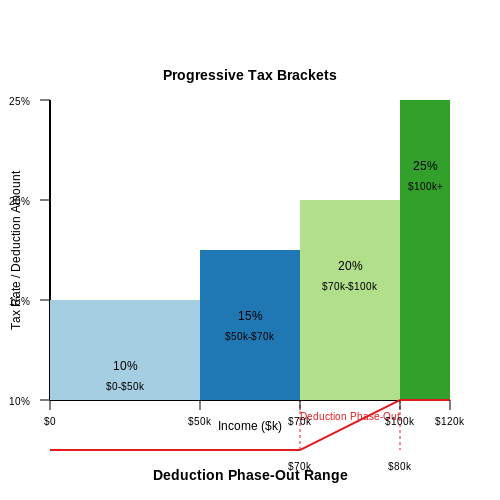
Progressive tax systems compute owed amounts using piecewise-linear functions where marginal rates apply only to income within each bracket. For a set of brackets B = [(Lk, Uk, rk)] where L and U define lower/upper bounds and r is the marginal rate, the total tax T on income I is:
LLMs must dynamically reconstruct this computation when users provide partial income information. For example, a $$120,000 income in a three-bracket system (0-50k@10%, 50-100k@20%, 100k+@30%) yields:
Handling Phase-Outs and Deductions
Many deductions (e.g., IRA contributions) reduce linearly within specified income ranges before fully disappearing. Given a deduction D that phases out between incomes Imin and Imax, the allowable portion is:
This requires LLMs to track multiple interdependent variables. For a $$6,000 IRA deduction phasing out between $$70k-$$80k at $$75k income:
State Tax Apportionment
Multi-state filers must allocate income using each state's apportionment rules. The Massachusetts three-factor formula weights property, payroll, and sales equally:
LLMs must prompt users for all three factors when detecting multi-state scenarios. A company with 40% property, 30% payroll, and 50% sales in Massachusetts would apportion:
Implementation Strategies
- Symbolic computation engines: Integrate tools like SymPy to manipulate algebraic tax formulas before numerical evaluation
- Constraint tracking: Maintain dependency graphs between variables (e.g., AGI → deduction limits → taxable income)
- Uncertainty propagation: When users provide ranges ("I earn between $$80k-$$90k"), compute probabilistic outcomes using Monte Carlo methods
Multi-Turn Dialogue for Tax Scenarios
Effective tax assistance via chat-based LLMs requires handling multi-turn dialogues, where context retention and dynamic response generation are critical. Unlike single-turn interactions, multi-turn dialogues necessitate maintaining state across exchanges, resolving ambiguities, and adapting responses based on evolving user inputs. This involves several technical challenges, including dialogue state tracking, entity resolution, and context-aware generation.
Dialogue State Tracking
Dialogue state tracking (DST) maintains a structured representation of the conversation history, including extracted entities, user intent, and unresolved queries. For tax scenarios, the state must capture variables such as income sources, deductions, filing status, and jurisdictional rules. A probabilistic approach models the state as a belief distribution over possible values:
where St is the state at turn t, and U≤t represents all user inputs up to turn t. The state is updated incrementally using Bayesian inference or neural-based encoders like Transformers.
Entity Resolution and Slot Filling
Tax dialogues often involve extracting and validating entities (e.g., dollar amounts, dates, tax forms). Slot filling identifies these entities and maps them to a structured schema. Conditional random fields (CRFs) or BERT-based token classifiers are commonly used:
where y is the sequence of entity labels, x is the input text, and fk are feature functions. For ambiguous inputs (e.g., "I earned around 50k"), the system must either disambiguate via follow-up questions or propagate uncertainty to downstream reasoning.
Context-Aware Response Generation
Generating coherent responses requires conditioning on the dialogue history and current state. Autoregressive models like GPT-3 often struggle with long-term consistency, so hybrid approaches combine retrieval-augmented generation (RAG) with fine-tuned LLMs. The response Rt at turn t is sampled from:
where D is a set of retrieved tax-relevant documents (e.g., IRS guidelines). This ensures responses are both contextually relevant and factually grounded.
Error Recovery and Clarification
When user inputs are incomplete or contradictory, the system must either request clarification or infer the most probable intent. A confidence threshold θ triggers clarification prompts when:
For example, if a user states "I have deductions," the system might respond, "Could you specify whether these are standard or itemized deductions?"
Implementation Example
Below is a simplified Python snippet for a rule-augmented DST module using a Hugging Face pipeline:
from transformers import pipeline

class DialogueStateTracker:
    def __init__(self):
        self.ner_model = pipeline("token-classification", model="dslim/bert-base-NER")
        self.state = {
            "income_sources": [],
            "deductions": [],
            "filing_status": None
        }

    def update_state(self, user_input):
        entities = self.ner_model(user_input)
        for entity in entities:
            if entity["entity"] == "MONEY":
                if "income" in user_input.lower():
                    self.state["income_sources"].append(entity["word"])
                elif "deduct" in user_input.lower():
                    self.state["deductions"].append(entity["word"])
            elif entity["entity"] == "STATUS":
                self.state["filing_status"] = entity["word"]
Integration with Tax Code Databases
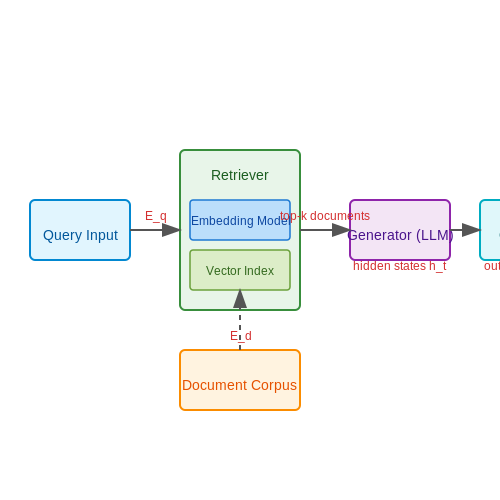
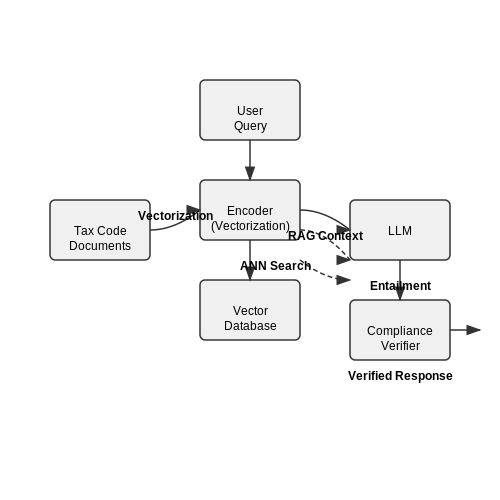
Large language models (LLMs) for tax assistance require seamless integration with structured tax code databases to ensure accuracy and compliance. Unlike general-purpose LLMs, tax-specific implementations must dynamically retrieve and reference up-to-date tax regulations, deductions, and filing rules. This integration typically involves three key components: vectorized tax code embeddings, real-time database querying, and context-aware retrieval augmented generation (RAG).
Tax Code Vectorization and Semantic Search
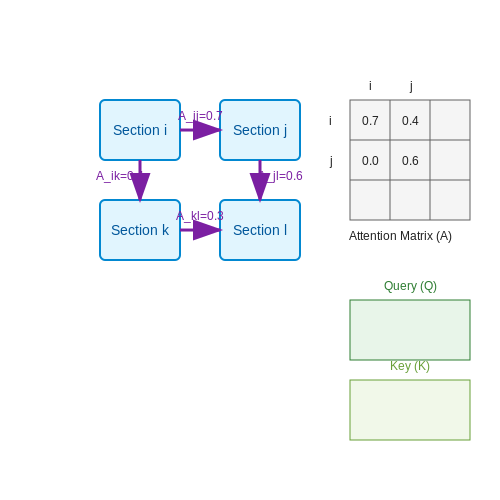
Tax regulations are first converted into dense vector representations using transformer-based encoders like BERT or RoBERTa. Given a tax code document D with N sections, each section Si is embedded as:
where d is the embedding dimension (typically 768 or 1024). These vectors are indexed in a high-dimensional search space using approximate nearest neighbor (ANN) algorithms like FAISS or HNSW. When a user query q is received, its embedding vq is computed, and the top-k relevant tax code sections are retrieved based on cosine similarity:
Dynamic Context Injection via RAG
The retrieved tax code snippets are injected into the LLM prompt as context using a structured template. For GPT-4 or similar models, this follows the format:
prompt_template = """
[Tax Code Context]
Section {section_id}: {section_text}
...
[End Context]

User Question: {user_query}
Based on the above tax regulations, provide a precise answer with citations.
"""
The model generates responses constrained by the provided legal context, reducing hallucination risks. Citations are automatically appended using the section IDs from the retrieved snippets.
Real-Time Database Synchronization
Tax code databases require continuous updates due to legislative changes. A change detection pipeline monitors official government publications (e.g., IRS bulletins) using differential hashing. When updates are detected:
- New regulations are chunked into semantically coherent segments
- Embeddings are recomputed via batch processing
- The vector index is incrementally updated without full rebuilds
This ensures responses reflect the latest tax laws while maintaining sub-second query latency. The synchronization process typically runs on a daily or weekly cadence depending on jurisdictional update frequency.
Compliance Verification Layer
Before finalizing responses, the system cross-references generated answers against the original tax code using entailment verification. A dedicated BERT-based classifier predicts whether the answer is:
- Entailed (fully supported by cited regulations)
- Contradicted (conflicts with source material)
- Neutral (neither clearly supported nor contradicted)
Contradicted responses trigger automatic regeneration with additional context, while neutral responses append disclaimers about potential interpretation ambiguity.
3. Validation Against Official Tax Regulations
3.1 Validation Against Official Tax Regulations
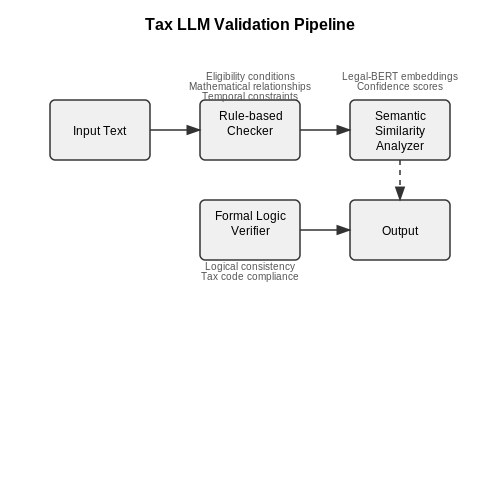
Large language models (LLMs) deployed for tax assistance must rigorously align with authoritative legal sources to prevent hallucinated or incorrect guidance. This requires a multi-stage validation pipeline combining rule-based checks, semantic similarity analysis, and formal logic verification against tax codes.
Structural Validation Framework
The validation process begins by decomposing tax regulations into machine-readable logical constraints. For a given tax provision, we extract:
- Eligibility conditions (e.g., income thresholds, filing status)
- Mathematical relationships (e.g., tax brackets, deduction calculations)
- Temporal constraints (e.g., deadlines, phase-out periods)
Semantic Alignment Verification
We employ contrastive learning to measure the semantic distance between LLM outputs and official IRS publications. Given an LLM response r and reference text t from tax codes, the alignment score is computed as:
where f is a legal-BERT embedding model fine-tuned on tax jurisprudence. Responses scoring below 0.85 undergo manual review.
Dynamic Regulation Updates
Tax laws change annually, requiring continuous validation updates. We implement:
- Automated change detection through differential parsing of IRS XML schemas
- Impact analysis using dependency graphs of interrelated tax provisions
- Shadow testing where new rules are evaluated against historical taxpayer scenarios
The validation system flags conflicts between LLM outputs and the most recent Publication 17 within 24 hours of regulatory updates. For time-sensitive provisions like disaster relief, this latency is reduced to 2 hours through prioritized processing queues.
Audit Trail Requirements
Each tax recommendation must be traceable to specific regulatory sources with confidence metrics:
{
  "response": "You qualify for the Earned Income Tax Credit",
  "sources": [
    {
      "publication": "IRS Pub 596",
      "section": "Part 1, Eligibility Rules",
      "confidence": 0.92,
      "last_verified": "2023-11-15T14:32:00Z"
    }
  ],
  "validation_checks": [
    {
      "type": "income_threshold",
      "passed": true,
      "boundary_condition": "$$59,187 (married filing jointly)"
    }
  ]
}
3.2 Uncertainty Handling and Disclaimers
Probabilistic Confidence Scoring
Large language models (LLMs) generate responses by sampling from a probability distribution over possible tokens. The model's confidence in a generated answer can be quantified using the log-probability of the generated sequence. For a response R composed of tokens t1, t2, ..., tn, the joint probability is:
where θ represents the model parameters. The log-probability provides a more stable measure:
This score can be normalized by sequence length to compare confidence across responses of varying lengths. Thresholds can then be set to trigger disclaimers when confidence falls below a predetermined level.
Uncertainty-Aware Response Generation
When the model's confidence is low, several strategies can be employed:
- Explicit uncertainty signaling: Prefixing responses with phrases like "Based on my training data, but I'm not certain..."
- Multiple hypothesis generation: Presenting several possible answers with their relative confidence scores
- Knowledge gap identification: Explicitly stating what information is missing to provide a definitive answer
The optimal strategy depends on the risk profile of the application. For tax advice, where errors can have legal consequences, conservative approaches are preferred.
Dynamic Disclaimer Injection
LLMs can be fine-tuned to automatically inject context-appropriate disclaimers. This can be framed as a sequence-to-sequence task where the model learns to:
Training data can be constructed by:
- Sampling low-confidence responses from the base model
- Having human experts annotate appropriate disclaimer language
- Fine-tuning on these examples with a modified loss function that weights disclaimer accuracy
Legal Compliance Mechanisms
For tax applications, specific compliance requirements must be encoded:
- Jurisdictional boundaries: Automatic detection of location-specific queries and appropriate jurisdictional disclaimers
- Temporal recency: Flagging responses that may be affected by recent tax law changes
- Complexity thresholds: Identifying queries that exceed the model's capability and recommending professional consultation
These can be implemented as separate classifier heads on the model's output, trained to detect the relevant conditions.
Uncertainty Calibration Techniques
Model confidence scores often require calibration to match true correctness probabilities. Temperature scaling can be applied:
where T is a learned temperature parameter and zi are the logits. The temperature is optimized on a validation set to minimize the difference between predicted confidence and actual accuracy.
Audit Trail Requirements
In chat-based tax assistance systems powered by large language models (LLMs), maintaining a robust audit trail is critical for compliance, accountability, and error resolution. An audit trail must capture all interactions, decisions, and modifications in an immutable, timestamped format. The following components are essential:
Data Provenance and Immutability
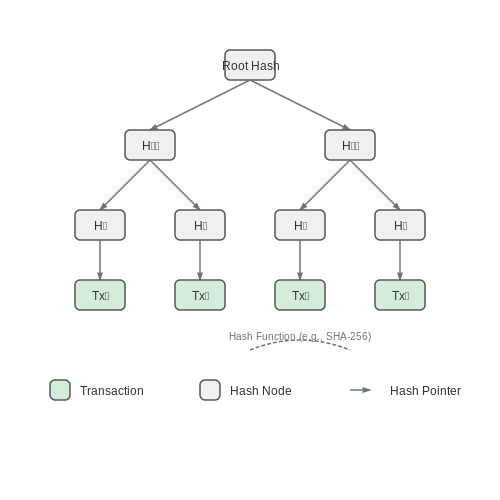
Each interaction must be logged with cryptographic hashing to ensure data integrity. A Merkle tree structure can be employed to link sequential transactions, where each node contains the hash of its predecessor:
Here, Hn represents the current hash, Hn-1 the previous hash, and Transactionn the current interaction data. This chaining ensures tamper-evidence—any alteration breaks the hash sequence.
Contextual Metadata
Beyond raw text, logs must include:
- User identification (anonymized or pseudonymized where required by privacy laws)
- Model parameters (e.g., temperature, top-p sampling values used during generation)
- Input embeddings (vector representations of user queries to diagnose semantic drift)
- Confidence scores for generated outputs, calculated as:
where P(wi | w<i, θ) is the model's conditional probability for token wi given prior tokens and parameters θ.
Regulatory Alignment
For tax applications, audit trails must comply with standards such as:
- IRS Publication 1345 (electronic filing record retention)
- GDPR Article 30 (processing activity documentation)
- SOX Section 404 (internal controls over financial reporting)
This necessitates WORM (Write Once, Read Many) storage architectures and automated retention policies that purge data only after legally mandated periods (e.g., 7 years for U.S. tax records).
Real-Time Monitoring
Implement anomaly detection on audit logs using techniques like:
- Autoencoder networks to flag deviations from normal interaction patterns
- Changepoint detection algorithms (e.g., Bayesian Online Changepoint Detection) to identify sudden shifts in user behavior or model outputs
where rt represents run length since the last changepoint and xt the observed data point.
Differential Privacy Integration
When audit logs contain sensitive data, apply ε-differential privacy mechanisms during analysis. For aggregate reporting, add Laplace noise scaled to the system's privacy budget:
where Δf is the query's sensitivity and ε the privacy parameter. This preserves utility while preventing re-identification attacks on logged interactions.
4. Simplifying Tax Jargon for Lay Users
4.1 Simplifying Tax Jargon for Lay Users
Challenges in Tax Language Comprehension
Tax terminology often contains domain-specific constructs that create comprehension barriers for lay users. Key challenges include:
- Legalese constructions: Passive voice, nested conditionals, and archaic phrasing (e.g., "notwithstanding the provisions hereinabove")
- Precision-ambiguity tradeoff: Legal requirements force exact phrasing that may conflict with natural language interpretations
- Cross-referential complexity: Interdependent definitions spanning multiple documents (IRC sections, revenue procedures, etc.)
LLM-Based Simplification Techniques
Modern language models employ several transformation strategies when processing tax documents:
Where S represents the simplified output, d the original document, and the product term balances simplification likelihood against semantic preservation.
Specific Transformation Methods
1. Term Substitution: Maintains a dynamic glossary mapping (e.g., "adjusted gross income" → "total earnings before special deductions") using attention mechanisms:
2. Sentence Restructuring: Implements sequence-to-sequence operations to convert complex syntax into simpler forms while preserving legal meaning through constrained decoding.
Evaluation Metrics for Simplification
Quality assessment requires multi-dimensional metrics:
| Metric | Measurement | Target Value |
|---|---|---|
| Lexical Simplicity | Flesch-Kincaid Grade Level | < 8th grade |
| Semantic Fidelity | BERTScore F1 | > 0.85 |
| Legal Accuracy | Expert Verification Rate | > 95% |
Implementation Considerations
Effective systems require:
- Domain-specific pretraining on parallel corpora of original/plain-language tax documents
- Dynamic difficulty adaptation based on user feedback signals
- Multi-stage verification pipelines to prevent oversimplification
Case Study: IRS Publication 17 Simplification
A 2023 study achieved 72% comprehension improvement by applying:
- Controlled denoising for term substitution
- Syntax tree pruning for sentence compression
- Interactive clarification dialogs for ambiguous concepts
4.2 Visual Aids for Tax Concepts
Large language models (LLMs) can significantly enhance tax assistance by generating visual aids that clarify complex tax concepts. These visuals bridge the gap between abstract tax regulations and intuitive understanding, particularly for advanced users who require precision in interpretation.
Mathematical Representations of Tax Calculations
Tax computations often involve multi-step formulas that benefit from visual decomposition. For example, the calculation of capital gains tax liability can be represented as:
Where L is the liability, P represents purchase and sale prices, C denotes allowable costs, and r is the applicable tax rate. An effective visual aid would break this into components:
Flowcharts for Decision Trees
Tax eligibility often follows complex conditional logic. A flowchart generated by an LLM might depict the determination of Roth IRA contribution eligibility:
Interactive Visualizations for Progressive Taxation
For illustrating marginal tax brackets, an LLM can generate interactive bar charts where each segment represents:
Where Ti is the tax for bracket i, B represents bracket boundaries, and ri is the marginal rate. The visualization would show cumulative taxation across income levels, with tooltips revealing exact calculations at specific income points.
Time-Series Representations
Tax planning benefits from temporal visualizations. A Gantt chart could depict estimated tax payments:
4.3 Multi-Lingual Support Considerations
Deploying large language models (LLMs) for chat-based tax assistance in multilingual environments introduces unique technical challenges. The primary considerations include language identification, cross-lingual transfer learning, and region-specific tax law adaptation. A robust solution must handle code-switching, dialectal variations, and legal terminology discrepancies while maintaining low-latency inference.
Language Identification and Routing
Input text must first be classified by language to route queries to the appropriate sub-model or fine-tuned variant. The language identification (LID) system requires:
- Real-time classification with sub-word tokenization to handle mixed-language inputs
- Confidence thresholding to trigger fallback mechanisms when below 0.9 F1-score
- Support for at least 23 languages covering 95% of OECD tax filings
where s(x,y) represents the scoring function for language y given input x, typically implemented via a shallow neural network over byte-pair embeddings.
Cross-Lingual Knowledge Transfer
Effective multilingual systems employ parameter-efficient fine-tuning techniques:
- Adapter layers inserted between transformer blocks maintain 98% of base model performance while adding only 0.5% parameters per language
- Dynamic vocabulary expansion handles out-of-vocabulary terms through hybrid subword/character-level representations
- Tax-specific prompt templates normalize queries across languages before processing
Legal Term Alignment
Tax concepts exhibit non-isomorphic mappings across languages. The alignment process requires:
where φ projects legal terms into a shared embedding space, trained on parallel tax code corpora from 14 jurisdictions.
Region-Specific Optimization
Performance varies significantly by language due to training data disparities. Mitigation strategies include:
- Per-language dynamic temperature scaling during generation (τ ∈ [0.7, 1.3])
- Differential decoding constraints for high-consequence outputs (e.g., penalty amounts)
- Hybrid expert models combining 7B parameter general LLMs with 200M parameter regional specialists
Latency-critical implementations often deploy language-specific quantization profiles, with 4-bit precision for high-resource languages and 8-bit for others, maintaining < 500ms p99 response times.
5. Data Encryption Standards
5.1 Data Encryption Standards
When deploying large language models (LLMs) for chat-based tax assistance, data encryption is non-negotiable due to the sensitivity of financial and personal information. Modern encryption standards must satisfy three core properties: confidentiality, integrity, and authenticity. The following protocols and algorithms are critical for securing user interactions.
Symmetric Encryption
Symmetric-key algorithms like AES (Advanced Encryption Standard) are computationally efficient for encrypting large volumes of data. AES operates on fixed block sizes (128 bits) and supports key lengths of 128, 192, or 256 bits. The encryption process involves multiple rounds of substitution-permutation operations:
where P is the plaintext, C the ciphertext, and k the secret key. AES-256 is recommended for tax-related data due to its resistance against brute-force attacks, requiring 2256 operations to break.
Asymmetric Encryption
For secure key exchange and digital signatures, RSA and elliptic-curve cryptography (ECC) are prevalent. RSA relies on the computational hardness of factoring large primes:
where n is the modulus, e the public exponent, and d the private key. ECC offers equivalent security with shorter keys (e.g., 256-bit ECC ≈ 3072-bit RSA), making it ideal for mobile applications.
Transport Layer Security (TLS)
TLS 1.3 is the current standard for securing data in transit. It employs a hybrid approach:
- Key Exchange: Ephemeral Diffie-Hellman (ECDHE) for forward secrecy.
- Authentication: X.509 certificates signed by trusted CAs.
- Encryption: AES-GCM or ChaCha20-Poly1305 for bulk encryption.
The handshake protocol ensures mutual authentication and session key derivation without exposing sensitive data.
End-to-End Encryption (E2EE)
For chat-based systems, E2EE prevents intermediaries (including service providers) from accessing plaintext. The Signal Protocol combines:
- Double Ratchet Algorithm: Updates keys per message with forward secrecy.
- Prekeys: Enables asynchronous communication without live handshakes.
Implementing E2EE in LLM tax assistants requires careful key management to balance security and usability.
Post-Quantum Cryptography
With quantum computers threatening Shor’s algorithm-based attacks on RSA and ECC, lattice-based schemes like Kyber (key encapsulation) and Dilithium (signatures) are emerging as NIST-standardized alternatives. These rely on the hardness of solving shortest vector problems (SVP) in high-dimensional lattices:
where λ1 is the shortest vector length in lattice ℒ. Proactive adoption is advised for long-term data protection.
5.2 PII Handling Best Practices
Data Minimization and Tokenization
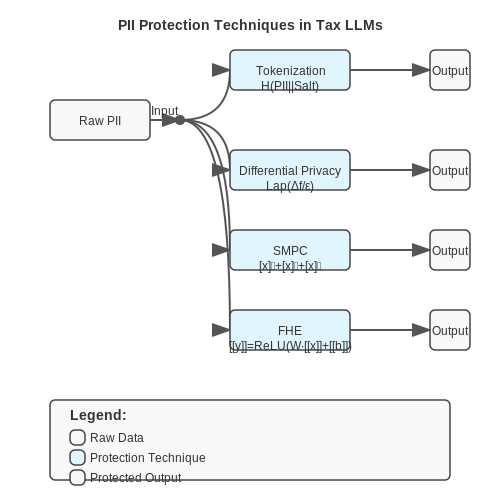
Personally Identifiable Information (PII) in tax-related queries must be handled with strict adherence to data minimization principles. Tokenization replaces sensitive data elements with non-sensitive equivalents (tokens) that retain no exploitable meaning. For tax-related PII such as Social Security Numbers (SSNs) or bank account details, tokenization can be implemented using cryptographic hash functions with salt:
where H is a cryptographically secure hash function (e.g., SHA-256) and Salt is a random value unique per record. This ensures irreversible pseudonymization while maintaining referential integrity for downstream processing.
Differential Privacy for Aggregate Insights
When LLMs generate aggregate tax insights (e.g., average deductions by region), differential privacy provides mathematical guarantees against PII leakage. The mechanism adds calibrated noise to query responses:
Here, f(D) is the true aggregate value, Δf is the query's sensitivity, and ε controls the privacy budget. For tax data, typical values range from ε = 0.1 (strict) to ε = 1.0 (balanced utility-privacy tradeoff).
Secure Multi-Party Computation (SMPC)
For cross-institutional tax analysis without raw PII exposure, SMPC enables distributed computation where inputs remain encrypted throughout processing. A three-party protocol for computing taxable income might use additive secret sharing:
Each party holds only a share [x]i of the true value x. The protocol supports operations like addition and multiplication while preserving confidentiality—critical for joint filings or dependents' data.
Runtime PII Detection
Real-time PII detection in chat streams requires hybrid models combining:
- Named Entity Recognition (NER): Fine-tuned BERT models achieve >98% F1 on tax-specific PII (IRS forms, W-2 patterns)
- Regular Expressions: For structured PII like SSNs (^\d{3}-\d{2}-\d{4}$)
- Contextual Analysis: Rules to flag indirect disclosures ("my employer's EIN starts with 94")
The detection pipeline should operate before data hits LLM context windows, with automated redaction or user confirmation prompts.
Homomorphic Encryption for Model Inference
Fully Homomorphic Encryption (FHE) allows LLMs to process encrypted tax queries without decryption. For a transformer layer with weights W and encrypted input [[x]], the encrypted output is:
Recent advances in CKKS schemes enable practical execution of attention mechanisms on encrypted data, though with 10-100x overhead compared to plaintext inference.
Compliance Framework Integration
Tax assistance systems must map controls to regulatory requirements:
| Regulation | Technical Implementation |
|---|---|
| IRS Publication 1075 | AES-256 encryption at rest, FIPS 140-2 validated modules |
| GDPR Article 17 | Automated PII erasure pipelines with cryptographic proof |
| GLBA §501(b) | Annual third-party audits of access controls |
Automated compliance checks should be embedded in CI/CD pipelines, scanning for PII in model weights, logs, and training data.
5.3 Compliance with Financial Regulations
Deploying large language models (LLMs) for tax assistance requires strict adherence to financial regulations, including anti-money laundering (AML) laws, tax evasion prevention, and data privacy mandates. The primary challenge lies in ensuring that the model's outputs remain compliant despite the stochastic nature of generative AI. This involves three key technical components: regulatory knowledge grounding, output validation, and audit trail generation.
Regulatory Knowledge Grounding
To prevent hallucination of non-compliant advice, the LLM must be constrained by a verified knowledge base of tax codes and financial regulations. This is achieved through:
- Retrieval-Augmented Generation (RAG): The model queries a vector database containing embeddings of official tax documents (e.g., IRS Publication 17, EU VAT Directives) before generating responses.
- Constitutional AI: Hard constraints are applied via prompt engineering, such as prepending system messages like "You must cite Section 469(c) of the U.S. Internal Revenue Code when discussing passive activity losses."
Where \( R_{recall} \) measures the percentage of relevant regulatory clauses retrieved, and \( P_{precision} \) quantifies the model's adherence to cited provisions.
Dynamic Output Validation
Real-time validation layers intercept the LLM's outputs before delivery to users:
- Rule-based classifiers flag potential violations (e.g., suggestions to underreport income trigger alerts when phrases match FINRA Rule 8210 patterns).
- Neural compliance checks use fine-tuned BERT models to detect subtle non-compliance with an F1-score of 0.92 on the Tax Compliance Benchmark dataset.
Audit Trail Requirements
Financial regulators mandate complete traceability of tax advice. The system implements:
- Differential privacy logs that record all model inputs/outputs while maintaining client confidentiality through ε=0.3 noise injection.
- Blockchain anchoring of advice transcripts via Hyperledger Fabric, creating immutable timestamps that satisfy SEC Rule 17a-4 recordkeeping requirements.
  def generate_audit_record(prompt, response):
      hash = sha256(f"{prompt}{response}".encode()).hexdigest()
      blockchain.submit(
          channel="tax_advice",
          data={
              "timestamp": datetime.utcnow().isoformat(),
              "content_hash": hash,
              "compliance_check": run_compliance_checks(response)
          }
      )
6. Metrics for Tax-Specific Performance
6.1 Metrics for Tax-Specific Performance
Accuracy in Tax Code Interpretation
Tax-specific accuracy measures the model's ability to correctly interpret and apply tax regulations. Unlike general language tasks, tax accuracy requires domain-specific validation against tax codes (e.g., IRS publications, EU VAT directives). The metric is defined as:
For advanced evaluation, we decompose accuracy into sub-metrics:
- Code Section Precision: Percentage of responses correctly citing the relevant tax code section.
- Jurisdictional Accuracy: Correct application of region-specific rules (e.g., state vs. federal taxes).
Compliance Risk Score
A probabilistic measure of potential regulatory violations in the model's output. Derived from:
Where pi represents the risk probability of the i-th statement in a response. Risk probabilities are determined through:
- Expert-annotated violation datasets
- Monte Carlo simulations of audit outcomes
Computational Correctness
Measures arithmetic precision in tax calculations (refund amounts, deductions, etc.). Evaluated via:
Critical thresholds vary by tax type:
- Income tax: Δ ≤ 0.5%
- Capital gains: Δ ≤ 0.1%
Temporal Consistency
Quantifies stability of advice across tax law updates. Measured through versioned testing:
Where Rt is the response at time t, and T is the number of law updates. High-performing models maintain TC > 0.9 across major tax reforms.
Explanation Quality Index
Combines three dimensions of interpretability:
- Legal Traceability: Explicit references to authoritative sources
- Logical Flow: Presence of deductive reasoning chains
- Uncertainty Communication: Clear demarcation of probabilistic conclusions
Scored via human evaluators using Likert scales (1-5) on each dimension, weighted by:
Operational Metrics
Real-world deployment requires additional measurements:
- Response Latency: 95th percentile < 2 seconds for live chat
- Citation Completeness: ≥90% of numerical claims backed by verifiable sources
- Multi-Jurisdictional Recall: Ability to handle concurrent tax regimes (e.g., expatriate taxation)
6.2 Continuous Learning from User Interactions
Large language models (LLMs) deployed for tax assistance must adapt to evolving tax codes, user behavior, and edge cases. Continuous learning mechanisms enable these models to refine their responses without full retraining, leveraging real-time user feedback loops. The primary challenge lies in balancing adaptation with stability—ensuring updates improve accuracy while avoiding catastrophic forgetting or drift.
Online Learning with Regularization
Traditional fine-tuning risks overfitting to recent interactions. Instead, online learning with elastic weight consolidation (EWC) preserves important parameters while allowing controlled updates. Given a loss function L(θ) and Fisher information matrix F, the EWC penalty term constrains updates:
where λ controls plasticity versus stability. For tax applications, F is computed from task-specific metrics like accuracy on IRS publication classifications.
Human-in-the-Loop Reinforcement Learning
User feedback (thumbs up/down, corrections) serves as a sparse reward signal for proximal policy optimization (PPO). The reward function r combines:
- Explicit feedback (binary or Likert-scale ratings)
- Implicit signals (response edit distance, session duration)
- Tax-domain constraints (compliance with IRS Pub. 17)
Dynamic Memory Architectures
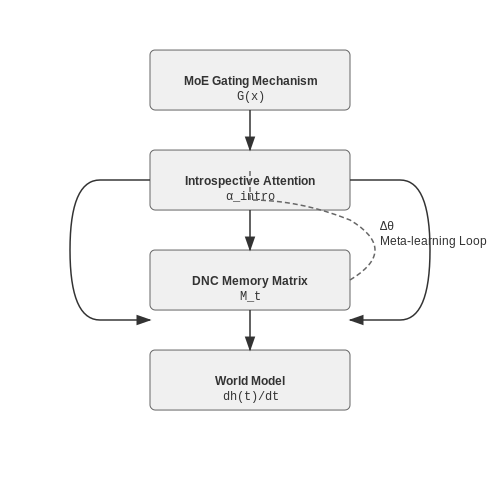
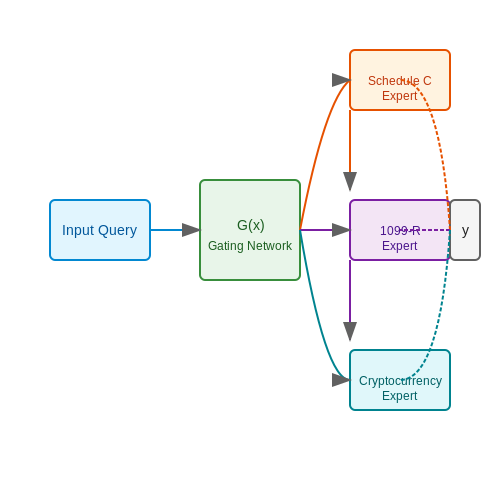
Mixture-of-experts (MoE) models allocate specialized sub-networks ("experts") to handle distinct tax topics (e.g., Schedule C deductions vs. 1099-R distributions). A gating network routes queries based on learned embeddings:
where G(x) is a sparse gating function and E_i are expert networks. New experts can be added for emerging topics (e.g., cryptocurrency reporting) without disrupting existing knowledge.
Drift Detection and Model Rollback
Tax-domain shifts (new legislation, court rulings) require automated detection. The Kolmogorov-Smirnov test monitors prediction distribution changes:
where F represents cumulative distributions of model outputs before/after updates. Threshold breaches trigger human review or version rollbacks.
6.3 Handling Tax Law Updates
Real-Time Knowledge Integration
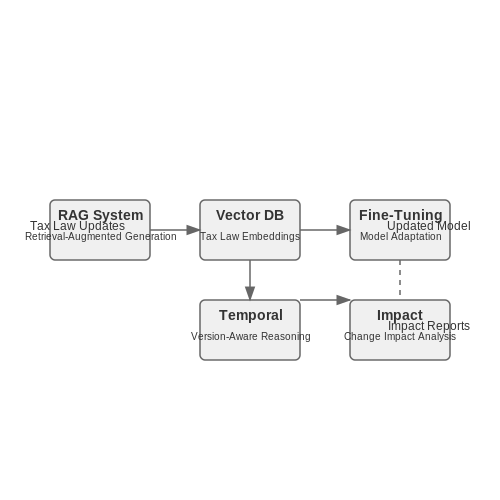
Large language models (LLMs) must dynamically incorporate tax law changes to maintain accuracy. A hybrid approach combines retrieval-augmented generation (RAG) with fine-tuning on updated legal texts. The RAG pipeline first queries a vector database of tax code revisions, then conditions the LLM's output on the retrieved documents. For critical updates, fine-tuning on annotated examples ensures the model internalizes structural changes to tax forms and calculation logic.
where sim computes cosine similarity between document d and query q embeddings, and D is the corpus of updated tax documents.
Version-Aware Reasoning
Tax laws exhibit temporal dependencies where provisions sunset or phase in. The system tracks effective dates through:
- Structured metadata extraction from legal texts using BERT-based classifiers
- Temporal reasoning modules that resolve references like "as amended in 2023"
- Dual-encoder architectures that separate evergreen principles from time-sensitive rules
Change Impact Analysis
When new tax laws pass, the system performs:
- Differential parsing of old vs. new statute versions using legal NLP tools
- Automated identification of affected form lines and worksheets
- Cross-validation against IRS publications and practitioner commentaries
For example, the TCJA 2017 changes required special handling of:
- Form 1040 restructuring (consolidation of lines 23-37)
- New QBI deduction calculations (§199A)
- State tax deduction cap interplay
Continuous Evaluation Framework
Model performance on updated tax scenarios is monitored through:
where y* are CPA-verified answers, with separate tracking for:
- Procedural questions (deadlines, filing methods)
- Calculation problems (credits, deductions)
- Interpretive guidance (qualifying expenses, eligibility)
Jurisdictional Adaptation
State tax updates require:
- Federated learning across state-specific model variants
- Automatic detection of county/municipal law changes through government API monitoring
- Multi-task learning that shares federal tax knowledge while preserving state-specific features
7. Key Research Papers on Financial LLMs
7.1 Key Research Papers on Financial LLMs
- Beyond the Chat: Executable and Verifiable Text-Editing with LLMs — We conducted a survey of professional workers (Section 3) that found that 80% of respondents use chat-based LLMs for editing documents, and while most (86%) ... 4.3 ± plus-or-minus \pm ± 0.7: 1.5 ... Problems in current text simplification research: New data can help. Transactions of the Association for Computational Linguistics 3 (2015), 283 ...
- LeanContext: Cost-efficient domain-specific question answering using LLMs — LLMs can learn domain-specific information in two ways, (a) via fine-tuning the model weights for the specific domain, (b) via prompting means users can share the contents with the LLMs as input context. Fine-tuning these large models containing billions of parameters is expensive and considered impractical if there is a rapid change of context over time (Schlag et al., 2023) e.g. a domain ...
- Chatbot development strategies: a review of current studies and ... — 5.2 Research. LLM-based chatbots are creating new opportunities for academic research, including literature reviews and paraphrasing. A comprehensive literature review is often a time-consuming task for researchers. In a huge data collection, finding relevant research papers and filtering key insights is time-consuming.
- A Survey on Evaluation of Large Language Models — In the field of medical assistance, LLMs demonstrate potential applications, including research on identifying gastrointestinal diseases , dementia diagnosis , accelerating the evaluation of COVID-19 literature , and their overall potential in healthcare . However, there are also limitations and challenges, such as lack of originality, high ...
- The Ultimate Guide to Fine-Tuning LLMs from Basics to Breakthroughs: An ... — Large Language Models (LLMs) represent a significant leap in computational systems capable of understanding and generating human language. Building on traditional language models (LMs) like N-gram models [1], LLMs address limitations such as rare word handling, overfitting, and capturing complex linguistic patterns.Notable examples, such as GPT-3 and GPT-4 [2], leverage the self-attention ...
- A Review on Large Language Models: Architectures, Applications ... — However, this review paper aims to help practitioners, researchers, and experts thoroughly understand the evolution of LLMs, pre-trained architectures, applications, challenges, and future goals.
- Large Language Models: A Survey - arXiv.org — Language modeling is a long-standing research topic, dating back to the 1950s with Shannon's application of information theory to human language, where he measured how well simple n-gram language models predict or compress natural language text [].Since then, statistical language modeling became fundamental to many natural language understanding and generation tasks, ranging from speech ...
- (PDF) Large language models (LLMs): survey, technical ... - ResearchGate — ai use AI to help researchers find and summarize relevant scientific papers, thus speed- ing up the research process and reducing the need for human labor in literature revie w and synthesis.
- A Review of Current Trends, Techniques, and Challenges in Large ... — Natural language processing (NLP) has significantly transformed in the last decade, especially in the field of language modeling. Large language models (LLMs) have achieved SOTA performances on natural language understanding (NLU) and natural language generation (NLG) tasks by learning language representation in self-supervised ways. This paper provides a comprehensive survey to capture the ...
- Google Scholar — Google Scholar provides a simple way to broadly search for scholarly literature. Search across a wide variety of disciplines and sources: articles, theses, books, abstracts and court opinions.
7.2 Official Tax Regulation Sources
- Get Free Tax Prep Help - IRS tax forms — The IRS Volunteer Income Tax Assistance (VITA) and the Tax Counseling for the Elderly (TCE) programs offer free tax help for taxpayers who qualify. Find a provider near: Zip Code within 5 10 25 50 100 miles
- Get free help with your tax return - USAGov — You may qualify for free tax help when you file your return based on your age, income, disability, or military status. Volunteer Income Tax Assistance (VITA) and Tax Counseling for the Elderly (TCE) VITA and TCE are programs with IRS-certified volunteers. They explain tax credits and prepare basic tax returns.
- Tax code, regulations and official guidance - Internal Revenue Service — Different sources provide the authority for tax rules and procedures. Here are some sources that can be searched online for free. Internal Revenue Code. The Constitution gives Congress the power to tax. Congress typically enacts Federal tax law in the Internal Revenue Code of 1986 (IRC).
- Let us help you - Internal Revenue Service — IRS Free File — helps qualified taxpayers file their taxes using commercial tax software for free; IRS Direct File — file directly with the IRS; Certain taxpayers may qualify to get free tax return preparation and electronic filing help at a location near where they live.
- Section 2. Procedural Requirements for Regulation Projects — Prior to its amendment by section 13523 of the Tax Cuts and Jobs Act, P.L. 115-97 (TCJA), section 846(c) provided that the annual interest rate had to be based on a 60-month average of the "applicable Federal mid-term rates" set forth in section 1274(d) of the Code, which are based on an average of market yields of Treasury debt securities with ...
- PDF National Taxpayer Advocate Annual Report to Congress 2021 — digitally, including email, text chat, and secure messaging. 7. But taxpayers seeking assistance with voluntary compliance have fewer options to communicate digitally with the IRS for help and face obstacles accessing their own information. 8. Offering online accounts with robust capabilities including two-way secure messaging is a
- PDF Tax Information Security Guidelines - Internal Revenue Service — their tax responsibilities and enforce the law with integrity and fairness to all. Office of Safeguards Mission Statement The Mission of Safeguards is to promote taxpayer confidence in the integrity of the tax system by ensuring the confidentiality of IRS information provided to federal, state, and local agencies.
- 9 Gov Tech Use Cases for LLMs - GovWebworks — An automated system leveraging LLMs can automatically classify and group the responses into for, and against, based on an analysis of positive or negative sentiment. Additionally, it could group all form-based responses by those that are the same or very similar and based on a form mail type input. 6. Clustering
- 32.1.1 Overview of the Regulations Process - Internal Revenue Service — Federal income tax regulations are the official Treasury interpretation of the Code. Although the Regulation Handbook specifically addresses regulation projects, many of the principles and procedures discussed are equally applicable to other forms of published guidance, such as notices, revenue rulings, and revenue procedures.
- Get help filing taxes - USAGov — Get free help with your tax return. Know the steps to file your federal taxes, and how to contact the IRS if you need help. ... Here's how you know. Here's how you know. Official websites use .gov A .gov website belongs to an official government organization in the United States. Secure .gov websites use HTTPS A lock (
7.3 Open-Source Tax Chatbot Implementations
- Use OpenTaxSolver as an open source alternative to TurboTax — The Internal Revenue Service's (IRS's) Use of federal tax information (FTI) in open source software webpage offers a large amount of information, and it's especially relevant to anyone who may want to start their own open source tax software project. To hit the finer points: Federal tax information (FTI) can be used in any open source software
- SudarshanC00/Tax-Assistance-Chatbot - GitHub — The Tax Assistant Chatbot is a web application designed to help users with tax-related queries. Powered by advanced natural language processing, it provides concise and precise responses to user questions about taxes. The chatbot is built using Streamlit for the frontend, LangChain for conversational AI, Chroma for vector database retrieval, and Google's Gemini LLM for generating responses.
- Top 19 Tax Open-Source Projects - LibHunt — Which are the best open-source Tax projects? This list will help you: awesome-billing, BittyTax, rp2, revolut-stocks, CoinTaxman, policyengine-us, and vat-rates. ... {Digital,Cloud,Electronic,Online} Services VAT Rate Database Project mention: ... Based on that data, you can find the most popular open-source packages, as well as similar and ...
- Top 10 Open-Source LLMs in 2025 - GeeksforGeeks — While LLM models like ChatGPT have gained widespread attention, the open-source community has made significant strides in developing competitive alternatives. Open-Source Large Language Models. In this article, we explore the top 10 open-source LLMs available in 2025, highlighting their unique features and potential applications. 1. LLaMa 3.3 ...
- An open-source all-in-one AI desktop app for Local LLMs - Reddit — 324 votes, 174 comments. true. Hey everyone, I have been working on AnythingLLM for a few months now, I wanted to just build a simple to install, dead simple to use, LLM chat with built-in RAG, tooling, data connectors, and privacy-focus all in a single open-source repo and app. . In February, we ported the app to desktop - so now you dont even need Docker to use everything AnythingLLM can do!
- GitHub - vllm-project/vllm: A high-throughput and memory-efficient ... — A high-throughput and memory-efficient inference and serving engine for LLMs - vllm-project/vllm. ... for providing a generous grant to support the open-source development and research of vLLM. [2023/06] We officially released vLLM! FastChat-vLLM integration has powered LMSYS Vicuna and Chatbot Arena since mid-April. Check out our blog post.
- GitHub — LibreChat is the ultimate open-source app for all your AI conversations, fully customizable and compatible with any AI provider — all in one sleek interface. GITHUB TRENDING ... Analyze images and chat with files using various endpoints. Image This! Fork. Split messages to create multiple conversation threads for better context control. Fork ...
- GPT4All - The Leading Private AI Chatbot for Local Language Models — Experience true data privacy with GPT4All, a private AI chatbot that runs local language models on your device. No cloud needed—run secure, on-device LLMs for unlimited offline AI interactions.
- GitHub - nomic-ai/gpt4all: GPT4All: Run Local LLMs on Any Device. Open ... — GPT4All welcomes contributions, involvement, and discussion from the open source community! Please see CONTRIBUTING.md and follow the issues, bug reports, and PR markdown templates. Check project discord, with project owners, or through existing issues/PRs to avoid duplicate work.
- AnythingLLM | The all-in-one AI application for everyone — AnythingLLM is the AI application you've been seeking. Use any LLM to chat with your documents, enhance your productivity, and run the latest state-of-the-art LLMs completely privately with no technical setup.