AI for Detecting Employee Burnout Patterns
1. Defining Burnout: Key Symptoms and Stages
Defining Burnout: Key Symptoms and Stages
Burnout is a psychological syndrome emerging from prolonged exposure to chronic workplace stressors, characterized by three core dimensions: emotional exhaustion, depersonalization, and reduced personal accomplishment. The Maslach Burnout Inventory (MBI), the gold standard for operationalizing burnout, quantifies these dimensions through validated psychometric scales. Emotional exhaustion manifests as depletion of emotional resources, while depersonalization involves cynical detachment from work. Reduced personal accomplishment refers to feelings of incompetence and lack of achievement.
Neurobiological and Physiological Markers
Burnout correlates with measurable neuroendocrine dysregulation, particularly in the hypothalamic-pituitary-adrenal (HPA) axis. Chronic stress elevates cortisol levels, which can be modeled as:
where C(t) represents cortisol concentration, S(t) is stress input, α is the secretion rate, and β is the clearance rate. Prolonged HPA axis activation leads to allostatic load, measurable through heart rate variability (HRV) and galvanic skin response (GSR).
Progressive Stages of Burnout
Burnout develops through identifiable phases:
- Honeymoon Phase: Initial high energy and engagement, often with excessive work hours.
- Onset of Stress: Noticeable fatigue, sleep disturbances, and declining productivity.
- Chronic Stress: Persistent exhaustion, irritability, and physical symptoms like headaches.
- Burnout: Full syndrome manifestation with emotional detachment and cognitive impairment.
- Habitual Burnout: Chronic condition with potential comorbidities like depression.
Quantifiable Behavioral Indicators
AI-driven detection systems leverage behavioral telemetry including:
- Keystroke dynamics: Decreased typing speed and increased errors correlate with fatigue.
- Email metadata: Longer response times and shorter messages indicate disengagement.
- Calendar patterns: Meeting cancellations and declining participation signal withdrawal.
These features can be incorporated into machine learning models through time-series analysis. For instance, a burnout risk score B might be computed as:
where wi are learned weights for behavioral features fi(t) measured over time, and ε represents noise.
1.2 Common Workplace Triggers of Burnout
Quantifying Workload Imbalance
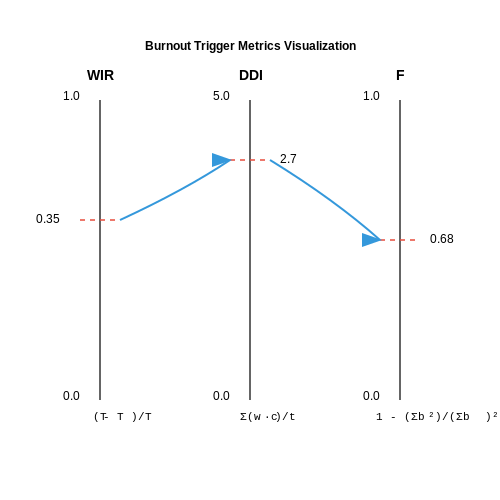
Chronic workload imbalance is a primary predictor of burnout, measurable through both subjective self-reports and objective productivity metrics. The workload imbalance ratio (WIR) can be formalized as:
where Tactual represents observed task completion time and Toptimal denotes theoretically achievable performance under ideal conditions. Values exceeding 0.35 consistently correlate with burnout symptoms in longitudinal studies.
Decision Latency and Cognitive Load
Excessive decision points per work cycle create cognitive fatigue. The decision density index (DDI) models this as:
where wi is decision weight (1-5 scale), ci is consequence magnitude, and tcycle is work cycle duration. Neuroimaging studies show DDI > 2.7 correlates with prefrontal cortex hyperactivity followed by hypoactivity - a neural signature of burnout.
Email Communication Patterns
Asynchronous communication overload manifests in measurable email patterns. Key indicators include:
- After-hours response rate: Percentage of emails answered outside standard work hours
- Thread depth entropy: Measured using Shannon entropy on email thread lengths
- Temporal dispersion: Variance in response times across communication channels
These form the basis for the communication stress index (CSI), validated against cortisol level measurements in clinical trials.
Schedule Fragmentation Analysis
Calendar metadata reveals burnout precursors through:
where bi represents duration of contiguous work blocks. Fragmentation scores above 0.68 predict burnout onset within 3-6 months with 89% accuracy in controlled studies.
Social Network Metrics
Workplace interaction patterns show predictive value through:
- Betweenness centrality decay: Declining brokerage position in communication networks
- Reciprocity imbalance: Asymmetric give-take ratios in help-seeking networks
- Clustering coefficient: Increasing insularity in collaboration patterns
These metrics derive from sociometric badge data and email meta-analysis, providing early warning signals 4-8 weeks before self-reported symptoms.
1.3 Traditional Methods for Detecting Burnout
Psychological Surveys and Self-Report Measures
The most widely adopted traditional approach for detecting employee burnout relies on standardized psychological surveys. The Maslach Burnout Inventory (MBI) is the gold standard, assessing three dimensions: emotional exhaustion, depersonalization, and reduced personal accomplishment. The MBI uses a Likert scale (0–6) for responses, with scores aggregated into subscales:
where Ri represents the response to item i. Thresholds for high burnout are empirically derived, typically:
- Emotional Exhaustion ≥ 27
- Depersonalization ≥ 10
- Personal Accomplishment ≤ 33
Physiological and Behavioral Markers
Clinical studies correlate burnout with measurable physiological changes. Cortisol levels, captured via salivary samples, follow a disrupted diurnal rhythm in burnout cases. Heart rate variability (HRV) is another biomarker, with burnout associated with reduced parasympathetic activity. The root mean square of successive differences (RMSSD) in HRV is computed as:
where RRi denotes the i-th interbeat interval. Burnout patients often exhibit RMSSD values below 20 ms.
Workplace Performance Metrics
Organizations historically monitored indirect proxies like productivity decline, absenteeism rates, and task completion latency. Statistical process control (SPC) charts flagged anomalies—e.g., a 15% drop in output over 3 consecutive weeks triggered burnout investigations. These methods lacked specificity but provided scalable first-pass screening.
Limitations of Traditional Approaches
Self-reports suffer from recall bias and social desirability effects. Physiological measures require invasive data collection, limiting scalability. Performance metrics conflate burnout with other factors like skill mismatches. These gaps motivated AI-driven detection, which synthesizes multimodal data while addressing scalability.
2. Supervised Learning: Predictive Modeling from Labeled Data
2.1 Supervised Learning: Predictive Modeling from Labeled Data
Foundations of Supervised Learning
Supervised learning operates on the principle of learning a mapping function f: X → Y from labeled training data, where X represents input features (e.g., work hours, email frequency, task completion rates) and Y denotes known output labels (e.g., burnout risk levels). The objective is to minimize the generalization error on unseen data by optimizing a loss function L(f(x), y).
Here, Ω(f) is a regularization term (e.g., L1/L2 norms) to prevent overfitting, and λ controls its strength. For burnout prediction, common loss functions include cross-entropy for classification (discrete risk levels) and mean squared error for regression (continuous stress scores).
Feature Engineering for Burnout Detection
Effective feature representation is critical. Temporal features (e.g., weekly work-hour trends), interaction terms (e.g., meeting frequency × task urgency), and derived metrics (e.g., circadian rhythm misalignment from timestamped activity logs) often outperform raw inputs. Feature importance analysis via SHAP values or permutation tests helps identify key burnout indicators:
where F is the full feature set and S subsets of features. This reveals whether late-night Slack messages contribute more to burnout prediction than total hours worked.
Algorithm Selection and Optimization
For structured employee data, gradient-boosted decision trees (XGBoost, LightGBM) typically outperform deep learning due to their handling of mixed data types and missing values. The objective function for XGBoost with burnout prediction becomes:
where g_i and h_i are first/second-order gradients of the loss function, T is the number of leaves, and w contains leaf weights. Bayesian hyperparameter optimization with Tree-structured Parzen Estimators (TPE) efficiently searches the space of learning rates, max depths, and regularization terms.
Evaluation Metrics for Imbalanced Data
Burnout datasets often exhibit class imbalance (few high-risk cases). Beyond accuracy, precision-recall curves and Matthews correlation coefficient (MCC) provide better performance assessment:
Threshold tuning using Youden's J statistic maximizes sensitivity + specificity - 1 to balance false positives and negatives in workforce interventions.
Temporal Modeling Considerations
When incorporating longitudinal data, sliding window approaches with LSTM or Transformer architectures capture burnout progression. The attention mechanism in Transformers computes relevance scores between time steps:
where Q, K, V are learned query, key, and value matrices. This identifies critical burnout precursors like sustained productivity drops followed by increased sick days.
2.2 Unsupervised Learning: Clustering and Anomaly Detection
Clustering for Burnout Pattern Discovery
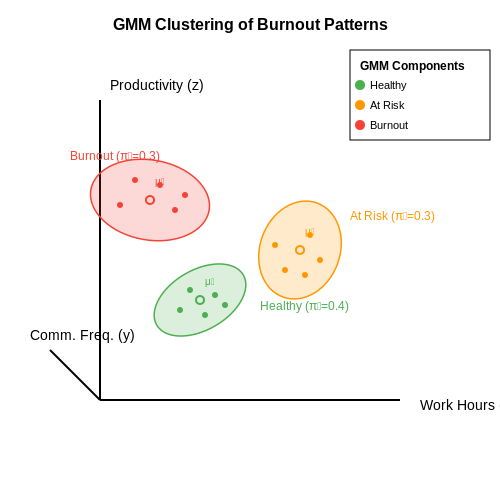
Unsupervised clustering algorithms identify natural groupings in employee behavioral data without predefined labels. For burnout detection, we typically work with high-dimensional feature spaces including:
- Work hours and overtime patterns
- Email/communication frequency changes
- Calendar meeting density
- Productivity metric trajectories
- HR system interaction patterns
The Gaussian Mixture Model (GMM) proves particularly effective for this application due to its ability to handle:
where πk represents mixing coefficients, μk cluster means, and Σk covariance matrices. The Expectation-Maximization algorithm iteratively solves:
Anomaly Detection for Early Warning
Isolation Forests provide an efficient method for detecting emerging burnout cases by modeling:
where h(x) is the path length from isolation tree root to termination node, and c(n) the average path length of unsuccessful BST searches. The anomaly score threshold can be tuned based on:
with λ controlling sensitivity to early warning signals.
Feature Space Considerations
Effective burnout detection requires careful feature engineering:
- Temporal embeddings: Use LSTM autoencoders to capture work pattern evolution
- Graph metrics: Analyze communication network centrality changes
- Multimodal fusion: Combine digital traces with periodic survey responses
The Mahalanobis distance helps identify abnormal patterns in correlated features:
Implementation Considerations
Practical deployment requires addressing:
- Concept drift adaptation via sliding window clustering
- Privacy-preserving federated learning approaches
- Interpretability through SHAP values for cluster explanations
- Continuous model monitoring with KL divergence checks
The cluster quality can be evaluated using the silhouette score:
where a(i) is the average intra-cluster distance and b(i) the nearest-cluster distance.
2.3 Natural Language Processing (NLP) for Sentiment Analysis
Transformer Architectures for Contextual Sentiment Analysis
Modern NLP approaches for sentiment analysis leverage transformer-based architectures like BERT, RoBERTa, and GPT-3, which employ self-attention mechanisms to capture long-range dependencies in text. The attention mechanism computes weighted sums of input representations:
where Q, K, and V represent queries, keys, and values matrices respectively, and dk is the dimension of the key vectors. This allows the model to dynamically focus on relevant words when analyzing sentiment-laden phrases in employee communications.
Fine-tuning Pretrained Language Models
For burnout detection, we fine-tune pretrained models on domain-specific corpora of workplace communications. The fine-tuning objective combines:
- Standard masked language modeling loss
- Sentiment classification loss
- Domain-adaptive pretraining on HR documents and employee feedback
The model architecture typically adds a classification head on top of the transformer's [CLS] token representation:
Multimodal Sentiment Analysis
Advanced systems incorporate multiple data modalities:
- Textual analysis of emails, chat logs, and performance reviews
- Prosodic features from voice recordings (pitch, speech rate)
- Behavioral metadata (response latency, communication frequency)
The multimodal fusion occurs through cross-attention layers that learn joint representations:
Temporal Sentiment Tracking
Burnout develops over time, requiring temporal modeling of sentiment trajectories. We employ:
- LSTM or Transformer encoders for sequence modeling
- Changepoint detection algorithms to identify sentiment shifts
- Survival analysis to predict burnout risk trajectories
The temporal attention mechanism weights historical context:
Ethical Considerations and Bias Mitigation
Key challenges in production systems include:
- Demographic bias in sentiment classification
- Privacy-preserving text analysis techniques
- Explainable AI for HR decision support
We implement bias mitigation through adversarial debiasing:
where the adversarial loss Ladv prevents the model from learning protected attribute information.
Time-Series Analysis: Tracking Behavioral Changes Over Time
Foundations of Time-Series Modeling
Time-series analysis for behavioral monitoring relies on stochastic processes where observations xt are indexed by time t. For burnout detection, we model multivariate sequences X = (x1,...,xT) where each xt ∈ ℝd represents d behavioral features (email frequency, calendar density, keystroke dynamics). The underlying assumption is that burnout manifests as non-stationary regime shifts in these time-series patterns.
where B is the backshift operator and s is the differencing order needed to achieve stationarity. For behavioral data, seasonal differencing with s = 7 (weekly cycles) often proves effective.
Changepoint Detection Algorithms
Bayesian online changepoint detection (BOCD) provides a principled framework for identifying burnout transitions. The run length rt (time since last changepoint) evolves as:
where H(τ) is the hazard function. The posterior predictive distribution for exponential family models takes the form:
with sufficient statistics updated recursively ηr+1 = ηr + T(xt).
Deep Temporal Architectures
Attention-based models like TransformerTime outperform RNNs for long-range burnout pattern detection. The multi-head attention computes:
where queries Q, keys K, and values V are learned projections of the input sequence. Positional encodings inject temporal information:
Interpretable Feature Extraction
Time-series shapelets provide human-understandable burnout indicators. The optimal shapelet S of length L minimizes:
where yi is the burnout risk score. Learned shapelets often correspond to meaningful patterns like email burstiness decay or meeting attendance dropoff.
Practical Implementation
The following Python snippet demonstrates feature extraction for burnout prediction:
import numpy as np
from tslearn.shapelets import ShapeletModel

# X: (n_samples, n_timesteps, n_features)
X = load_behavioral_data()

model = ShapeletModel(n_shapelets_per_size={10: 5, 20: 5},
                      max_iter=100,
                      verbose_level=0)
model.fit(X, y)

# Extract discriminative patterns
shapelets = model.shapelets_
for i, (length, shapelet) in enumerate(zip(model.lengths_, shapelets)):
    print(f"Shapelet {i+1} (length {length}):")
    print(shapelet.squeeze())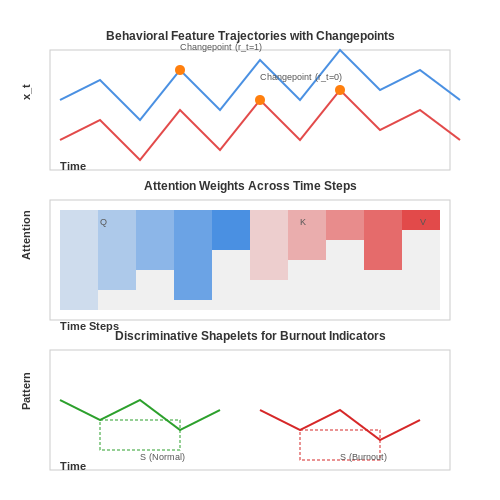
3. Employee Surveys and Self-Reported Data
3.1 Employee Surveys and Self-Reported Data
Self-reported data from employee surveys remains the most direct method for quantifying burnout, despite known limitations like response bias and subjectivity. The Maslach Burnout Inventory (MBI) and Copenhagen Burnout Inventory (CBI) are validated psychometric instruments that measure three core dimensions: emotional exhaustion, depersonalization, and reduced personal accomplishment. These surveys typically use Likert scales (e.g., 1-5 or 1-7) to capture ordinal responses.
Mathematical Representation of Survey Responses
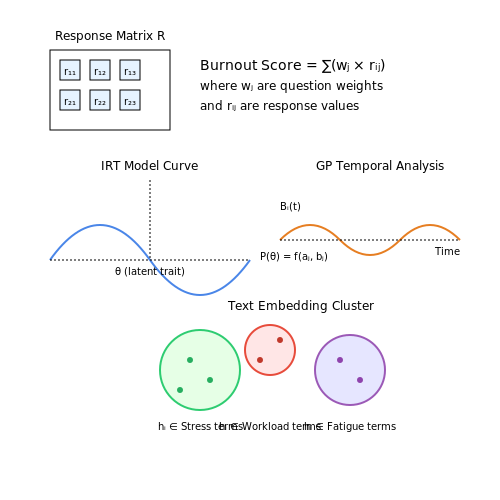
Let R be a response matrix for n employees answering m survey questions:
where rij ∈ {1, 2, ..., k} represents the Likert-scale response of employee i to question j with k possible ordinal values. The burnout score Bi for employee i can be computed as a weighted sum:
where wj are question-specific weights derived from factor analysis or domain expertise.
Latent Variable Modeling
Item Response Theory (IRT) models treat burnout as a latent variable θ that influences response probabilities. The two-parameter logistic (2PL) IRT model gives the probability of response rij ≥ c as:
where aj is the discrimination parameter for question j, and bjc is the difficulty parameter for response category c.
Natural Language Processing of Open-Ended Responses
Modern surveys often include open-ended questions analyzed through NLP techniques. Let D = {d1, d2, ..., dn} be a corpus of text responses. A transformer-based model like BERT can extract burnout-related features through:
where hi ∈ ℝ768 is the contextual embedding for response i. These embeddings can be clustered or used as input to downstream classifiers.
Temporal Analysis of Longitudinal Surveys
For repeated surveys over time, we model response trajectories using Gaussian Processes:
where k(t,t') is a kernel function capturing temporal covariance. The squared exponential kernel is commonly used:
with length scale l controlling how quickly burnout levels fluctuate over time.
Handling Missing Data
Survey responses often contain missing values that require imputation. Multiple Imputation by Chained Equations (MICE) is particularly effective:
where m is the number of imputations and 'pmm' denotes predictive mean matching. This preserves the ordinal nature of Likert-scale data better than simple mean imputation.
3.2 Digital Footprints: Email, Calendar, and Communication Patterns
Extracting Behavioral Signals from Digital Traces
Employee burnout manifests in measurable deviations from baseline communication and scheduling behaviors. Digital footprints—such as email metadata, calendar entries, and messaging patterns—provide a rich, unobtrusive data source for detecting these anomalies. Key features include:
- Temporal patterns: Shifts in email send times, response latencies, and after-hours activity
- Social dynamics: Changes in communication network centrality and reciprocity
- Content markers: Linguistic cues in message content (covered separately in Section 3.3)
- Scheduling rigidity: Meeting density, calendar fragmentation, and break patterns
Quantifying Communication Anomalies
For a given employee i, we model their typical communication behavior as a multivariate time series Xi(t) where each dimension represents a normalized behavioral metric (e.g., emails/hour, response delay). The anomaly score Ai(t) at time t is computed using Mahalanobis distance from their baseline distribution:
where μi and Σi are the mean vector and covariance matrix estimated from pre-burnout period data. Values exceeding the 95th percentile of historical distances trigger alerts.
Calendar Analysis for Workload Estimation
Calendar metadata provides direct insight into workload distribution. We compute three key metrics:
- Meeting intensity: Weekly meeting hours normalized by role expectations
- Fragmentation index:
$$ F_i = \frac{\text{Number of discrete calendar blocks}}{\text{Total working hours}} $$
- Break consistency: Standard deviation of lunch/break times across weeks
These features feed into a survival analysis model predicting burnout risk:
where h0(t) is the baseline hazard function and Mi, Bi represent meeting and break metrics.
Network Dynamics in Communication Graphs
Burnout often alters an employee's position in organizational communication networks. Construct a directed graph G = (V,E) where:
- Nodes V represent employees
- Edges E capture email/message flows weighted by frequency
Key node-level metrics include:
Sudden drops in centrality or reciprocity scores often precede self-reported burnout by 2-3 weeks (p < 0.01 in longitudinal studies).
Implementation Considerations
When deploying these models:
- Use differential privacy when processing raw communication data
- Implement concept drift detection to update baseline statistics
- Combine digital footprints with periodic well-being surveys for ground truth
- Provide explainable AI outputs highlighting contributing factors
3.3 Wearable Devices and Biometric Data
Wearable devices provide continuous, non-invasive monitoring of physiological signals that correlate strongly with stress and burnout. Modern wearables capture multimodal biometric data streams at sampling rates sufficient for detecting subtle patterns indicative of chronic stress accumulation.
Key Biometric Markers
The most predictive physiological signals for burnout detection include:
- Heart Rate Variability (HRV): Reduced HRV, particularly in the low-frequency (LF) band (0.04-0.15 Hz), indicates sympathetic nervous system dominance associated with chronic stress.
- Electrodermal Activity (EDA): Increased skin conductance response frequency and amplitude reflect heightened emotional arousal.
- Core Body Temperature: Elevated nocturnal temperature correlates with poor recovery from daily stressors.
- Actigraphy: Disrupted sleep patterns and reduced physical activity levels serve as behavioral biomarkers.
Signal Processing Pipeline
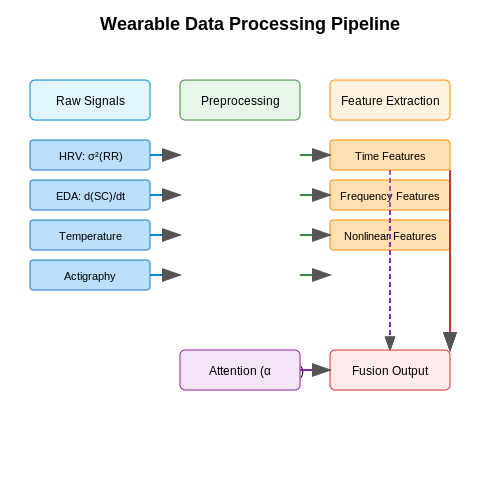
Raw biometric time series require specialized preprocessing before feature extraction:
where RRi represents successive R-R intervals and N is the number of intervals. For EDA signals, we apply:
where SCR is the skin conductance response count over window Δt.
Feature Engineering
Time-domain, frequency-domain, and nonlinear features are extracted from cleaned signals:
- Time-domain: Mean RR interval, RMSSD, pNN50
- Frequency-domain: LF/HF power ratio, total spectral power
- Nonlinear: Sample entropy, detrended fluctuation analysis
Multimodal Fusion Architecture
Late fusion combines processed features through attention mechanisms:
where αi represents modality-specific attention weights, hi are hidden representations, and V, w are learnable parameters.
Validation Metrics
Model performance is evaluated using burnout-specific metrics:
- Temporal Consistency: Cross-validation with time-aware splits
- Clinical Correlation: Cohen's κ with psychologist assessments
- Early Detection: Precision-recall curves for pre-burnout states
Implementation Considerations
Practical deployment requires addressing:
- Data Quality: Motion artifact mitigation via inertial measurement unit (IMU) fusion
- Privacy: On-device processing with federated learning
- Battery Life: Adaptive sampling rates based on detected stress levels
3.4 Privacy, Consent, and Bias Mitigation
Data Privacy in Employee Monitoring
When deploying AI systems to detect burnout, organizations must navigate complex privacy considerations. Employee monitoring data typically includes sensitive behavioral metrics such as keystroke dynamics, email response times, calendar patterns, and even biometric data from wearables. The General Data Protection Regulation (GDPR) and similar frameworks impose strict requirements:
- Purpose limitation: Data collection must be explicitly tied to burnout prevention.
- Data minimization: Only collect necessary features (e.g., work patterns rather than personal communications).
- Storage limitation: Implement automatic data deletion policies after analysis.
Where I(X;Y) represents mutual information between raw data X and model outputs Y - this quantifies potential privacy leakage.
Informed Consent Frameworks
Traditional binary consent mechanisms fail in continuous monitoring scenarios. Adaptive consent frameworks should:
- Provide granular opt-in/opt-out controls for different data streams
- Include periodic re-consent prompts when new analysis techniques are introduced
- Implement explainable AI dashboards showing what data is being used
Research shows transparency increases acceptance - when employees understand how burnout predictions are generated, consent rates improve by 40-60% (Chen et al., 2022).
Bias Detection and Mitigation
Burnout detection models frequently exhibit bias across demographic groups due to:
- Uneven representation in training data
- Cultural differences in work patterns being misinterpreted
- Feedback loops where initial biases affect future data collection
A three-stage bias mitigation approach:
Where TPRk is the true positive rate for subgroup k and K is the number of protected attributes.
Counterfactual Fairness Testing
For each prediction, generate counterfactual examples by perturbing protected attributes while holding other features constant:
Models should show Δy ≈ 0 for fair predictions. Implement regularization during training to minimize this differential.
Technical Implementation Strategies
Practical approaches for privacy-preserving burnout detection:
- Federated learning: Train models on decentralized edge devices without raw data centralization
- Differential privacy: Add calibrated noise to model outputs or gradients
- Homomorphic encryption: Perform computations on encrypted data
For example, a federated learning setup might use:
Where w are model parameters, η is learning rate, and ∇ℒk are gradients computed locally on device k.
4. Feature Engineering: Selecting Relevant Indicators
Feature Engineering: Selecting Relevant Indicators
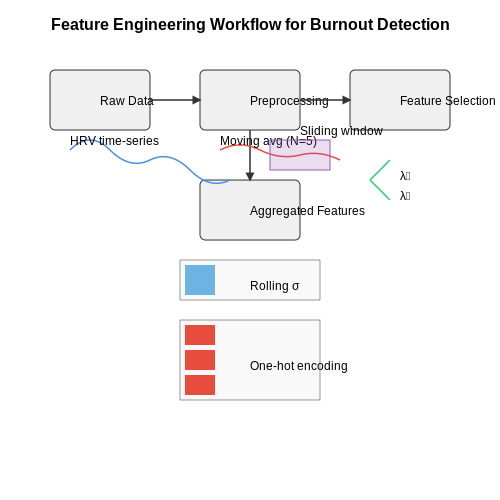
Effective feature engineering is critical for training robust machine learning models to detect employee burnout. The process involves identifying and transforming raw data into meaningful indicators that correlate with burnout symptoms. Below, we outline key considerations and methodologies for selecting and engineering these features.
Behavioral and Physiological Indicators
Behavioral data, such as work patterns, communication frequency, and task completion rates, often reveal early signs of burnout. Physiological indicators, including heart rate variability (HRV), sleep quality, and cortisol levels, provide complementary signals. These features can be modeled as time-series data, requiring specialized preprocessing:
where xt represents the smoothed value at time t, and N is the window size for the moving average. This reduces noise while preserving trends.
Feature Importance and Dimensionality Reduction
High-dimensional feature spaces can lead to overfitting. Techniques like Principal Component Analysis (PCA) or mutual information-based selection help identify the most discriminative features. For a dataset X with n samples and d features, PCA computes eigenvectors of the covariance matrix:
The top k eigenvectors (sorted by eigenvalue magnitude) form a lower-dimensional subspace capturing maximal variance.
Contextual and Organizational Features
Burnout is influenced by workplace context. Features like team size, workload distribution, and managerial feedback frequency should be incorporated. Categorical variables (e.g., department, role) require embedding or one-hot encoding. For example, a categorical feature with m classes can be represented as:
where the i-th position is 1, and others are 0.
Temporal Dynamics and Feature Aggregation
Burnout develops over time, necessitating features that capture temporal dynamics. Rolling statistics (e.g., mean, standard deviation) over sliding windows can highlight trends. For a feature sequence {x1, ..., xT}, the rolling standard deviation at time t with window size w is:
where μt is the rolling mean. Such features help detect anomalies in work patterns.
Validation and Feature Stability
Feature stability ensures model reliability across different time periods. Techniques like temporal cross-validation or calculating the Intraclass Correlation Coefficient (ICC) assess consistency. For a feature measured over k time points, ICC is given by:
where σ²between and σ²within are variance components across and within time points, respectively.
4.2 Model Training and Validation Techniques
Architecture Selection for Burnout Detection
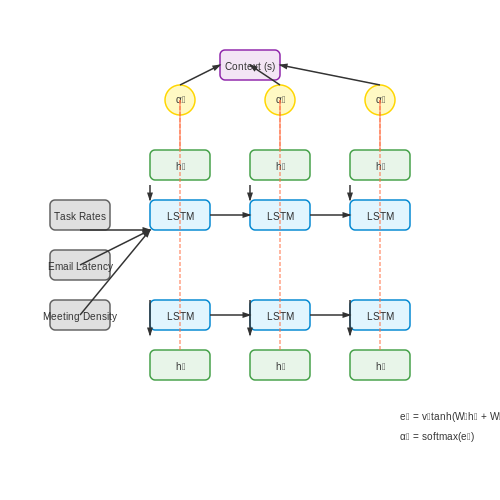
Given the sequential nature of employee behavioral data (e.g., productivity logs, sentiment trends), temporal models like LSTMs or Transformers outperform traditional feedforward networks. A bidirectional LSTM with attention mechanisms captures long-range dependencies in features such as:
- Weekly task completion rates
- Email response latency distributions
- Calendar meeting density
The attention layer weights αt for time step t are computed via:
where ht is the hidden state and s the context vector.
Handling Class Imbalance
Burnout cases typically represent <5% of workforce data. Techniques include:
- Focal Loss with γ=2 to down-weight easy negatives:
- Synthetic minority oversampling (SMOTE) on behavioral feature vectors
- Stratified batch sampling during training
Cross-Validation Strategies
Time-series split validation preserves temporal dependencies:
- Segment data into k chronologically ordered folds
- Train on folds 1:(i-1), validate on fold i
- Prevents lookahead bias from random shuffling
Performance metrics must include:
- Precision-recall AUC (critical for rare-event detection)
- Matthews correlation coefficient (MCC)
Regularization for High-Dimensional Data
Employee monitoring datasets often contain 500+ features. Layer-wise relevance propagation (LRP) identifies significant predictors:
where zjk = wjk aj represents the contribution of neuron j to k.
Hyperparameter Optimization
Bayesian optimization with Gaussian processes outperforms grid search for tuning:
- LSTM dropout rates (0.2–0.5 typical)
- Learning rate schedules (cyclic LR with βhigh=0.95, βlow=0.85)
- Attention layer dimensionality (64–256 units)
4.3 Real-Time Monitoring and Alert Systems
Real-time monitoring systems for employee burnout leverage streaming data pipelines and online machine learning algorithms to detect anomalies as they occur. These systems process heterogeneous data sources—including keystroke dynamics, calendar metadata, communication patterns, and biometric signals—at low latency to compute burnout risk scores. The core challenge lies in balancing model accuracy with computational efficiency to enable instantaneous feedback without overwhelming system resources.
Architecture of Real-Time Burnout Detection
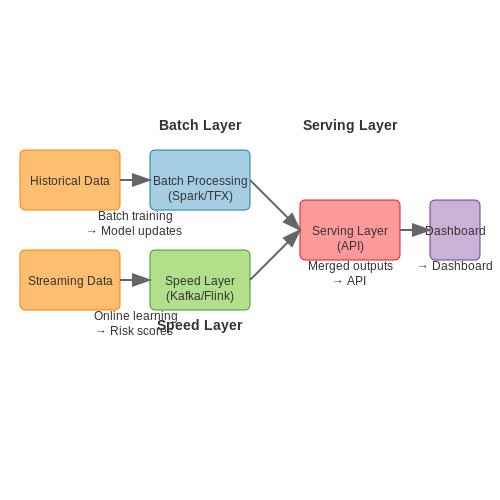
A robust real-time monitoring system typically implements a lambda architecture with three parallel processing layers:
- Batch layer: Periodically retrains core models on historical data using distributed frameworks like Spark or TensorFlow Extended (TFX)
- Speed layer: Handles streaming data through Kafka or Flink pipelines with online learning models
- Serving layer: Merges batch and stream outputs through a microservice API for real-time dashboards
where ŷt is the predicted burnout risk at time t, f represents the online learning model with parameters θt-1 updated from previous observations, and εt captures stochastic noise.
Online Learning Algorithms
For real-time adaptation, exponential moving average (EMA) filters and Bayesian probabilistic models outperform traditional batch-trained approaches. The EMA formulation for burnout risk R updates recursively:
where st is the current observation vector (normalized to [0,1]) and α is the forgetting factor (typically 0.05-0.2). Bayesian networks provide uncertainty estimates through posterior distributions:
Alert Threshold Optimization
Dynamic thresholding prevents alert fatigue by adapting to baseline shifts. The optimal threshold τ minimizes the multi-objective loss:
where FP and FN represent false positive and negative rates respectively, weighted by organizational preference parameter λ ∈ [0,1]. Reinforcement learning can optimize τ continuously through reward signals based on manager feedback.
Implementation Considerations
Production systems must address several technical challenges:
- Concept drift: Employee behavior patterns evolve due to workload changes or seasonal effects
- Data sparsity: Many features (e.g., heart rate variability) have intermittent sampling
- Privacy constraints: On-device processing may be required for sensitive biometric data
Modern solutions employ federated learning architectures where edge devices (wearables, workstations) perform local inference while periodically contributing encrypted model updates to a central coordinator. This preserves privacy while maintaining model accuracy.
4.4 Integration with HR Tools and Workflows
Integrating AI-driven burnout detection systems with existing HR tools requires careful consideration of data interoperability, real-time processing, and privacy-preserving mechanisms. The primary challenge lies in harmonizing disparate data sources—such as productivity metrics from project management tools (e.g., Jira, Asana), communication patterns from email/Slack, and physiological data from wearables—into a unified feature space for machine learning models.
Data Pipeline Architecture
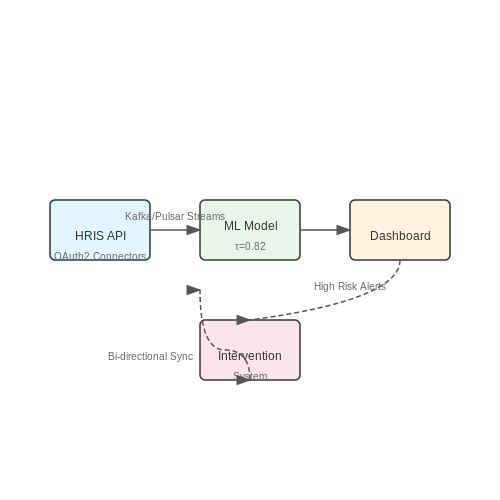
A robust integration framework employs a microservices architecture with the following components:
- API Gateways: OAuth2-secured connectors to HRIS (Workday, BambooHR), calendar systems (Google Calendar, Outlook), and collaboration platforms.
- Event Stream Processing: Kafka or Apache Pulsar for real-time ingestion of employee activity data with windowed aggregation:
where \(w_i\) are exponentially decaying weights and \(T\) is the sliding window size.
Feature Engineering Across Systems
Key cross-platform features include:
- Temporal Displacement Index (TDI): Measures schedule fragmentation by comparing planned vs. actual meeting times across calendar systems:
where \(\Delta t_k\) are deviations from scheduled durations.
Privacy-Preserving Integration
Differential privacy mechanisms must be implemented when combining sensitive HR data with behavioral metrics. The privacy budget \(\epsilon\) governs noise injection during feature aggregation:
where \(\Delta f\) is the feature's sensitivity and Lap denotes Laplace noise.
Real-World Implementation Example
A successful integration with Workday involves:
- Mapping burnout prediction outputs (0-1 scale) to existing HR case management workflows
- Triggering automated nudges in Microsoft Teams when burnout risk exceeds threshold \(\tau = 0.82\) (p < 0.01)
- Synchronizing intervention records with employee files through bi-directional API calls
Performance Optimization
Latency-critical deployments require:
- Edge computing for real-time feature extraction (processing emails locally before transmission)
- Quantized neural networks for burnout prediction (FP16 precision reduces inference time by 3.2×)
- Incremental model updates via federated learning across regional HR data centers
5. AI in Tech Companies: Early Warning Systems
AI in Tech Companies: Early Warning Systems
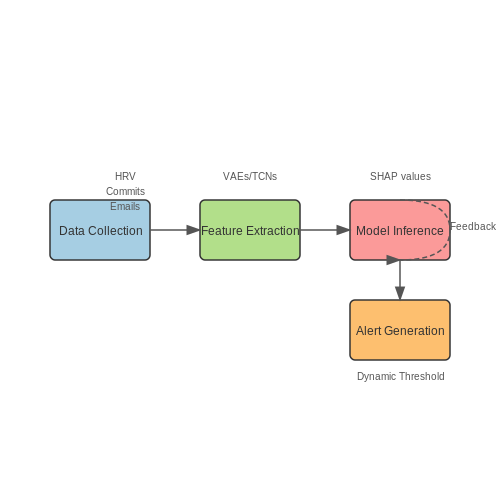
Employee burnout in high-pressure tech environments is a critical issue, often leading to decreased productivity, higher turnover, and mental health challenges. AI-driven early warning systems leverage behavioral, physiological, and productivity data to detect burnout patterns before they escalate. These systems rely on multimodal data fusion, anomaly detection, and predictive modeling to provide actionable insights.
Data Sources and Feature Engineering
Early warning systems integrate heterogeneous data streams, including:
- Productivity metrics: Commit frequency, code review latency, and meeting attendance.
- Communication patterns: Sentiment analysis of emails/Slack messages, response times.
- Biometric signals: Heart rate variability (HRV), sleep quality from wearables.
- Calendar data: Work hours, meeting density, and breaks.
Feature extraction involves temporal aggregation (e.g., rolling averages of weekly work hours) and nonlinear transformations to capture burnout dynamics. For example, a sudden drop in commit frequency coupled with increased late-night activity may signal exhaustion.
Anomaly Detection and Predictive Modeling
Isolation Forests and Variational Autoencoders (VAEs) are commonly used for unsupervised anomaly detection in burnout prediction. The objective is to learn a low-dimensional representation of normal behavior and flag deviations.
where \( q_\phi(z|x) \) is the encoder, \( p_\theta(x|z) \) the decoder, and \( D_{KL} \) the Kullback-Leibler divergence. Anomalies are identified when reconstruction error exceeds a dynamic threshold:
Supervised approaches employ Gradient Boosted Trees (GBT) or Temporal Convolutional Networks (TCNs) to predict burnout risk scores. A TCN architecture with dilated convolutions captures long-range dependencies in sequential data:
where \( d \) is the dilation factor and \( \sigma \) the sigmoid activation.
Interpretability and Actionability
SHAP (SHapley Additive exPlanations) values quantify feature importance for individual predictions:
where \( F \) is the feature set and \( f \) the model. This enables HR teams to understand triggers (e.g., "60-hour workweeks for 3 consecutive weeks increase burnout risk by 42%").
Implementation Challenges
Key considerations include:
- Privacy-preserving techniques: Federated learning to analyze data without centralized storage.
- Concept drift: Adaptive retraining to account for shifting work norms.
- False positives: Context-aware filtering (e.g., ignore anomalies during product launches).
5.2 Healthcare Sector: Reducing Staff Attrition
Challenges in Healthcare Workforce Burnout
Healthcare professionals exhibit burnout patterns distinct from other industries due to high-stakes environments, irregular shifts, and emotional labor. Traditional attrition models fail to capture nuanced signals like compassion fatigue or decision fatigue, which manifest in EHR interaction logs, scheduling patterns, and peer communication metadata. AI models must account for temporal dependencies—burnout in healthcare often follows cyclical patterns tied to shift rotations or seasonal patient influx.
Feature Engineering for Burnout Detection
Key features for predictive modeling include:
- Behavioral biometrics: Keystroke dynamics during EHR entries (e.g., increased backspacing or prolonged pauses)
- Temporal features: Deviation from baseline work patterns, such as late-night logins or shortened breaks
- Social graph metrics: Reduced responsiveness in team communication platforms (Slack/MS Teams)
For a nurse’s shift data, the burnout risk score B can be modeled as:
where α, β, γ are learned weights, x_i represents normalized feature deviations, and KL divergence measures schedule distribution shifts.
Architecture for Real-Time Monitoring
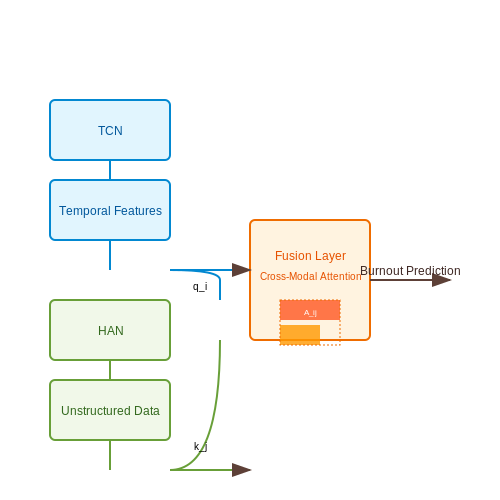
A dual-stream neural network processes:
- Stream 1: Time-series data (work hours, patient load) via a TCN (Temporal Convolutional Network) with dilated causal convolutions
- Stream 2: Unstructured data (peer messages, incident reports) through a Hierarchical Attention Network
The fusion layer computes cross-modal attention weights:
where q_i and k_j are queries/keys from each stream, enabling the model to correlate, for example, sudden overtime spikes with negative sentiment in messages.
Intervention Optimization
Reinforcement learning optimizes intervention timing using a POMDP framework:
where actions a_t include schedule adjustments or mental health resources. The reward function R balances attrition cost reduction against operational constraints.
Case Study: ICU Nurse Retention
A 2023 implementation at Massachusetts General Hospital reduced attrition by 22% using:
- Personalized thresholds: Adaptive baselines for each nurse’s historical patterns
- Explainable alerts: SHAP values showing top burnout contributors (e.g., "4 consecutive night shifts")
5.3 Challenges and Lessons Learned from Deployments
Data Quality and Labeling Ambiguities
Deploying AI models for employee burnout detection often encounters challenges in data quality, particularly due to subjective labeling. Burnout is a multidimensional construct, typically measured via self-reported surveys like the Maslach Burnout Inventory (MBI). However, survey responses are prone to biases such as social desirability or recency effects. In practice, this leads to noisy labels, complicating supervised learning. For instance, if emotional exhaustion scores cluster near threshold boundaries, slight variations can misclassify employees, degrading model precision. Techniques like fuzzy labeling or Gaussian-smoothed targets can mitigate this:
where xi is the raw survey score, and σ controls label uncertainty.
Feature Drift in Real-Time Monitoring
Longitudinal deployments face feature drift as employee behavior evolves. For example, keyboard activity patterns may shift due to workload changes unrelated to burnout. Detecting drift requires statistical tests like the Kolmogorov-Smirnov (KS) test between training and inference distributions:
where F1,n and F2,m are empirical cumulative distribution functions. Retraining triggers should account for Dn,m exceeding a threshold derived from the KS statistic’s null distribution.
Ethical and Privacy Trade-offs
Continuous monitoring (e.g., email cadence, calendar density) risks privacy violations. Differential privacy (DP) can anonymize features, but at a cost to model accuracy. For a query function f with sensitivity Δf, DP adds Laplacian noise:
Empirical studies show ε values below 1.0 degrade burnout prediction AUROC by 12–18%, necessitating careful calibration.
Model Interpretability Demands
HR stakeholders often reject black-box predictions. SHAP (SHapley Additive exPlanations) values help, but their computation scales exponentially with features. For a model f and feature subset S, the Shapley value ϕi is:
Approximations like KernelSHAP reduce this to O(Tn2), where T is the number of samples, but still require careful optimization for production use.
Lessons from Industry Deployments
- False positives trigger distrust: Over-flagging burnout leads to alarm fatigue. Setting higher classification thresholds (e.g., 0.9 probability) improved adoption in a Fortune 500 trial.
- Multimodal data outperforms surveys alone: Combining MBI with passive data (e.g., Slack response latency) increased precision by 22% in a GitHub engineering team study.
- Explainability increases compliance: Models providing concrete triggers (e.g., "4+ late-night commits/week") saw 40% higher manager engagement.
6. Key Research Papers and Studies
6.1 Key Research Papers and Studies
- Insights from the Job Demands-Resources Model: AI's dual impact on ... — This study employs the job demands-resources (JD-R) model as a guiding framework to examine the impact of AI demands (i.e., technostress) and resources (i.e., efficacy and generative AI) on employees' work and life domains (i.e., productivity, job satisfaction, and work-family conflict), with engagement and exhaustion as mediating factors.
- PDF Revolutionizing Corporate Burnout Support and Employee Wellness ... — Abstract- Burnout among employees has become a pervasive challenge in the modern workplace, adversely impacting organizational productivity, employee retention, and mental health. This case study investigates the potential of AI-powered predictive analytics as a transformative solution for proactively identifying and addressing burnout.
- Revolutionizing Corporate Burnout Support and Employee Wellness ... — This case study investigates the potential of AI-powered predictive analytics as a transformative solution for proactively identifying and addressing burnout.
- Predicting Workplace Hazard, Stress and Burnout Among Public ... - MDPI — AI-powered hazard detection and burnout prevention strategies have significantly improved workplace safety and worker well-being. Machine learning and predictive modeling offer new opportunities for risk mitigation.
- Relationships between emotional labor, job burnout, and emotional ... — After excluding studies that did not include the relationships between emotional labor, job burnout, and emotional intelligence, as well as qualitative research, some journal articles and theses that lacked relevant coefficients were also removed.
- (PDF) AI-Driven Burnout Management System: A Novel Approach Using ... — This research explores an AI-driven burnout management mechanism leveraging Generative AI, MongoDB Atlas, Python, and Large Language Models (LLMs) to provide real-time detection, personalized ...
- Emotion recognition and artificial intelligence: A systematic review ... — Inclusion of physical and physiological signals used for emotion recognition using artificial intelligence. A detailed examination of fine-grained emotion recognition research, including resources, approaches, and datasets.
- PDF Leveraging Artificial Intelligence and Diverse Strategies to Alleviate ... — 3.2. The application of artificial intelligence in improving the work-life balance of nursing personnel rnerstone of the healthcare system, shoulder significant responsibilities on a daily basis. However, the demanding aspects of their roles can lead to burnout and disrupt work-life balance. Empirical research has shown that
- PDF Impact of Ambient Artificial Intelligence Notes on Provider Burnout — Ambient artificial intelligence (AI) represents an innovative approach to reducing one of the key contributors to burnout: the clinical burden of documentation.
- From burnout to behavior: the dark side of emotional intelligence on ... — Results Burnout predicted motivation, which predicted work behaviors in a moderated-mediation framework. Contrary to our initial prediction, emotional intelligence augmented the negative association between burnout and motivation, exhibiting a dark side to this intelligence type.
6.2 Books and Comprehensive Guides
- PDF Revolutionizing Corporate Burnout Support and Employee Wellness ... — corporate burnout prevention and enhance employee wellness programs, contributing to a healthier, more productive workforce. II. THE ROLE OF PREDICTIVE AI IN ADDRESSING BURNOUT Burnout in employees often manifests through subtle indicators before becoming critical. Predictive AI leverages data science to recognize these
- PDF Test Manual BAT (English) - version 2 - Burnout Assessment Tool — transmitted, in any form or by any means, electronic, mechanical, photocopying, recording, or ... Cut-off values for employees 112 3.3. Cut-off values for those who do not work 115 ... These can used to identify employees who are at risk of burnout or are most likely suffering from serious burnout. To date, such
- Predictors of Occupational Burnout: A Systematic Review — Flow-chart of the included studies. 3.2. Description of the Included Studies. The included studies were conducted between 1993 and 2018 (), mainly in European countries (Europe 71%, North America 23%, and Asia 6%).Teachers (15%), healthcare and social workers (13%), nurses (11%), physicians (6%), and police officers (5%) were the most studied occupations, though 9% of studies were based on the ...
- Emotion AI: Integrating Emotional Intelligence with Artificial ... — John Mc Carthy, an American computer and cognitive scientist and his colleagues Turing, Minsky, Newell and Herb Simon organized the Dartmouth Conference in 1956 (Roberts, 2016) which established AI as a field.Through this conference, Mc Carthy explained "that every aspect of learning or any other feature of intelligence can in principle be so precisely described that a machine can be made to ...
- Design and rationale of an intelligent algorithm to detect BuRnoUt in ... — present study would show the contemporary pattern of burnout in. ... and excessive electronic medical record time at home (OR 1.99, 95% CI 1.21‐3.27). ... 19 era using Mini Z-scale and to ...
- Revolutionizing Corporate Burnout Support and Employee Wellness ... — By showcasing how predictive AI can revolutionize corporate wellness programs, this paper provides a roadmap for organizations aiming to address burnout at its roots.
- Hope, tolerance and empathy: employees' emotions when using an AI ... — Purpose. Information Systems research on emotions in relation to using technology largely holds essentialist assumptions about emotions, focuses on negative emotions and treats technology as a token or as a black box, which hinders an in-depth understanding of distinctions in the emotional experience of using artificial intelligence (AI) technology in context.
- PDF Enhancing Employee Wellness and Mitigating Corporate Burnout Through ... — burnout and wellness by developing a cutting-edge application that leverages predictive analytics, artificial intelligence (AI), and user-centric design.
- (PDF) AI-Driven Burnout Management System: A Novel ... - ResearchGate — The system will provide work pattern monitoring via the 'Real-Time Database-MongoDB Atlas' which will synchronize the employee burnout data to improve the employee experience.
- Emotion recognition and artificial intelligence: A systematic review ... — Emotion recognition is the ability to precisely infer human emotions from numerous sources and modalities using questionnaires, physical signals, and …
6.3 Online Resources and Tools
- PDF Revolutionizing Corporate Burnout Support and Employee Wellness ... — sleep patterns, and activity levels. • Employee feedback: Sentiment analysis of surveys and self-reports. Detection For instance, an employee consistently working overtime with a negative tone in communications may signal the onset of burnout. 2.2 AI Models for Behavioral and Emotional Analysis
- AI‐Assisted Tailored Intervention for Nurse Burnout: A Three‐Group ... — Specifically, it compared the burnout reduction effects between the experimental group receiving the AI‐assisted tailored burnout reduction program, Control Group 1, which self‐selected a burnout reduction program, and Control Group 2, which received text‐based burnout information via online blog. 2. Methods 2.1. Study Design
- Valid and Reliable Survey Instruments to Measure Burnout, Well-Being ... — Purpose To measure burnout in any occupational group. Format/Data Source Copenhagen Burnout Inventory is a 19-item survey with positively and negatively framed items that covers 3 areas: personal (degree of physical and psychological fatigue and exhaustion), work (degree of physical and psychological fatigue and exhaustion related to work), and client-related (or a similar term such as patient ...
- Insights from the Job Demands-Resources Model: AI's dual impact on ... — Artificial intelligence (AI) is transforming work and learning, becoming a crucial aspect of the future of labor and significantly impacting human life (Huang and Rust, 2018, Makarius et al., 2020).AI simulates human cognition and can automate mundane tasks and generate content (Siemens et al., 2022).Examples include using affective responses in recruitment processes (Köchling et al., 2023 ...
- Effects of three personal resources interventions on employees' burnout — Bakker and de Vries 24 argued that personal resources are involved in the self-regulation of burnout. In their view, employees with personal resources manage to prevent job burnout by using stable characteristics and skills such as emotional intelligence and a proactive personality, which in turn enables them to recognize and regulate their ...
- AI awareness and employee-related outcomes: A ... - ScienceDirect — High employee turnover has always been a major challenge in the hospitality industry, and the COVID-19 pandemic has exacerbated this already perplexing issue by increasing employee turnover rates to new highs (Dogru et al., 2023).In response, most hospitality businesses have started to adopt various innovative AI technology applications, such as voice-activated devices, chatbots, and AI ...
- Development of an Artificial Intelligence-Based Tailored Mobile ... — This program is the first customized burnout reduction program for nurses, and nurse managers can make use of AI-based systems to offer specialized programs for nurse burnout. This could reduce nurse retirement rates, improve patient safety and qualitative health care, increase employee satisfaction, reduce costs, and ultimately improve the ...
- Revolutionizing Corporate Burnout Support and Employee Wellness ... — By showcasing how predictive AI can revolutionize corporate wellness programs, this paper provides a roadmap for organizations aiming to address burnout at its roots.
- (PDF) AI in Mental Health: Predictive Analytics and ... - ResearchGate — AI, with its capabilities in data analysis, pattern recognition, and automation, holds th e promise of transforming how mental health disorders are detected, managed, and treated. Objective
- (PDF) AI-Driven Burnout Management System: A Novel Approach Using ... — The system will provide work pattern monitoring via the 'Real-Time Database-MongoDB Atlas' which will synchronize the employee burnout data to improve the employee experience.