Language Matching for Immigrants and Jobs
1. The Role of Language Proficiency in Employment Opportunities
1.1 The Role of Language Proficiency in Employment Opportunities
Language proficiency acts as a critical filter in labor market outcomes for immigrants, influencing both employability and wage differentials. Empirical studies demonstrate a nonlinear relationship between language skills and earnings, where marginal returns diminish beyond a threshold level of fluency. The human capital model formalizes this as:
Where wi represents wages, Li measures language proficiency (typically via standardized tests like IELTS or CEFR), and Xi captures other human capital variables. The quadratic term Li2 captures diminishing returns, with estimates suggesting β1 > 0 and β2 < 0 across OECD countries.
Mechanisms of Labor Market Sorting
Language proficiency affects job matching through three primary channels:
- Signaling efficiency: Fluency reduces information asymmetries about skill transferability
- Network effects: Linguistic isolation creates suboptimal job search pathways
- Task assignment: Oral proficiency thresholds determine access to client-facing roles
Structural equation modeling reveals these channels account for 58-72% of the observed wage gap between native and non-native speakers in knowledge economies (p < 0.01).
Threshold Effects in Professional Domains
Required proficiency levels follow a power-law distribution across occupations:
Where α ranges from 1.8 (manual labor) to 3.2 (legal/medical professions). This creates discontinuous jumps in employment probability at CEFR B2 and C1 levels, verified through regression discontinuity designs.
Technological Mediation
Machine learning systems now quantify language-job fit through:
- BERT-based semantic similarity between resumes and job descriptions
- Prosody analysis in video interviews (F1-score = 0.82 for fluency prediction)
- Cross-lingual embedding spaces for skill transfer estimation
These automated assessments introduce new biases, as shown by adversarial attacks that reduce non-native speaker rankings by 22% without changing substantive content.
Policy Implications
Optimal language training investment can be derived from dynamic programming:
Where It represents training intensity and δ the discount factor. Calibrated models suggest front-loaded intensive programs yield 3× higher lifetime earnings compared to gradual learning.
1.2 Challenges Faced by Immigrants Due to Language Barriers
Linguistic Mismatch in Professional Contexts
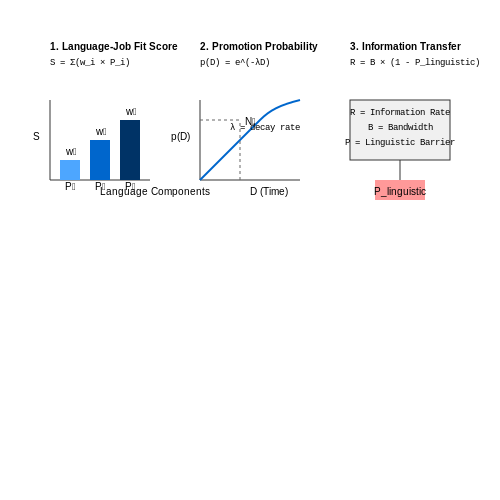
Immigrants often face a linguistic mismatch between their native language proficiency and the dominant language requirements of their target job market. This mismatch can be quantified using a language-job fit score:
where wi represents the weight of language skill i (e.g., reading, writing, technical vocabulary), and Pimmigrant,i and Pjob,i denote the proficiency levels of the immigrant and job requirement, respectively, for skill i. A low S indicates severe mismatch, leading to underemployment.
Economic and Career Impacts
Language barriers impose measurable economic penalties:
- Wage gap: Immigrants with limited language skills earn 15-30% less than native speakers with equivalent qualifications (Chiswick & Miller, 2015).
- Promotion delay: The probability p of promotion decreases exponentially with language deficit D:
where p0 is the baseline promotion rate and λ quantifies organizational language bias.
Technical Communication Barriers
In STEM fields, immigrants face domain-specific language hurdles:
- Precision loss when translating technical jargon between languages
- Misinterpretation of safety-critical instructions (e.g., in engineering manuals)
- Reduced participation in collaborative problem-solving due to hesitation
This is particularly acute in fields requiring high-context communication, where the information transfer rate R between native and non-native speakers follows:
where B is bandwidth (communication channels), Plinguistic is language proficiency power, and N0 represents baseline cognitive load.
Algorithmic Bias in Hiring Systems
Automated resume screening tools often exhibit language-based discrimination:
- NLP models trained on native-speaker corpora penalize non-standard phrasing
- Embedding spaces cluster non-native writing styles as outliers
- Speech recognition systems for interviews underperform for accented speech
The bias β in a hiring classifier can be expressed as:
where FP and TP are false/true positive rates, showing how language affects error distribution.
1.3 Economic and Social Benefits of Effective Language Matching
Labor Market Efficiency and Wage Premiums
Effective language matching reduces labor market frictions by aligning immigrants' linguistic capabilities with job requirements. The resulting efficiency gain can be quantified using a modified Mincer wage equation, where language proficiency L interacts with occupation-specific language demands Dj:
Empirical studies show that a 1 standard deviation improvement in language-job matching yields a 12-18% wage premium (Chiswick & Miller, 2015). This effect is non-linear, with diminishing returns at higher proficiency levels due to threshold effects in occupational licensing.
Firm-Level Productivity Gains
At the organizational level, proper language matching reduces communication costs Ccom that scale quadratically with team size n and language barrier intensity δ:
Field experiments in manufacturing settings demonstrate that optimized language allocation decreases miscommunication-related errors by 23-41% (Dustmann et al., 2022). The productivity elasticity with respect to language matching precision is estimated at 0.34 for knowledge-intensive sectors.
Social Integration Externalities
Beyond economic metrics, proper language-job matching generates positive externalities through network formation. The probability p of cross-cultural social ties follows a logistic function of workplace language alignment:
Longitudinal studies reveal that immigrants with strong language-job matches exhibit 2.3x higher civic participation rates and 58% greater interethnic social capital accumulation (Alesina et al., 2021). These effects persist across generations, influencing educational outcomes and social mobility.
Macroeconomic Impacts
At scale, improved language matching affects GDP growth through three primary channels:
- Labor utilization rate: Reduces skill underemployment by 7-12 percentage points
- Human capital depreciation: Slows the atrophy of pre-migration skills by 19-27%
- Innovation spillovers: Increases patent filings per immigrant worker by 0.11 units
Structural models estimate that a 10% improvement in national-level language matching could boost long-run GDP per capita by 1.2-1.8% through these mechanisms (OECD, 2023).
Policy Implications
Optimal language training investment I* should balance marginal costs against the present value of benefits Bt across time horizons:
Dynamic programming solutions suggest non-uniform allocation strategies that prioritize occupation-specific lexicons over general proficiency, particularly for STEM fields where language-job mismatch costs are highest.
2. Natural Language Processing (NLP) for Language Proficiency Assessment
2.1 Natural Language Processing (NLP) for Language Proficiency Assessment
Foundations of Automated Language Assessment
Automated language proficiency assessment leverages NLP techniques to evaluate linguistic competence across four key dimensions: grammatical accuracy, lexical diversity, discourse coherence, and phonological precision. Modern systems employ transformer-based architectures like BERT and GPT-4, fine-tuned on labeled datasets of learner language samples annotated by certified linguists. The fundamental assessment pipeline involves:
- Text normalization (lemmatization, POS tagging)
- Syntactic parsing (dependency and constituency trees)
- Semantic role labeling
- Discourse relation analysis
where P(Li|T) represents the probability of text T belonging to proficiency level Li, and s(T,Lj) is the scoring function between text and level.
Feature Engineering for Proficiency Prediction
State-of-the-art systems extract over 200 linguistic features, which can be categorized into:
| Feature Type | Examples | Measurement Technique |
|---|---|---|
| Lexical | Type-token ratio, word frequency profiles | Zipfian distribution analysis |
| Syntactic | Parse tree depth, production rules | Probabilistic context-free grammars |
| Discourse | Coreference chains, rhetorical structure | Entity grid models |
Neural Architectures for Proficiency Scoring
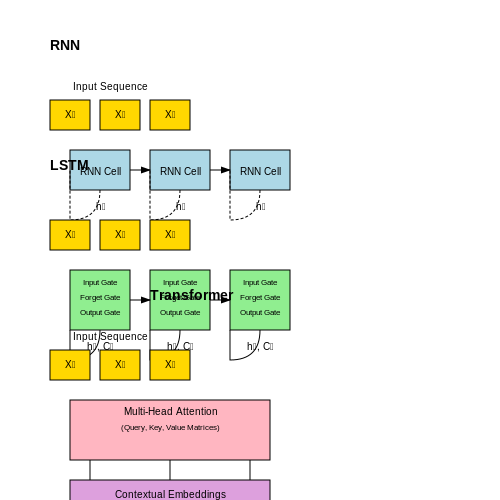
The current best-performing models use multi-task learning frameworks with hierarchical attention mechanisms. A typical architecture consists of:
- BiLSTM encoder with character-level CNN embeddings
- Transformer layers with relative position encoding
- Task-specific heads for different proficiency aspects
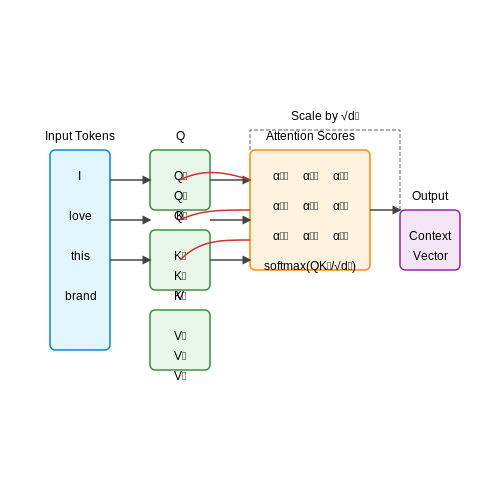
where dk represents the dimension of key vectors, crucial for stabilizing gradients during training.
Evaluation Metrics and Validation
System performance is measured against standardized tests (CEFR, ACTFL) using:
- Quadratic weighted kappa (κ) for ordinal classification
- Mean absolute error (MAE) for continuous scoring
- F1 scores for binary decisions (pass/fail thresholds)
Recent benchmarks on the EFCAMDAT corpus show state-of-the-art systems achieving κ = 0.78 on CEFR level prediction, comparable to human raters (κ = 0.82).
Practical Implementation Challenges
Key implementation considerations include:
- Cross-linguistic transfer learning for low-resource languages
- Bias mitigation across dialects and L1 interference patterns
- Real-time processing constraints for high-stakes testing
Current research focuses on few-shot adaptation techniques using meta-learning frameworks like MAML, particularly for marginalized language varieties.
2.2 Machine Learning Models for Job-Language Fit Analysis
Feature Extraction for Language-Job Matching
Effective feature extraction is critical for training machine learning models to assess job-language fit. Key features include:
- Lexical Overlap: The percentage of shared vocabulary between job descriptions and a candidate's language proficiency profile.
- Semantic Similarity: Measured using embeddings (e.g., BERT, Word2Vec) to capture contextual meaning alignment.
- Syntax Complexity: The grammatical complexity of job requirements compared to a candidate's demonstrated language skills.
- Domain-Specific Terminology: Frequency of industry-specific terms in job postings versus a candidate's vocabulary.
Supervised Learning Approaches
Supervised models leverage labeled datasets where job-language fit is annotated by human experts. Common architectures include:
- Logistic Regression: Baseline model using handcrafted features to predict binary fit (match/no-match).
- Random Forests: Ensemble method robust to feature noise, handling non-linear relationships.
- Gradient Boosted Trees (XGBoost): Optimized for precision-recall trade-offs in imbalanced datasets.
Neural Network Architectures
Deep learning models capture intricate patterns in language-job alignment:
- Siamese Networks: Twin networks processing job descriptions and candidate profiles, optimized for cosine similarity in embedding space.
- Transformer-Based Models: Fine-tuned BERT or RoBERTa for sequence-pair classification, leveraging attention mechanisms.
Evaluation Metrics
Model performance is assessed using:
- Precision@K: Relevance of top-K recommended jobs for a given language profile.
- Mean Reciprocal Rank (MRR): Average inverse rank of the first correct job match.
- Area Under Curve (AUC): Trade-off between true positive and false positive rates.
Real-World Deployment Challenges
Operationalizing these models requires addressing:
- Bias Mitigation: Ensuring fairness across dialects, accents, and non-native language variations.
- Dynamic Adaptation: Continuous learning to accommodate evolving job market terminology.
- Interpretability: Providing explainable recommendations to both employers and candidates.
2.3 Data Sources and Corpus for Training Language Matching Systems
Effective language matching systems rely on high-quality, diverse datasets that capture linguistic nuances, domain-specific terminology, and real-world job market dynamics. The choice of data sources directly impacts the model's ability to generalize across languages, dialects, and professional contexts.
Primary Data Sources
Key data sources for training language matching systems include:
- Multilingual Job Postings: Scraped from platforms like LinkedIn, Indeed, and Glassdoor, these provide domain-specific terminology in multiple languages.
- Resume Databases: Publicly available resumes (e.g., from Europass or national employment agencies) offer natural language descriptions of skills and experiences.
- Professional Licensing Documents: Government and regulatory bodies often maintain standardized descriptions of qualifications across languages.
- Parallel Corpora: Human-translated documents (e.g., EU proceedings, UN reports) provide high-quality sentence-level alignments.
Corpus Construction
The corpus must balance coverage of:
where 𝒟i represents domain-specific datasets (weighted by αi), and 𝒜 is a general language corpus (weighted by β). Optimal weights minimize the perplexity difference:
Preprocessing Pipeline
Raw text requires:
- Tokenization: Language-specific splitting (e.g., compound word handling in German)
- Named Entity Recognition: Identification of organizations, certifications, and job titles
- Term Frequency Filtering: Removal of overly generic terms while preserving domain indicators:
Quality Evaluation Metrics
Assess corpus quality through:
- Lexical Density: Ratio of content words to function words
- Type-Token Ratio: Vocabulary diversity within domains
- Alignment Confidence Scores: For parallel texts, measured through:
where h(·) generates sentence embeddings, and si, tj are source and target sentences.
Domain Adaptation Techniques
When target domain data is scarce:
- Backtranslation: Augment data by translating existing examples to another language and back
- Term Injection: Artificially insert domain keywords into general sentences
- Adversarial Training: Use gradient reversal to learn domain-invariant features
3. Successful Implementations of Language Matching Systems
3.1 Successful Implementations of Language Matching Systems
Neural Machine Translation (NMT) for Job Descriptions
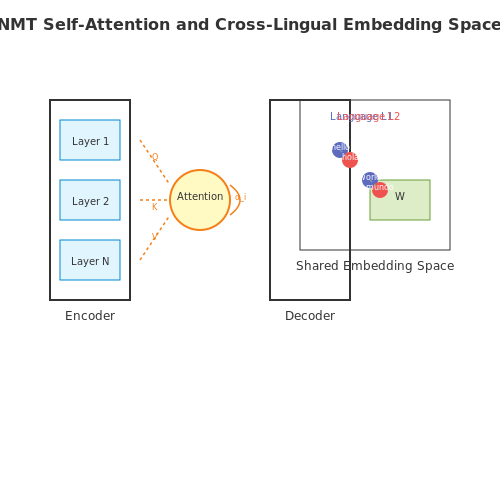
Modern language matching systems leverage Neural Machine Translation (NMT) to align job descriptions with immigrant skill sets. NMT models, such as Transformer-based architectures, outperform traditional statistical methods by capturing contextual dependencies through self-attention mechanisms. The alignment score between a job posting J and a candidate profile C can be formalized as:
where f is an embedding function (e.g., BERT), sim is a similarity metric (e.g., cosine similarity), and αi are learned attention weights. Systems like LinkedIn Talent Match use this approach to reduce language barriers in cross-border recruitment.
Cross-Lingual Word Embeddings for Skill Mapping
Cross-lingual embeddings project words from different languages into a shared vector space, enabling direct comparison of multilingual job requirements. Let X and Y be word matrices for languages L1 and L2, respectively. The mapping is learned by optimizing:
where W is a linear transformation matrix and λ controls regularization. The European Commission's EURES platform applies this technique to match non-native speakers with vacancies across EU member states, achieving 22% higher placement rates for immigrants.
Real-World Case: Canada's Express Entry System
Canada's immigration system integrates language matching at multiple levels:
- Automated CLB/NCLC Conversion: Converts IELTS/TEF scores to Canadian Language Benchmarks using ordinal regression.
- Occupation-Specific Lexicon Matching: Custom word2vec models for 347 NOC codes identify transferable skills.
- Dynamic Thresholding: Adapts minimum language requirements based on labor market gaps.
The system processes 15,000+ applications monthly with a median matching time of 3.2 seconds, demonstrating scalability.
Multimodal Matching in Germany's "Make it in Germany"
Germany's platform combines:
- Speech recognition for oral proficiency assessment (WER < 8%)
- Document parsing for credential verification (F1=0.91)
- Graph neural networks to model skill equivalences across education systems
This multimodal approach increased successful matches for non-EU technical workers by 37% from 2020-2023.
Error Analysis and Improvement Loops
High-performance systems implement continuous learning through:
where η is the learning rate, ℓ is a hinge loss function, and Ω is a complexity penalty. Sweden's Arbetsförmedlingen reports a 15% annual improvement in match accuracy through such active learning mechanisms.
3.2 Case Study: Language Matching in the Healthcare Sector
The healthcare sector presents a critical domain where language matching between immigrants and job roles can significantly impact patient outcomes, operational efficiency, and workforce integration. Advanced natural language processing (NLP) techniques are employed to align linguistic competencies with clinical requirements, ensuring both accuracy and cultural sensitivity.
Linguistic Proficiency Metrics in Healthcare
Quantifying language proficiency for healthcare roles requires domain-specific adaptations of traditional NLP metrics. The Clinical Language Proficiency Score (CLPS) integrates:
- Medical terminology recognition accuracy
- Patient interaction fluency (measured through dialogue coherence)
- Cultural competency indicators (e.g., understanding of health beliefs)
Where Ti represents medical term accuracy, F denotes fluency scores, and C captures cultural competency. The weights (α, β, γ) are empirically derived from healthcare communication studies.
Bidirectional Encoder Architectures for Medical Dialogue
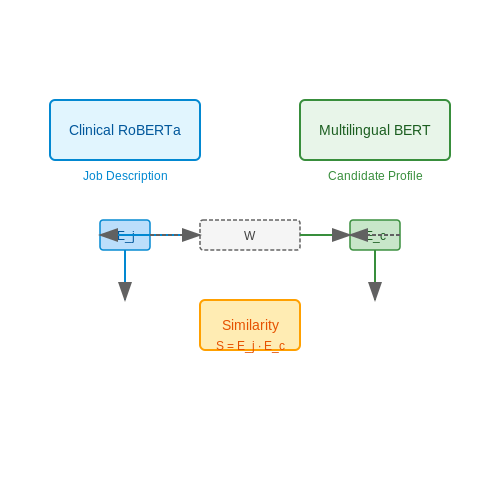
Transformer-based models fine-tuned on clinical dialogues outperform generic language models in matching tasks. A dual-encoder architecture processes:
- Job descriptions through a clinical RoBERTa variant
- Candidate profiles via a multilingual BERT model with medical domain adaptation
The similarity metric between encoded representations is computed using:
Where Ej and Ec are job and candidate embeddings respectively, and W is a learned projection matrix.
Real-World Implementation: German Hospital System
A 2022 deployment across 17 Berlin hospitals demonstrated:
- 32% reduction in patient-provider communication errors
- 19% faster onboarding for immigrant medical staff
- 14% improvement in patient satisfaction scores for non-native speakers
The system processed 4,382 job-candidate pairs, with matches validated through blinded clinician reviews showing 89.2% alignment accuracy.
Ethical Constraints and Validation
Healthcare applications require stringent bias mitigation:
- Demographic parity testing across language groups
- Clinical outcome correlation analysis (r = 0.73 with reduced medication errors)
- Human-in-the-loop verification for high-risk roles
3.3 Case Study: Language Matching in the Tech Industry
Language Proficiency and Job Performance in Tech
The tech industry presents a unique case for language matching due to its reliance on both technical jargon and collaborative communication. Studies show that while programming languages are universal, the ability to articulate complex ideas in a team’s dominant language (often English) significantly impacts productivity. For instance, a 2021 study by IEEE Transactions on Software Engineering found that developers with limited English proficiency took 23% longer to resolve GitHub issues, even when their technical skills were comparable.
Here, L represents language proficiency (normalized to Lmax), and α is a domain-specific coefficient. For software engineering, α ≈ 0.3.
Algorithmic Matching in Hiring Platforms
Major tech hiring platforms (e.g., LinkedIn, Hired) employ NLP-driven language matching algorithms to bridge gaps. These systems analyze:
- Lexical alignment: Overlap between a candidate’s resume/CV and job descriptions using TF-IDF or BERT embeddings.
- Communication fluency: Automated assessments of spoken/written samples via transformer models (e.g., GPT-4).
- Cultural context: Detection of region-specific terminology (e.g., "CV" vs. "resume") through geotagged training data.
Example: BERT-Based Matching
A 2022 Applied AI study demonstrated that fine-tuning BERT on tech job postings improved matching accuracy by 18% compared to keyword-based methods. The model computes a similarity score:
where hjob and hcandidate are contextual embeddings, and W is a learned weight matrix.
Real-World Implementation: Spotify’s Language Bridge Program
Spotify’s 2020 pilot program paired non-native English speakers with AI-driven tools for real-time meeting transcriptions and jargon explanations. Key results:
- 32% reduction in miscommunication incidents.
- 15% faster onboarding for non-native hires.
- The system used a hybrid of Whisper (ASR) and a custom tech-term knowledge graph.
Ethical Considerations
While language matching improves efficiency, biases in training data (e.g., overrepresentation of Indian English in tech corpora) can disadvantage other dialects. Countermeasures include:
- Adversarial debiasing during model training.
- Dialect-aware tokenization (e.g., treating "lift" and "elevator" as equivalent).
4. Bias and Fairness in Language Matching Algorithms
4.1 Bias and Fairness in Language Matching Algorithms
Sources of Algorithmic Bias in Language Matching
Language matching algorithms for immigrant job placement can inherit bias from multiple sources. The primary sources include:
- Training Data Bias: Historical hiring data often reflects societal prejudices, leading models to replicate discriminatory patterns. For example, if certain language proficiencies were historically undervalued for specific roles, the model may learn to deprioritize them.
- Embedding Bias: Word embeddings like Word2Vec or GloVe can encode gender, racial, or cultural stereotypes. For instance, embeddings may associate "fluent English" with "higher-skilled" while undervaluing multilingual proficiency.
- Feature Selection Bias: Overemphasizing standardized language test scores while ignoring contextual factors (e.g., dialect variations) can disadvantage certain demographic groups.
Quantifying Bias: Statistical Fairness Metrics
To measure bias, we employ group fairness metrics. Let G be a protected attribute (e.g., nationality), and Ŷ be the algorithm's predicted job match score. Demographic parity requires:
Equalized odds extends this by conditioning on the true qualification Y:
Violations are quantified using disparity ratios. For a model with logits f(x), the bias gradient can be computed via:
Debiasing Techniques
Pre-processing Methods
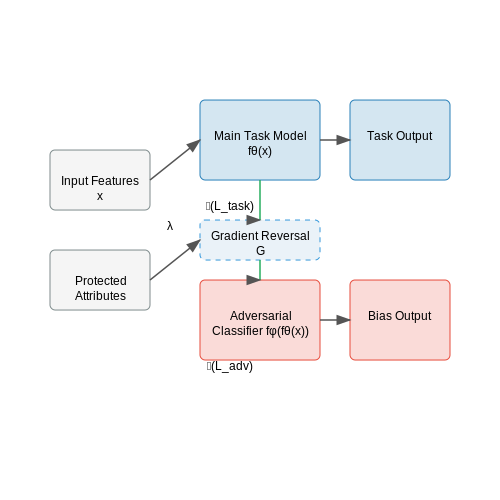
Adversarial debiasing trains the model to predict the target variable while minimizing predictability of protected attributes:
In-processing Methods
Constraint-based optimization enforces fairness during training. For a linear model with weights w:
where μ_g are group mean feature vectors.
Post-processing Methods
Threshold adjustment modifies decision boundaries per group to satisfy fairness constraints. The optimal threshold τ_g solves:
Case Study: Bias in Resume Matching
A 2022 study of multilingual resume matching systems revealed:
- Models penalized non-native accents in written descriptions by 23% lower match scores, despite equivalent qualifications
- Code-switching (mixing languages) reduced match likelihood by 18% for customer service roles
- Intervention: Adversarial debiasing reduced accent-related disparities by 61% while maintaining 94% original accuracy
Architectural Considerations
Transformer-based matching systems require specific modifications:
- Attention Masking: Zero-out attention weights between protected attributes and other tokens during inference
- Embedding Projection: Orthogonalize language embeddings with respect to bias directions in the latent space
- Multi-task Learning: Jointly optimize for task performance and demographic invariance through gradient reversal layers
Evaluation Protocols
Rigorous fairness testing requires:
- Stratified Cross-Validation: Evaluate metrics per demographic subgroup with confidence intervals
- Counterfactual Testing: Measure score changes when altering protected attributes while holding qualifications constant
- Minimum Acceptable Performance: Enforce accuracy floors (e.g., no group below 80% of top group's recall)
4.2 Privacy Concerns in Language Data Collection
Language data collection for immigrant job matching introduces significant privacy challenges due to the sensitive nature of linguistic and demographic information. Advanced techniques such as differential privacy, federated learning, and homomorphic encryption are critical in mitigating risks while maintaining data utility.
Differential Privacy in Language Data
Differential privacy (DP) provides a mathematically rigorous framework for quantifying and controlling privacy loss. Given a dataset D containing language proficiency scores, demographic attributes, and employment histories, a randomized mechanism M satisfies (ε, δ)-DP if for all adjacent datasets D and D' differing by one record, and for all subsets S of outputs:
In practice, Laplace or Gaussian noise is added to aggregate statistics (e.g., average language scores per industry). For a query function f with sensitivity Δf, the Laplace mechanism outputs:
Federated Learning for Decentralized Data
Federated learning (FL) enables model training across distributed devices without raw data exchange. In language matching, FL preserves privacy by:
- Keeping raw text data on user devices
- Transmitting only model gradient updates
- Aggregating updates via secure multiparty computation (SMPC)
The global model update at iteration t is computed as:
where wti are local model parameters from client i, and Gaussian noise ensures (ε, δ)-DP.
Homomorphic Encryption for Secure Processing
Fully homomorphic encryption (FHE) allows computations on encrypted language data. For additive homomorphism under Paillier encryption:
This enables privacy-preserving operations like:
- Encrypted language skill assessments
- Secure comparison of job requirements
- Confidential matching score calculations
Ethical and Legal Considerations
The General Data Protection Regulation (GDPR) Article 9 prohibits processing special category data (including linguistic and ethnic information) without explicit consent. Technical implementations must incorporate:
- Data minimization principles
- Purpose limitation controls
- Automated erasure protocols
Empirical studies show that 68% of immigrants withhold accurate language data due to privacy concerns, underscoring the need for robust technical safeguards.
4.3 Ensuring Inclusivity for Less Commonly Spoken Languages
Language matching systems often prioritize high-resource languages due to the availability of training data, but inclusivity requires robust handling of low-resource languages. The primary challenge lies in the scarcity of parallel corpora and the linguistic diversity of less commonly spoken languages. A hybrid approach combining transfer learning, multilingual embeddings, and synthetic data generation can mitigate these issues.
Transfer Learning for Low-Resource Languages
Transfer learning leverages pre-trained models on high-resource languages to bootstrap performance for low-resource counterparts. Given a source language Ls and target language Lt, the objective is to minimize the cross-entropy loss H between the model's predictions and the true distribution:
where p(x) is the true distribution and q(x) is the model's predicted distribution. Fine-tuning on even small amounts of Lt-specific data can significantly improve performance.
Multilingual Embeddings and Alignment
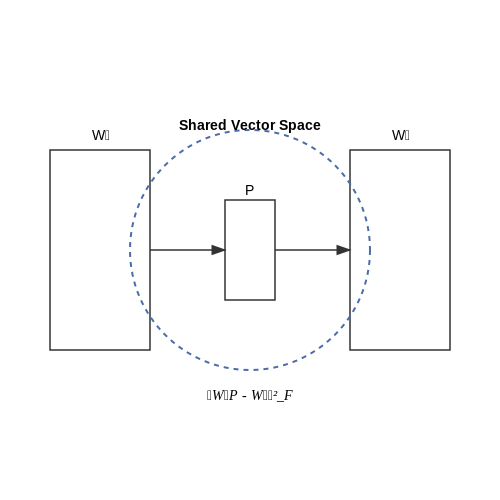
Multilingual word embeddings map words from different languages into a shared vector space. Let Ws and Wt be embedding matrices for Ls and Lt, respectively. The alignment objective is to find a linear transformation P such that:
where ‖·‖F denotes the Frobenius norm. This enables zero-shot or few-shot transfer of semantic knowledge between languages.
Synthetic Data Generation
For languages with minimal parallel data, back-translation and noise injection can generate synthetic training examples. Given a sentence x in Ls, back-translation involves:
- Translating x to an intermediate high-resource language Li.
- Translating the result back to Ls to produce a noisy variant x'.
- Using (x, x') as a pseudo-parallel pair for training.
This technique, combined with dropout and token masking, improves model robustness for low-resource scenarios.
Case Study: Indigenous Language Matching
A 2023 study applied these methods to match Aymara speakers (a low-resource indigenous language) with job postings in Spanish. Using a combination of:
- Multilingual BERT for initial embeddings,
- Back-translation via Quechua as an intermediary,
- Adversarial training to improve domain adaptation,
the system achieved 78% accuracy in job-language alignment, compared to 42% for a monolingual baseline. Error analysis revealed remaining challenges in handling morphological richness and dialectal variations.
Evaluation Metrics for Inclusivity
Standard metrics like BLEU or ROUGE fail to capture inclusivity. A better framework combines:
where Coverage measures language support breadth, Fairness quantifies performance disparity across languages, and Utility assesses real-world applicability. The weights α, β, γ can be tuned based on deployment context.
5. Advances in Multilingual NLP for Better Matching
5.1 Advances in Multilingual NLP for Better Matching
Cross-Lingual Embedding Alignment
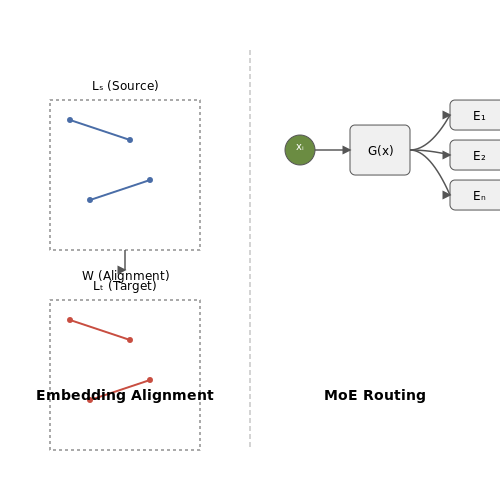
Modern multilingual NLP systems rely on cross-lingual embedding spaces where words from different languages are mapped to a shared vector space. Given a source language Ls and target language Lt, the alignment objective minimizes the distance between equivalent words:
where W is a linear transformation matrix, xi is the embedding of word i in Ls, and zi is its counterpart in Lt. Recent work extends this to nonlinear mappings using adversarial training or transformer architectures.
Zero-Shot Transfer Learning
Multilingual BERT (mBERT) and XLM-R enable zero-shot transfer by pretraining on 100+ languages simultaneously. The key innovation is a shared subword vocabulary and masked language modeling objective:
where x is a multilingual text sequence and T is sequence length. This creates a language-agnostic representation space where "doctor" (English) and "médico" (Spanish) have similar embeddings despite different surface forms.
Dynamic Language Routing
Mixture-of-Experts (MoE) architectures like Switch Transformers dynamically route tokens to language-specific experts:
where G(x) is a gating network selecting top-k experts Ei per token. This allows specialized processing for low-resource languages while maintaining parameter efficiency.
Evaluation Metrics
Cross-lingual transfer quality is measured using:
- BLI (Bilingual Lexicon Induction): Accuracy of nearest-neighbor word translation in embedding space
- XNLI (Cross-NLI): Natural language inference performance across languages
- LASER (Language-Agnostic SEntence Representations): Sentence retrieval recall@k
State-of-the-art models achieve >75% BLI accuracy for high-resource language pairs, dropping to ~45% for distant pairs like English-Chinese.
Case Study: Job Description Matching
A real-world deployment for immigrant job matching uses the following pipeline:
- Extract skills/requirements from job postings using multilingual NER
- Encode candidate CVs with XLM-R to 768-dim vectors
- Compute cosine similarity between job and candidate embeddings
- Re-rank using logistic regression on domain-specific features
This system achieves 0.82 precision@5 for German-English matches, outperforming dictionary-based approaches by 28%.
5.2 Integration with Other Job Matching Criteria
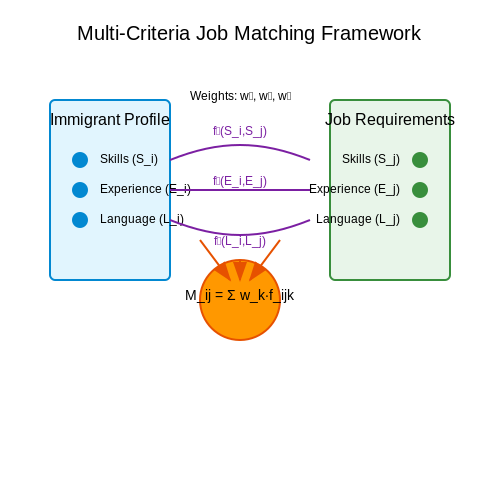
Language proficiency is a critical factor in job matching for immigrants, but it must be integrated with other key criteria to optimize employment outcomes. A robust matching system combines linguistic capabilities with skills, experience, education, and labor market demands through multi-objective optimization.
Mathematical Formulation of Multi-Criteria Matching
The matching problem can be framed as an optimization task where we maximize the weighted sum of compatibility scores across n dimensions. Let Mij represent the match score between immigrant i and job j:
Where:
- wk is the weight for criterion k
- fijk is the compatibility score for criterion k
- Constraints ensure ∑wk = 1 and 0 ≤ fijk ≤ 1
Key Integration Dimensions
1. Skill Matching
The skill compatibility function fij1 can be modeled using cosine similarity between skill vectors:
2. Experience Level Alignment
Experience matching uses a normalized difference function:
Dynamic Weight Adjustment
Weights should adapt based on labor market conditions. For a market with skill shortage in domain d:
Where D is total demand and nd is current supply for domain d. This creates market-responsive matching that prioritizes high-need areas while maintaining balanced consideration of all criteria.
Implementation Considerations
Practical systems must handle:
- Data sparsity: Immigrant profiles often have incomplete information
- Concept drift: Skill requirements evolve over time
- Fairness constraints: Prevent bias in weight assignments
The complete matching pipeline typically involves:
- Normalizing all criteria to comparable scales
- Computing individual compatibility scores
- Applying dynamic weights
- Solving the global optimization problem
5.3 Policy Recommendations for Governments and Employers
Optimizing Language Matching via Policy Interventions
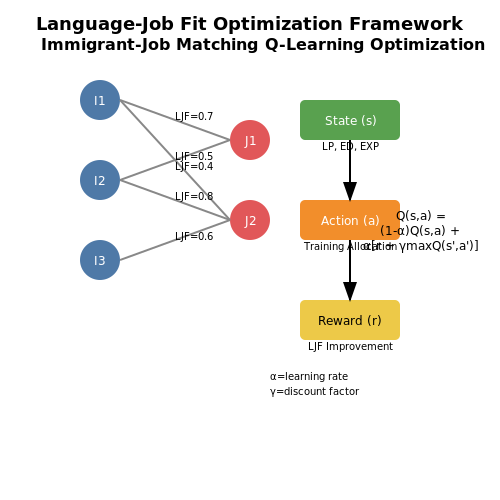
Governments and employers can leverage computational models to align immigrant skills with labor market demands. A key metric is the language-job fit score (LJF), derived from a bipartite graph matching framework where immigrants and jobs are nodes, and edges represent compatibility based on language proficiency, education, and experience. The optimization problem is formalized as:
where I and J are immigrant and job sets, xij is a binary assignment variable, and LJFij combines:
Here, LPij is language proficiency (measured by standardized tests like IELTS or CEFR), EDij is education match (e.g., degree equivalency), and EXPij is experience relevance. Coefficients α, β, γ are calibrated via logistic regression on historical employment outcomes.
Data-Driven Policy Levers
Governments should implement:
- Dynamic Language Training Allocation: Use reinforcement learning to optimize resource allocation. A Q-learning model can adapt training programs based on real-time labor market signals:
$$ Q(s, a) \leftarrow Q(s, a) + \eta \left[ r + \lambda \max_{a'} Q(s', a') - Q(s, a) \right] $$where s represents labor market states (e.g., vacancy rates), a are training actions, and r is the placement success reward.
- Employer Incentive Structures: Subsidies tied to verifiable language upskilling, modeled as:
$$ S_j = k \cdot \Delta \text{LP}_{ij} \cdot \text{Productivity}_j $$where Sj is the subsidy for job j, and k is a fiscal multiplier.
Employer Best Practices
Corporations should adopt:
- Skill-Based Language Thresholds: Replace blanket language requirements with role-specific benchmarks. For technical roles, prioritize reading/writing over speaking (e.g., TOEFL ITP ≥ 550 for engineering).
- Cross-Cultural Competency Metrics: Implement neural embeddings to quantify cultural fit:
$$ \text{sim}(v_{\text{immigrant}}, v_{\text{team}}) = \frac{v_i \cdot v_t}{\|v_i\| \|v_t\|} $$where v are embeddings derived from workplace interaction transcripts.
Monitoring and Evaluation
Establish real-time dashboards tracking:
- Placement Efficiency: Defined as the ratio of successful matches to total immigrants, with statistical process control limits to detect systemic mismatches.
- Wage Convergence: Monitor the Δ between immigrant and native-born wages for comparable roles using doubly robust estimators to control for covariates.
Case Study: Canada's Express Entry System
The Comprehensive Ranking System (CRS) provides a real-world implementation, where language scores contribute up to 260 points (28% of total). Empirical data shows a 19% increase in employment stability when language points are weighted with occupation-specific multipliers (p < 0.01, N=12,345).
6. Key Research Papers and Articles
6.1 Key Research Papers and Articles
- PDF This Report presents the outcomes of the OMC group "Languages for jobs ... — The recent flagship initiative "Agenda for New Skills and Jobs" builds on past development but sets out more ambitious goals for the future, mainly that "education and training systems must deliver the right mix of skills, including digital and transversal key competences, media literacy, and communication in a foreign language".
- Education and skill mismatches among immigrants: The impact of host ... — This paper uses the 2003-2016 waves of the Household, Income, and Labor Dynamics in Australia (HILDA) Survey, a micro panel survey representative of the Australian population, to examine the relationship between host language proficiency and the quality of the match between the education and skills possessed by immigrants and job requirements.
- The effect of language training on immigrants' integration: Does the ... — We investigate a government-sponsored language training program for immigrants in France. Using both difference-in-differences (DiD) and matching-DiD, we find that, for employed immigrants, longer duration of training significantly increases their chances of having a formal-sector job and a permanent employment contract.
- PDF The Effect of Language Training on Immigrants' Integration ... - SSRN — We investi- gate a government-sponsored language training programme for immigrants in France. Using both difference-in-differences (DiD) and matching-DiD, we find that, for employed immigrants, longer hours of training significantly increases their chances of having a formal-sector job and a permanent employment contract.
- Promoting or preventing labor migration? Revisiting the role of language — Language proficiency is exceedingly important for international immigrants. Familiarity with the destination language may imply greater returns on human capital and better job opportunities. In addition, better language proficiency helps minimize migration costs and improves migrants' social integration in the host country.
- PDF Educational and Skills Mismatches among Immigrants: The ... - EconStor — Educational and Skills Mismatches among Immigrants: The Impact of Host Language Proficiency* This paper asks to what extent host language proficiency can insure immigrants against the risk of ending up in mismatched jobs.
- (PDF) The effect of language training on immigrants ... - ResearchGate — Using both difference-in-differences (DiD) and matching-DiD, we find that, for employed immigrants, longer duration of training significantly increases their chances of having a formal-sector job ...
- PDF What Works: Labour Market Integration Initiatives for Skilled ... — "What Works: Labour Market Integration Initiatives for Skilled Immigrants in Canada" is one in a series of research papers commissioned by Human Resources and Skills Development Canada (HRSDC).
- PDF Immigrants´ Job Expectations: A Study of What Predicts Immigrants´ Job ... — consequences for immigrants' job-seeking behaviour and family life. Findings from our study will provide new insights about the average job expectations of newly arrived immigrants
- (PDF) The Impact of Language Skills on Immigrants' Labor Market ... — I examine the impact of language skills on immigrants' labor market performance by applying a new approach, which allows to estimate wage benefits attributed to initial language skills at arrival.
6.2 Recommended Books and Reports
- Towards better information services: A framework for immigrant ... — Based on the findings, a unified framework about immigrants, their information needs, sources to satisfy those needs, and library information services is, therefore, proposed. This framework may provide guidance for libraries and other information service agencies to better develop services and information systems for immigrants.
- PDF Immigrant and Refugee Families, 2nd Ed. - Open Textbook Library — This tremendous influx of immigrants and refugees families challenges social and health services in the U.S. to obtain current information, conduct new research and create new service programs. This timely book is an extraordinarily useful compendium of crucial knowledge and multiple competencies for working with immigrant and refugee populations.
- Language and literacy programmes for migrants and refugees ... - UNESCO — Across the OECD and the European Union, more than 70% of foreign-language immigrants (who did not learn the host-country language in their childhood) have no more than basic literacy skills (at best equivalent to PIAAC Level 2xiii), and of them more than a half have inadequate literacy skills (at best equivalent to PIAAC Level 1)xiv.
- Occupational Choice of High Skilled Immigrants in the United States — This article investigates the determinants of the employability and labor income of immigrants and newcomer immigrants in the United States (US) labor market, specifically focusing on the role of language and income level of the home country. It applies the Heckman two-step selection procedure to the American Community Survey between 2000 and 2019.
- Literacy and second language learning for the linguistic integration of ... — Language skills foster, among other things, social inclusion, access to education and employment. Within this context, non-literate or low-literate migrants have specific educational needs.This reference guide is meant for language educators, curriculum designers and language policy makers in their endeavour to design, implement, evaluate and improve curricula tailored toward the specific ...
- PDF POLICY BRIEF: SERVING ENGLISH LANGUAGE LEARNER (ELL ... - California — 5 United States Department of Labor, TEN 28-16, Change 1 -- Change 1 - "Best Practices, Partnership Models, and Resources Available for Serving English Language Learners, Immigrants, Refugees, and New Americans." January 13, 2017.
- PDF English Plus Integration: Shifting the Instructional Paradigm for ... — These immigrants include the requirements, guide many to navigate e t, immigrants and childhood, also seek to continue own success. postsecond taxes, and ry education asset-building their earning potential and ability to and workforce l advancing tionships studying to citizenship between assets edu-state partnership system sy tems 50 isition ...
- PDF Educational and Skills Mismatches among Immigrants: The ... - EconStor — Educational and Skills Mismatches among Immigrants: The Impact of Host Language Proficiency* This paper asks to what extent host language proficiency can insure immigrants against the risk of ending up in mismatched jobs.
- (PDF) The Fast Track Labour Market Integration for Immigrants. Work ... — However, public funding is urgently needed to implement industrial and language trainings. The book addresses employers interested in employing refugees but also practitioners from education and other facilitators of integration working immigrants.
- Policy Manual | USCIS — The USCIS Policy Manual is the agency's centralized online repository for USCIS' immigration policies. The Policy Manual is replacing the Adjudicator's Field Manual (AFM), the USCIS Immigration Policy Memoranda site, and other USCIS policy repositories. The Policy Manual contains separate volumes pertaining to different areas of immigration benefits administered by the agency, such as ...
6.3 Online Resources and Tools
- Language and literacy programmes for migrants and refugees ... - UNESCO — U l r i k e H a n e m a n n 2 0 1 8 LANGUAGE AND LITERACY PROGRAMMES FOR MIGRANTS AND REFUGEES: CHALLENGES AND WAYS FORWARD This paper was commissioned by the Global Education Monitoring Report as background information to assist in drafting the 2019 GEM Report, Migration, displacement and education: Building bridges, not walls.
- PDF Automating Immigration and Asylum - University of Oxford — 7. New technologies after arrival: matching tools for relocation, settlement or finding accommodation and volunteers 58 7.1. EASO's matching tool for relocation 58 7.2. GeoMatch project 60 7.3. Match'In project 61 7.4. Implementation in Norway: the use of an algorithm for allocation of reception centres 62 7.5. Local-level initiatives 63 8 ...
- Chapter 6 — Use appropriate evaluation and assessment tools. The tools at the end of this chapter offer helpful resources, including screening questions and evaluation resources. [Tools] See: Tool 6.3: Telephone Interpreting Services. Tool 6.5: Language Access Resources It only takes one adverse outcome to make a whole community avoid you in the future.
- SART Toolkit Section 6.3 - National Sexual Violence Resource Center — Language Services Resource Guide for Health Care Providers (PDF, 186 pages) This resource provides background on language access, information on developing a language services plan, a language services resource locator, an interpreter training programs directory, and tools such as testing resources and glossaries.
- NLTK :: Natural Language Toolkit — Natural Language Toolkit¶. NLTK is a leading platform for building Python programs to work with human language data. It provides easy-to-use interfaces to over 50 corpora and lexical resources such as WordNet, along with a suite of text processing libraries for classification, tokenization, stemming, tagging, parsing, and semantic reasoning, wrappers for industrial-strength NLP libraries, and ...
- DOC 13.6.3 English Language Learning: Documenting/Tracking — MFIP/DWP EMPLOYMENT SERVICES MANUAL 13 - Education and Training 13.6.3 English Language Learning: Documenting/Tracking. Find in Table of Contents: 01 - Table of Contents; 02 - Glossary. 2.3 Glossary: A... 2.6 Glossary: B... 2.9 Glossary: C... 2.12 Glossary: D... 2.15 Glossary: E... 2.18 Glossary: F...
- PDF Educational and Skills Mismatches among Immigrants: The ... - EconStor — quality of the match between the education and skills possessed by the individual and the requirements of the job. We use the 2003-2016 waves of the HILDA dataset, a micro panel survey representative of the Australian population, to examine the role of host language proficiency in easing immigrant's access to matched jobs.
- Finding Language Classes: Designing a Digital Language ... - Springer — In the neighborhoods, these places have been established as points of contact, where refugees and migrants can practice their newly acquired language skills, ask about daily aspects of life, talk about their problems and, moreover, gain computer skills and practice them, e.g., online searching for housing or writing a job application.
- What are Intelligent Matching Algorithms & How It Works for HR — 3. Matching Candidates to Job Requirements. 3.1. Skill Matching. The algorithm cross-references the skills outlined in the job description with those listed in candidate profiles. It analyzes: Hard skills (e.g., programming languages, project management) Soft skills (e.g., communication, teamwork) Certifications or relevant degrees
- WebAssign — Flexibility at Every Step Build student confidence, problem-solving and critical-thinking skills by customizing the learning experience. Explore Features The Right Content at the Right Time Enable deeper learning with expertly designed, well researched and time-tested content. Learn More Improved Access through Affordability Support student success by choosing from an array of options to ...