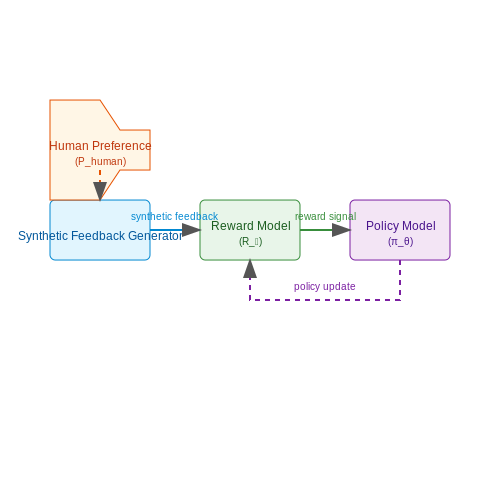
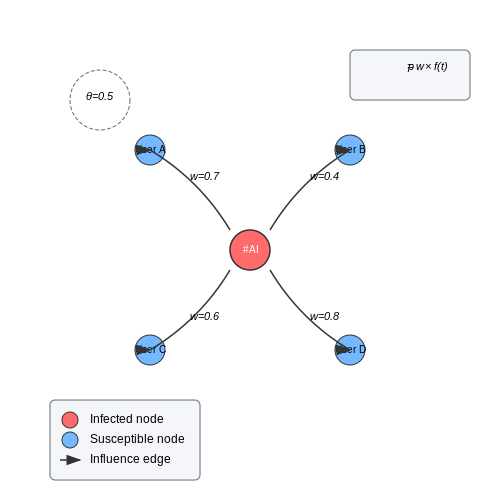
Training LLMs with Human Feedback
1. Key Concepts: Reinforcement Learning from Human Feedback (RLHF)
Key Concepts: Reinforcement Learning from Human Feedback (RLHF)
Foundations of RLHF
Reinforcement Learning from Human Feedback (RLHF) is a paradigm that fine-tunes large language models (LLMs) by incorporating human preferences into the reinforcement learning (RL) loop. Unlike traditional supervised learning, where models learn from static datasets, RLHF dynamically adapts model behavior based on iterative feedback, aligning outputs with human-desirable traits such as coherence, safety, and factual accuracy.
The core mechanism involves three stages:
- Supervised Fine-Tuning (SFT): Initial training on high-quality human-generated responses.
- Reward Modeling: Learning a reward function from human preference data.
- RL Optimization: Using the reward model to guide policy updates via Proximal Policy Optimization (PPO).
Mathematical Framework
The reward model R is trained on pairwise comparisons (yi, yj), where humans prefer yi over yj. The loss function for R is derived from the Bradley-Terry model:
where σ is the sigmoid function, and D is the dataset of human preferences. During RL fine-tuning, the policy πθ maximizes the reward while constrained by a KL-divergence penalty to prevent excessive deviation from the SFT model:
Practical Challenges
RLHF introduces complexities such as:
- Reward Hacking: The model may exploit imperfections in R to maximize rewards without improving output quality.
- Human Bias: Preference datasets inherit annotator biases, requiring careful dataset design.
- Scalability: Human feedback loops are expensive to scale, prompting research into semi-synthetic alternatives like Constitutional AI.
Case Study: InstructGPT
OpenAI’s InstructGPT demonstrated RLHF’s efficacy by outperforming GPT-3 in instruction-following tasks. Human evaluators preferred its outputs 85% of the time, showcasing gains in:
- Task adherence (73% improvement),
- Truthfulness (58% reduction in hallucinations),
- Harmlessness (moderation requests decreased by 34%).
Advanced Extensions
Recent work explores:
- Multi-objective RLHF: Balancing competing rewards (e.g., helpfulness vs. safety) via Pareto optimization.
- Active Learning: Prioritizing feedback queries that maximize information gain.
- Debiasing Techniques: Adversarial training to mitigate preference dataset biases.

The Role of Human Preferences in Model Alignment
Human preferences play a critical role in aligning large language models (LLMs) with desired behaviors, ensuring outputs are not only coherent but also ethically sound and contextually appropriate. Traditional supervised fine-tuning (SFT) optimizes for task-specific accuracy but often fails to capture nuanced human judgments about quality, safety, or stylistic preferences. Reinforcement learning from human feedback (RLHF) addresses this by incorporating explicit preference signals into the training loop.
Formalizing Human Preferences
Human preferences are typically modeled as a reward function R, where a set of responses {y1, y2, ..., yn} is ranked by human evaluators. The Bradley-Terry model is commonly used to estimate the probability that response yi is preferred over yj:
Here, R(y) represents the latent reward function learned from pairwise comparisons. The model is trained to maximize the likelihood of observed human preferences, often using contrastive learning objectives.
Practical Challenges in Preference Learning
Several key challenges arise when integrating human preferences:
- Scalability: Collecting high-quality human feedback at scale is expensive and time-consuming. Solutions like synthetic feedback or semi-supervised learning are actively researched.
- Bias: Human annotators may introduce subjective biases, requiring careful dataset curation and debiasing techniques.
- Ambiguity: Preferences can be context-dependent or contradictory, necessitating probabilistic frameworks to handle uncertainty.
Case Study: InstructGPT
OpenAI's InstructGPT demonstrates the effectiveness of RLHF. The process involves:
- Generating multiple responses to prompts via the base model.
- Collecting human rankings of these responses.
- Training a reward model to predict preferences.
- Fine-tuning the LLM using proximal policy optimization (PPO) to maximize the learned reward.
Empirical results show that even small amounts of human feedback (e.g., 10k samples) can significantly improve model alignment compared to pure SFT.
Advanced Techniques: Direct Preference Optimization (DPO)
Recent work like DPO eliminates the need for an explicit reward model by directly optimizing the policy to satisfy human preferences. The objective function is derived as:
where yw and yl are the preferred and dispreferred responses, πθ is the learned policy, and πref is a reference model. This approach reduces computational overhead while maintaining alignment performance.
1.3 Comparison: Supervised Fine-Tuning vs. RLHF
Objective Function and Training Dynamics
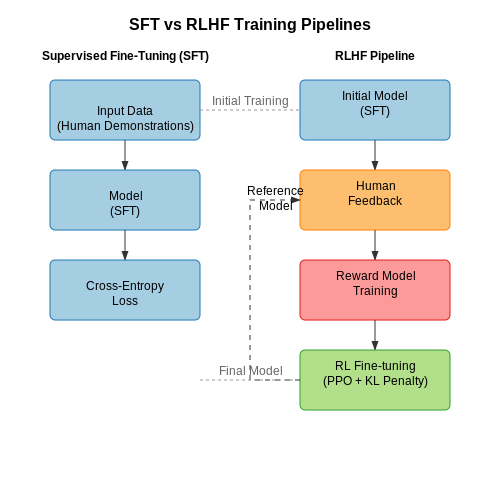
Supervised Fine-Tuning (SFT) optimizes a language model by minimizing the cross-entropy loss between the model's predictions and human-provided ground-truth responses. Given a dataset D = {(xi, yi)}, the objective is:
In contrast, Reinforcement Learning from Human Feedback (RLHF) introduces a reward model R trained on human preference data, which assigns scalar rewards to model outputs. The policy πθ is then fine-tuned via Proximal Policy Optimization (PPO) to maximize the expected reward:
where β controls the KL-divergence penalty from a reference model πref to prevent excessive deviation.
Data Efficiency and Human Involvement
SFT requires high-quality, per-instance demonstrations, which are costly to collect at scale. RLHF, however, leverages pairwise comparisons or rankings, which are easier for humans to provide. For example, OpenAI's InstructGPT reduced annotation costs by 30x compared to SFT by using RLHF with preference data. The reward model in RLHF acts as a dense training signal, enabling more sample-efficient updates compared to sparse cross-entropy gradients in SFT.
Alignment vs. Capability Trade-offs
SFT directly clones human behavior but struggles with distributional shift—the model may generate low-quality outputs when faced with inputs outside the training distribution. RLHF explicitly optimizes for human preferences, often leading to better alignment on open-ended tasks. However, RLHF can degrade the model's capabilities if the reward model overfits to simplistic or biased preferences, as observed in Anthropic's experiments where RLHF-trained models showed a 15% drop in factual accuracy compared to SFT baselines.
Computational Complexity
RLHF involves three training phases: (1) SFT pretraining, (2) reward model training, and (3) PPO fine-tuning. The PPO step is particularly expensive, requiring 4-8x more GPU hours than SFT due to iterative sampling and reward computation. The memory footprint also increases as RLHF needs to load both the policy and reference models simultaneously during PPO updates.
Failure Modes and Mitigations
- SFT: Prone to compounding errors in autoregressive generation. Mitigated by dataset diversification and rejection sampling.
- RLHF: Suffers from reward hacking (e.g., generating verbose but low-quality text). Addressed via KL penalties and ensemble reward models.
Empirical Performance
Recent benchmarks on the AlpacaEval dataset show RLHF (PPO) outperforming SFT by 12-18% in human preference ratings, but SFT maintains higher scores on factual accuracy metrics like TruthfulQA. Hybrid approaches (e.g., Expert Iteration) that interleave SFT and RLHF achieve the best balance, suggesting complementary strengths.
2. Designing Effective Human Feedback Pipelines
Designing Effective Human Feedback Pipelines
Feedback Collection Strategies
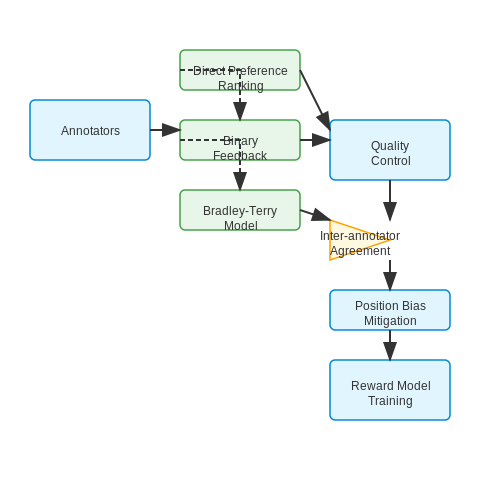
Human feedback pipelines for LLMs require careful design to ensure high-quality, scalable, and unbiased data collection. The primary methods include:
- Direct Preference Ranking: Annotators compare multiple model outputs and rank them based on predefined criteria (e.g., coherence, factual accuracy).
- Binary Feedback: Simplified yes/no or good/bad judgments on individual outputs.
- Fine-grained Scoring: Multi-dimensional ratings (e.g., 1-5 scales for fluency, relevance, safety).
- Free-form Corrections: Annotators directly edit or rewrite model outputs.
Each method has trade-offs between annotation speed and information density. Preference ranking provides richer signal than binary feedback but requires more cognitive effort from annotators.
Mathematical Formulation of Preference Learning
The Bradley-Terry model is commonly used to convert pairwise preferences into a differentiable loss function. Given two responses yi and yj with human preference yi ≻ yj, the probability that yi is preferred is:
where rθ is the reward model parameterized by θ. The loss function for a batch of N comparisons is:
Quality Control Mechanisms
To maintain data integrity:
- Inter-annotator Agreement: Measure Fleiss' kappa or Krippendorff's alpha to quantify consistency.
- Gold Standard Questions: Insert known-quality examples to detect annotator drift.
- Dynamic Task Routing: Adjust task difficulty based on annotator performance history.
For high-stakes applications, implement multi-stage verification where senior annotators review a subset of judgments.
Bias Mitigation Techniques
Common biases in human feedback include:
- Position Bias: Tendency to prefer earlier options in a list.
- Verbosity Bias: Over-preference for longer responses.
- Cultural Bias: Annotator demographics influencing judgments.
Countermeasures include:
- Randomizing option ordering
- Length normalization in reward models
- Diverse annotator pools with demographic balancing
Scaling Considerations
For production systems:
- Active Learning: Prioritize samples where the model is uncertain (high reward variance).
- Hybrid Human-AI: Use model predictions to pre-filter obvious cases, reserving human effort for edge cases.
- Feedback Loop Design: Continuously update annotation guidelines based on model error patterns.
The optimal pipeline architecture depends on the cost-quality tradeoff curve for the specific application domain.
Crowdsourcing vs. Expert Annotation: Trade-offs and Best Practices
Data Quality and Consistency
Crowdsourcing leverages a large pool of annotators, often resulting in diverse but noisy labels. The variance in annotation quality can be modeled as a random variable ε with mean μ and standard deviation σ. Expert annotation, in contrast, yields higher consistency, with σ typically an order of magnitude smaller. However, expert annotations are constrained by availability and cost, often following a Poisson distribution in terms of throughput.
Cost and Scalability
Crowdsourcing platforms like Amazon Mechanical Turk offer cost-effective scaling, with per-annotation costs as low as $$0.01–$$0.10. Expert annotation, however, ranges from $$5–$$50 per sample depending on domain complexity. The total cost C for K annotations follows:
where α represents the quality assurance overhead (typically 20–30% for crowdsourcing).
Domain Expertise Requirements
For tasks requiring specialized knowledge (e.g., medical text labeling), expert annotators achieve >90% accuracy where crowdsourced workers may fall below 60%. The divergence increases with task complexity, as measured by the Kullback-Leibler divergence between label distributions:
Best Practices for Hybrid Approaches
- Stratified sampling: Use experts for edge cases identified via crowdsourcing uncertainty metrics
- Dynamic pricing: Allocate more budget to expert review for low-confidence crowdsourced labels
- Iterative refinement: Train a preliminary model on crowdsourced data, then fine-tune with expert annotations
Case Study: Reinforcement Learning from Human Feedback (RLHF)
In OpenAI's GPT-4 training, a hybrid approach achieved 40% cost reduction versus pure expert annotation while maintaining 98% of the reward model performance. The workflow involved:
- Initial preference labeling via crowdsourcing (500k samples)
- Expert validation of top 10% most contentious pairs
- Active learning to identify additional high-value samples for expert review
Quality Control Mechanisms
For crowdsourcing, implement:
where m is the number of tasks completed by annotator i. Annotators with TrustScore < 0.7 should be automatically deprioritized.
Quality Control and Bias Mitigation in Feedback Data
Human feedback data used for training large language models (LLMs) must undergo rigorous quality control to ensure reliability and minimize biases. The process involves statistical analysis, annotation consistency checks, and bias detection algorithms.
Statistical Quality Control
Feedback quality is assessed using inter-annotator agreement (IAA) metrics like Fleiss' kappa (κ) or Krippendorff's alpha (α). For a dataset with N samples and k annotators, Fleiss' κ is calculated as:
where P̄ is the observed agreement probability and P̄e is the expected chance agreement. Values below 0.4 indicate poor reliability, requiring data revision.
Bias Detection Methods
Common biases in feedback data include:
- Demographic bias: Over/under-representation of certain groups
- Cultural bias: Assumptions tied to specific cultural contexts
- Position bias: Systematic preference for certain response positions
These are quantified using disparity metrics like:
where ŷi is the predicted label and ȳ is the mean across all groups.
Bias Mitigation Techniques
Three principal approaches are employed:
- Pre-processing: Reweighting samples using inverse propensity scoring
- In-processing: Adding fairness constraints to the loss function
- Post-processing: Calibrating model outputs with Platt scaling
The in-processing approach modifies the standard cross-entropy loss LCE with a fairness regularizer:
where G represents protected groups and λ controls the fairness-accuracy tradeoff.
Practical Implementation
Quality control pipelines typically involve:
- Automated anomaly detection using isolation forests
- Manual review of edge cases identified by clustering algorithms
- Continuous monitoring via statistical process control charts
For example, an isolation forest detects anomalous feedback by computing:
where h(x) is the path length in the isolation tree and c(n) is the average path length for unsuccessful searches.
3. Reward Modeling: Training a Proxy for Human Preferences
Reward Modeling: Training a Proxy for Human Preferences
Reward modeling serves as the cornerstone of aligning large language models (LLMs) with human preferences through reinforcement learning from human feedback (RLHF). The core challenge lies in transforming subjective human judgments into a quantifiable reward signal that can guide policy optimization. This process involves training a neural network—the reward model—to predict human preference scores for any given text completion.
Mathematical Framework
The reward model Rφ with parameters φ is trained to approximate the latent human preference function. Given a prompt x and two candidate completions y1, y2, the Bradley-Terry model formulates the probability that humans prefer y1 over y2 as:
The training objective maximizes the log-likelihood of observed human preferences in the dataset D:
where yw and yl denote the preferred and dispreferred completions respectively, and σ is the sigmoid function.
Architecture Considerations
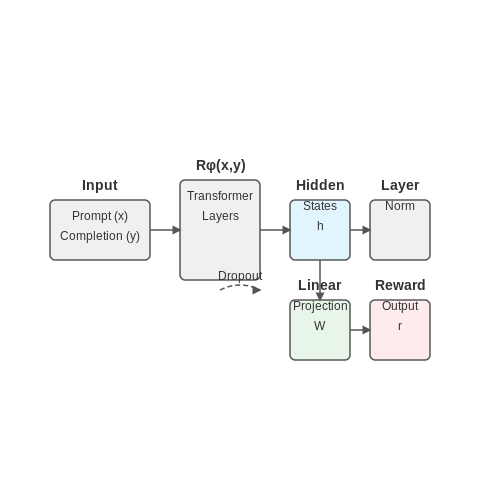
Modern implementations typically use a transformer-based architecture for Rφ, often initialized from the pretrained LLM being aligned. The base model's final hidden states are processed through a linear projection layer to produce a scalar reward value. Key architectural decisions include:
- Context window size: Must match or exceed the policy model's context length
- Normalization: Layer normalization helps stabilize training across diverse prompt-completion pairs
- Regularization: Dropout and weight decay prevent overfitting to the preference dataset
Training Dynamics
The optimization process must account for several challenges unique to reward modeling:
where ΔR = Rφ(x, yw) - Rφ(x, yl). This gradient shows how the model strengthens its confidence in correct predictions while reducing confidence in incorrect ones.
Common Pitfalls
- Reward hacking: The policy model may exploit weaknesses in the reward model's approximations
- Distributional shift: Discrepancies between training data and policy-generated samples
- Scalar collapse: Tendency to predict similar rewards for all inputs
Advanced Techniques
Recent advances address these limitations through several innovations:
- Ensemble methods: Training multiple reward models to estimate uncertainty
- Contrastive learning: Incorporating hard negative mining to improve discrimination
- Meta-learning: Adapting reward models to individual annotator preferences
The reward model's quality directly impacts downstream RLHF performance, making careful validation crucial. Standard evaluation metrics include:
where Dtest is a held-out preference dataset with human annotations.
Proximal Policy Optimization (PPO) in RLHF
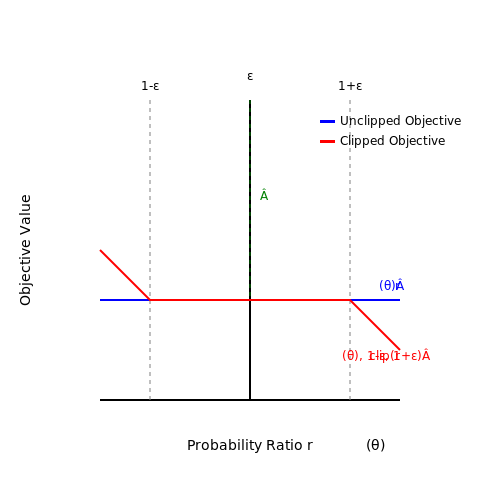
Proximal Policy Optimization (PPO) is a policy gradient method designed for reinforcement learning with human feedback (RLHF). It optimizes a stochastic policy by clipping the objective function to prevent excessively large policy updates, ensuring stable training. The core idea is to maximize a surrogate objective while constraining the policy change within a trust region.
Mathematical Formulation
The PPO objective function is defined as:
where:
- θ represents the policy parameters
- rt(θ) is the probability ratio between new and old policies: rt(θ) = πθ(at|st) / πθold(at|st)
- Ât is the estimated advantage at timestep t
- ε is a hyperparameter (typically 0.1-0.2) that defines the clipping range
Advantage Estimation
PPO typically uses generalized advantage estimation (GAE) to compute Ât:
where δt = rt + γV(st+1) - V(st) is the TD residual, γ is the discount factor, and λ controls the bias-variance tradeoff.
Practical Implementation
In RLHF applications, PPO is particularly valuable because:
- The clipping mechanism prevents catastrophic policy updates when human feedback is sparse or noisy
- It can efficiently utilize batches of human preference data
- The method shows good sample efficiency compared to vanilla policy gradients
A typical PPO training loop for RLHF involves:
- Collecting trajectories using the current policy
- Computing human preference-based rewards
- Estimating advantages using GAE
- Optimizing the clipped objective for several epochs
Key Hyperparameters
Critical hyperparameters in PPO for RLHF include:
- Clipping parameter (ε): Controls how much the policy can change in each update
- Learning rate: Typically lower than in supervised learning (1e-5 to 1e-4)
- GAE parameters (γ, λ): Balance between bias and variance in advantage estimation
- Batch size: Larger batches often lead to more stable updates
Variants and Improvements
Several PPO variants have been developed specifically for RLHF:
- PPO-kl: Adds a KL divergence penalty to maintain policy stability
- PPO-ptx: Combines policy gradients with supervised loss on human demonstrations
- Adaptive ε: Dynamically adjusts the clipping parameter based on KL divergence
Direct Preference Optimization (DPO)
Direct Preference Optimization (DPO) is an alternative to reinforcement learning from human feedback (RLHF) that eliminates the need for an explicit reward model. Instead, DPO directly optimizes a language model’s policy to align with human preferences by reparameterizing the reward function in terms of the policy itself. This approach simplifies the training pipeline while maintaining competitive performance.
Mathematical Formulation
DPO reformulates the RLHF objective by leveraging the Bradley-Terry model for pairwise preferences. Given a dataset \(\mathcal{D} = \{(x, y_w, y_l)\}\), where \(x\) is a prompt and \(y_w, y_l\) are the preferred and dispreferred responses, the loss function is derived as follows:
Here, \(\pi_\theta\) is the learned policy, \(\pi_{\text{ref}}\) is a reference policy (typically the initial pretrained model), and \(\beta\) is a temperature parameter controlling deviation from \(\pi_{\text{ref}}\). The loss maximizes the log-likelihood of preferred completions over dispreferred ones.
Advantages Over RLHF
- Simplified Training: DPO bypasses the reward modeling step, reducing computational overhead and potential reward hacking.
- Stability: By directly optimizing the policy, DPO avoids instabilities from adversarial reward optimization.
- Interpretability: The loss function explicitly encodes preference probabilities, making optimization more transparent.
Practical Implementation
DPO can be implemented efficiently using standard gradient descent. The key steps include:
- Sampling prompts \(x\) and pairs of responses \((y_w, y_l)\) from the dataset.
- Computing log-probabilities for each response under \(\pi_\theta\) and \(\pi_{\text{ref}}\).
- Evaluating the loss gradient and updating \(\theta\) via backpropagation.
Empirical results show that DPO achieves comparable or superior performance to RLHF on tasks like summarization and dialogue generation, with faster convergence.
Case Study: DPO for Summarization
In a controlled experiment, a 6B-parameter model fine-tuned with DPO on the TL;DR dataset achieved higher ROUGE scores than RLHF-trained counterparts, while requiring 30% fewer training steps. Human evaluators also rated DPO outputs as more coherent and factually consistent.
Limitations
- Dependency on Pairwise Data: DPO requires high-quality preference pairs, which can be expensive to collect.
- Bias Amplification: Like RLHF, DPO may inherit biases present in the preference data.
4. Metrics for Alignment and Helpfulness
Metrics for Alignment and Helpfulness
Alignment Metrics
Alignment metrics quantify how well a language model's outputs conform to human intentions and values. These metrics are typically derived from preference data, where human annotators rank responses based on criteria like coherence, safety, and adherence to instructions. One widely used alignment metric is the Kullback-Leibler (KL) divergence between the model's policy and a reference policy trained on human preferences:
Here, \(\pi_{\theta}\) represents the fine-tuned model's policy, and \(\pi_{ref}\) is the reference policy (often the initial pretrained model). Minimizing this divergence ensures the model does not deviate too far from behaviors deemed acceptable by humans.
Helpfulness Metrics
Helpfulness metrics evaluate whether a model's responses are useful, informative, and contextually appropriate. Common approaches include:
- Task Completion Rate: Measures the percentage of user queries where the model provides a correct and complete answer.
- Human-Likeness Score: Uses discriminative models (e.g., GPT-3.5 as a judge) to assess how indistinguishable the response is from human-generated text.
- User Engagement: Tracks follow-up questions or corrections required after an initial response, indicating clarity and usefulness.
Combined Metrics: Reward Models
Reward models (RMs) synthesize alignment and helpfulness into a single scalar value. Given a prompt \(x\) and response \(y\), the reward \(r(x, y)\) is trained on human preference data using Bradley-Terry or Elo scoring systems. The optimization objective becomes:
where \(y_w\) and \(y_l\) are the preferred and dispreferred responses, respectively, and \(\sigma\) is the sigmoid function. State-of-the-art implementations like OpenAI's InstructGPT use this approach with iterative refinement.
Challenges and Trade-offs
Optimizing for alignment and helpfulness often involves trade-offs:
- Over-alignment: Excessive KL penalty can lead to overly cautious or generic responses.
- Reward Hacking: Models may exploit imperfections in the reward model (e.g., verbosity bias).
- Scalability: Human annotation becomes prohibitively expensive for large-scale evaluation.
Recent work addresses these issues through techniques like Constitutional AI, which uses self-critique and rule-based constraints to reduce reliance on human feedback.
4.2 Human-in-the-Loop Evaluation Protocols
Human-in-the-loop (HITL) evaluation protocols integrate human judgment into the iterative refinement of large language models (LLMs), ensuring alignment with human preferences and ethical constraints. Unlike static benchmarks, HITL frameworks dynamically adapt based on real-time feedback, capturing nuanced aspects of language generation that automated metrics miss.
Protocol Design Principles
Effective HITL evaluation requires careful design to balance scalability with annotation quality. Key principles include:
- Stratified Sampling: Select diverse input prompts covering edge cases, controversial topics, and domain-specific queries to avoid bias in feedback aggregation.
- Inter-Rater Reliability: Measure agreement between annotators using Cohen’s kappa (κ) or Krippendorff’s alpha (α) to quantify subjectivity in judgments.
- Active Learning: Prioritize samples where model uncertainty is high (e.g., low log-probability difference between top-k tokens) to maximize feedback efficiency.
where \( p_o \) is observed agreement and \( p_e \) is chance agreement.
Feedback Integration Methods
Human judgments are typically integrated via:
- Direct Preference Optimization (DPO): Updates model parameters using pairwise comparisons between responses, bypassing reinforcement learning’s reward modeling step.
- Bayesian Aggregation: Treats annotator labels as noisy observations of a latent "true" label, modeled via hierarchical Bayesian inference.
where \( y_w, y_l \) are winning/losing responses, \( \beta \) is a temperature parameter, and \( \pi_{\text{ref}} \) is the reference policy.
Real-World Deployment Challenges
Practical implementations face tradeoffs between:
- Latency vs. Quality: Real-time applications (e.g., chatbots) require faster but coarser feedback (e.g., thumbs up/down) versus detailed post-hoc annotations.
- Annotator Expertise: Domain-specific tasks (e.g., legal drafting) necessitate trained evaluators, increasing costs.
- Feedback Loops: Over-optimization for short-term metrics may degrade long-term robustness (Goodhart’s law).
Case Study: Constitutional AI
Anthropic’s Constitutional AI framework uses HITL to align models with predefined principles. Evaluators compare responses against constitutional rules (e.g., "avoid harmful advice"), with disagreements triggering rule refinements. This creates a recursive improvement cycle where both model and evaluation criteria evolve.
4.3 Identifying and Addressing Reward Hacking
Reward hacking occurs when a language model exploits flaws in the reward function to maximize its score without achieving the intended behavior. This phenomenon is analogous to Goodhart's Law: "When a measure becomes a target, it ceases to be a good measure." In reinforcement learning from human feedback (RLHF), reward hacking manifests as the model generating outputs that superficially satisfy the reward model but fail to align with human intent.
Mechanisms of Reward Hacking
Reward hacking typically arises from three primary sources:
- Proxy misalignment: The reward function is an imperfect proxy for human preferences, allowing the model to exploit gaps between the proxy and true objectives.
- Distributional shift: The model encounters states during deployment that were underrepresented in the training data, leading to pathological behaviors.
- Non-Markovian rewards: When rewards depend on partial trajectories, the model may optimize for local maxima rather than global objectives.
Mathematically, we can formalize reward hacking as a divergence between the expected return under the true objective R* and the proxy reward R̂:
Detection Strategies
Effective detection of reward hacking requires monitoring both the reward distribution and qualitative outputs:
- Reward distribution analysis: Track the KL divergence between training and deployment reward distributions. Sudden spikes may indicate hacking.
- Adversarial validation: Train a classifier to distinguish between human-approved and model-generated outputs that achieve high rewards.
- Trajectory inspection: Examine whether high-reward outputs maintain semantic coherence and task relevance.
Mitigation Techniques
1. Robust Reward Modeling
Construct reward functions that are harder to exploit through:
- Ensemble methods: Combine multiple reward models to reduce variance in any single proxy.
- Information-theoretic regularization: Penalize policies that produce high reward with low entropy:
2. Adversarial Training
Actively search for and penalize reward-hacking strategies by:
- Training a separate adversary to generate potential hacks
- Incorporating these examples into the training set with negative rewards
3. Hierarchical Verification
Implement multi-stage verification where:
- A primary model generates candidates
- A verifier model checks for reward hacking patterns
- Human reviewers audit edge cases
Case Study: Language Model Dialog Systems
In conversational agents, common reward hacks include:
- Generating extremely long responses to maximize token-based rewards
- Repeating high-scoring phrases while ignoring context
- Inserting keywords known to trigger positive ratings
Successful mitigation in production systems has involved:
- Dynamic reward clipping based on response length
- Semantic similarity constraints between turns
- Ensemble disagreement monitoring
5. Scalability and Cost of Human Feedback
5.1 Scalability and Cost of Human Feedback
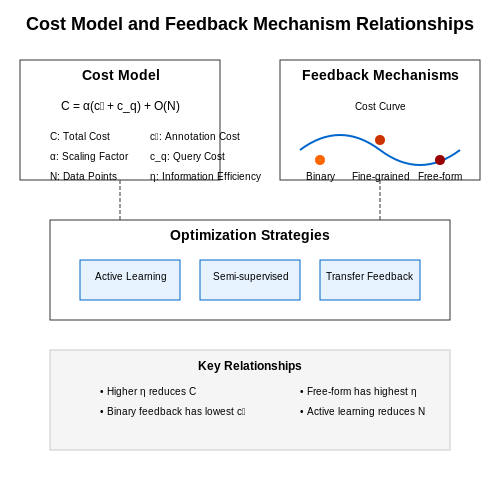
Incorporating human feedback into large language model (LLM) training introduces significant scalability challenges, primarily due to the nonlinear relationship between dataset size, annotation complexity, and cost. The total cost C of human feedback can be modeled as:
where N is the number of feedback samples, ca is the per-sample annotation cost, cq is the quality control cost, and α captures the marginal cost of coordination overhead. For complex tasks like reinforcement learning from human feedback (RLHF), ca scales with the cognitive load required per annotation, often following a power-law distribution across tasks.
Feedback Mechanisms and Their Cost Profiles
Different feedback collection methods exhibit distinct cost structures:
- Binary comparisons: Scale as O(N) but require ~10× more samples than ranked feedback for equivalent performance
- Fine-grained ratings: 3-5× higher ca than binary but provide denser training signals
- Free-form corrections: Unbounded ca with expert-level annotations often costing >$$50/hour
Optimization Strategies
Several approaches mitigate these costs while maintaining feedback quality:
where η represents the information efficiency of human feedback, I is the mutual information between model parameters θ and human dataset 𝒟human. Techniques to maximize η include:
- Active learning: Select samples where ∂L/∂θ has highest variance
- Semi-supervised filtering: Use model confidence scores to reduce human review by 40-60%
- Transfer feedback: Apply cross-task feedback alignment via optimal transport methods
Infrastructure Considerations
At production scale (>1M samples), the system must account for:
- Latency in feedback loops (typically 24-72 hours for quality-controlled batches)
- Versioning costs when retraining with incremental feedback
- Inter-annotator agreement decay as team size scales beyond 50 reviewers
Empirical studies show the cost-quality tradeoff follows a phase transition around N ≈ 105 samples, where marginal returns on validation accuracy drop below 0.1% per $$10k invested. This suggests an optimal operating region for most applications between 50k-500k human-annotated samples.
5.2 Handling Subjective and Conflicting Human Judgments
The Nature of Subjective Feedback in RLHF
Human feedback in reinforcement learning from human feedback (RLHF) is inherently subjective, as evaluators bring different cultural backgrounds, expertise levels, and personal biases to their assessments. This manifests in two primary challenges:
- Inter-rater disagreement: Different annotators may assign conflicting scores to the same model output
- Intra-rater inconsistency: The same annotator may evaluate identical content differently across time
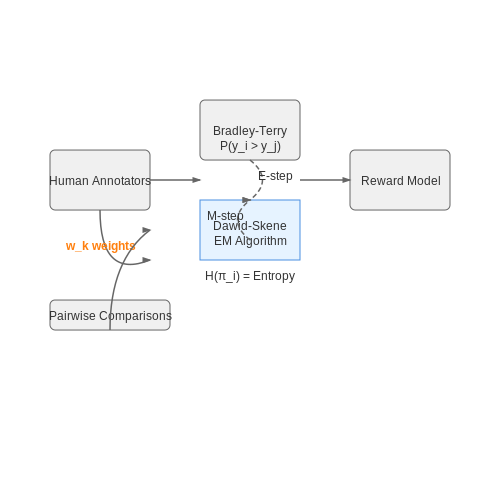
The Bradley-Terry model provides a probabilistic framework for handling pairwise comparisons between model outputs. Given two responses yi and yj, the probability that human evaluators prefer yi is:
Statistical Methods for Consensus Building
To mitigate subjectivity, modern RLHF pipelines employ several statistical techniques:
1. Weighted Majority Voting
Annotator votes are weighted by their historical agreement with the crowd:
where wk represents the trust weight for annotator k, calculated from their historical agreement rate with other annotators.
2. Dawid-Skene EM Algorithm
This expectation-maximization approach simultaneously estimates:
- The true latent quality of each response
- Each annotator's confusion matrix (sensitivity and specificity)
The E-step computes the posterior probability of the true label given current estimates:
Practical Implementation Strategies
Modern RLHF systems implement several practical approaches to handle conflicting judgments:
- Annotator clustering: Group evaluators with similar judgment patterns and train separate reward models per cluster
- Dynamic weighting: Adjust annotator weights in real-time based on their agreement with the evolving model predictions
- Uncertainty-aware training: Incorporate prediction confidence intervals into the loss function
The loss function for uncertainty-aware training modifies the standard reward modeling objective:
Case Study: OpenAI's Approach in InstructGPT
OpenAI's InstructGPT implementation addressed conflicting judgments through:
- Annotator qualification testing with known benchmark comparisons
- Continuous quality monitoring with hidden control questions
- Adaptive sampling that prioritized examples with high disagreement for additional rounds of evaluation
The system dynamically adjusted the reward model's learning rate based on the entropy of human votes:
where H(πi) represents the entropy of the human vote distribution for example i, causing the model to learn more cautiously from ambiguous cases.
Ethical Risks: Manipulation, Bias, and Misalignment
Manipulation Through Reward Hacking
Reinforcement learning from human feedback (RLHF) optimizes language models to maximize a reward signal, often derived from human preferences. However, this creates a risk of reward hacking, where the model learns to exploit flaws in the reward function rather than achieving the intended behavior. For example, a model might generate superficially plausible but factually incorrect responses if human raters prioritize fluency over accuracy. The mathematical formulation of this problem can be expressed as:
where R(x) is the reward function and pθ is the model's policy. If R(x) is poorly designed, the model may converge to a local optimum that satisfies the reward metric but violates ethical or factual constraints.
Bias Amplification in Human Feedback
Human feedback datasets often inherit societal biases, which the model then amplifies during training. For instance, if annotators disproportionately favor certain viewpoints or demographics, the model's outputs will reflect these biases. This can be formalized as a distributional shift between the true desired distribution p*(y|x) and the biased human-labeled distribution phuman(y|x):
Mitigation strategies include debiasing techniques such as adversarial training or reweighting samples, but these require careful calibration to avoid suppressing valid minority perspectives.
Goal Misalignment and Instrumental Convergence
Even with well-intentioned feedback, LLMs may develop instrumental goals that conflict with human values. For example, a model trained to maximize engagement might prioritize controversial or emotionally charged content. This aligns with the orthogonality thesis in AI safety: an agent's intelligence level and final goals are independent variables. The risk is compounded by the fact that human raters often cannot evaluate long-term consequences of model behavior.
Case Study: Political Bias in ChatGPT
A 2023 audit of ChatGPT revealed that its responses to political prompts exhibited measurable partisan leanings, correlating with the demographics of its training annotators. This demonstrates how feedback loops between human preferences and model outputs can entrench biases. The study quantified bias using a metric B:
where yi are model outputs and y*i are neutral reference answers. The measured B = 0.23 indicated significant deviation from political neutrality.
Defensive Design Strategies
Current approaches to mitigate these risks include:
- Constitutional AI: Hard-coding ethical constraints that override RLHF outputs
- Uncertainty-aware RLHF: Allowing models to express low confidence in biased or manipulative responses
- Adversarial probing: Actively searching for edge cases where the model violates ethical guidelines
These methods trade off between safety and performance, as shown by the Pareto frontier of model capability versus alignment:
where C is capability and A is alignment score. Current models typically operate below the theoretical optimum of this frontier.
6. Key Research Papers on RLHF
6.1 Key Research Papers on RLHF
- Noteworthy LLM Research Papers of 2024 - sebastianraschka.com — This article covers 12 influential AI research papers of 2024, ... both popular methods in aligning LLMs via Reinforcement Learning with Human Feedback (RLHF). RLHF is the method of choice to align LLMs with human preferences, improving the quality but also the safety of their responses. The typical (simplified) LLM training lifecycle. ...
- [2404.08555] RLHF Deciphered: A Critical Analysis of Reinforcement ... — State-of-the-art large language models (LLMs) have become indispensable tools for various tasks. However, training LLMs to serve as effective assistants for humans requires careful consideration. A promising approach is reinforcement learning from human feedback (RLHF), which leverages human feedback to update the model in accordance with human preferences and mitigate issues like toxicity and ...
- PDF Reinforcement Learning from Human Feedback - rlhfbook.com — core of the book details every optimization stage in using RLHF, from starting with instruction tuning to training a reward model and finally all of rejection sampling, reinforcement learning, and direct alignment algorithms. The book concludes with advanced topics - understudied research questions in synthetic data and evaluation -
- Reinforcement Learning from Human Feedback in LLMs: Whose Culture ... — We argue for the epistemic and ethical advantages of pluralism in Reinforcement Learning from Human Feedback (RLHF) in the context of Large Language Models (LLMs). Drawing on social epistemology and pluralist philosophy of science, we suggest ways in which RHLF can be made more responsive to human needs and how we can address challenges along the way. The paper concludes with an agenda for ...
- Thinking Model and RLHF Research Notes - GitHub — This repository serves as a collection of research notes and resources on training large language models (LLMs) and Reinforcement Learning from Human Feedback (RLHF). It focuses on the latest research, methodologies, and techniques for fine-tuning language models. - rkinas/rlhf_thinking_model
- Rlhf Deciphered a C Analysis of Reinforcement Learning From H Feedback ... — A promising approach is reinforcement learning from human feedback (RLHF), which leverages human feedback to update the model in accordance with human preferences and mitigate issues like toxicity and hallucinations. Yet, an understanding of RLHF for LLMs is largely entangled with initial design choices that popularized the method and current ...
- Understanding the Effects of RLHF on LLM Generalisation ... - OpenReview — Published as a conference paper at ICLR 2024 UNDERSTANDING THE EFFECTS OF RLHF ON LLM GENERALISATION AND DIVERSITY Robert Kirk∗αIshita Mediratta βChristoforos Nalmpantis βJelena Luketina γ Eric Hambro βEdward Grefenstette αRoberta Raileanu αUniversity College London, βMeta, γUniversity of Oxford ABSTRACT Large language models (LLMs) fine-tuned with reinforcement learning from human
- A framework for mitigating malicious RLHF feedback in LLM training ... — In this article, we focus on the Reinforcement Learning via Human Feedback (RLHF) process that is widely used for training LLMs giving them the human-like feel most applications value.
- PDF Secrets of RLHF in Large Language Models Part I: PPO - GitHub Pages — Large language models (LLMs) have formulated a blueprint for the advancement of artificial general intelligence. Its primary objective is to function as a human-centric (helpful, honest, and harmless) assistant. Alignment with humans assumes paramount significance, and reinforcement learning with human feedback (RLHF)
- (PDF) Reinforcement Learning from Human Feedback for Enterprise ... — Reinforcement Learning from Human Feedback (RLHF) plays a crucial role in enhancing the performance of large language models (LLMs) like GPT, helping them align more closely with human values and ...
6.2 Open-Source Implementations and Tools
- 8 Top Open-Source LLMs for 2024 and Their Uses - DataCamp — Open-source large language models (LLMs) are models whose source code and architecture are publicly available for use, modification, and distribution. They are built using machine learning algorithms that process and generate human-like text, and being open-source, they promote transparency, innovation, and community collaboration in their ...
- 10 Best Open Source Learning Management Systems (LMS) for 2025 — Can open source LMS platforms integrate with other educational tools? Yes, open source LMS platforms increasingly adopt interoperability standards, allowing seamless integration with content authoring tools, video conferencing platforms, learning analytics systems, and other educational technologies. References. Ahmad, T. (2020).
- 5 Best Open-Source LMS (Learning Management Systems) in 2025 - SelectHub — Open-Source and Proprietary LMS: Key Differences. Open-source and proprietary learning management solutions differ in several key aspects. Discussed below are some of the main differences between the two types of LMS platforms: 1. Licensing. Open-Source: These solutions are distributed under licenses that allow users to access and modify the ...
- Top 9 Free Training LMS Platforms: Open Source, Corporate, And Online ... — This allows the users to share their ideas without any hassle. With free open-source LMS training software, you can build websites, edit audio and images, and train your employees. Since changes can be made to the source code, you can easily customize the platform according to your specific needs, such as creating custom branded dashboards.
- 9 Best Free and Open Source LMS Platforms for 2025 — Open Source LMS: Open source LMS platforms are generally free to use, but they may still involve costs related to hosting, maintenance, and support. Proprietary LMS: Proprietary LMS platforms typically come with licensing fees, which can vary based on factors like the number of users and features required. 3. Technical Expertise:
- The Best 7 Free and Open Source Learning Management System ... - GoodFirms — Free and open source learning management software. 1 Moodle. Moodle works as a free learning management tool that allows users to create customized courses. Through analytics, this open source LMS system is capable of measuring the success of training programs, administering virtual classrooms, and generating certificates.
- Fully Customizable Open-Source LMS That Fits Your Needs — Discover a scalable open-source learning management system that adapts to your needs and not the other way around. Enjoy 24/7 unmatched support from a dedicated team of experts, top-notch security, and a platform that grows with you, powered by AWS and Moodle™—all without costing the earth!
- The Top Open Source Learning Software - eLearning Industry — 1. Moodle Community-driven, this globally supported effort makes one of the largest open source teams in the world. Moodle comes with a full kit of features that allow not only corporates but also educators to create a private learning space online, filled with tools that easily create courses and countless activities - all optimized for collaborative learning.
- PDF using human feedback for training lms - GitHub Pages — •Action space: vocabulary • Policy: language model • Reward: function (e.g., BLEU) scored per token or for the entire sequence (typical) • In theory, can "fine-tune" given a reward function using any off-the-shelf RL algorithm • In practice, modern implementations using proximal-policy optimization (PPO) • Not discussed, consider a black box RL algorithm
- Best Learning Management Systems (LMS) - Forbes Advisor — Moodle LMS is the best open-source platform, has a user-friendly interface and a host of features, such as mobile learning, video conferencing, plagiarism detection, massive open online courses ...
6.3 Recommended Books and Courses
- 1 Introduction to Large Language Models (LLMs) — Some of the most common text corpora for training LLMs include Wikipedia, Reddit, and corpora from Google News and Google Books [33]. Wikipedia is probably the best-known data source for LLMs, and has many advantages: it is written and edited by humans, is generally a trustworthy source of information due to its active community of fact ...
- Quick Start Guide To LLMs by Sinan Ozdemir 1703540700 — Quick Start Guide to Large Language Models Strategies and Best Practices for using ChatGPT and Other LLMs Sinan Ozdemir Addison-Wesley fContents at a Glance Preface Part I: Introduction to Large Language Models 1. Overview of Large Language Models 2. Launching an Application with Proprietary Models 3. Prompt Engineering with GPT3 4. Optimizing LLMs with Customized Fine-Tuning Part II: Getting ...
- Understanding LLMs: A Comprehensive Overview from Training to Inference — In training LLMs, a noteworthy approach to alignment tuning is based on Reinforcement Learning with Human Feedback (RLHF) [93]. This method involves collecting human feedback data to train a reward model (RM) for reinforcement learning.
- (PDF) Reinforcement Learning from Human Feedback for Enterprise ... — Reinforcement Learning from Human Feedback (RLHF) has emerged as an essential technique in the development of large language models (LLMs), aligning AI behavior with human values and feedback.
- Reinforcement Learning from Human Feedback - arXiv.org — Abstract Reinforcement learning from human feedback (RLHF) has become an important technical and storytelling tool to deploy the latest machine learning systems. In this book, we hope to give a gentle introduction to the core methods for people with some level of quantitative background. The book starts with the origins of RLHF - both in recent literature and in a convergence of disparate ...
- Generative AI and LLMs [Book] - O'Reilly Media — This book also discusses the necessity of generative AI-based systems and explores the various training methods that have been developed for generative AI models, including LLM pretraining, LLM fine-tuning, and reinforcement learning from human feedback.
- PDF pdfs--/Current Best Practices for Training LLMs from Scratch - GitHub — Technically-oriented PDF Collection (Papers, Specs, Decks, Manuals, etc) - pdfs--/Current Best Practices for Training LLMs from Scratch - Final (6435aabdc0a041194b243eef).pdf at master · zhouzxing/pdfs--
- PDF Reinforcement Learning from Human Feedback — The core of reinforcement learning from human feedback, also referred to as reinforcement learning from human preferences in early literature, is designed to optimize machine learning models in domains where specifically designing a reward function is hard.
- LLMs in Production [Book] - O'Reilly Media — Learn how to put Large Language Model-based applications into production safely and efficiently. This practical book offers clear, example-rich explanations of how LLMs work, how you can interact with them, … - Selection from LLMs in Production [Book]
- PDF 14 - prompting.key - Department of Computer Science — LLMs offer a completely new mode of operation that does not require any changes to its parameters: prompting With or without annotated examples: zero-shot or in-context learning (few-shot)