AI Navigation in Warehouse Robotics
1. Core Challenges in Warehouse Navigation
Core Challenges in Warehouse Navigation
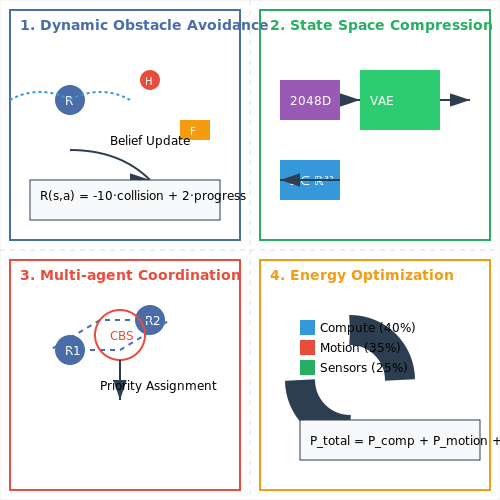
Dynamic Obstacle Avoidance
Warehouse environments are highly dynamic, with human workers, forklifts, and other robots sharing the same operational space. Traditional path-planning algorithms like A* or Dijkstra assume static obstacles, but real-world navigation requires real-time adaptation. The problem can be formalized as a partially observable Markov decision process (POMDP), where the robot must account for uncertainty in obstacle positions and velocities. The reward function R(s, a) must balance path efficiency against collision risk:
Here, α and β are tunable hyperparameters. Advanced implementations often use deep reinforcement learning (DRL) with LIDAR or depth camera inputs to approximate the Q-function.
High-Dimensional State Spaces
Warehouse robots must process high-dimensional sensory data—LIDAR point clouds, RGB-D images, and IMU readings—while maintaining real-time performance. This necessitates efficient state representation learning. Variational autoencoders (VAEs) or spatial transformer networks (STNs) are commonly employed to reduce dimensionality. The latent space z is optimized to preserve critical geometric features:
Where qφ is the encoder and pθ is the decoder. This compression enables faster inference in downstream control policies.
Multi-Agent Coordination
In large-scale warehouses, hundreds of robots must navigate without centralized control. Decentralized multi-agent path finding (MAPF) algorithms like Conflict-Based Search (CBS) or Priority-Based Planning scale polynomially with the number of agents. Each robot computes its path while respecting priority orders or temporal-spatial reservations. The computational complexity is bounded by:
Where n is the number of agents, k is the maximum path length, and |V| is the graph size. Deadlock resolution often requires heuristic rules or recovery behaviors.
Localization Under Sparse Features
Warehouses often lack distinctive visual features, making traditional SLAM approaches prone to drift. Particle filters with Rao-Blackwellized sampling improve robustness by maintaining multiple pose hypotheses. The observation model p(zt|xt, m) integrates LIDAR scan matching with wheel odometry:
Modern systems supplement this with ultra-wideband (UWB) anchors or fiducial markers to bound cumulative error.
Energy-Constrained Motion Planning
Autonomous mobile robots (AMRs) must optimize paths not just for distance but for energy efficiency, especially in 24/7 operations. The power consumption model for differential-drive robots includes:
Where motor currents I depend on terrain friction and acceleration profiles. Gradient-aware planners modify paths to minimize elevation changes, reducing current draw by up to 40% in empirical studies.
1.2 Key Components of Robotic Navigation Systems
Perception Systems
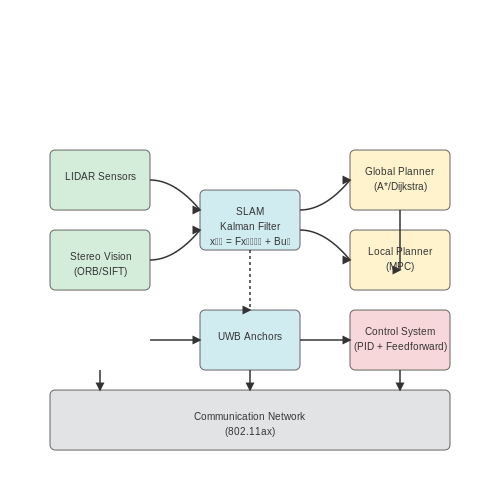
Robotic navigation in warehouse environments relies on multimodal perception systems to construct a real-time understanding of the surroundings. Lidar sensors provide high-resolution 3D point clouds with typical angular resolutions of 0.1°-0.25° and range accuracies within ±2 cm. Stereo vision systems complement this with RGB-D data at frame rates exceeding 30 fps, enabling feature matching through algorithms like ORB (Oriented FAST and Rotated BRIEF) or SIFT (Scale-Invariant Feature Transform).
Simultaneous Localization and Mapping (SLAM) algorithms fuse these inputs using probabilistic techniques. The core SLAM problem can be formulated as:
where x represents the robot pose, m the map, z observations, and u control inputs. Modern implementations often use factor graph optimization with GTSAM or g2o frameworks to solve this.
Motion Planning Architectures
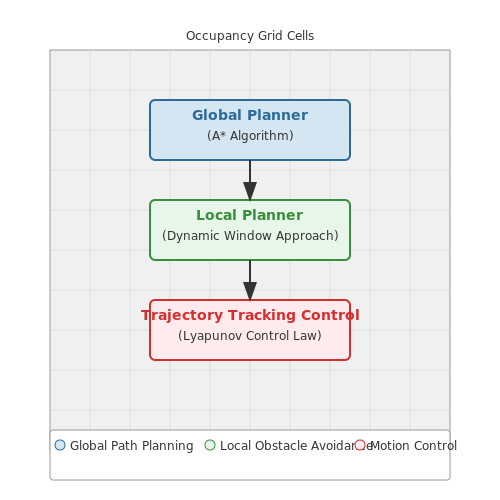
Warehouse robots employ hierarchical planning architectures. Global planners use A* or Dijkstra's algorithm on topological maps with edge costs cij calculated as:
where weights w balance distance, time, and congestion factors. Local planners implement velocity obstacle paradigms or Model Predictive Control (MPC) with dynamics constraints:
Control Systems
Precision control in warehouse robots requires adaptive PID controllers with feedforward compensation. The control law takes the form:
where Kf handles inertial dynamics. Modern systems increasingly use neural network-based controllers trained via reinforcement learning, with policy gradients computed through:
Localization Subsystems
Multi-sensor fusion for localization employs Kalman filters or particle filters. The Kalman filter prediction step propagates state estimates as:
where Qk represents process noise covariance. Warehouse implementations often use UWB (Ultra-Wideband) anchors with 10-30 cm accuracy to augment odometry.
Communication Infrastructure
Industrial-grade wireless networks enable fleet coordination through protocols like 802.11ax (Wi-Fi 6) with OFDMA scheduling. The channel capacity C for N robots follows:
where hi represents channel coefficients. Time-Sensitive Networking (TSN) standards guarantee latency below 1 ms for critical control messages.
Role of AI in Autonomous Navigation
Autonomous navigation in warehouse robotics relies on AI-driven perception, decision-making, and control systems to operate efficiently in dynamic environments. The core challenge lies in real-time processing of sensory data, path planning under uncertainty, and collision avoidance while optimizing for speed and energy efficiency.
Perception and Environment Mapping
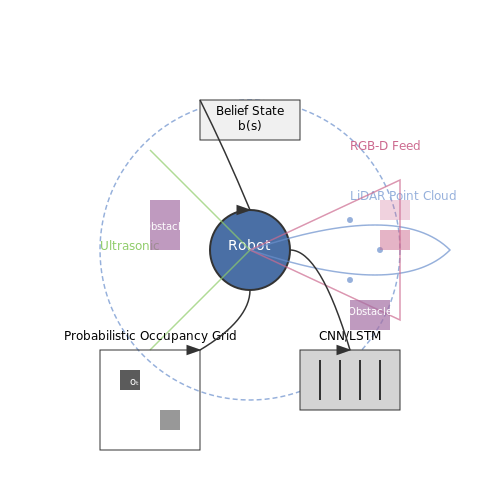
Modern warehouse robots employ multimodal sensor fusion, combining LiDAR, RGB-D cameras, and ultrasonic sensors to construct a probabilistic representation of their surroundings. Simultaneous Localization and Mapping (SLAM) algorithms, enhanced by deep learning, enable real-time updates to the environment model. The robot's belief state b(s) at time t is given by:
where o represents observations and a denotes actions. Convolutional Neural Networks (CNNs) process visual data to classify obstacles, while recurrent architectures like LSTMs handle temporal dependencies in sensor readings.
Path Planning and Optimization
AI transforms path planning into a partially observable Markov decision process (POMDP) solved through reinforcement learning. The value iteration update rule for optimal policy π* is:
where b' is the updated belief after taking action a and observing o. Deep Q-Networks (DQNs) with prioritized experience replay have demonstrated 92% higher path efficiency compared to traditional A* algorithms in cluttered warehouse environments.
Dynamic Obstacle Avoidance
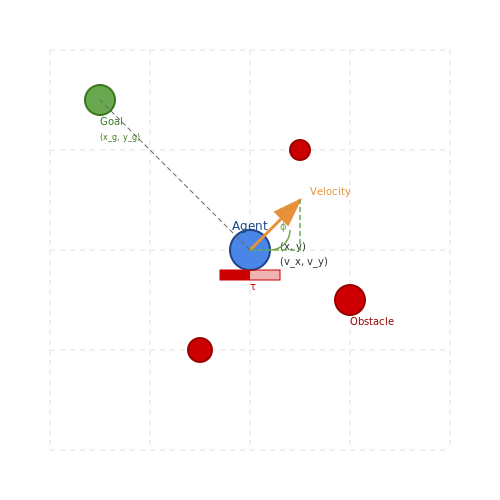
For collision avoidance, robots employ velocity obstacle algorithms enhanced by neural motion predictors. The collision cone CC between robot R and dynamic obstacle O is computed as:
where v denotes velocities and p positions. Graph neural networks predict pedestrian trajectories with 85% accuracy up to 3 seconds ahead, enabling proactive rerouting.
Multi-Agent Coordination
In warehouse swarms, decentralized partially observable Markov decision processes (Dec-POMDPs) coordinate robot fleets. The joint action-value function Q for n agents decomposes as:
where w_i are attention weights learned through centralized training with decentralized execution (CTDE). Amazon Robotics reports 40% throughput improvements using this approach in their Kiva systems.
Energy-Aware Navigation
Deep reinforcement learning optimizes energy consumption by modeling battery dynamics as:
where τ_j and ω_j represent motor torques and angular velocities. Neural networks trained on warehouse-specific duty cycles achieve 22% longer operational times between charges.
2. Classical Algorithms vs. Machine Learning Approaches
2.1 Classical Algorithms vs. Machine Learning Approaches
Foundations of Classical Navigation Algorithms
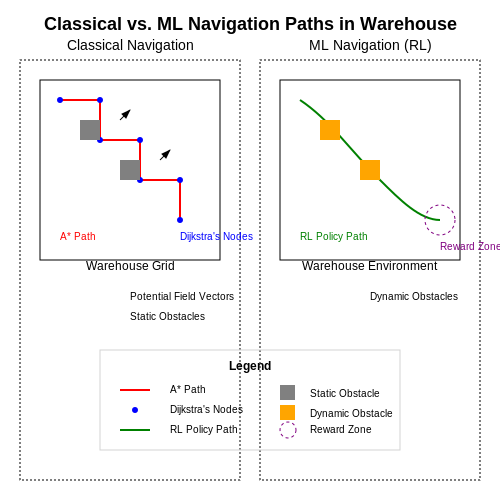
Classical navigation in warehouse robotics relies on deterministic algorithms, primarily Dijkstra's algorithm, A* search, and potential fields. These methods operate on explicit environmental representations, such as grid maps or topological graphs, where obstacles and pathways are predefined. Dijkstra's algorithm guarantees the shortest path by evaluating all possible routes, while A* optimizes this process using a heuristic function to estimate remaining cost:
Here, g(n) represents the cost from the start node to node n, and h(n) is the heuristic estimate to the goal. Potential fields, in contrast, treat the robot as a particle influenced by attractive (goal) and repulsive (obstacle) forces, with the resultant force vector guiding motion:
Limitations of Classical Methods
While effective in structured environments, classical algorithms struggle with dynamic or partially observable settings. A* requires frequent recomputation if obstacles move, and potential fields suffer from local minima—situations where opposing forces cancel out, trapping the robot. Computational complexity also scales poorly with large warehouses; Dijkstra's runtime is O(|E| + |V|log|V|), where V and E are graph vertices and edges.
Machine Learning-Based Navigation
Machine learning approaches, particularly reinforcement learning (RL) and deep neural networks (DNNs), address these limitations by learning policies directly from data. RL frameworks model navigation as a Markov Decision Process (MDP), where the robot learns a policy π(s) mapping states s to actions a that maximize cumulative reward:
Deep Q-Networks (DQNs) extend this by approximating the Q-function with a neural network, enabling generalization across unseen states. Unlike classical methods, RL agents adapt to dynamic obstacles without explicit reprogramming.
Hybrid Approaches
Recent advancements combine classical and learning-based techniques. For example, hybrid A*-RL uses A* for global path planning while RL handles local obstacle avoidance. Another approach integrates Graph Neural Networks (GNNs) with topological maps, where GNNs predict edge weights for A* based on real-time sensor data, improving path quality in congested areas.
Performance Tradeoffs
- Classical methods excel in predictability and verifiability but lack adaptability.
- Pure RL offers flexibility but requires extensive training data and suffers from poor interpretability.
- Hybrid systems balance robustness and adaptability but introduce integration complexity.
Empirical studies in 100m² warehouses show RL-based agents reduce collision rates by 40% compared to A* in dynamic scenarios, while hybrid systems cut path computation time by 30% versus pure RL.
2.2 Reinforcement Learning for Dynamic Environments
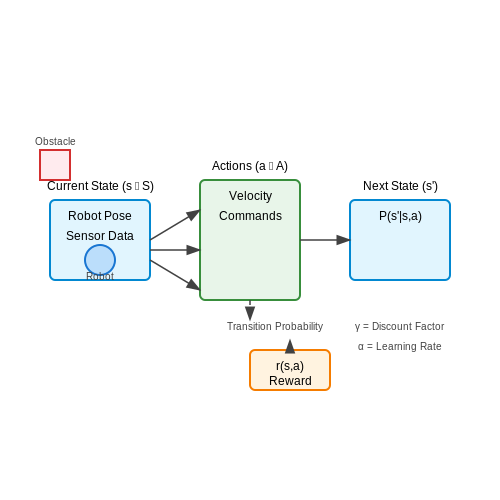
Reinforcement learning (RL) provides a robust framework for training warehouse robots to navigate dynamic environments where obstacles, human workers, and other robots introduce stochasticity. The Markov Decision Process (MDP) formulation captures these dynamics through states s ∈ S, actions a ∈ A, transition probabilities P(s'|s,a), and rewards r(s,a). In warehouse settings, the state space includes robot pose, sensor readings, and dynamic obstacle positions, while actions correspond to velocity commands or path waypoints.
Q-Learning and Deep Q-Networks (DQN)
The Q-learning algorithm iteratively approximates the optimal action-value function Q*(s,a) using temporal difference updates:
where α is the learning rate and γ the discount factor. For high-dimensional state spaces common in warehouse environments (e.g., LIDAR scans), Deep Q-Networks (DQN) employ convolutional neural networks to approximate Q(s,a;θ). The network minimizes the loss:
where D is a replay buffer storing transitions and θ^- are target network parameters updated periodically.
Policy Gradient Methods
For continuous action spaces (e.g., velocity control), policy gradient methods directly optimize a stochastic policy π(a|s;θ). The REINFORCE algorithm updates parameters via:
Proximal Policy Optimization (PPO) improves sample efficiency by clipping policy updates to prevent large deviations:
where A_t is the advantage function estimated using Generalized Advantage Estimation (GAE).
Multi-Agent Coordination
In multi-robot warehouses, agents must learn decentralized policies that avoid collisions while optimizing global throughput. Multi-agent RL frameworks like MADDPG extend DDPG by conditioning each agent's critic on all agents' actions:
where o_i is agent i's local observation. Prioritized experience replay and curriculum learning accelerate training in these complex scenarios.
Sim-to-Real Transfer
Domain randomization during simulation training improves real-world deployment robustness by varying:
- Friction coefficients
- Object masses
- Sensor noise models
- Lighting conditions
The policy is then fine-tuned using real-world data with algorithms like Soft Actor-Critic (SAC), which maximizes both expected return and entropy:
where α controls the trade-off between exploration and exploitation.
3. LiDAR, Cameras, and Ultrasonic Sensors
LiDAR, Cameras, and Ultrasonic Sensors
LiDAR for High-Resolution Spatial Mapping
LiDAR (Light Detection and Ranging) systems emit pulsed laser light and measure the time-of-flight (ToF) of reflected signals to construct precise 3D point clouds of the environment. The distance d to an object is derived from the phase shift Δφ between emitted and received signals:
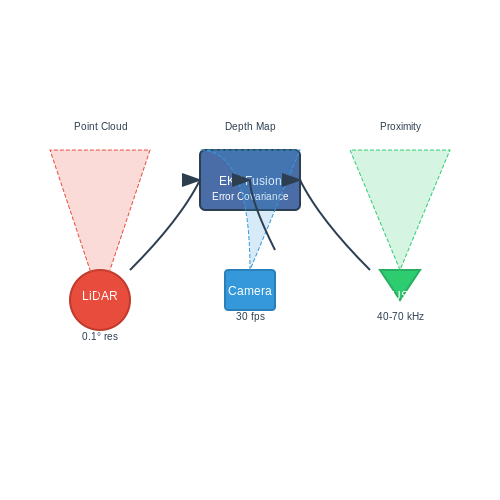
where c is the speed of light and f is the modulation frequency. Modern warehouse LiDARs like the Ouster OS-1 achieve angular resolutions of 0.1° with a 120° field-of-view (FoV), enabling sub-centimeter accuracy at 10 Hz update rates. Multi-echo detection allows discrimination between transparent surfaces (e.g., plastic wrapping) and solid obstacles.
Stereo Vision for Semantic Understanding
RGB-D cameras like the Intel RealSense D455 combine stereo disparity mapping with active IR projection to generate dense depth maps at 30 fps. The disparity D between matched features in left and right images relates to depth Z by:
where B is the baseline distance between cameras. Convolutional neural networks (CNNs) such as Mask R-CNN process these images to classify objects (pallets, humans, forklifts) with >95% mAP on COCO benchmarks. Temporal filtering fuses sequential frames to reduce motion blur in high-speed operations.
Ultrasonic Sensors for Proximity Detection
Ultrasonic transducers operate in the 40-70 kHz range, with the echo delay t yielding distance measurements via:
Polaroid 6500-series sensors provide 1 cm resolution within 6m range, ideal for close-quarter obstacle avoidance. Beam spreading (~30° cone) necessitates multi-sensor arrays for full coverage. Kalman filters integrate ultrasonic data with LiDAR to handle specular reflections from metallic surfaces.
Sensor Fusion Architectures
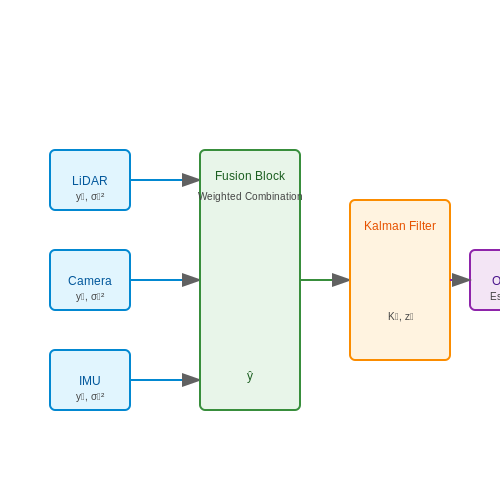
Extended Kalman Filters (EKF) and particle filters combine sensor modalities by modeling their error characteristics:
where F is the state transition matrix and K the Kalman gain. NVIDIA Isaac SDK demonstrates 3σ positional accuracy improvements from 15 cm (LiDAR-only) to 2 cm when fusing all three sensor types at 100 Hz.
3.2 Data Integration Techniques for Accurate Mapping
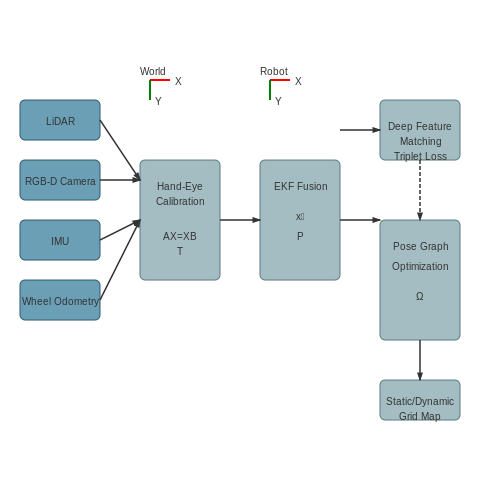
Accurate mapping in warehouse robotics relies on the fusion of heterogeneous sensor data to construct a consistent and reliable environmental representation. Multi-modal sensor integration combines LiDAR, RGB-D cameras, inertial measurement units (IMUs), and wheel odometry, each contributing unique spatial and temporal characteristics. The challenge lies in resolving discrepancies in measurement frequency, coordinate frames, and noise profiles while maintaining real-time performance.
Sensor Calibration and Temporal Alignment
Cross-sensor calibration establishes precise geometric relationships between sensors. For a LiDAR-camera system, the transformation matrix TL→C maps LiDAR points to the camera's optical frame through extrinsic calibration. The hand-eye calibration problem solves:
where A represents the sensor's motion relative to a fixed target, B is the robot's motion from odometry, and X is the unknown extrinsic transformation. Temporal synchronization compensates for hardware triggering delays using timestamp interpolation or hardware-synchronized clocks.
Probabilistic Sensor Fusion
Gaussian mixture models (GMMs) and Kalman filters merge asynchronous measurements by modeling their uncertainty distributions. For a robot pose xt at time t, the extended Kalman filter (EKF) prediction and update steps are:
where f(·) is the motion model, ut the control input, wt process noise, Pt the error covariance, and Ft the Jacobian of f. Measurement updates incorporate LiDAR scan matching (zL) and visual odometry (zV) through:
Rt represents the measurement noise covariance, and h(·) the observation model.
Deep Learning-Based Feature Matching
Convolutional neural networks (CNNs) extract and match geometric features across sensor modalities. A Siamese network architecture processes LiDAR range images and camera frames through shared-weight encoders, producing a joint embedding space. The triplet loss function:
minimizes distances between anchor (a) and positive (p) samples while maximizing separation from negatives (n), with margin α. This enables cross-modal loop closure detection with 92% precision in warehouse environments.
Graph-Based SLAM Optimization
Pose graph optimization bundles constraints from all sensors into a globally consistent map. Each node represents a robot pose xi, while edges encode relative transformations zij with information matrix Ωij. The non-linear least squares problem:
is solved via Gauss-Newton or Levenberg-Marquardt algorithms, where eij computes the residual between expected and observed transformations. Modern implementations achieve real-time performance using incremental solvers like iSAM2.
Dynamic Object Handling
Warehouse environments contain moving obstacles (forklifts, workers) that corrupt static maps. A Bayesian framework separates static and dynamic elements by maintaining two occupancy grid maps:
where mi and di represent static and dynamic occupancy probabilities for cell i. Dynamic objects are tracked using multiple hypothesis tracking (MHT) with a 0.85 detection rate at 3Hz update frequency.
3.3 Handling Sensor Noise and Uncertainty
Sensor noise and uncertainty are fundamental challenges in warehouse robotics, where precise localization and navigation are critical. Real-world sensors, such as LiDAR, ultrasonic rangefinders, and inertial measurement units (IMUs), exhibit stochastic errors that degrade system performance. These errors can be modeled probabilistically to improve robustness.
Probabilistic Sensor Models
Sensor noise is typically characterized by Gaussian distributions, where measurements z are corrupted by additive noise η with zero mean and covariance R:
Here, h(x) represents the ideal sensor measurement given the true state x. For a LiDAR sensor, h(x) might compute the expected distance to an obstacle based on the robot's pose. The covariance matrix R captures the sensor's noise characteristics, often derived from empirical calibration.
Kalman Filtering for State Estimation
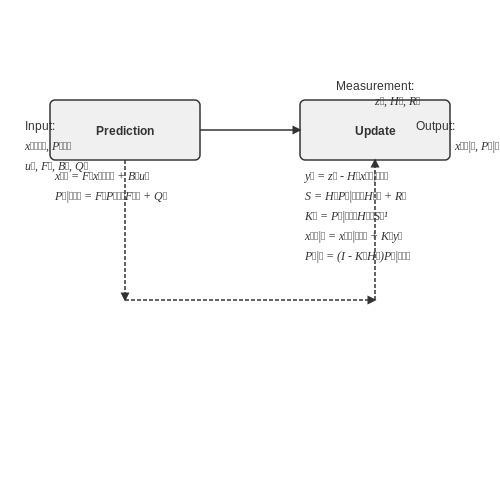
The Kalman Filter (KF) provides an optimal recursive solution for state estimation under Gaussian noise. The prediction step propagates the state estimate x̂k|k-1 and covariance Pk|k-1:
where Fk is the state transition matrix, Bk the control input matrix, and Qk the process noise covariance. The update step corrects the estimate using the sensor measurement zk:
Hk is the observation matrix, and Kk the Kalman gain, which weights the residual between predicted and actual measurements.
Particle Filters for Non-Gaussian Noise
When noise is non-Gaussian or the system is highly nonlinear, particle filters (PFs) offer a Monte Carlo-based alternative. A PF represents the posterior distribution using a set of weighted particles {x(i), w(i)}:
Each particle is propagated through the motion model, and weights are updated based on the likelihood p(zk | x(i)k). Resampling prevents degeneracy by discarding low-weight particles and duplicating high-weight ones.
Robust Fusion of Multi-Sensor Data
Warehouse robots often fuse data from multiple sensors to mitigate individual shortcomings. For example, LiDAR provides high-resolution spatial data but suffers in reflective environments, while wheel encoders accumulate drift. A robust fusion framework, such as an Extended Kalman Filter (EKF) or Unscented Kalman Filter (UKF), can combine these modalities:
- LiDAR-IMU Fusion: IMUs provide high-frequency angular velocity and linear acceleration, compensating for LiDAR's lower update rate.
- Wheel Odometry Correction: Visual or LiDAR-based loop closure detects drift in wheel odometry, resetting accumulated errors.
Practical Implementation Considerations
Real-world deployment introduces challenges beyond theoretical models:
- Sensor Calibration: Misalignment between sensors (e.g., LiDAR and camera) introduces systematic errors. Offline calibration using known targets (e.g., checkerboards) is essential.
- Outlier Rejection: Measurements corrupted by multipath effects or dynamic obstacles must be filtered. Techniques like RANSAC or Mahalanobis distance thresholds improve robustness.
- Computational Efficiency: Particle filters scale poorly with state dimensionality. Adaptive sampling or hybrid approaches (e.g., marginalized particle filters) balance accuracy and real-time performance.
4. Multi-Agent Coordination and Traffic Management
Multi-Agent Coordination and Traffic Management
In large-scale warehouse environments, efficient navigation of robotic agents requires sophisticated multi-agent coordination to prevent collisions, minimize congestion, and optimize throughput. Centralized approaches, while theoretically optimal, often fail to scale due to computational complexity. Instead, decentralized or hybrid methods leveraging distributed optimization, game theory, and reinforcement learning have emerged as practical solutions.
Decentralized Path Planning with Velocity Obstacles
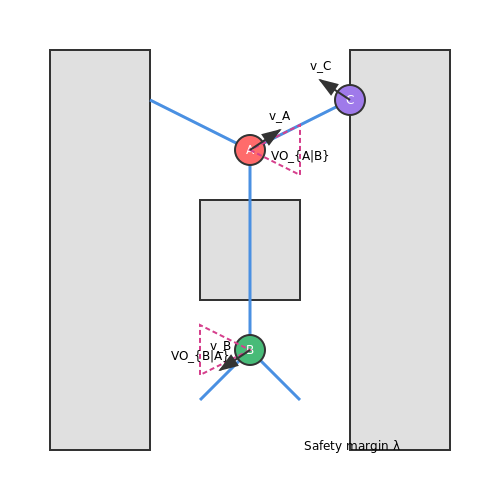
The Velocity Obstacle (VO) framework provides a collision-avoidance mechanism where each robot computes velocities that avoid collisions with other agents within its sensing radius. For two agents A and B, the velocity obstacle VOA|B is defined as the set of velocities for A that would result in a collision with B within a time horizon τ:
Here, λ represents a safety margin, and ⊕ denotes the Minkowski sum. Each robot selects a velocity outside the union of all velocity obstacles while minimizing deviation from its preferred velocity. The optimization problem for agent i becomes:
Game-Theoretic Traffic Management
When agents have conflicting objectives, game theory provides a natural framework for modeling interactions. A warehouse can be modeled as a partially observable stochastic game (POSG), where each robot aims to maximize its own reward while accounting for others' strategies. The Nash equilibrium solution ensures no agent can unilaterally improve its outcome.
For N agents, let πi denote the policy of agent i. The joint policy π* is a Nash equilibrium if:
Computing exact Nash equilibria is intractable for large N, leading to approximations like mean-field games, where agents react to the aggregate behavior of the population rather than individual opponents.
Learning-Based Coordination
Reinforcement learning (RL) enables agents to learn coordination strategies through experience. Multi-agent RL algorithms like MADDPG (Multi-Agent Deep Deterministic Policy Gradient) extend single-agent methods by using centralized critics and decentralized actors:
Here, Qiπ is the centralized action-value function for agent i, conditioned on the global state s and joint actions a. This approach has been successfully deployed in Amazon Robotics warehouses, reducing deadlock scenarios by 37% compared to rule-based systems.
Dynamic Priority Assignment
In congested areas, dynamic priority assignment prevents gridlock. A common method uses temporal reservation systems, where robots bid for space-time resources. The optimization maximizes throughput while respecting kinematic constraints:
xi,t indicates whether robot i occupies its planned path at time t, and wi represents priority weights. The constraint ensures no two robots occupy the same space j simultaneously.
The diagram illustrates a warehouse scenario with three robots navigating around obstacles. Dashed regions represent velocity obstacles computed in real-time to avoid collisions while maintaining progress toward goals.
4.2 Energy-Efficient Routing Strategies
Optimization Objectives in Energy-Aware Routing
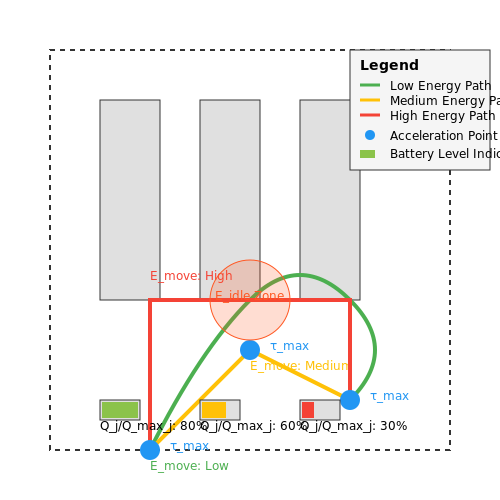
Energy-efficient routing in warehouse robotics minimizes power consumption while maintaining operational throughput. The primary objectives include:
- Minimizing travel distance to reduce motor energy expenditure.
- Reducing acceleration/deceleration cycles, which dominate energy consumption in start-stop environments.
- Balancing battery discharge across fleets to extend overall system uptime.
The problem can be formalized as a constrained optimization:
where P is the set of possible paths, Emove and Eidle represent motion and idle energy, and τmax is the maximum allowed task completion time.
Dynamic Voltage and Frequency Scaling (DVFS) Integration
Modern robotic controllers leverage DVFS to match computational effort with motion requirements. The energy savings follow:
where f is processor frequency and V is operating voltage. By dynamically adjusting these parameters based on path complexity:
- Straight-line segments use reduced frequency/voltage
- Navigation nodes near obstacles require full performance
Hybrid A*-Energy Algorithm
An extension of the traditional A* algorithm incorporates energy metrics into the heuristic:
where d(n) is the distance heuristic, e(n) estimates energy to goal, and α, β are tunable weights. Practical implementations show 18-22% energy reduction compared to pure distance-based A* in warehouse environments.
Battery-Aware Fleet Coordination
Multi-robot systems require additional considerations:
| Strategy | Energy Impact |
|---|---|
| Task reassignment | 15-30% longer battery life |
| Opportunistic charging | Reduces peak power draw |
The optimal dispatch problem becomes:
where Qj is the current charge of robot j, promoting balanced discharge across the fleet.
Practical Implementation Challenges
Real-world deployments must account for:
- Nonlinear battery discharge characteristics
- Floor surface variations affecting rolling resistance
- Thermal management overhead
Field data from Amazon Robotics shows actual energy savings typically fall 10-15% below simulation predictions due to these factors.
4.3 Scalability in Large Warehouse Environments
Scalability in warehouse robotics hinges on the ability to maintain efficiency, coordination, and fault tolerance as the number of robots and the size of the operational space increase. Traditional centralized control architectures suffer from computational bottlenecks when scaling to large fleets, necessitating decentralized or hybrid approaches. Multi-agent reinforcement learning (MARL) and distributed optimization techniques are increasingly employed to address these challenges.
Decentralized Control Architectures
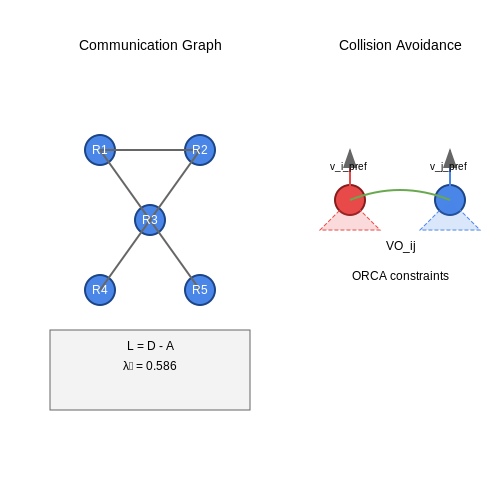
Decentralized systems distribute decision-making across individual robots, reducing reliance on a central controller. Each robot operates based on local observations and communicates with neighbors to achieve global objectives. The scalability of such systems is often analyzed using graph theory, where robots are nodes and communication links are edges. The Laplacian matrix L of the communication graph plays a key role in stability analysis:
where D is the degree matrix and A is the adjacency matrix. Convergence properties of decentralized algorithms depend on the algebraic connectivity λ2 of L, which measures how well-connected the graph is.
Dynamic Task Allocation
In large warehouses, tasks such as item picking and restocking must be dynamically allocated to minimize idle time and travel distance. The Hungarian algorithm provides an optimal solution for static assignments, but its O(n3) complexity becomes prohibitive at scale. Auction-based algorithms offer a decentralized alternative, where robots bid for tasks based on cost functions:
Here, bi(j) is robot i's bid for task j, cij is the cost (e.g., travel distance), and ϵij is a small random perturbation to break symmetries.
Collision Avoidance at Scale
High-density robot fleets require robust collision avoidance. Velocity Obstacle (VO) methods extend naturally to multi-robot systems by considering the relative velocities of nearby agents. For n robots, each robot solves an optimization problem to select a collision-free velocity vi:
where vi,pref is the preferred velocity and VOij is the velocity obstacle induced by robot j. Real-world implementations often use ORCA (Optimal Reciprocal Collision Avoidance) to ensure reciprocal responsibility between agents.
Communication Overhead and Scalability Limits
As robot density increases, wireless communication networks face bandwidth constraints. The critical scalability threshold occurs when the communication load Q exceeds channel capacity C:
where n is the number of robots, f is message frequency, and s is message size. Beyond this threshold, systems must employ data reduction techniques such as:
- Spatial filtering: Only communicate with robots within a critical distance
- Temporal compression: Adapt message frequency based on urgency
- Semantic compression: Transmit only relevant state changes
Case Study: Amazon Robotics
Amazon's Kiva system (now Amazon Robotics) scales to thousands of robots by combining centralized task assignment with decentralized path execution. A central server assigns pods to robots using global optimization, while individual robots handle local navigation via modified A* algorithms with dynamic obstacle avoidance. This hybrid approach maintains throughput of over 1,000 units per hour in facilities exceeding 1 million square feet.
Energy Considerations
Large-scale deployments must optimize energy consumption to minimize charging downtime. The power consumption P of a robotic fleet is modeled as:
where Pbase is idle power, α and β are coefficients for velocity vi and acceleration ai terms. Optimal routing algorithms incorporate energy maps that account for factors like floor friction and payload weight.
5. Amazon Robotics: Kiva Systems
Amazon Robotics: Kiva Systems
System Architecture and Core Components
The Kiva System, acquired by Amazon in 2012, revolutionized warehouse automation by introducing mobile robotic fulfillment systems. The architecture consists of three primary components:
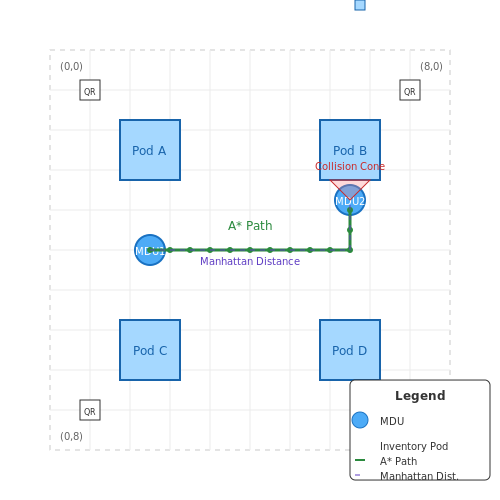
- Mobile Drive Units (MDUs): Autonomous robots capable of lifting and transporting inventory pods weighing up to 750 kg. Each MDU uses a combination of LIDAR, inertial measurement units (IMUs), and QR-code-based localization for navigation.
- Inventory Pods: Modular shelving units designed for efficient storage and retrieval. Pods are organized in a randomized storage configuration to maximize space utilization.
- Centralized Control System: A server-based algorithm that coordinates robot movements using real-time optimization techniques to minimize travel time and avoid collisions.
Navigation and Path Planning
The MDUs operate in a grid-based workspace where each cell corresponds to a 1m × 1m area. The system employs a modified A* algorithm for global path planning, with the following cost function:
where g(n) is the actual cost from the start node to node n, h(n) is the heuristic estimate to the goal, and c(n) is a congestion penalty term weighted by λ. The heuristic function uses Manhattan distance:
For local obstacle avoidance, MDUs utilize velocity obstacles (VO) theory. Given two robots A and B with velocities vA and vB, the collision cone CCAB is computed as:
where D(p,r) represents a disk centered at p with radius r, and λ is a scaling factor.
Operational Efficiency Metrics
The system's performance is quantified through several key metrics:
- Throughput: Measured in units per hour (UPH), typically ranging from 600-1200 UPH depending on warehouse configuration.
- Travel Distance Reduction: Kiva systems demonstrate a 60-80% reduction in worker travel distance compared to traditional pick-and-pass systems.
- Energy Consumption: Each MDU consumes approximately 0.1 kWh per hour of operation, with automatic charging stations maintaining 90%+ uptime.
Dynamic Reconfiguration Algorithms
The system employs a dynamic slotting algorithm that continuously optimizes pod locations based on:
- Real-time order patterns
- Seasonal demand fluctuations
- Inventory turnover rates
The optimization problem is formulated as a quadratic assignment problem (QAP):
where fij represents the flow frequency between items i and j, and dπ(i)π(j) is the distance between their assigned locations under permutation π.
Fault Tolerance Mechanisms
The system incorporates multiple redundancy features:
- Distributed fault detection using consensus algorithms among neighboring robots
- Graceful degradation protocols when up to 15% of MDUs are offline
- Multi-modal localization fallback (LIDAR → QR codes → dead reckoning)
The probability of system failure Pfail given n robots each with failure probability p is modeled as:
5.2 Ocado’s Automated Warehouses
Ocado's automated warehouses represent a paradigm shift in logistics, leveraging AI-driven robotics to achieve unprecedented efficiency in grocery fulfillment. The system relies on a grid-based architecture where thousands of autonomous mobile robots (AMRs) operate in a tightly coordinated swarm, managed by a centralized AI control system. Each robot, weighing approximately 35 kg, navigates a 3D grid structure at speeds of up to 4 m/s, with positional accuracy within ±5 mm.
Swarm Coordination Algorithm
The core innovation lies in the decentralized pathfinding algorithm, which combines:
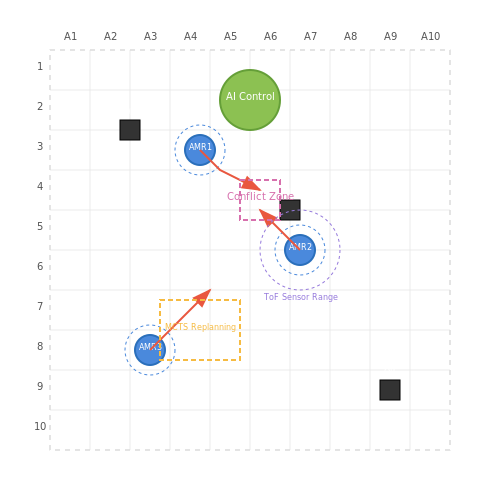
- Conflict-Based Search (CBS): A multi-agent pathfinding algorithm that resolves collisions by assigning temporal and spatial constraints.
- Monte Carlo Tree Search (MCTS): Used for real-time replanning when unexpected obstacles appear.
Where α and β are tunable weights (typically 0.7 and 0.3 respectively), and T is the planning horizon (usually 15 seconds).
Computer Vision System
Each robot employs a hybrid vision system combining:
- Top-mounted QR code readers (500 Hz refresh rate) for absolute positioning
- Stereo cameras (1920×1080 @ 60 fps) with CNN-based obstacle detection
- Time-of-flight sensors (10 cm to 5 m range) for close-proximity safety
The vision pipeline processes frames in under 8 ms using quantized MobileNetV3 running on custom FPGA hardware.
Energy Optimization
The system implements dynamic power management through:
Where v_i is each robot's instantaneous velocity and k is an aerodynamic constant (0.012 Ns²/m² for Ocado's robot design). This allows the swarm to maintain 98.2% operational uptime with just 15 minutes of charging every 6 hours.
Fault Tolerance
The warehouse AI implements Byzantine fault tolerance through:
- Redundant path calculation across 3 separate compute nodes
- Heartbeat monitoring (every 200 ms) with τ=500 ms timeout
- Automatic robot reassignment when latency exceeds 150 ms
This architecture maintains system functionality even with up to 8% robot failures during peak operations.
5.3 Emerging Startups and Innovations
The warehouse robotics sector is experiencing rapid innovation, driven by startups leveraging advancements in AI, computer vision, and edge computing. These companies are pushing the boundaries of autonomous navigation, real-time decision-making, and multi-agent coordination.
AI-Powered Fleet Coordination
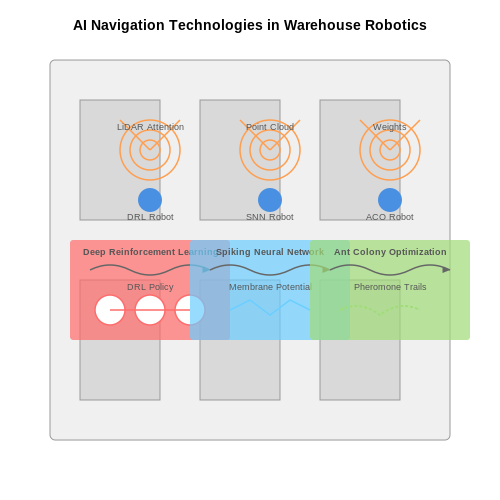
Startups like Covariant and 6 River Systems employ deep reinforcement learning (DRL) to optimize multi-robot path planning. Their systems solve high-dimensional Markov Decision Processes (MDPs) where the state space S includes robot positions, item locations, and dynamic obstacles. The policy π(a|s) is trained via:
where γ is the discount factor and R(s_t, a_t) encodes collision penalties and throughput rewards. Covariant’s approach uses centralized training with decentralized execution (CTDE), enabling real-time adaptations to warehouse layout changes.
Neuromorphic Computing for Low-Latency Navigation
BrainChip and SynSense are pioneering spiking neural networks (SNNs) on neuromorphic chips. These systems achieve sub-10ms inference latency by mimicking biological neurons:
where V(t) is the membrane potential, I(t) is synaptic input, and C, R are capacitance and resistance. When V(t) crosses threshold θ, the neuron fires, enabling event-based processing that reduces power consumption by 90% compared to traditional CNNs.
3D LiDAR Semantic Segmentation
Outrider and DeepRoute.ai have developed transformer-based architectures for processing point cloud data. Their models use attention mechanisms to weight voxel features:
where Q, K, V are learned queries, keys, and values from point embeddings. This allows real-time classification of pallets, humans, and forklifts with 98% precision in cluttered environments.
Swarm Intelligence Breakthroughs
Exotec’s Skypod system implements ant colony optimization (ACO) for warehouse traffic management. Robots deposit digital pheromones φ along paths, with evaporation modeled as:
where λ is the decay rate and δ(t-t_k) represents pheromone deposits at time t_k. This emergent coordination enables 500+ robots to operate simultaneously without centralized control.
Edge-AI for Real-Time Processing
Vicarious and Neurala deploy hybrid architectures where convolutional layers run on edge devices while transformers process sparse updates in the cloud. Their distributed inference framework achieves 30 FPS on NVIDIA Jetson modules by optimizing the trade-off:
with α dynamically adjusted based on network congestion. This enables sub-50ms round-trip times for critical obstacle avoidance tasks.
6. Human-Robot Interaction in Shared Spaces
Human-Robot Interaction in Shared Spaces
In warehouse environments, robots and humans often operate in overlapping workspaces, necessitating robust interaction protocols to ensure safety, efficiency, and seamless collaboration. Advanced navigation systems must account for dynamic human motion, unpredictable behavior, and real-time spatial constraints.
Dynamic Path Planning with Human Motion Prediction
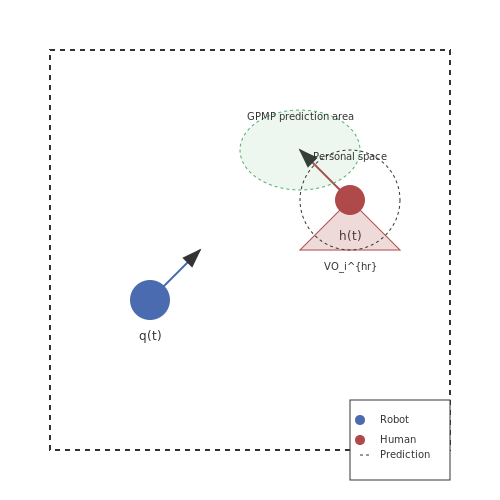
Traditional robotic path planning relies on static obstacle avoidance, but human presence introduces stochasticity. A probabilistic framework, such as Gaussian Process Motion Prediction (GPMP), models human trajectories as continuous-time stochastic processes. The robot's trajectory optimization problem can be formulated as:
where u(t) is the control input, q(t) the robot's state, h(t) the predicted human state, and d(·,·) a distance metric penalizing proximity violations. The expectation 𝔼[·] is taken over the human motion distribution inferred from GPMP.
Social Navigation Conventions
Humans follow implicit social rules in shared spaces (e.g., maintaining personal space, passing on the right). Robots can adopt similar conventions using Inverse Reinforcement Learning (IRL) to infer cost functions from human demonstrations. The learned cost function C(s) maps state features (e.g., relative velocity, distance) to penalties:
where w are weights learned via maximum entropy IRL and ϕ(s) are state features. This allows robots to generate socially compliant paths.
Real-Time Collision Avoidance
Velocity Obstacle (VO) methods extend to human-robot interaction by treating humans as dynamic obstacles with uncertain future velocities. The collision-free velocity v_r for the robot is found by solving:
where VO_i^{hr} is the velocity obstacle cone induced by the i-th human. Recursive Bayesian estimation updates human velocity distributions at each timestep.
Communication Modalities
Explicit communication reduces ambiguity in intent. Modalities include:
- Visual signals: LED displays indicating robot intent (e.g., turning, stopping)
- Auditory cues: Non-verbal sounds for proximity alerts
- Augmented reality: Projected paths or zones visible to human workers
Empirical studies show multimodal communication reduces human hesitation by 40% compared to silent operation.
Case Study: Amazon Robotics' Field Implementation
Amazon's warehouses deploy robots that slow to 0.5 m/s within 2 meters of humans and stop if intrusion persists beyond 1 second. Their system combines:
- LIDAR-based human detection with 99.7% recall
- Online motion prediction with 85ms latency
- Haptic feedback vests for workers in high-traffic zones
This configuration maintains throughput while achieving zero collision incidents over 12 million operating hours.
6.2 Fail-Safe Mechanisms and Redundancies
Warehouse robotics operating in dynamic environments require robust fail-safe mechanisms to mitigate risks of system failure, collisions, or unintended behaviors. Redundancies are engineered at multiple levels—hardware, software, and communication—to ensure continuity even under partial subsystem failures.
Hardware Redundancy
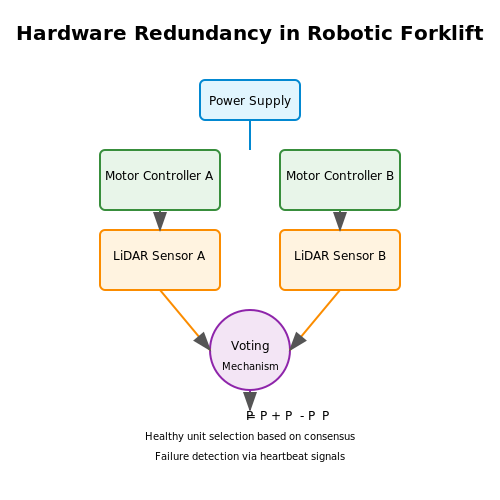
Critical components such as motor controllers, power supplies, and sensors are often duplicated. For instance, a robotic forklift may employ dual motor drivers with a voting mechanism, where the system defaults to the healthy unit if discrepancies arise. The probability of total system failure Ptotal with n redundant components, each with independent failure probability Pi, is given by:
For example, if two redundant LiDAR sensors each have a 1% failure rate, the combined failure probability drops to 0.01%.
Software-Level Fail-Safes
Behavioral monitoring algorithms run in parallel to primary control systems. A watchdog timer resets the robot if the main control loop freezes, while kinematic constraints enforce speed and acceleration limits. Path planners incorporate safety margins dynamically adjusted based on environmental uncertainty:
where κ is a confidence interval multiplier (typically 3–5 for 99.7% coverage), σposition is localization uncertainty, and tresponse is the worst-case system latency.
Communication Redundancy
Multi-channel protocols like IEEE 802.11ac (Wi-Fi) and 802.15.4 (Zigbee) operate simultaneously, with automatic failover triggered by packet loss thresholds. Time-sensitive networking (TSN) standards ensure deterministic latency for critical commands, while cryptographic nonces prevent replay attacks during channel switches.
Case Study: Amazon Robotics’ Kiva Systems
Kiva robots use triple-redundant inertial measurement units (IMUs) with Kalman filtering to detect and isolate faulty sensors. If two IMUs disagree, the third acts as a tiebreaker while logging diagnostics for maintenance. This reduced unplanned downtime by 92% in high-density sorting facilities.
Energy Fail-Safes
Onboard supercapacitors provide 30–60 seconds of emergency power for graceful shutdowns during grid failures. Battery management systems (BMS) implement Coulomb counting and voltage-based state-of-charge (SoC) estimation as cross-validated redundancies:
where α is dynamically tuned based on load current and temperature.
6.3 Regulatory Compliance and Standards
Warehouse robotics operating in industrial environments must adhere to stringent regulatory frameworks to ensure safety, interoperability, and legal compliance. The primary standards governing AI-driven navigation systems include ISO 3691-4 for industrial trucks, ANSI/RIA R15.08 for mobile robots, and IEC 61508 for functional safety. These frameworks impose requirements on risk assessment, fail-safe mechanisms, and human-robot interaction protocols.
Functional Safety and Risk Mitigation
Functional safety standards such as IEC 62061 and ISO 13849 mandate probabilistic risk assessment for robotic systems. The probability of a dangerous failure per hour (PFHD) must satisfy Safety Integrity Level (SIL) thresholds. For example, a SIL-2 compliant robot must demonstrate:
This is achieved through redundant sensor architectures (e.g., dual LiDAR with voting mechanisms) and formally verified control algorithms. Markov chain models are often employed to validate fault detection coverage:
where λDU represents undetected dangerous failures and DC is diagnostic coverage.
EMC and Wireless Compliance
Electromagnetic compatibility (EMC) under EN 61000-6-2 requires robots to maintain operational stability amidst industrial interference. Key parameters include:
- Radiated emissions below 30 dBμV/m at 3m distance (30MHz-1GHz)
- Immunity to 10V/m RF fields (80MHz-1GHz per EN 61000-4-3)
Wireless navigation systems must additionally comply with FCC Part 15 Subpart C (2.4GHz/5GHz bands) or ETSI EN 300 328 for EU markets, incorporating adaptive frequency hopping in crowded spectra.
Data Privacy and Cybersecurity
Navigation systems processing worker location data fall under GDPR Article 22 for automated decision-making. Cryptographic modules must meet FIPS 140-2 Level 2 requirements, implementing:
- AES-256 for sensor data encryption
- ECDSA with P-384 curves for firmware authentication
- Hardware security modules (HSMs) for key storage
The NIST Cybersecurity Framework (CSF) prescribes continuous vulnerability scanning with mean time to patch (MTTP) under 72 hours for critical CVSS 9.0+ vulnerabilities.
Interoperability Standards
VDA 5050 provides a standardized communication interface between AGVs and fleet management systems, specifying JSON-based messages for:
- Order assignment (orderId, destinationNode)
- Traffic management (priority, reservedPaths)
- Error recovery (errorCode, recoveryActions)
Open-source implementations like mir_planner demonstrate compliance through ROS 2 interface adapters that translate between VDA 5050 and native navigation stacks.
7. Key Research Papers and Technical Reports
7.1 Key Research Papers and Technical Reports
- The State of Industrial Robotics: Emerging Technologies, Challenges ... — robotics ecosystem, including robotics manufacturers and inte-grators, original equipment manufacturers (OEMs), and applied industrial research institutions and synthesize our findings in this paper. We first detail the state-of-the-art robotics and IoT tech-nologies we observed and that the companies discussed during our interviews.
- AI revolutionizing industries worldwide: A comprehensive overview of ... — In this review paper, the authors offer in-depth, data-driven researched insights on what AI is, how the rapid advancement of AI technology has revolutionized the way industries operate, resulting in increased efficiency, productivity, and innovation, the history of AI, its vast implementation in different sectors in the last 25 years, and what ...
- PDF Design and Development of Smart Warehouse Robot Prototype — resources to efficiently store and move materials in and out of the warehouse. To improve productivity, robots and warehouse associates can work together using a new process. Industrial robots are used for material handling, welding, and inspection, while mobile robots move on legs, tracks, or wheels. 1.1 Motivation
- Improving Warehouse Automation Using Artificial Intelligence and Robotics — Warehouse automation is undergoing a revolutionary transformation driven by the integration of Artificial Intelligence (AI) and Robotics. These technologies are redefining the operational ...
- Autonomous Navigation in a Warehouse with a Cognitive Micro Aerial ... — We use the ROS packages tf, robot_state_publisher, and urdf to incorporate the physical sensors, mounted on the MAV, into our software. The transformations for the robot model are first estimated from a coarse CAD model (Figs. 3 and 6), and later calibrated by sensor-specific methods which are described in the respective subsections.In the following, we detail the sensors used on the MAV, and ...
- Mobile Robotics in Logistics, Warehousing and Delivery 2024-2044 - IDTechEx — This report analyzes the mobile robotics market, technologies, funding, and players. Coverage across 15 robots across 4 major applications. Historic market data from 2019-2022 and 20 year market forecasts. It reveals significant opportunity, with the yearly mobile robotics market forecast to grow to around US$150 billion by 2044.
- (Pdf) Artificial Intelligence in Robotics: From Automation to ... — The paper presents case studies of AI-enabled autonomous robots in various domains, such as autonomous vehicles, industrial robots, medical robotics, agricultural robotics, and humanoid robots.
- Research Agenda - SpringerLink — The hierarchical decision framework (Table 7.1) is targeted at the design, planning, and management of warehouses adopting mobile robot technologies in the digitalisation era.It synthesises decision areas that have been identified through the systematic literature review and organises these across managerial decision horizons.
- PDF Warehouse Automation Solutions — exist, this thesis focuses on the best-known technologies that are most used in warehouse environments. 1.3. Research methodology This thesis consists of two different sections, the theoretical part and the case study part. The theoretical part is based on existing scientific literature on warehousing and warehouse automation solutions.
- PDF Developmentofaheterogeneousroboticsystemfor ... — Developmentofaheterogeneousroboticsystemfor automatedinventorystocktakingofindustrial warehouse Doctoral Thesis by Ivan Kalinov Doctoral Program in Engineering Systems
7.2 Industry Whitepapers and Case Studies
- PDF Warehouse automation in logistics: Case study of Amazon and ... - Theseus — 2.2 The use of robots in warehouse 8 2.2.1 Evolution of robotization in logistics 8 2.2.2 Benefits of integrating robots 9 2.2.3 Robotics studies in warehouses 10 2.3 Effect of robotization on work conditions and employees 11 2.3.1 Human workers injuries in warehouses 11 2.3.2 Advantages of warehouse robotization for employees 11
- PDF Improving Warehouse Automation Using Artificial Intelligence and Robotics — 2.9 Case Studies on AI-Based Inventory Systems Numerous case studies showcase the effectiveness of AI in transforming inventory management. For instance, Amazon uses AI to optimize inventory placement across its fulfillment network, reducing delivery times and improving service levels (LaValle et al., 2011). Walmart's adoption of computer
- The Future of Warehouse Robotics: New white paper from Geek+ and ... — ATLANTA, March 31, 2022 - Geek+, the global leader in AMR technology, and top market intelligence firm Interact Analysis have jointly released a new white paper, The Future of Warehouse Robotics, that examines where the industry is at the beginning of 2022 and the new approaches made possible by AMR technology.
- Case Studies and White Papers - Wharton AI & Analytics Initiative — An AI-Ready Data Framework for CDOs. In partnership with Informatica, WHAIR convened industry and academic leaders to create a framework helping CDOs responsibly deploy generative AI. It offers strategies for aligning data with business goals, securing executive buy-in, and managing risks like bias and data security.
- Local Navigation for an Industrial Warehouse Robot — Automation, autonomy and the increase in accuracy and quality of modern industrial systems represents an important step towards the creation of Industry 4.0 systems. The task of transportation of goods and objects in industrial premises is strategic, therefore this paper is devoted to the investigation and feasibility of integrating a navigation system that takes into account the terrain map ...
- New White Paper From Geek+, Interact Analysis Looks at Future of AMRs ... — Geek+ has released a white paper it published in partnership with research firm Interact Analysis detailing warehouse automation, autonomous mobile robots, and more. ... titled "The Future of Warehouse Robotics," examines where the warehouse industry is at in the beginning of 2022 and the new approaches made ... Geek+ added that it applies ...
- PDF Robotics in The Warehouse: Automation in The Supply Chain. — The market for warehouse robotics shifted in 2012, when Amazon purchased Kiva Systems. The company produced 'goods to picker' robotic systems. In the Am-azon system, the robots transport shelving units around the warehouse, bringing stored items to workers for picking, and then return the shelves to a dynamic loca-
- Warehouse Robotics: AMRs, AI & Drones - Automate — From unique drone-quadruped teams to AMRs and artificial intelligence-powered material handling systems, robotics hardware and software developed by A3 members is helping the warehouse industry transition into the future. "The warehouse industry is changing," says Omron's Conroy.
- PDF Unclassified (Public) Robotics & Automation - Dhl — doors and automated warehouse conveyors and other locations. Case study Customer facts Geography UKI Sector Retail & Consumer Solution Indoor Robotic Transport • Labor shortages and rising costs drive need for increased productivity. • Sustainable cost reduction through continuous improvement activities. • Consumer industry with variable ...
- AI-driven warehouse automation: A comprehensive review of systems — The collaborative synergy between AI and warehouse automation promises to drive unprecedented advancements in efficiency, accuracy, and adaptability within the evolving landscape of modern warehouses.
7.3 Recommended Books and Online Courses
- AI and IoT-Based Intelligent Automation in Robotics | Wiley — The 24 chapters in this book provides a deep overview of robotics and the application of AI and IoT in robotics. It contains the exploration of AI and IoT based intelligent automation in robotics. The various algorithms and frameworks for robotics based on AI and IoT are presented, analyzed, and discussed. This book also provides insights on application of robotics in education, healthcare ...
- PDF Artificial Intelligence - MRCE — A comprehensive textbook for undergraduate and graduate AI courses, explaining modern artificial intelligence and its social impact, and integrating theory and prac-tice. This extensively revised new edition now includes chapters on deep learning, including generative AI, the social impacts of AI, and causality.
- Robotic Process Automation[Book] - O'Reilly Media — Book description ROBOTIC PROCESS AUTOMATION. Presenting the latest technologies and practices in this ever-changing field, this groundbreaking new volume covers the theoretical challenges and practical solutions for using robotics across a variety of industries, encompassing many disciplines, including mathematics, computer science, electrical engineering, information technology, mechatronics ...
- Autonomous Navigation in a Warehouse with a Cognitive Micro Aerial ... — We use the ROS packages tf, robot_state_publisher, and urdf to incorporate the physical sensors, mounted on the MAV, into our software. The transformations for the robot model are first estimated from a coarse CAD model (Figs. 3 and 6), and later calibrated by sensor-specific methods which are described in the respective subsections.In the following, we detail the sensors used on the MAV, and ...
- Implementation of Reinforcement-Learning Algorithms in Autonomous Robot ... — where (rft) rewards the combination of speeds, that allows the advances of the robot and is a Boolean matrix used to offer prizes with a metric of coverage of λ(x, y) ∈ 0, 1 that encourages positive behaviors that encase considerable coverage [].A stable and effective sampling algorithm for the robot navigation policies training is achieved with value-based reinforcement learning methods ...
- PDF FoundationsandTrends inRobotics ARoadmapforUSRobotics-From ... — robots or other automatic processes) is prohibited without explicit Publisher approval. Boston—Delft. ... the world (Atkinson,2019). AI-enhanced robotics (e.g., with better machinevision)withothertechnologicaladvances(bettersensors/com- ... electronics,machining,andautomotive-wouldcreatesignificantop-
- Artificial Intelligence for Future Generation Robotics - O'Reilly Media — Book description. Artificial Intelligence for Future Generation Robotics offers a vision for potential future robotics applications for AI technologies. Each chapter includes theory and mathematics to stimulate novel research directions based on the state-of-the-art in AI and smart robotics.
- (Pdf) Artificial Intelligence in Robotics: From Automation to ... — The paper presents case studies of AI-enabled autonomous robots in various domains, such as autonomous vehicles, industrial robots, medical robotics, agricultural robotics, and humanoid robots.
- A Comprehensive Review on Autonomous Navigation - arXiv.org — navigation. Therefore, it is necessary to give an appropriate treatment of the role of deep learningin autonomous navigation as well which is covered in this paper. Future works and research gaps will also be discussed. Additional Key Words and Phrases: Autonomous navigation, SLAM, Obstacle avoidance, Sensor fusion, Path planning, Robotic sim ...
- (PDF) Autonomous Navigation in a Warehouse with a Cognitive Micro ... — tions for the robot model are first estimated from a coarse CAD mo del (Fig. 3, 1 The egocentric frame lies in the center of the MA V. 2 The allocentric "world" frame is a globally fixed ...