Edge AI with Quantized Neural Networks
1. What is Edge AI? Key Concepts and Use Cases
What is Edge AI? Key Concepts and Use Cases
Edge AI refers to the deployment of artificial intelligence models directly on edge devices—such as sensors, smartphones, drones, or embedded systems—rather than relying on centralized cloud servers. This paradigm shift enables real-time inference with reduced latency, bandwidth savings, and enhanced privacy by processing data locally. The computational constraints of edge devices necessitate optimization techniques like quantization, pruning, and model distillation to maintain performance while minimizing memory and energy consumption.
Core Technical Challenges in Edge AI
Deploying neural networks on edge devices introduces several constraints:
- Memory Footprint: Edge devices often have limited RAM (e.g., microcontrollers with ≤ 256KB), requiring models to fit within tight memory budgets.
- Power Efficiency: Battery-powered devices demand ultra-low-power inference, often below 1mW for always-on applications.
- Latency: Real-time applications (e.g., autonomous drones) require inference speeds ≤ 10ms.
Quantization addresses these challenges by reducing the precision of weights and activations. For a neural network layer with full-precision (32-bit) weights W, 8-bit quantization maps values to a discrete set:
where μ and σ are the mean and standard deviation of W, and b is the bit-width. This reduces memory usage by 4× while often preserving >95% of the original model's accuracy.
Use Cases and Performance Trade-offs
Edge AI is critical in scenarios where cloud dependency is impractical:
- Autonomous Vehicles: LiDAR processing requires < 10ms latency to avoid collisions, achievable only with on-device inference.
- Medical Wearables: ECG anomaly detection must operate continuously at < 1mW power draw.
- Industrial IoT: Predictive maintenance models deployed on 8-bit microcontrollers reduce unplanned downtime by 30%.
The table below compares resource requirements for common edge AI tasks:
| Application | Model Size (MB) | Latency (ms) | Power (mW) |
|---|---|---|---|
| Keyword Spotting | 0.5 | 2 | 0.3 |
| Object Detection | 3.2 | 15 | 12 |
| Semantic Segmentation | 8.7 | 45 | 90 |
Hardware-Software Co-Design
Modern edge AI systems leverage specialized hardware accelerators like NPUs (Neural Processing Units) with INT8 support. The peak throughput T of such accelerators is given by:
where fclk is the clock frequency, Ncores is the number of parallel cores, and OPScore is operations per cycle. For example, the ARM Ethos-U55 delivers 0.5 TOPS at 1GHz while consuming just 1W.
Neural Network Quantization: Principles and Benefits
Quantization reduces the numerical precision of weights and activations in neural networks, enabling efficient deployment on edge devices with constrained computational resources. By mapping 32-bit floating-point values to lower-bit integers (e.g., 8-bit or 4-bit), quantization achieves significant memory savings and faster inference while maintaining acceptable accuracy.
Mathematical Foundations of Quantization
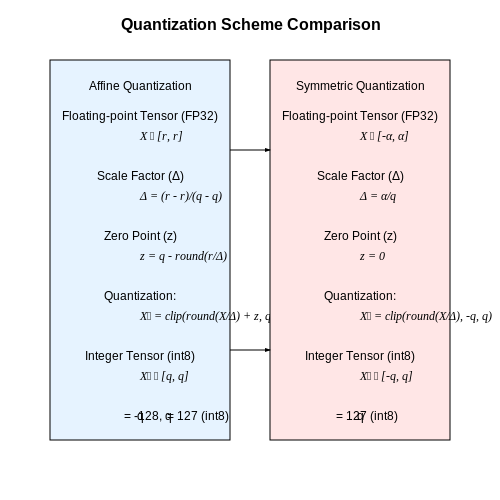
The core operation in quantization involves transforming a floating-point tensor X with range [α, β] to an integer tensor X̂ with range [qmin, qmax]. The affine quantization scheme is defined as:
where the scale factor Δ and zero-point z are computed as:
For symmetric quantization (common in weight tensors), the zero-point is eliminated by centering the range around zero:
Quantization Granularity
The choice of quantization granularity impacts both model accuracy and hardware efficiency:
- Per-tensor quantization: Single scale/zero-point for entire tensor (simplest but least accurate)
- Per-channel quantization: Separate parameters for each output channel (preserves accuracy for weight tensors)
- Group-wise quantization: Intermediate approach with parameters shared across subgroups of elements
Benefits of Quantization
Quantized neural networks provide three key advantages for edge deployment:
- Memory reduction: 8-bit quantization yields 4× compression over FP32, critical for devices with limited RAM
- Compute acceleration: Integer operations require fewer cycles and enable specialized hardware instructions (e.g., ARM NEON, Intel VNNI)
- Energy efficiency: Reduced memory bandwidth and simpler arithmetic lower power consumption substantially
Practical Considerations
Effective quantization requires addressing several implementation challenges:
- Range calibration: Determining optimal [α, β] through techniques like min/max tracking or KL divergence minimization
- Quantization-aware training: Simulating quantization effects during training to maintain accuracy
- Mixed-precision: Strategically allocating higher precision to sensitive layers while aggressively quantizing others
Modern frameworks like TensorFlow Lite and PyTorch Mobile implement these techniques through:
- Dynamic range quantization (activations quantized at runtime)
- Full integer quantization (weights and activations both quantized)
- Float16 quantization (for GPUs with native FP16 support)
1.3 Hardware Constraints and Optimization Goals for Edge Devices
Power Consumption and Thermal Limits
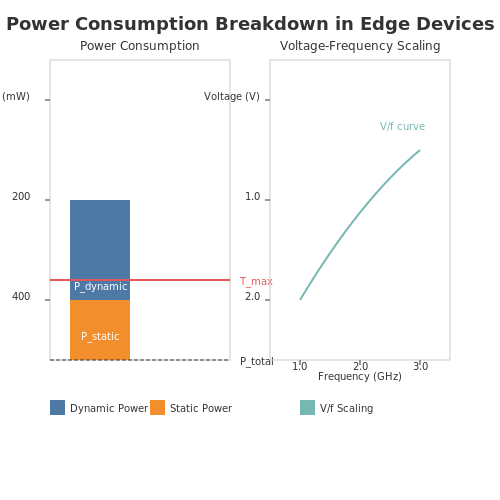
Edge devices operate under strict power budgets, often ranging from milliwatts to a few watts, dictated by battery capacity or energy harvesting constraints. The power consumption P of a neural network on edge hardware can be decomposed into dynamic and static components:
where α is the activity factor, C is the switched capacitance, V is the operating voltage, f is the clock frequency, and Ileak represents leakage current. Thermal constraints further limit maximum power dissipation, as excessive heat degrades reliability and violates safety standards in consumer devices.
Memory Bandwidth and Latency
Edge processors typically employ hierarchical memory architectures (registers, SRAM, DRAM) with drastically varying access costs. The energy ratio for accessing off-chip DRAM versus on-chip SRAM can exceed 100×. Quantized networks reduce memory traffic by compressing weights and activations, but introduce overhead for packing/unpacking bitfields. The effective bandwidth Beff for a quantized model is:
where Bpeak is the physical bus bandwidth, bnative and bquant are the bitwidths of native and quantized data types, and ηutil accounts for memory access pattern efficiency.
Compute Throughput and Sparsity
Modern edge AI accelerators like Google's Edge TPU or NVIDIA's Jetson platforms employ specialized integer arithmetic units (INT4/INT8) with peak throughputs up to 10 TOPS/W. However, realizable performance depends on:
- Operation mix: Ratio of multiply-accumulate (MAC) to non-linear activation ops
- Sparsity utilization: Ability to skip zero-valued computations (achieving 2-4× speedups in pruned networks)
- Data reuse: Maximizing operand locality through tiling and caching
Accuracy-Latency Tradeoff
The Pareto frontier for quantized models reveals non-linear relationships between precision and inference speed. For a network with L layers, end-to-end latency T scales as:
where Ni, Mi, Ki are the tensor dimensions at layer i, and bi is the bitwidth. Mixed-precision quantization achieves better accuracy than uniform quantization by allocating more bits to sensitive layers.
Real-World Optimization Case Study
Deploying a ResNet-18 variant on a Coral Dev Board (Edge TPU) demonstrates practical constraints:
| Precision | Accuracy (Top-1) | Latency (ms) | Energy (mJ) |
|---|---|---|---|
| FP32 | 69.8% | 120 | 480 |
| INT8 | 68.3% | 18 | 72 |
| INT4 | 64.1% | 9 | 36 |
The 6.7× latency improvement from FP32 to INT8 comes with only 1.5% accuracy drop, while INT4 sacrifices 5.7% accuracy for additional 2× speedup—highlighting the need for application-specific precision selection.
2. Post-Training Quantization (PTQ) vs. Quantization-Aware Training (QAT)
Post-Training Quantization (PTQ) vs. Quantization-Aware Training (QAT)
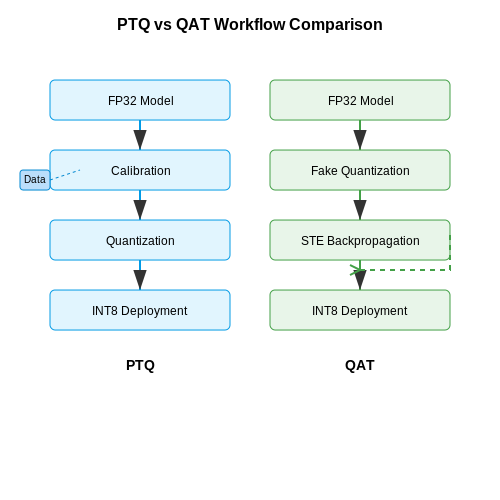
Quantization reduces the precision of neural network weights and activations to lower-bit representations (e.g., 8-bit integers), enabling efficient deployment on edge devices. Two dominant approaches exist: Post-Training Quantization (PTQ) and Quantization-Aware Training (QAT). The choice between them depends on computational constraints, accuracy requirements, and deployment flexibility.
Post-Training Quantization (PTQ)
PTQ applies quantization after a model has been trained in full precision (FP32). It involves:
- Calibration: A small representative dataset is used to determine dynamic ranges for activations and weights.
- Quantization: Weights and activations are mapped to lower-bit integers using scale (∆) and zero-point (z) parameters:
where \( \Delta = \frac{x_{max} - x_{min}}{2^b - 1} \) for a \( b \)-bit quantization. PTQ is computationally efficient but may suffer from accuracy degradation due to the absence of retraining.
Quantization-Aware Training (QAT)
QAT simulates quantization during training by inserting fake quantization nodes into the forward pass. These nodes apply:
where \( q_{min} \) and \( q_{max} \) are the minimum and maximum quantized values. Gradients are approximated using the Straight-Through Estimator (STE), allowing backpropagation through the rounding operation:
QAT typically achieves higher accuracy than PTQ but requires retraining with quantization-aware loss.
Key Trade-offs
- Accuracy: QAT outperforms PTQ, especially for ultra-low precision (≤4 bits), by adapting weights to quantization noise.
- Compute Cost: PTQ requires no retraining, making it faster and cheaper. QAT demands full training cycles with quantization simulation.
- Deployment Flexibility: PTQ allows dynamic adjustment of bit-width post-training. QAT fixes quantization parameters during training.
Practical Considerations
For edge deployment:
- Use PTQ when latency and compute resources are critical, and accuracy drop is tolerable (e.g., MobileNetV3 on microcontrollers).
- Opt for QAT when high accuracy is required (e.g., medical imaging models) or for aggressive quantization below 8 bits.
Hybrid approaches, such as PTQ with partial fine-tuning, are emerging to balance these trade-offs.
Fixed-Point vs. Dynamic Quantization
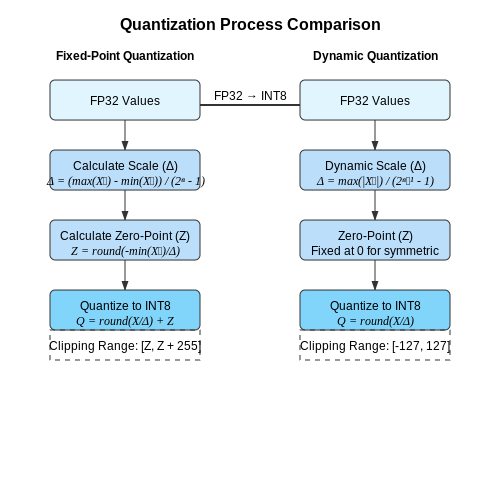
Quantization reduces the precision of neural network weights and activations to lower-bit representations, enabling efficient deployment on edge devices. Two primary approaches dominate: fixed-point quantization and dynamic quantization, each with distinct trade-offs in computational efficiency, memory footprint, and model accuracy.
Fixed-Point Quantization
Fixed-point quantization maps floating-point values to integers using a predetermined scale and zero-point offset. The transformation is defined as:
where Δ (scale) and Z (zero-point) are constants computed during calibration. The dequantization step reconstructs the original value as:
Fixed-point schemes are statically determined, meaning the quantization parameters remain unchanged during inference. This allows for hardware optimizations like integer-only arithmetic, reducing power consumption by up to 10× compared to floating-point operations. However, the static range can lead to clipping errors if input distributions shift at runtime.
Dynamic Quantization
Dynamic quantization recalculates scale and zero-point for each input tensor during inference, adapting to varying data distributions. The quantization process becomes:
where Xt is the input tensor at timestep t, and n is the bit-width. This adaptability improves accuracy for non-stationary data but introduces computational overhead from runtime range calculations.
Comparative Analysis
- Latency: Fixed-point quantization achieves 1.2–2× lower latency by eliminating dynamic scaling calculations.
- Memory: Dynamic schemes require storing per-tensor scaling factors, increasing memory by 2–5% for 8-bit quantization.
- Accuracy: On ImageNet, dynamic 8-bit quantization preserves within 0.5% top-1 accuracy of FP32 models, whereas fixed-point may lose 1–2%.
Hardware Considerations
Fixed-point quantization aligns with dedicated AI accelerators like TPUs and EdgeTPUs, which implement 8-bit integer (INT8) multiply-accumulate (MAC) units. Dynamic quantization is more suited for DSPs with flexible scaling support, such as Qualcomm Hexagon or ARM Cortex-M55 with Helium extensions.
shows the energy advantage of fixed-point operations in hardware-optimized scenarios.
Binary and Ternary Quantization for Extreme Efficiency
Binary Neural Networks (BNNs)
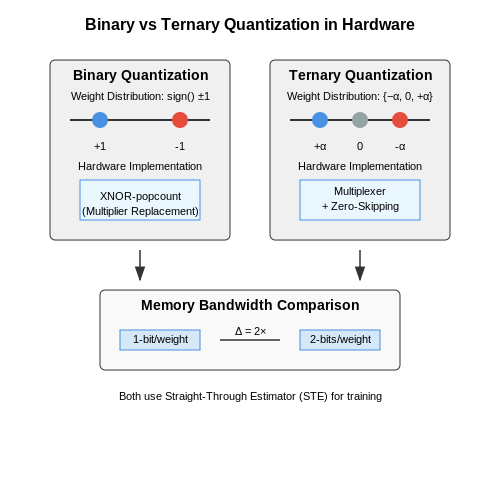
Binary Neural Networks constrain weights and activations to ±1, reducing memory footprint by 32× compared to FP32 while eliminating floating-point multiply-accumulate (MAC) operations. The forward pass simplifies to:
where sign(x) outputs +1 if x ≥ 0 and -1 otherwise. During backpropagation, the non-differentiable sign function is approximated using the Straight-Through Estimator (STE):
BNNs achieve 58× faster inference on FPGAs by replacing MACs with XNOR-popcount operations, as demonstrated on ImageNet with ResNet-18 (2.3% accuracy drop vs FP32).
Ternary Weight Networks (TWNs)
TWNs extend binary quantization by introducing a zero state: weights take values in {−α, 0, +α}, where α is layer-wise learned. The weight distribution is optimized via:
Δ is typically the mean absolute weight value. TWNs achieve 16× compression with <1.8% accuracy degradation on CIFAR-10, outperforming binary networks in tasks requiring fine-grained feature discrimination.
Hardware Acceleration
Ternary quantization enables 1.58× energy efficiency gains in systolic arrays by:
- Exploiting sparsity (zero-skipping)
- Replacing multipliers with multiplexers
- Reducing memory bandwidth via 2-bit storage
Recent implementations on RISC-V processors achieve 3.2 TOPS/W for ternary CNNs, making them viable for always-on edge applications.
Practical Trade-offs
While binary/ternary networks reduce compute intensity, they require:
- Modified training protocols (gradient clipping, scaled learning rates)
- Batch normalization with learned affine parameters
- Careful initialization near the ternary threshold Δ
Hybrid approaches (e.g., binary activations with ternary weights) balance efficiency and accuracy, achieving 72.1% top-1 accuracy on ImageNet with MobileNetV3.
3. Frameworks for Quantization: TensorFlow Lite, PyTorch Mobile, ONNX Runtime
Frameworks for Quantization: TensorFlow Lite, PyTorch Mobile, ONNX Runtime
TensorFlow Lite
TensorFlow Lite (TFLite) provides a streamlined approach to deploying quantized models on edge devices. It supports both post-training quantization and quantization-aware training (QAT). Post-training quantization converts pre-trained floating-point models to 8-bit integers without retraining, while QAT simulates quantization during training to improve accuracy. The quantization process in TFLite can be represented as:
where x is the floating-point value, Δ is the quantization step size, and Q(x) is the quantized output. TFLite optimizes for ARM Cortex-M and DSP architectures via its delegate system, enabling efficient execution on heterogeneous hardware.
PyTorch Mobile
PyTorch Mobile integrates quantization through the torch.quantization module, supporting dynamic and static quantization. Dynamic quantization quantizes weights but keeps activations in floating-point during inference, while static quantization pre-computes activation quantization parameters. The static approach involves:
where b is the bit-width (typically 8). PyTorch Mobile’s QNNPACK backend accelerates quantized operations on mobile CPUs, achieving near-linear speedup for depthwise convolutions common in MobileNet-style architectures.
ONNX Runtime
ONNX Runtime (ORT) offers cross-platform quantization via its Quantization Toolkit, which includes QAT and post-training optimization. ORT’s quantization leverages integer-only arithmetic, avoiding floating-point operations entirely. The quantization formula for symmetric quantization (used for weights) is:
ORT’s Execution Providers (EPs) allow hardware-specific optimizations, such as TensorRT for NVIDIA GPUs or OpenVINO for Intel CPUs, making it versatile for edge deployments.
Framework Comparison
- TensorFlow Lite: Best for TensorFlow ecosystems, with broad hardware support via delegates.
- PyTorch Mobile: Ideal for PyTorch models, with flexible quantization modes and QNNPACK optimizations.
- ONNX Runtime: Cross-framework compatibility, with hardware-agnostic quantization and EP-based acceleration.
Practical Considerations
When selecting a framework, consider:
- Model origin: TFLite for TensorFlow, PyTorch Mobile for PyTorch, ORT for cross-framework models.
- Hardware targets: TFLite delegates for DSPs, QNNPACK for ARM CPUs, ORT EPs for heterogeneous hardware.
- Quantization granularity: Per-tensor (TFLite default) vs. per-channel (PyTorch Mobile) quantization.
# Example: Post-training quantization in TFLite
import tensorflow as tf
converter = tf.lite.TFLiteConverter.from_saved_model(saved_model_dir)
converter.optimizations = [tf.lite.Optimize.DEFAULT]
quantized_model = converter.convert()
3.2 Deployment Pipelines: From Model Training to Edge Inference
Model Quantization for Edge Deployment
Quantization reduces the precision of weights and activations in a neural network, enabling efficient deployment on edge devices with limited computational resources. Post-training quantization (PTQ) and quantization-aware training (QAT) are the two dominant approaches. PTQ transforms a pre-trained full-precision model (FP32) into a lower-bit representation (e.g., INT8), while QAT simulates quantization effects during training for better accuracy retention.
Here, α (scale) and β (zero-point) are quantization parameters calibrated to minimize information loss. For symmetric quantization, β = 0, simplifying the computation.
Optimization for Edge Hardware
Deploying quantized models requires hardware-specific optimizations:
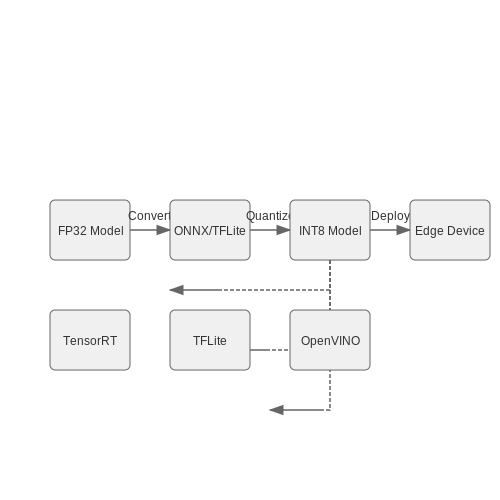
- TensorRT (NVIDIA) optimizes layer fusion and kernel selection for GPUs.
- TFLite (Google) leverages ARM NEON instructions for CPU acceleration.
- OpenVINO (Intel) optimizes for Intel CPUs, GPUs, and VPUs.
These frameworks convert models into hardware-executable formats, often involving:
- Operator-level optimizations (e.g., replacing FP32 convolutions with INT8 equivalents).
- Memory layout adjustments (NHWC vs. NCHW).
- Dynamic tensor shape handling for variable input sizes.
Deployment Pipeline Stages
A robust edge AI pipeline consists of:
1. Model Conversion
Convert the trained model to an edge-compatible format (e.g., ONNX, TFLite, or UFF). For example, PyTorch to ONNX:
import torch
model = torch.load('model.pth')
dummy_input = torch.randn(1, 3, 224, 224)
torch.onnx.export(model, dummy_input, 'model.onnx', opset_version=11)
2. Quantization
Apply PTQ or QAT using frameworks like TensorRT or TFLite Converter:
import tensorflow as tf
converter = tf.lite.TFLiteConverter.from_saved_model('saved_model')
converter.optimizations = [tf.lite.Optimize.DEFAULT]
quantized_model = converter.convert()
3. Compilation for Target Hardware
Compile the quantized model using platform-specific tools. For TensorRT:
trtexec --onnx=model.onnx --int8 --saveEngine=model.engineLatency-Accuracy Tradeoffs
Edge deployment introduces constraints that affect model performance:
Quantization reduces FLOPs but may degrade accuracy. Techniques like mixed-precision quantization (e.g., INT8 for weights, FP16 for activations) balance these tradeoffs. Empirical validation on target hardware is critical.
Real-World Case Study: Autonomous Drones
In drone navigation, a ResNet-18 model quantized to INT8 achieved a 3.9× speedup on an NVIDIA Jetson TX2 with only a 1.2% drop in mAP. The deployment pipeline included:
- QAT with TensorFlow.
- TensorRT compilation with layer fusion.
- Dynamic batching for real-time inference.
Performance Benchmarks: Latency, Memory, and Energy Efficiency
Quantization Impact on Latency
Latency in Edge AI systems is primarily dictated by the computational complexity of neural network inference, which is directly influenced by weight and activation bit-width. Quantization reduces the number of bits per parameter, leading to faster arithmetic operations and lower memory bandwidth requirements. For a convolutional layer with N filters, each of size k × k, the latency reduction factor L when moving from 32-bit floating-point (FP32) to b-bit fixed-point (INTb) can be approximated as:
where α accounts for hardware-specific acceleration (e.g., SIMD instructions on ARM Cortex-M). Empirical studies show that INT8 quantization typically achieves 2–4× latency reduction compared to FP32 on edge devices like Raspberry Pi or NVIDIA Jetson.
Memory Footprint Optimization
Quantization compresses model weights and activations, drastically reducing memory storage and access overhead. The total memory M required for a network with P parameters and A activation maps is:
where bw and ba are bit-widths for weights and activations, respectively. For example, MobileNetV2 quantized to INT8 (vs. FP32) shrinks memory usage from 14 MB to 3.5 MB—critical for microcontrollers with ≤1 MB SRAM.
Energy Efficiency Gains
Energy consumption scales quadratically with voltage and linearly with frequency and capacitance. Quantization enables voltage scaling by reducing arithmetic precision, as shown in the modified Pollack’s Rule:
where C is switched capacitance and V is operating voltage. INT8 inference on Coral Edge TPU demonstrates 10× lower energy/operation (0.5 pJ) than FP32 on general-purpose CPUs (5 pJ).
Case Study: Keyword Spotting on ARM Cortex-M4
A quantized DS-CNN (Depthwise Separable CNN) for keyword spotting achieves:
- Latency: 12 ms (INT8) vs. 45 ms (FP32) per inference
- Memory: 150 KB (INT8) vs. 600 KB (FP32)
- Energy: 3 mJ (INT8) vs. 28 mJ (FP32) per 1-second audio clip
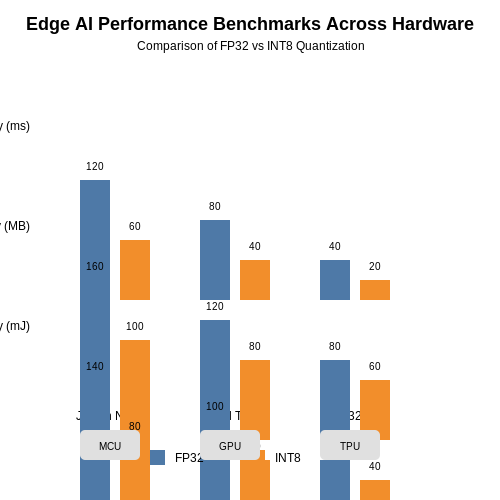
Hardware-Specific Benchmarks
Performance varies across edge hardware due to architectural differences:
- GPU (Jetson Nano): INT8 leverages Tensor Cores for 4× throughput over FP16
- TPU (Coral Dev Board): 100 TOPS/W for INT8 via systolic array optimization
- MCU (STM32H7): 1.25 DMIPS/MHz with ARM CMSIS-NN INT8 acceleration
For INT8 models, throughput on edge devices typically ranges from 50 GOPS (MCUs) to 4 TOPS (TPUs), with power budgets under 5W.
4. Accuracy vs. Efficiency Trade-offs
Accuracy vs. Efficiency Trade-offs
Quantization introduces an inherent tension between model accuracy and computational efficiency. Reducing bit-widths compresses model size and accelerates inference but introduces quantization noise, degrading predictive performance. The trade-off is governed by the relationship between numerical precision and the signal-to-noise ratio (SNR) in weight and activation distributions.
Quantization Error Analysis
For a uniform quantizer with step size Δ, the mean squared quantization error (MSE) for a uniformly distributed signal is:
For a k-bit quantizer, Δ = (x_{\text{max}} - x_{\text{min}})/(2^k - 1), where x_{\text{max}} and x_{\text{min}} are the clipping bounds. This error propagates through the network nonlinearly, with deeper layers accumulating larger deviations from full-precision outputs.
Empirical Accuracy Drop
Post-training quantization (PTQ) typically incurs a 1-5% accuracy drop for 8-bit models and 5-15% for 4-bit models on ImageNet-class tasks. Quantization-aware training (QAT) mitigates this by simulating quantization during training, often recovering within 1% of FP32 accuracy even at 4 bits. The accuracy-efficiency Pareto frontier varies by architecture:
- ResNet-50: 4-bit QAT achieves 75.1% top-1 (vs. 76.1% FP32) at 4.2× compression
- MobileNetV2: 4-bit PTQ drops to 68.3% (vs. 71.8% FP32) due to depthwise separable convolutions' sensitivity
Hardware Efficiency Gains
On edge TPUs, 8-bit quantization provides:
compared to FP32, as shown in Google's EdgeTPU benchmarks. The improvement stems from reduced memory bandwidth (32→8 bits) and simpler arithmetic logic units (no floating-point multipliers).
Optimal Bit Allocation
Mixed-precision quantization assigns varying bit-widths per layer based on sensitivity analysis. The gradient-weighted sensitivity metric for layer l is:
where Wl are the layer's weights and ℒ is the loss function. Layers with higher Sl receive more bits.
Practical Deployment Considerations
Real-world edge deployments often use:
- 8-bit everywhere: For applications with <2% accuracy tolerance (e.g., object detection)
- 6-bit mixed precision: When power constraints dominate (e.g., always-on sensors)
- 4-bit with QAT: For extreme edge devices (microcontroller-class)
Emergent techniques like learned step size quantization (LSQ) and gradient-based bit-width optimization further tighten the accuracy-efficiency trade-off, achieving near-FP32 accuracy at sub-8-bit precision in transformer architectures.
Handling Non-Linear Activations and Batch Normalization
Challenges in Quantizing Non-Linear Activations
Non-linear activation functions like ReLU, LeakyReLU, and Swish introduce discontinuities that complicate quantization. Unlike linear operations, activations cannot be decomposed into simple integer-bit shifts or additions. The primary challenge lies in preserving the non-linear behavior while operating in low-bit integer arithmetic. For example, ReLU is defined as:
In floating-point, this is trivial, but in 8-bit quantization, the zero-point must align precisely with the floating-point zero to avoid introducing bias. Mismatches here lead to systematic errors that accumulate across layers.
Piecewise Linear Approximation
Advanced quantization schemes often approximate activations using piecewise linear segments. For instance, a 4-bit quantized ReLU can be implemented as:
where z is the zero-point and S is the scaling factor. This preserves the exact zero-point while allowing efficient integer computation. The error introduced by this approximation is bounded by the segment granularity, making it suitable for Edge AI applications where compute resources are limited.
Batch Normalization Folding
Batch normalization (BN) layers are typically absorbed into preceding convolutional or linear layers during quantization to reduce computational overhead. The BN operation:
is fused with the weight tensor W of the preceding layer. The folded weights W' and biases b' become:
This folding must account for quantization scaling factors to maintain numerical equivalence. The fused layer then operates entirely in integer arithmetic, eliminating floating-point operations during inference.
Quantization-Aware Training (QAT) for Activations
QAT simulates quantization effects during training by injecting fake quantization nodes. For activations, this involves:
- Clamping: Restricting values to the representable range of the target bit-width
- Rounding: Applying stochastic or nearest rounding to mimic integer behavior
- Scaling: Normalizing values according to the learned quantization parameters
The gradient through these non-differentiable operations is approximated using straight-through estimators (STE), enabling end-to-end training of quantized networks.
Practical Implementation Considerations
When deploying quantized models on edge devices:
- Activations with large dynamic ranges (e.g., Swish) may require higher bit-widths or specialized quantization schemes
- Batch normalization folding must account for potential distribution shifts between training and inference
- Hardware-specific constraints (e.g., DSP-supported operations) can dictate the choice of activation functions
Modern frameworks like TensorFlow Lite and PyTorch Mobile provide built-in support for these optimizations, automating much of the process while exposing key parameters for fine-tuning.
4.3 Adaptive Quantization for Dynamic Workloads
Static quantization methods often fail to handle real-world edge scenarios where computational demands fluctuate dynamically. Adaptive quantization addresses this by adjusting precision levels in response to runtime constraints, optimizing the trade-off between accuracy and efficiency.
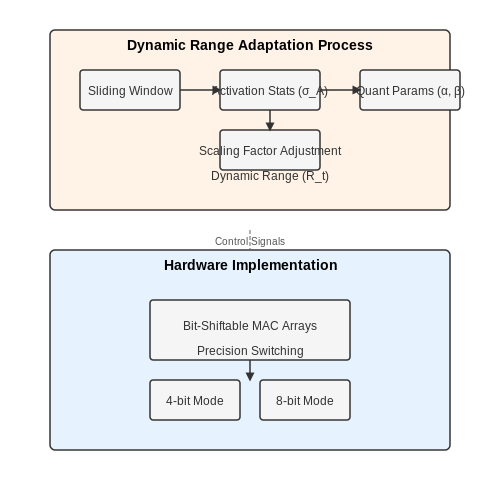
Dynamic Range Adaptation
The core challenge lies in maintaining model fidelity while adapting to varying resource availability. A sliding window approach tracks activation statistics over recent inference cycles, updating quantization parameters in real-time. For a layer with weights W and activations A, the dynamic range R at timestep t is computed as:
where α controls the exponential moving average decay, σA represents the current activation standard deviation, and β ensures weight dominance in mixed-precision scenarios.
Bit-Width Allocation Strategies
Layer sensitivity analysis guides adaptive bit-width assignment. The gradient-weighted importance metric Il for layer l is:
Modern implementations use hardware-aware Pareto optimization to solve:
where bl denotes the allocated bits for layer l, and τ is the accuracy threshold.
Hardware-Conscious Implementation
Deploying adaptive quantization requires tight coupling with accelerator architectures. Contemporary edge TPUs implement:
- On-the-fly scaling factor adjustment units
- Bit-shiftable multiply-accumulate (MAC) arrays
- Zero-overhead switching between 4/8-bit modes
The NVIDIA TensorRT implementation demonstrates this through its dynamic range API, which triggers requantization when activation entropy exceeds:
where SNRtarget is the signal-to-noise ratio threshold for acceptable quality degradation.
Case Study: Autonomous Drone Navigation
In a real-world evaluation on NVIDIA Jetson AGX Xavier, adaptive quantization reduced power consumption by 43% during low-complexity flight segments while maintaining full 8-bit precision during obstacle avoidance maneuvers. The system achieved this by implementing:
- Sub-millisecond layer-wise precision switching
- Context-aware bit-width prediction using LSTM controllers
- Hardware-validated clipping threshold adaptation
Energy measurements showed non-linear benefits from dynamic quantization, with 4-bit operations consuming only 22% the energy of 8-bit equivalents while maintaining 94.2% task accuracy.
5. Key Research Papers on Quantized Neural Networks
5.1 Key Research Papers on Quantized Neural Networks
- Quantized convolutional neural networks through the lens of partial ... — Quantization of convolutional neural networks (CNNs) is a common approach to ease the computational burden involved in the deployment of CNNs, especially on low-resource edge devices. However, fixed-point arithmetic is not natural to the type of computations involved in neural networks. In this work, we explore ways to improve quantized CNNs using PDE-based perspective and analysis. First, we ...
- Quantization and Deployment of Deep Neural Networks on ... - MDPI — This work focuses on quantization and deployment of deep neural networks onto low-power 32-bit microcontrollers. The quantization methods, relevant in the context of an embedded execution onto a microcontroller, are first outlined. Then, a new framework for end-to-end deep neural networks training, quantization and deployment is presented.
- Efficient Neural Networks on the Edge with FPGAs by Optimizing an ... — The implementation of neural networks (NNs) on edge devices enables local processing of wireless data, but faces challenges such as high computational complexity and memory requirements when deep neural networks (DNNs) are used. Shallow neural networks customized for specific problems are more efficient, requiring fewer resources and resulting in a lower latency solution. An additional benefit ...
- Recent Progress on Memristive Convolutional Neural Networks for Edge ... — Recent Progress on Memristive Convolutional Neural Networks for Edge Intelligence. Yi-Fan Qin ... Especially, the quantized neural network can greatly alleviate requirements for device performance, which at this stage can already be met by existing devices. ... This work was financially supported by the National Key Research and Development ...
- Scaling for edge inference of deep neural networks - Nature — Quantized neural networks 88, binarized neural networks 95 and XNOR-net 92 achieved a large reduction in memory/computation cost by reducing the weights to only 1 bit and the activations to 1-2 ...
- QEBVerif: Quantization Error Bound Verification of Neural Networks — To alleviate the practical constraints for deploying deep neural networks (DNNs) on edge devices, quantization is widely regarded as one promising technique. ... A quantized neural network (QNN) is structurally similar to its real-valued counterpart, except that all the parameters, inputs of the QNN, and outputs of all the hidden layers are ...
- Efficient neural networks for edge devices - ScienceDirect — The computational and space complexity of a high-performance neural network is high, and thus it is challenging to deploy a high-performance neural network on edge devices. A common approach to address the high computational and space complexity is to compress neural network models using quantization techniques [3] , [4] , [5] , which use a few ...
- FPGA-based acceleration for binary neural networks in edge computing ... — This paper gives a brief overview of binary neural networks (BNNs) and the corresponding hardware accelerator designs on edge computing environments, and analyzes some significant studies in detail. The performances of some methods are evaluated through the experiment results, and the latest binarization technologies and hardware acceleration ...
- A Novel Quantization and Model Compression Approach for Hardware ... — In quantized neural networks (QNNs), the objective is to ensure acceptable prediction accuracy is achieved, on which the degree of quantization errors has a direct impact. ... and difficult for AI models applying to resource-limited edge computing devices with intensive communications in IoT scenario. To tackle this challenge, we proposed a P ...
- Edge artificial intelligence for big data: a systematic review | Neural ... — Edge computing, artificial intelligence (AI), and machine learning (ML) concepts have become increasingly prevalent in Internet of Things (IoT) applications. As the number of IoT devices continues to grow, relying solely on cloud computing for real-time data processing and analysis is proving to be more challenging. The synergy between edge computing and AI is particularly intriguing due to AI ...
5.2 Open-Source Tools and Libraries for Edge AI
- Hardware Implementation for Spiking Neural Networks on Edge Devices — Evolutionary approaches have also been explored to train the SNN for the edge-IoT applications [19,20,21].The evolutionary training approaches achieve better accuracy on the small-size networks on the edge devices as compared to the conventional ways of training the neural network, in which the synaptic weights are obtained by learning the training samples.
- Edge AI: Leveraging the Full Potential of Deep Learning — Edge AI eliminates the cloud transmission of data reducing cyber threats. In addition, the Edge AI applications are limited to a smaller edge network that prevents data stealing and ensures user privacy . 5. Automatic Decision-Making. Edge AI is capable of automatic and learned decision-making without requiring human intervention.
- Recent Progress on Memristive Convolutional Neural Networks for Edge ... — Advanced Intelligent Systems is a top-tier open access journal covering topics such as robotics, automation & control, AI & machine learning, and smart materials. ... Therefore, the study on building LSTM neural networks with edge intelligence devices and doing inference locally is of high application value. ... Especially, the quantized neural ...
- Efficient neural networks for edge devices - ScienceDirect — The computational and space complexity of a high-performance neural network is high, and thus it is challenging to deploy a high-performance neural network on edge devices. A common approach to address the high computational and space complexity is to compress neural network models using quantization techniques [3] , [4] , [5] , which use a few ...
- Quantized Convolutional Neural Network Implementation on a Parallel ... — Quantized Convolutional Neural Network Implementation on a Parallel-Connected Memristor Crossbar Array for Edge AI Platforms March 2021 DOI: 10.1166/jnn.2021.18925
- A Methodology and Open-Source Tools to Implement Convolutional Neural ... — Due to their ability to extract features from input data, convolutional neural networks (CNNs) are being used in machine learning (ML) applications such as object detection, facial expression recognition, and medical imaging [1,2,3].The training of CNNs is typically performed on high-performance computing platforms to speed up the optimization routines determining the CNN parameters.
- Powering AI at the edge: A robust, memristor-based binarized neural ... — Memristor-based neural networks provide an exceptional energy-efficient platform for artificial intelligence (AI), presenting the possibility of self-powered operation when paired with energy ...
- Quantization-Aware NN Layers with High-throughput FPGA ... - MDPI — This is the case with modern GPU-based lightweight processing units, such as the Jetson, which easily allows one to port full-fledged neural networks on the edge [13,14], or downright dedicated hardware implementations of the desired algorithms . The second (and opposite) path aims at reducing the size and complexity of the neural network, by ...
- Quantization-Aware NN Layers with High-throughput FPGA Implementation ... — Among these, the term edge AI (Artificial Intelligence) has recently emerged to describe the scenario where the distributed task involves neural networks (NN) or other flavors of AI-based inference (see for a comprehensive survey). There are several advantages in performing inference on the edge rather than sending data to a central server.
- FPGA-based acceleration for binary neural networks in edge computing ... — Power consumption is also a major factor hindering the deployment of DNNs to embedded mobile terminals. In order to allow DNNs to be adopted on edge computing devices, neural network binarization has emerged. The sign(⋅) function is a commonly used function for binarization, which sets numbers greater than 0 as 1, and less than 0 as −1.
5.3 Industry Case Studies and Real-World Applications
- Analysing Edge Computing Devices for the Deployment of Embedded AI — These devices are used in a wide variety of applications like industry, research and development. ... In most cases, AI models are trained with high precision and quantized after training. ... it discusses hardware products in various categories and also focuses on emerging trends in Edge AI software, including neural network optimization and ...
- Edge Computing for Industry 5.0: Fundamental, Applications, and ... — Industry 5.0 is the next stage in industrial evolution, collaborating between human ingenuity and intelligent technologies to provide manufacturing solutions. Integrating modern technology like artificial intelligence (AI), robotics, and the Internet of Things (IoT) into manufacturing and production processes characterizes Industry 5.0. On the other hand, edge computing provides real-time data ...
- Edge AI on Constrained IoT Devices: Quantization Strategies ... - Springer — 2.2 Previous Studies on Pruning. In study [] the authors focus on pruning filters from CNNs, enhancing efficiency without compromising accuracy.Using CIFAR-10 and ILSVRC2012 datasets with models VGG-16 with 34.2% pruned and RES NET-56/110 with 10.4%, 15.9% pruned. The method effectively reduces model size about 30% of FLOP reduction without sacrificing too much accuracy.
- Edge AI: A survey - ScienceDirect — Edge AI has the potential to revolutionize industries by enabling intelligent and autonomous devices that can make real-time decisions based on sensor data [164]. Its applications are diverse, and the technology is still in its early stages, so we can expect to see even more creative and innovative applications of Edge AI in the future [165].
- Efficient neural networks for edge devices - ScienceDirect — The computational and space complexity of a high-performance neural network is high, and thus it is challenging to deploy a high-performance neural network on edge devices. A common approach to address the high computational and space complexity is to compress neural network models using quantization techniques [3] , [4] , [5] , which use a few ...
- End-to-end codesign of Hessian-aware quantized neural networks for ... — FPGA and ASIC platforms. It is a popular tool for both scientific and industry edge ML applications [2,22,36]. To demonstrate the performance of our end-to-end workflow, we develop a NN for real-time decision-making in particle physics. The CERN Large Hadron Collider (LHC) is the world's largest and most powerful particle accelerator.
- Possible Applications of Edge Computing in the Manufacturing Industry ... — In the history of industry so far, we can distinguish four breakthrough concepts that have had a huge impact on production systems: Industry 1.0—water and steam mechanization; Industry 2.0—mass production based on electricity; Industry 3.0—increasing production automation based on digitization; and Industry 4.0—digitalization of ...
- Survey of Deep Learning Accelerators for Edge and Emerging Computing - MDPI — The unprecedented progress in artificial intelligence (AI), particularly in deep learning algorithms with ubiquitous internet connected smart devices, has created a high demand for AI computing on the edge devices. This review studied commercially available edge processors, and the processors that are still in industrial research stages. We categorized state-of-the-art edge processors based on ...
- Recent Progress on Memristive Convolutional Neural Networks for Edge ... — All these works have contributed progressively to the implementation of a fully hardware LSTM neural network and its application in edge intelligence devices. 5 Challenges and Outlook. In this review, we present a comprehensive induction on convolution neural networks for memristive implementation.
- At the Confluence of Artificial Intelligence and Edge Computing in IoT ... — A schematic overview of the paper organization structure. 2. Artificial Intelligence in Edge-Based IoT Applications: Literature Review. Artificial intelligence techniques such as DL, ML, and bioinspired algorithms in IoT-based applications are necessary to manage the amount of data generated by various IoT devices, to process and analyze these data and, hence, to transform them into insights ...