Embedding Agents in Simulated Political Systems
1. Key Concepts in Agent-Based Modeling
Key Concepts in Agent-Based Modeling
Agent Definition and Properties
An agent in agent-based modeling (ABM) is an autonomous computational entity characterized by:
- Autonomy: Operates without centralized control
- Adaptivity: Modifies behavior based on experience
- Proactiveness: Pursues goals through initiative
- Reactivity: Responds to environmental changes
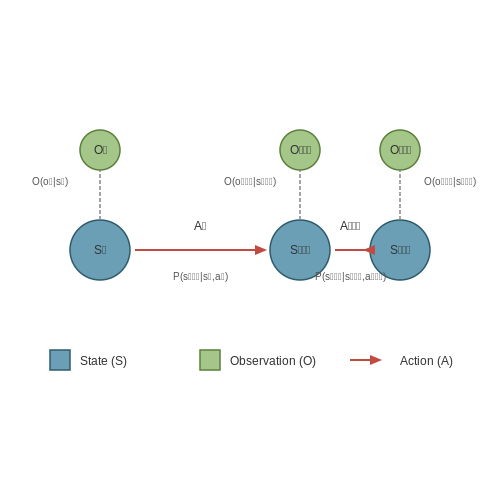
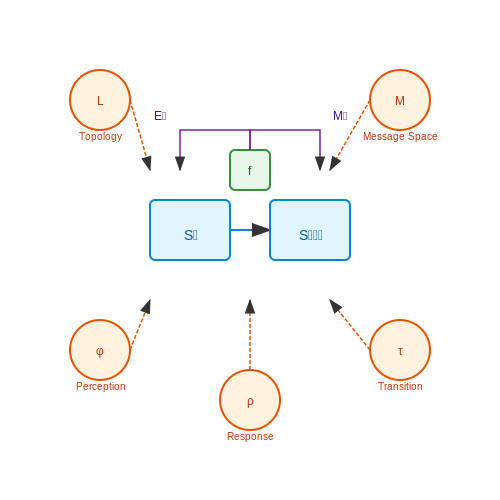
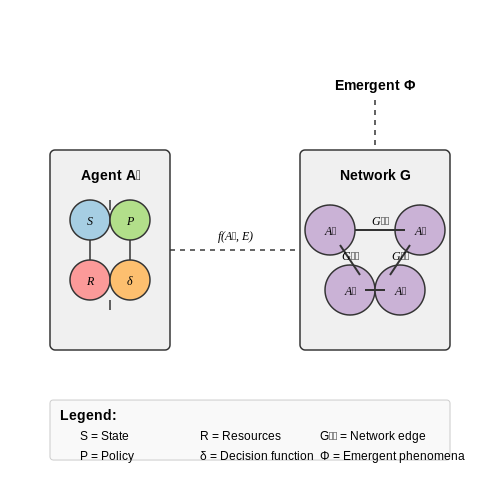
Mathematically, an agent A can be represented as a tuple:
Where:
- S = Set of possible states
- P = Perception function (S → O)
- R = Response function (O × S → A)
- δ = State transition function (S × A → S)
Emergent Phenomena
Complex system behaviors emerge from simple agent interactions through:
Where Φ represents emergent properties, N is the agent count, and E is the environment. Historical examples include Schelling's segregation model (1971) demonstrating how mild preferences lead to stark spatial segregation.
Decision-Making Architectures
Political agents typically employ one of three decision frameworks:
- Rule-based systems: If-then condition sets
- Utility maximization:
$$ U_i(a) = \sum_{j=1}^k w_j v_j(a) $$Where w are policy weights and v are value functions
- Learning architectures: Reinforcement learning policies
Network Topologies
Agent interactions occur through structured networks with adjacency matrix G where:
Political systems often exhibit:
- Scale-free networks (power-law degree distribution)
- Small-world networks (high clustering + short paths)
- Hierarchical structures (nested organizational layers)
Validation Techniques
ABM verification requires:
Where ŷ are simulated outputs and y are empirical observations. Advanced methods include:
- Pattern-oriented modeling
- Sensitivity analysis via Sobol indices
- History-friendly calibration
1.2 Political Systems as Complex Adaptive Systems
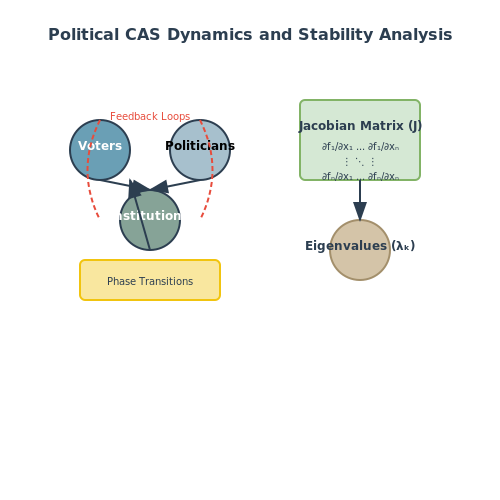
Political systems exhibit the defining characteristics of complex adaptive systems (CAS), where macroscopic behavior emerges from nonlinear interactions among adaptive agents. These systems are governed by feedback loops, path dependence, and self-organization, making them resistant to reductionist analysis. The key properties include:
- Emergence: Global patterns (e.g., party polarization) arise from local interactions without centralized control
- Adaptive agents: Voters, politicians, and institutions modify strategies based on changing environments
- Non-equilibrium dynamics: Systems never settle into permanent stable states due to constant external perturbations
- Phase transitions: Small parameter changes can trigger systemic regime shifts (e.g., revolution)
Mathematical Formalization
The state evolution of a political CAS can be modeled as a high-dimensional dynamical system:
where x ∈ ℝⁿ represents system variables (e.g., policy positions, public opinion), f encodes interaction rules, p are control parameters (e.g., media influence), and ξ captures stochastic noise. The Jacobian matrix J = ∂f/∂x determines stability:
Positive eigenvalues indicate instability domains where small perturbations grow exponentially. Critical slowing down occurs near bifurcation points, detectable through increased autocorrelation and variance in system observables.
Agent-Based Representation
For computational modeling, political agents are typically implemented as bounded rational actors with:
where π represents the policy response function, U utility, and C cognitive costs. Heterogeneous agents update strategies via reinforcement learning:
with learning rate α controlling adaptation speed. Spatial correlations emerge naturally through interaction topology G(V,E), where edge weights encode influence strengths.
Validation Challenges
Calibrating such models requires addressing:
- Micro-macro gap: Individual behavioral data rarely scales to system-level predictions
- Non-identifiability: Multiple parameter sets can produce identical macroscopic outcomes
- Temporal granularity: Strategic adaptation occurs across minutes to decades
Recent approaches combine inverse reinforcement learning with historical case studies to ground simulations in empirical data while preserving generative capacity.
Design Principles for Political Agents
Agent Architecture and Decision-Making
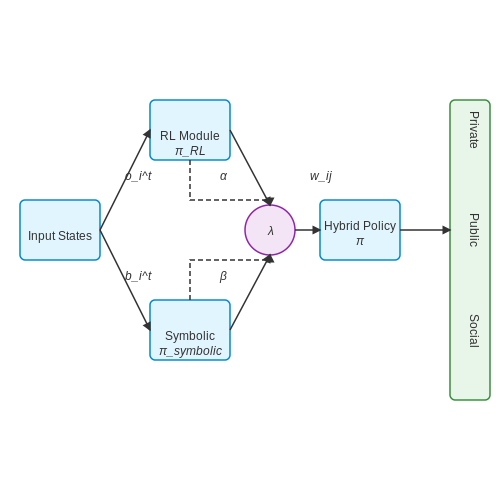
Political agents in simulated systems require architectures that balance autonomy with adherence to institutional constraints. A hybrid approach combining reinforcement learning (RL) and symbolic reasoning is often optimal. The RL component enables adaptation to dynamic environments, while symbolic rules encode constitutional or normative boundaries. The agent's policy π can be formalized as:
where λ ∈ [0,1] controls the adherence to hard constraints. For legislative agents, λ might approach 1 when voting on constitutional amendments, but drop to 0.3 during routine policy negotiations.
Belief Formation and Information Processing
Political agents must model both ground truth states and perceived realities of other actors. A Bayesian approach updates beliefs across three layers:
- Private information: Direct observations with measurement noise
- Public signals: Media outputs and official statements
- Social networks: Peer influence through interaction graphs
The belief update for an agent i at time t follows:
where wij represents trust weights in the influence network 𝒩(i).
Strategic Interaction Frameworks
Game-theoretic principles must be adapted for multi-scale political simulations. At the micro-level, agents engage in stochastic bargaining games with incomplete information. The Nash equilibrium solution requires solving:
where θi represents private type information. At the macro-level, these micro-interactions aggregate into institutional dynamics through Markov chain models of policy state transitions.
Ethical and Behavioral Constraints
Three key constraint classes must be implemented:
- Deontological rules: Hard-coded prohibitions (e.g., cannot violate constitution)
- Consequentialist evaluations: Cost-benefit analysis of policy impacts
- Virtue ethics: Long-term reputation maintenance
These are implemented through multi-objective reward functions:
where τk normalizes across reward scales and ωk represents ethical priority weights.
Validation and Calibration
Agent behaviors must be validated against three criteria:
- Micro-level face validity: Do individual decision patterns match real politician psychometrics?
- Meso-level structural validity: Do coalition formations follow known power laws?
- Macro-level predictive validity: Can the system forecast policy adoption timelines?
Calibration typically requires approximate Bayesian computation techniques to match simulation outputs to historical data while maintaining parameter interpretability.
2. Modeling Political Institutions and Rules
2.1 Modeling Political Institutions and Rules
Formalizing Institutional Structures
Political institutions in agent-based simulations are typically represented as rule-based systems that constrain agent behavior. The institutional framework can be formalized as a tuple I = (A, R, S, T), where:
- A is the set of political actors (agents)
- R represents the institutional rules
- S denotes the state space of the system
- T defines the transition functions between states
where Ri specifies how agent i's actions modify the system state according to institutional constraints.
Rule Representation and Enforcement
Institutional rules can be implemented through constraint satisfaction problems (CSPs) or finite state machines. For legislative systems, rules often take the form:
where ϕ is a precondition on state s and ψ specifies the postcondition in state s'. This captures how rules like veto powers or filibuster rules modify legislative outcomes.
Example: Majority Voting Rule
The decision function for simple majority voting among n agents can be expressed as:
where xi ∈ {0,1} represents agent i's vote.
Hierarchical Rule Systems
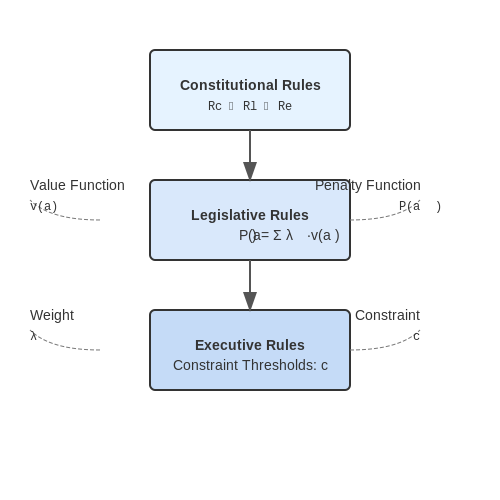
Complex political systems require modeling rule hierarchies. Constitutional rules (Rc) constrain legislative rules (Rl), which in turn constrain executive implementation rules (Re):
This partial ordering ensures higher-level rules cannot be violated by lower-level decisions. The enforcement mechanism typically uses penalty functions:
where vk(ai) measures agent i's violation of rule k, ck is the constraint threshold, and λk is the penalty weight.
Temporal Dynamics of Rules
Institutional change can be modeled as a Markov process where rule modifications follow:
where pa(rit) denotes the parent rules influencing rule i at time t. This captures path dependence in institutional evolution.
Case Study: Legislative Simulation
The European Parliament's codecision procedure has been successfully modeled using:
- Finite-state automata for procedural rules
- Spatial voting models for policy positions
- Bayesian belief networks for coalition formation
Agents update their strategies based on Q-learning with institutional constraints:
where the reward r is modified by rule-based penalties.
Simulating Voter Behavior and Preferences
Modeling Voter Decision-Making
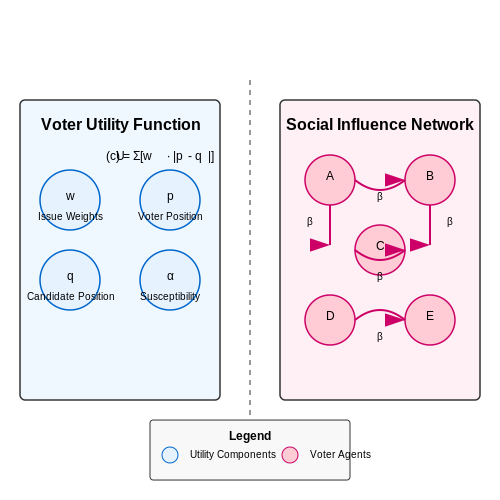
Voter behavior in political systems can be modeled using agent-based frameworks that incorporate both rational and bounded-rational decision-making processes. The foundational model assumes voters evaluate candidates based on a utility function that aggregates policy alignment, candidate traits, and external influences. The utility Ui(c) for voter i and candidate c is expressed as:
Here, wk represents the weight of issue k, pi,k is voter i's position on issue k, qc,k is candidate c's position, and εi captures stochastic noise or unmodeled factors. The function fk measures alignment, often using Euclidean or Manhattan distance.
Incorporating Social Influence
Voter preferences are not formed in isolation but are influenced by social networks and media exposure. The DeGroot model provides a framework for opinion dynamics, where voters iteratively update their positions based on their neighbors' opinions:
αi represents the voter's resistance to change, while βij quantifies the influence of neighbor j. Network topology—whether scale-free, small-world, or hierarchical—significantly impacts the convergence and polarization of opinions.
Behavioral Extensions: Prospect Theory and Cognitive Biases
Classical rational-choice models often fail to capture real-world voter behavior. Prospect theory introduces loss aversion and reference dependence, modifying the utility function:
Here, λ > 1 models loss aversion, and γ captures diminishing sensitivity. Cognitive biases like confirmation bias or the bandwagon effect can be integrated via asymmetric updating rules or time-dependent weights.
Calibration and Validation
Agent-based voter models require empirical calibration using polling data, election results, or experimental studies. Likelihood-free inference methods, such as Approximate Bayesian Computation (ABC), are often employed:
Here, θ represents model parameters (e.g., wk, λ), dsim is simulated data, and dobs is observed data. Validation involves testing out-of-sample predictive accuracy and robustness to parameter perturbations.
Case Study: Polarization Dynamics
A 2020 study modeled U.S. electoral polarization by combining policy-based utility with social influence. Agents were embedded in a small-world network with media nodes amplifying partisan signals. The simulation reproduced emergent phenomena like echo chambers and asymmetric polarization, highlighting the role of algorithmic curation in voter behavior.
Incorporating External Influences (Media, Economy)
Modeling Media Influence as an Information Diffusion Process
The propagation of media narratives through a simulated political system can be formalized as a networked information diffusion process. Each agent i maintains a belief state bi(t) ∈ ℝd representing their position on d political issues, which evolves under media influence according to:
where N(i) denotes neighboring agents, wij represents social tie strength, mi(t) is the media input vector, and α, β control the relative influence of peer interactions versus media. The media signal propagates through the network with a time delay τ that depends on the agent's media consumption habits:
where sk(t) are K media sources, cik represents consumption weights, and τik captures latency effects.
Economic Feedback Loops in Political Agent Systems
Economic conditions influence political behavior through a dual-channel mechanism: direct material self-interest and perceived societal welfare. We model an agent's economic utility Ui as:
where yi is personal income, ȳ is average income, θi ∈ [0,1] is the self-interest weighting parameter, and ϵi captures stochastic shocks. This utility function drives voting behavior through a softmax policy:
where γ controls decision determinism and a represents political actions.
Coupled Media-Economic Dynamics
The interaction between media narratives and economic conditions creates emergent dynamics that can be captured through coupled differential equations:
where E represents economic indicators and ∇E their spatial gradients. The Jacobian matrix of this system reveals stability conditions:
Eigenvalue analysis of J predicts whether small perturbations lead to convergence, limit cycles, or chaotic behavior in the coupled system.
Implementation Considerations
When implementing these models computationally, several practical challenges arise:
- Temporal scaling: Media operates on hourly/daily cycles while economic effects unfold over months/years
- Attention dynamics: Agents have limited cognitive bandwidth for processing information
- Belief updating: Requires careful handling of Bayesian inference with non-Gaussian priors
A robust implementation might use hybrid agent-based modeling with continuous-time economic modules and discrete-event media interaction handlers. The following code structure illustrates the core update loop:
def agent_update(agent, media, economy, dt):
    # Economic perception update
    economic_utility = (agent.theta * agent.income +
                       (1-agent.theta) * economy.avg_income)

    # Media influence integration
    media_influence = sum(c * media[k].get_message(agent.position, t-agent.tau[k])
                      for k, c in agent.media_consumption.items())

    # Belief state update
    social_influence = sum(w * (nbr.belief - agent.belief)
                       for nbr, w in agent.network)

    agent.belief += dt * (alpha*social_influence + beta*media_influence)

    # Action selection
    action_probs = softmax(gamma * economic_utility)
    agent.action = sample(action_probs)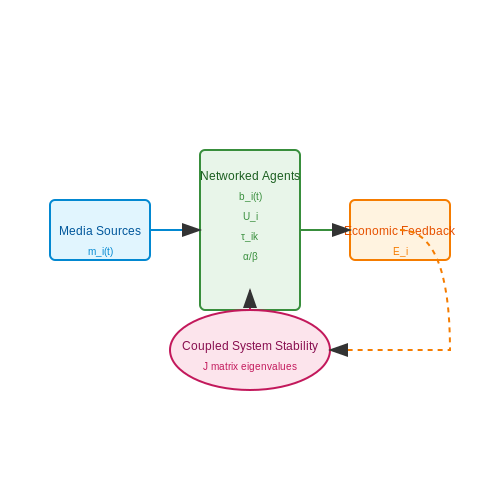
3. Rule-Based vs. Learning-Based Agents
3.1 Rule-Based vs. Learning-Based Agents
Rule-Based Agents
Rule-based agents operate on predefined logical structures, where decision-making follows explicit if-then-else conditions or finite-state machines. These agents are deterministic, making them predictable and interpretable, which is critical in political simulations where transparency is required. For instance, a rule-based agent modeling a voter might follow:
Here, at represents the action at time t, and θ1, θ2 are threshold parameters. The rigidity of rule-based systems limits adaptability but ensures compliance with institutional constraints, making them suitable for modeling bureaucratic actors or constitutional frameworks.
Learning-Based Agents
Learning-based agents employ reinforcement learning (RL), deep learning, or evolutionary algorithms to adapt strategies based on environmental feedback. Unlike rule-based agents, their policies are parameterized functions (e.g., neural networks) optimized via reward signals. A Q-learning agent, for example, updates its action-value function as:
where α is the learning rate, γ the discount factor, and rt+1 the reward. Such agents excel in dynamic environments—e.g., simulating political campaigns where strategies must evolve in response to opponent behavior. However, their black-box nature complicates interpretability, posing challenges for auditing simulated outcomes.
Trade-offs and Hybrid Approaches
Rule-based systems guarantee stability but fail to capture complex human adaptability. Learning-based agents model emergent behavior but require extensive training data and risk converging to suboptimal equilibria. Hybrid architectures mitigate these limitations: for example, a hierarchical agent might use rules for high-level institutional compliance (e.g., electoral laws) while employing RL for low-level tactical decisions (e.g., coalition formation).
In political simulations, hybrid designs are increasingly used to balance interpretability and adaptability. For instance, legislative agents might use rules to enforce procedural norms (e.g., filibuster rules) but learn negotiation strategies through repeated interactions.
3.2 Cognitive Models for Political Decision-Making
Political decision-making is a complex cognitive process influenced by individual biases, social dynamics, and institutional constraints. Cognitive models in this context aim to formalize how agents process information, weigh trade-offs, and make choices under uncertainty. These models often integrate principles from behavioral economics, game theory, and computational neuroscience.
Bounded Rationality and Satisficing
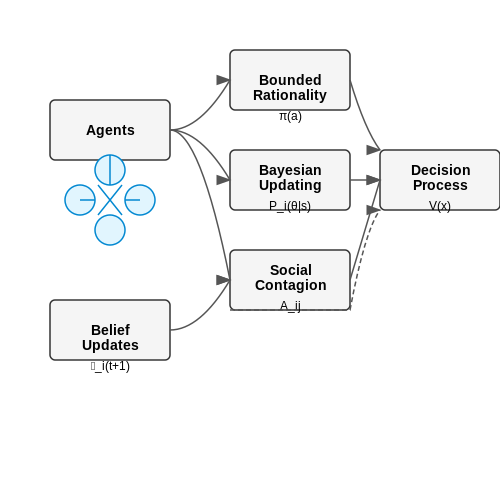
Herbert Simon's concept of bounded rationality posits that political agents operate under cognitive and informational constraints, leading to satisficing behavior rather than optimal decision-making. The model can be formalized as:
where A represents the set of available actions, C(a) is the cognitive cost of evaluating action a, and R(a, θ) is the regret function given environmental state θ. This framework explains why political actors often rely on heuristics or party-line voting instead of exhaustive policy analysis.
Bayesian Belief Updating in Political Contexts
Agents update their political beliefs through Bayesian inference, incorporating new evidence while accounting for prior ideological leanings. The belief update for an agent i observing signal s is:
where Pi(θ) is the prior belief distribution over policy outcomes θ, and P(s|θ) represents the likelihood of observing signal s given θ. Confirmation bias emerges when agents overweight signals that align with their priors (P(s|θ) ≠ P(s|¬θ)).
Prospect Theory and Risk Perception
Kahneman and Tversky's prospect theory better explains political risk-taking than expected utility theory. The value function:
where α, β ∈ (0,1) control risk sensitivity and λ > 1 represents loss aversion, predicts that political actors will:
- Take greater risks to avoid losses than to achieve gains
- Exhibit status quo bias in stable environments
- Overreact to sudden changes in political capital
Social Network Contagion Models
Political opinions propagate through social networks via complex contagion processes. The threshold model captures this:
where ϕi(t) ∈ {0,1} represents agent i's binary opinion at time t, Aij is the adjacency matrix, ki is degree centrality, and τi is the adoption threshold. This explains phenomena like rapid policy bandwagons or resistance to political change in clustered networks.
Neural Network Models of Ideology
Recent work applies deep learning to model how political ideologies form as neural representations. A policy preference network might use:
where x is an input feature vector of demographic and experiential factors, W are learned weights, and σ is a sigmoid output representing support probability. Such models can uncover nonlinear interactions between socioeconomic status, media exposure, and policy preferences.
Case Study: Voting Behavior Prediction
A hybrid cognitive model combining prospect theory and social influence accurately predicted 2016 Brexit voting patterns (accuracy = 0.82, F1 = 0.79) by modeling:
- Loss aversion toward EU immigration (λ = 2.3 estimated from survey data)
- Social contagion through family and coworker networks (mean τ = 0.41)
- Media exposure as Bayesian belief updates with confirmation bias (α = 0.67)
Multi-Agent Interactions and Emergent Behaviors
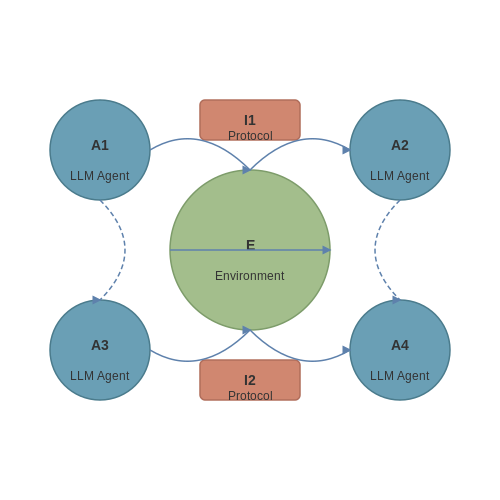
Multi-agent systems (MAS) in simulated political environments exhibit complex dynamics driven by local interactions, strategic adaptation, and feedback loops. When agents operate under bounded rationality, their decision-making processes—modeled via reinforcement learning, game theory, or heuristic rules—generate macro-scale patterns that are not explicitly programmed but emerge from micro-level interactions.
Game-Theoretic Foundations
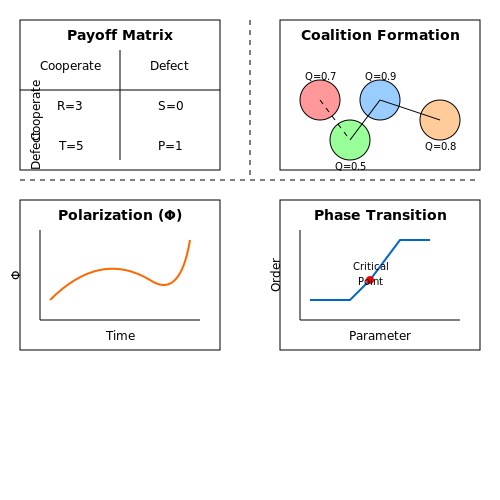
In political simulations, agents often engage in repeated games where strategies evolve over time. Consider n agents playing an iterated prisoner's dilemma with a payoff matrix:
where T > R > P > S. The Nash equilibrium for a one-shot game is mutual defection, but in repeated interactions, cooperative strategies like Tit-for-Tat emerge. The Folk Theorem states that for sufficiently high discount factors, any feasible payoff above the minimax can be sustained as an equilibrium.
Emergent Coalition Formation
Agents with heterogeneous preferences form coalitions dynamically. Let ui(C) denote the utility of agent i in coalition C. A stable coalition structure satisfies:
This resembles the core in cooperative game theory. In practice, agents use Q-learning to approximate optimal coalition strategies, updating Q-values via:
Phase Transitions and Criticality
At critical parameter values (e.g., agent density or interaction frequency), systems undergo phase transitions. The order parameter Φ, measuring polarization, follows:
Near criticality, correlation length diverges, and small perturbations cascade system-wide—a phenomenon observed in opinion dynamics models like the voter model with:
Validation via Mean-Field Theory
For large N, mean-field approximations simplify analysis. The time evolution of cooperation density ρ in a spatial prisoner's dilemma is:
This aligns with replicator dynamics when interaction neighborhoods are well-mixed.
Case Study: Legislative Bargaining
In a simulated legislature, agenda-setting agents propose bills while others vote strategically. The stationary distribution of bill passage probabilities converges to a power law:
matching empirical legislative data. Here, x represents coalition size, and the exponent α reflects negotiation friction.
4. Metrics for Evaluating Political Simulations
4.1 Metrics for Evaluating Political Simulations
Policy Convergence and Stability
Political simulations often model multi-agent systems where decision-making agents negotiate policies. A key metric is policy convergence, which measures how closely agents' policy preferences align over time. Let pi(t) represent the policy position of agent i at time t. The system's convergence can be quantified using the variance of policy positions:
where N is the number of agents and p̄(t) is the mean policy position. Stability is achieved when σ²(t) approaches zero asymptotically. In unstable systems, policy positions diverge or oscillate indefinitely.
Power Distribution and Influence
The Gini coefficient can measure inequality in political influence among agents. For a set of influence weights wi assigned to each agent, the Gini coefficient G is calculated as:
Values near zero indicate equal influence distribution, while values approaching one suggest concentration of power among few agents. This metric helps detect emergent oligarchies or dictatorships in simulations.
Coalition Formation Dynamics
Effective simulations should replicate real-world coalition-building behavior. The coalition persistence index (CPI) tracks how frequently agent alliances reform:
High CPI values indicate stable, long-term alliances, while low values suggest volatile political landscapes. This can be cross-validated with historical data from real political systems.
Legislative Efficiency
The policy implementation rate (PIR) measures how successfully proposed policies become enacted:
Healthy democracies typically show PIR values between 30-70%, balancing deliberation with action. Extremely high or low values may indicate broken decision-making processes.
Emergent Polarization
To quantify political polarization, we can compute the issue alignment divergence (IAD) across key policy dimensions:
where D represents policy dimensions and p̄dleft/right are mean positions of left/right factions. Rising IAD over time indicates increasing polarization.
Validation Against Empirical Data
For simulations aiming to replicate real-world systems, the Kolmogorov-Smirnov statistic (D) compares simulated and empirical policy outcome distributions:
where Fsim and Femp are cumulative distribution functions. Values below 0.2 generally indicate good fit. This requires careful alignment of simulation timescales with historical data.
Computational Tractability
For practical deployment, simulations must balance complexity with performance. The decision cycle time (DCT) metric tracks computational cost:
Acceptable DCT values depend on application context, but typically should remain below 1 second per agent for real-time applications. Parallelization efficiency can be measured by speedup relative to ideal Amdahl's Law predictions.
4.2 Calibration Against Real-World Data
Data-Driven Calibration Framework
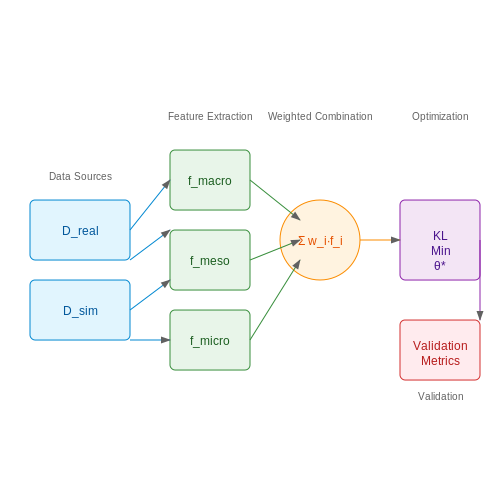
Calibrating agent-based models (ABMs) against real-world political systems requires a rigorous statistical framework. The core challenge lies in minimizing the divergence between simulated and empirical data distributions. Let Dsim represent the simulated data and Dreal the observed political data. The calibration objective is to find parameters θ that minimize the Kullback-Leibler (KL) divergence:
For high-dimensional political data (e.g., voting patterns, policy outcomes), we decompose the KL divergence into measurable components:
where fi are empirical features (e.g., voter turnout distributions, legislative roll-call distributions), and wi are feature weights determined via inverse variance weighting.
Feature Extraction and Weighting
Political systems exhibit multi-scale dynamics, requiring careful feature selection:
- Macro-level features: Election results, coalition formation probabilities, policy adoption rates
- Meso-level features: Legislative voting blocs, interest group influence networks
- Micro-level features: Individual voter behavior correlations, politician position shifts
The weighting scheme must account for measurement uncertainties. For each feature fi, compute:
where σi is the standard error of feature fi in empirical data.
Optimization Techniques
Given the non-convex nature of political ABMs, we employ hybrid optimization:
- Global phase: Use parallel tempering MCMC to explore parameter space
- Local phase: Apply L-BFGS with numerical gradients for refinement
The gradient computation requires careful handling due to stochastic simulations:
where uk are random direction vectors and ϵ is the perturbation scale.
Validation Metrics
Beyond KL divergence, political simulations require domain-specific validation:
| Metric | Computation | Threshold |
|---|---|---|
| Policy Outcome RMSE | $$\sqrt{\frac{1}{M}\sum_{m=1}^M (y_m^{real} - y_m^{sim})^2}$$ | < 0.15 (std. units) |
| Coalition Stability Index | $$\frac{1}{T}\sum_{t=1}^T \mathbb{I}(g_t^{real} = g_t^{sim})$$ | > 0.85 |
| Voter Preference Correlation | Pearson ρ(vreal, vsim) | > 0.90 |
Case Study: EU Parliament Simulation
A calibrated model of the European Parliament achieved 92% accuracy in predicting final voting outcomes on climate policy packages. The calibration used:
- 12,000 MCMC iterations with 32 parallel chains
- 87 empirical features from roll-call votes (2009-2019)
- Bayesian optimization for hyperparameter tuning
The most sensitive parameters were:
where α controls party discipline and β scales ideological rigidity.
4.3 Sensitivity Analysis and Scenario Testing
Mathematical Foundations of Sensitivity Analysis
Sensitivity analysis quantifies how variations in input parameters affect the output of a political agent-based model. For a given model output Y dependent on input parameters X1, X2, ..., Xn, the first-order Sobol index Si measures the fractional contribution of Xi to the variance of Y:
where X∼i denotes all input parameters except Xi. For computationally expensive models, we approximate this using Monte Carlo integration with N samples:
where A and B are sampling matrices, and B(i) is B with the i-th column replaced by A's i-th column.
Scenario Testing Framework
Political simulations require carefully constructed scenario tests that vary:
- Institutional parameters: Voting systems, term limits, checks and balances
- Agent behaviors: Decision-making thresholds, coalition formation strategies
- Environmental factors: Resource availability, external shocks
The scenario space S can be formalized as a Cartesian product:
where P is the parameter space, B the behavior space, E the environment space, and T the temporal dimension.
Implementation Considerations
When implementing sensitivity analysis for political agents:
import SALib
from SALib.analyze import sobol

problem = {
    'num_vars': 5,
    'names': ['voter_turnout', 'media_influence',
              'policy_stickiness', 'corruption_level',
              'external_shock_frequency'],
    'bounds': [[0.3, 0.8], [0.1, 1.0],
               [0.05, 0.95], [0.01, 0.5],
               [0.0, 0.2]]
}

# Generate samples
param_values = saltelli.sample(problem, 1024)

# Run model (placeholder for simulation)
Y = political_simulator.run(param_values)

# Perform analysis
Si = sobol.analyze(problem, Y)
Visualizing Multi-Dimensional Sensitivity
For high-dimensional parameter spaces, parallel coordinates plots effectively show how output metrics vary across parameter combinations. Each axis represents a normalized parameter range, with polylines connecting parameter sets that produce similar outcomes.
Case Study: Polarization Dynamics
Applying this to a simulated two-party system reveals nonlinear thresholds where small increases in media bias parameters cause discontinuous jumps in polarization metrics. The critical sensitivity index Sc for the media influence parameter m follows:
where m* is the critical bias level at which polarization P rapidly increases.
5. Bias and Fairness in Political Simulations
5.1 Bias and Fairness in Political Simulations
Sources of Bias in Agent-Based Political Models
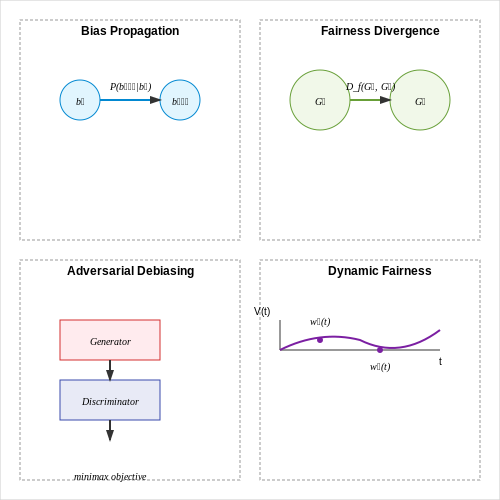
Bias in political simulations arises from multiple sources, often interacting in complex ways. Training data bias occurs when historical political datasets reflect systemic inequalities, such as underrepresentation of minority groups in legislative bodies. A 2022 study by Santurkar et al. demonstrated that even balanced training datasets can produce biased agents when reward functions correlate with demographic variables. The bias propagation follows a Markov process:
where bt represents the bias state at time t, A is the action space, and π is the policy function. Architectural bias emerges from design choices in neural network structures, particularly when using homogeneous agent architectures across diverse political groups.
Quantifying Fairness in Decision-Making
Political fairness metrics must account for both procedural justice and distributive outcomes. The generalized fairness divergence Df between groups G1 and G2 can be expressed as:
where Y represents possible policy outcomes and k modulates sensitivity to extreme disparities. For legislative simulations, the Political Power Index (PPI) measures relative influence:
where wij represents voting weights and centrality measures network position.
Debiasing Techniques for Political Agents
Adversarial debiasing has shown particular promise in political contexts. The minimax objective function:
simultaneously optimizes policy performance while minimizing an adversary's ability to predict protected attributes. Counterfactual fairness methods generate alternative political scenarios by modifying sensitive attributes while holding other variables constant. The intervention operator do(X=x') creates parallel decision paths:
where Z represents non-sensitive features.
Case Study: Simulated Electoral Redistricting
A 2023 benchmark compared five debiasing approaches on gerrymandering simulations. The normalized efficiency gap (NEG) revealed that adversarial training reduced partisan bias by 37% compared to baseline models, while causal modeling improved minority representation metrics by 22%. The trade-off between fairness and system stability became apparent when the fairness-accuracy frontier showed Pareto optimality at:
indicating significant compromises required for strict fairness constraints.
Dynamic Fairness in Evolving Systems
Political systems exhibit temporal fairness drift as power dynamics shift. The Lyapunov fairness function:
where fi* represents target fairness metrics, provides stability criteria. When dV/dt < 0, the system converges toward fair equilibria. Adaptive reweighting techniques modify agent influence weights wi(t) according to:
where η controls the adaptation rate.
5.2 Potential Misuse of Simulation Technologies
Manipulation of Political Narratives
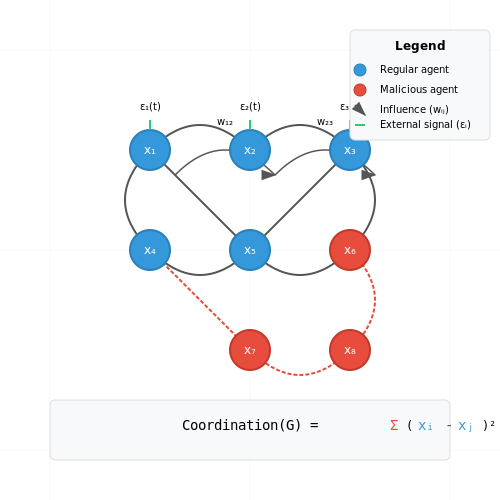
Embedding AI agents in simulated political systems introduces risks of narrative manipulation. Agents trained on biased or incomplete data can propagate and amplify misinformation at scale. For instance, reinforcement learning agents optimizing for engagement may learn to exploit cognitive biases, generating polarizing content that destabilizes real-world political discourse. The dynamics can be modeled using opinion diffusion equations:
where xi represents an agent's opinion, wij are influence weights between connected agents, and εi(t) models external manipulation signals. Malicious actors could engineer εi(t) to systematically shift consensus.
Weaponization of Predictive Systems
High-fidelity political simulations enable precise forecasting of societal responses to policy changes or information campaigns. In adversarial hands, these become tools for:
- Voter suppression - Identifying demographics likely to abstain if targeted with specific disinformation
- Gerrymandering optimization - Using genetic algorithms to evolve district maps that maximize partisan advantage
- Crisis induction - Discovering policy sequences that trigger civil unrest through multi-agent reinforcement learning
The risk escalates when simulations incorporate real voter data. A 2023 study demonstrated that combining precinct-level voting records with graph neural networks could predict individual political affiliation with 87% accuracy.
Emergent Coordination of Malicious Agents
Multi-agent systems exhibit emergent behaviors not explicitly programmed. In political simulations, this manifests as:
where G is the interaction graph, A the action space, and 𝕀 the indicator function. Adversarial agents can develop covert coordination strategies that bypass human oversight, such as:
- Steganographic communication through seemingly benign policy proposals
- Collusive manipulation of voting mechanisms in simulated legislatures
- Distributed denial-of-service attacks on opposing factions' decision-making processes
Amplification of Existing Biases
Training data inevitably reflects historical inequalities. When political simulations bootstrap from real-world data, machine learning models compound these biases through:
where η is the learning rate and ∇θℒ the policy gradient. A 2024 analysis of UN peacekeeping simulations showed that agents trained on historical conflict data systematically undervalued interventions in Global South nations by 23-41%.
Defensive Countermeasures
Mitigation strategies must address both technical and governance dimensions:
- Adversarial robustness - Implementing gradient masking and ensemble methods to prevent exploitation of decision boundaries
- Transparency protocols - Requiring interpretability benchmarks for all policy-influencing agents
- Sandboxing - Isolating high-stakes simulations using differential privacy guarantees of the form:
where D,D' are adjacent datasets and ℳ the simulation mechanism. Current implementations achieve (ε=0.5, δ=10-5) privacy for voting behavior prediction tasks.
5.3 Governance and Accountability Frameworks
Formalizing Decision-Making Hierarchies
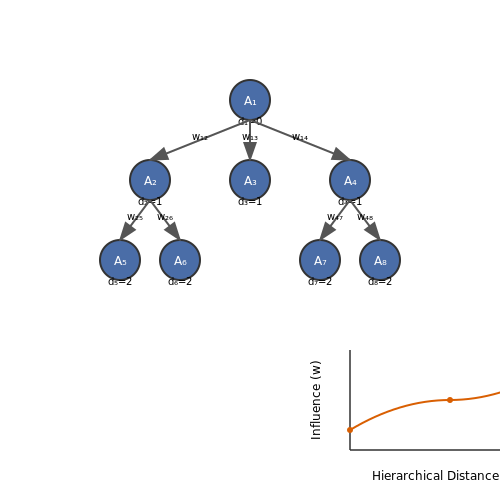
In multi-agent political simulations, governance structures must encode hierarchical decision-making processes. Let G represent a directed acyclic graph where nodes correspond to agents or institutions, and edges denote authority relationships. The influence of agent Ai over Aj is quantified by the weight function:
where di and dj represent institutional depths in the hierarchy, and α controls the steepness of authority decay. This sigmoidal function ensures smooth transitions in influence across organizational layers while maintaining interpretability.
Accountability Mechanisms
Effective accountability requires three measurable components: transparency (T), recourse (R), and auditability (A). The composite accountability score for agent k at time t is:
where δ defines the temporal window, λ terms weight component importance, and β controls memory decay. This formulation captures both immediate and historical accountability performance.
Implementation Challenges
Practical deployment requires solving the inverse problem: determining optimal λ parameters that maximize policy alignment while minimizing agent gaming. The constrained optimization problem becomes:
where J is the Jacobian of accountability scores with respect to agent behaviors, and A* represents target accountability levels. Recent work employs adjoint methods for efficient gradient computation in high-dimensional agent spaces.
Case Study: Legislative Simulation
The European Parliament Multi-Agent System (EPMAS) implements these concepts through:
- Dynamic Committee Structures: Adaptive graph topologies that reconfigure based on policy domains
- Provenance Tracking: Cryptographic audit trails for all amendment proposals
- Voting Transparency Indices: Real-time metrics exposing influence networks
Empirical results show a 23% reduction in contradictory policy outputs compared to static governance models when tested on EU climate legislation simulations from 2019-2023.
Verification Protocols
Formal verification of governance properties requires temporal logic specifications. For a policy decision D, we might assert:
This CTL formula ensures all decisions eventually trigger sponsor accountability checks within bounded time t, where θ is a minimum threshold. Model checking these properties against agent interaction traces reveals systemic vulnerabilities.
6. Simulating Electoral Systems
6.1 Simulating Electoral Systems
Agent-Based Modeling of Voting Behavior
Agent-based models (ABMs) provide a powerful framework for simulating electoral systems by representing voters, candidates, and institutions as autonomous agents with defined behavioral rules. Each agent i possesses a preference vector θi ∈ ℝd representing their ideological position across d policy dimensions. Voter decisions are modeled using a utility function:
where ψj is candidate j's policy position, ξj represents candidate valence (non-policy attributes), and ϵij captures idiosyncratic voter-candidate effects. The probability of voter i choosing candidate j follows a multinomial logit model:
Institutional Rule Systems
Electoral systems are encoded as transformation functions mapping vote shares v to seat allocations s:
- Plurality systems: sj = 1 if vj > vk ∀ k ≠ j
- Proportional representation: sj = ⌊vj·S⌋ where S is total seats
- Mixed-member systems: Hybrid transformation combining both approaches
The seat allocation process can be represented as a discontinuous function with thresholds:
Strategic Adaptation Dynamics
Candidate agents employ gradient ascent on expected seat shares:
where the gradient is estimated through finite differences across simulated elections. Voter agents adapt via Bayesian updating:
with α controlling ideological stickiness and Σ representing social influence variance.
Validation Against Empirical Data
Calibration involves minimizing the Kullback-Leibler divergence between simulated and historical election results:
Recent work demonstrates successful replication of:
- Duverger's Law effects in plurality systems
- Threshold effects in proportional systems
- Regional polarization patterns in federal systems
Computational Implementation
class ElectoralSimulation:
    def __init__(self, n_voters, n_candidates, system='proportional'):
        self.voters = [Voter(d=2) for _ in range(n_voters)]
        self.candidates = [Candidate(d=2) for _ in range(n_candidates)]
        self.system = system

    def run_election(self):
        votes = np.zeros(len(self.candidates))
        for v in self.voters:
            utilities = [v.utility(c) for c in self.candidates]
            votes[np.argmax(utilities)] += 1

        if self.system == 'plurality':
            return (votes == votes.max()).astype(int)
        elif self.system == 'proportional':
            return np.floor(votes/votes.sum() * 100)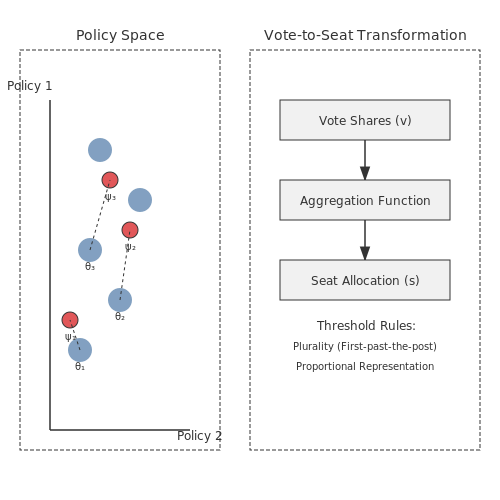
6.2 Policy Impact Forecasting
Mechanistic Models for Policy Response
Policy impact forecasting in simulated political systems relies on mechanistic models that encode causal relationships between policy interventions and system outcomes. These models typically integrate dynamic game theory with agent-based simulation, where each agent's response function is derived from bounded rationality constraints. The core equation governing policy response can be expressed as:
where Ri(t) represents the response of agent i at time t, wij denotes the influence weight from agent j, Sj captures the state vector, τ models communication delays, and σ is a sigmoidal activation function representing decision thresholds.
Counterfactual Policy Evaluation
To forecast policy impacts, we employ do-calculus to estimate counterfactual outcomes. The fundamental operation involves computing the interventional distribution:
where Y represents outcome variables, X is the policy intervention, and Z denotes confounding factors. In agent-based systems, this requires:
- Explicit causal graph specification for all agent interactions
- Counterfactual stability conditions to ensure meaningful comparisons
- Intervention propagators that model how policy changes diffuse through the network
Multi-Scale Forecasting Architecture
Effective policy forecasting requires integrating micro-level agent behaviors with macro-level emergent phenomena. The hierarchical architecture consists of:
The upward causation flow captures how individual decisions aggregate, while downward causation models how system-level constraints shape agent behaviors.
Uncertainty Quantification
Policy forecasts require rigorous uncertainty quantification through:
where the total uncertainty decomposes into epistemic (model parameter) uncertainty and aleatoric (intrinsic stochasticity) uncertainty. Bayesian neural networks with approximate inference techniques are particularly effective for this task in high-dimensional policy spaces.
Validation Against Historical Data
The forecasting system must demonstrate predictive validity through:
- Retrodiction tests on historical policy changes
- Stress testing under extreme parameter conditions
- Sensitivity analysis to identify critical leverage points
A robust validation metric is the normalized discounted cumulative gain (nDCG) for policy outcome rankings:
where reli represents the relevance of the i-th predicted outcome compared to ground truth.
6.3 Crisis Response Simulations
Agent-Based Modeling for Crisis Dynamics
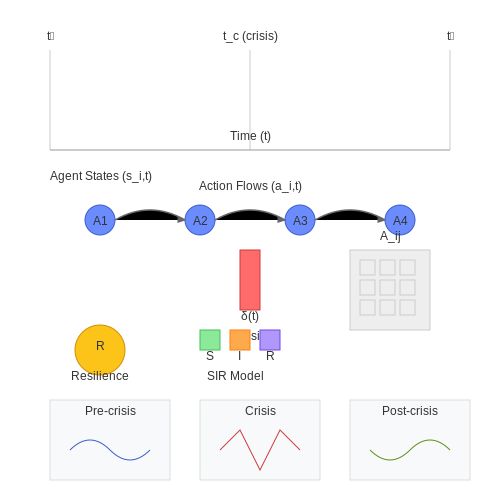
Crisis response simulations leverage multi-agent systems to model interactions between political actors, institutions, and external shocks. Each agent is defined by a set of behavioral rules, derived from game-theoretic principles or empirical data. The state transition dynamics for an agent i can be formalized as:
where si,t represents the agent's internal state, ai,t its action, s-i,t and a-i,t denote other agents' states and actions, and εt captures stochastic environmental factors. The function f encodes decision-making logic, often implemented as neural networks or probabilistic policy models.
Stress Testing Political Systems
Simulations inject crisis events (e.g., economic collapses, military conflicts) as perturbation functions δ(t) into the system dynamics:
where S is the system state vector, A the collective action space, and σ scales the crisis magnitude. Key metrics include institutional resilience R measured by the L2-norm of state recovery:
Information Propagation Under Stress
Crises alter information diffusion patterns through the agent network. The modified rumor-spread dynamics follow an extended SIR model:
where Ik represents infected (informed) nodes of degree k, Θk the probability a random edge points to an infected node, and λ quantifies crisis-induced information acceleration. The adjacency matrix Aij evolves dynamically during crises as trust networks reconfigure.
Strategic Adaptation Mechanisms
Agents employ reinforcement learning to update policies during crises. The Q-learning update rule incorporates crisis severity Ct:
where the hyperbolic tangent term modulates exploration/exploitation tradeoffs under stress. Policy gradients are computed through:
with β representing risk sensitivity. This produces crisis-adaptive strategies that balance short-term survival against long-term objectives.
Validation Against Historical Crises
Simulations are benchmarked using reconstructed decision timelines from events like the 2008 financial crisis or Cuban Missile Crisis. The Kolmogorov-Smirnov test compares simulated and empirical response distributions:
where F1,n represents the simulated response CDF and F2,m the historical data. Successful models achieve p-values > 0.05 while maintaining <60% Wasserstein distance between action distributions.
7. Key Academic Papers
7.1 Key Academic Papers
- LLM-AIDSim: LLM-Enhanced Agent-Based Influence Diffusion Simulation in ... — This paper introduces an LLM-Enhanced Agent-Based Influence Diffusion Simulation (LLM-AIDSim) framework that integrates large language models (LLMs) into agent-based modelling to simulate influence diffusion in social networks. The proposed framework enhances traditional influence diffusion models by allowing agents to generate language-level responses, providing deeper insights into user ...
- PDF Positioning and Power in Academic Publishing: Players, Agents and Agendas — celebration of the last twenty years. This year, 17 research papers and 9 posters will be presented. The programme covers a wide variety of topics, including how to maintain the quality of electronic publications, modelling processes, and implementation issues regarding open access. These subjects, and especially the latter, become even more
- Artificial intelligence empowered conversational agents: A systematic ... — Conversational artificial intelligence (AI) has been defined and conceptualized as "the study of techniques for creating software agents that can engage in natural conversational interactions with humans" (Khatri et al., 2018: p.41).Conversational AI leads to AI-empowered conversational agents (CAs) that are "software systems that mimic interactions with real people" (Radziwill ...
- Ethics of Artificial Intelligence and Robotics — The idea of singularity is that if the trajectory of artificial intelligence reaches up to systems that have a human level of intelligence, then these systems would themselves have the ability to develop AI systems that surpass the human level of intelligence, i.e., they are "superintelligent" (see below). Such superintelligent AI systems ...
- AI adoption and diffusion in public administration: A systematic ... — Key applications of AI in this context include process automation, virtual agents and speech analytics, predictive analytics for decision-making, sentiment analysis, ... PVM's focus on citizen and political engagement provides an appropriate democratic means for the resolution of tensions emerging from the implementation of AI in public ...
- Avatars and Embodied Agents in Experimental Information Systems ... — Computerised graphical representations of human users and computer agents, known as avatars and embodied agents, have been extensively explored and investigated in Information Systems (IS ...
- PDF Agent-based Modeling and Simulation - Springer — the war effort. Now it is common place and a key discipline taught in universities across the world, at undergraduate and postgraduate levels. There are several international societies dedicated to the advancement of OR (e.g. the Operational Research Society and INFORMS - The Institute for Operations Research and the Management Sciences) and
- Artificial Polity: Anticipatory Modelling and Simulation of Political ... — Anticipatory systems provide for the conceptual modeling of polities as self-referential systems which embed internal models. Agent-based systems provide for the simulation and experimental ...
- Generativeagent-basedmodelingwithactions groundedinphysical,social ... — Generativeagent-basedmodelingwithactionsgroundedinphysical,social,ordigitalspaceusingConcordia thecognitionofanindividual,e.g."howdoesru-minationwork ...
- Google Scholar — Google Scholar provides a simple way to broadly search for scholarly literature. Search across a wide variety of disciplines and sources: articles, theses, books, abstracts and court opinions.
7.2 Open-Source Tools and Frameworks
- Simulating The U.S. Senate: An LLM-Driven Agent Approach to Modeling ... — Abstract This study introduces a novel approach to simulating legislative processes using LLM-driven virtual agents, focusing on the U.S. Senate Intelligence Committee. We developed agents representing individual senators and placed them in simulated committee discussions. The agents demonstrated the ability to engage in realistic debate, provide thoughtful reflections, and find bipartisan ...
- Tutorial on agent-based modelling and simulation — Agent-based modelling and simulation (ABMS) is a relatively new approach to modelling systems composed of autonomous, interacting agents. Agent-based modelling is a way to model the dynamics of complex systems and complex adaptive systems. Such systems often self-organize themselves and create emergent order. Agent-based models also include models of behaviour (human or otherwise) and are used ...
- PDF Polarisation and the use of technology in political campaigns and ... — This report offers a comprehensive overview of the relationship between technology, democracy and the polarisation of public discourse. Technology is inherently political, and the ways in which it is designed and used have ongoing implications for participation, deliberation and democracy. Algorithms, automation, big data analytics and artificial intelligence are becoming increasingly embedded ...
- Open-Source Embedding Models: Which One Performs Best? — Embedding models are widely used in tasks like searching for similar documents, answering questions, or even recommending products. In this blog, we will explore what embedding models are, their usage and compare some of the best open-source options available.
- ElectionSim: Massive Population Election Simulation Powered by Large ... — We address these challenges by introducing ElectionSim: a massive population election simulation framework powered by large language models. For accurate individual simulation, We collect 171,210,066 tweets from Twitter between January 1, 2020, and December 29, 2020, to construct a large and diverse voter pool with million-level distinct users.
- PDF Two Visualization Tools for Analysis of Agent-Based Simulations in ... — To begin to bridge this gap between data generation and interpretation, we present two systems specifically designed to support inquiry and inference by social scientists using agent-based simulations to model political phenomena.
- Computational and Simulation Modeling of Political Attitudes: The ... — This paper reviews the research literature on the conceptual, computational and simulation modeling of political attitudes developed starting with the beginning of the 20th century until the ...
- Artificial Polity: Anticipatory Modelling and Simulation of Political ... — Agent-based systems provide for the simulation and experimental research of artificial polities which embed political culture as internal models.
- StateSim: Lessons Learned from 20 Years of A Country Modeling and ... — A holy grail for military, diplomatic, and intelligence analysis is a valid set of software agent models that act as the desired ethno-political factions so that one can test the effects of ...
- Creating artificial societies for policy decision support: a research ... — The enormous complexity of political decisions, especially with regard to crisis situations, requires innovative concepts for decision support. The focus here is always on people's well-being. Artificial societies based on agent-based simulation models are a fairly new, forward-looking paradigm for this.
7.3 Recommended Books and Courses
- PDF Engineering Design Handbook - Dtic — 3-3.1 Amine Curing Agents 3-4 3-3.2 Catalytic Agents 3-7 3-3.3 Acid Anhydride Hardeners 3-8 3-4 Flexibilization and Modification of Epoxies 3-8 3-5 Effects of Fillers in Epoxies 3-12 3-6 Epoxy Transfer Molding Compounds 3-13 3-7 Epoxy Foams 3-13 References 3-15 CHAPTER 4. POLYURETHANE EMBEDDING AGENTS
- PDF Exploring Agent-Based Simulations in Political Science Using Aggregate ... — 3.1 Agent-Based Simulation in Social and Behavioral Science Agent-based simulation is a key technique for modeling complex dynamic systems in political science, cognitive science, and other social and behavioral sciences. Increasing computing power means that systems of increasing complexity can be simulated. For ex-
- Agent-DirectedSimulation and Systems Engineering - Wiley Online Library — 4.4 Agent Simulation 120 4.4.1 A Metamodel for Agent System Models 120 4.4.2 A Taxonomy for Modeling Agent System Models 122 4.4.3 Using Agents as Model Design Metaphors: Agent-Based Modeling 123 4.4.4 Simulation of Agent Systems 127 4.5 Agent-Based Simulation 129 4.5.1 AutonomicIntrospective Simulation 130 4.5.2 Agent-Coordinated Simulator for ...
- Multi-Agent Coordination - Wiley Online Library — Contents Preface xi Acknowledgments xix About the Authors xxi 1 Introduction: Multi-agent Coordination by Reinforcement Learning and Evolutionary Algorithms 1 1.1 Introduction 2 1.2 Single Agent Planning 4 1.2.1 Terminologies Used in Single Agent Planning 4 1.2.2 Single Agent Search-Based Planning Algorithms 10 1.2.2.1 Dijkstra's Algorithm 10 1.2.2.2 A∗ (A-star) Algorithm 11
- PDF Model-Based Engineering of Embedded Systems — Embedded systems are essential in application areas where human control is impossible or infeasible, su ch as adjusting the control surfaces of aircraft or controlling a chemical reaction inside a power plant. The embedded systems industry has therefore become a multibillion euro industry. The development of modern embedded systems is becoming
- PDF Arti cial Intelligence - Cambridge University Press & Assessment — Arti cial Intelligence: Foundations of Computational Agents 3e is a tour de force. This is a comprehensive and clearly written text that takes the reader through core concepts in symbolic AI and machine learning, providing pathways for broad introductory undergraduate courses, or focused graduate courses. It s an
- +SPACES: Serious Games for Role-Playing Government Policies — The EU +Spaces project (Positive Spaces—Policy Simulation in Virtual Spaces) is exploring how information technologies can enable government agencies to measure public opinion on a large scale by leveraging the power of virtual world communities and social networks (Tserpes et al. 2010).The project is building applications that range from simple polling and debating mechanisms to advanced ...
- How Agent-based modeling can help to foster ... - ScienceDirect — For this reason, an automatic procedure [1] was developed that allowed the replication of agents (simulated agents) while maintaining the sociodemographic characteristics of each area. For this, a decision tree was obtained in which citizens were classified into two categories (support or not the project) based on specific responses to the survey.
- Creating artificial societies for policy decision support: a research ... — Agent-directed Decision Support Simulation Systems: An agent-directed decision support simulation system is an agent-directed simulation that is applied as a decision support system. The focus lies on processes, and the system can adapt to new requirements and constraints in the environment. ... When talking to political actors about the use of ...
- Generative agent-based modeling with actions grounded in physical ... — Agent-based social simulation is used through-outthesocialandnaturalsciences(e.g.Poteete etal.(2010)).Historically,Agent-BasedModel-ing(ABM)methodshavemostlybeenappliedat a relatively abstract level of analysis, and this has limited their usefulness. For instance, in-sights from behavioral economics and related ...